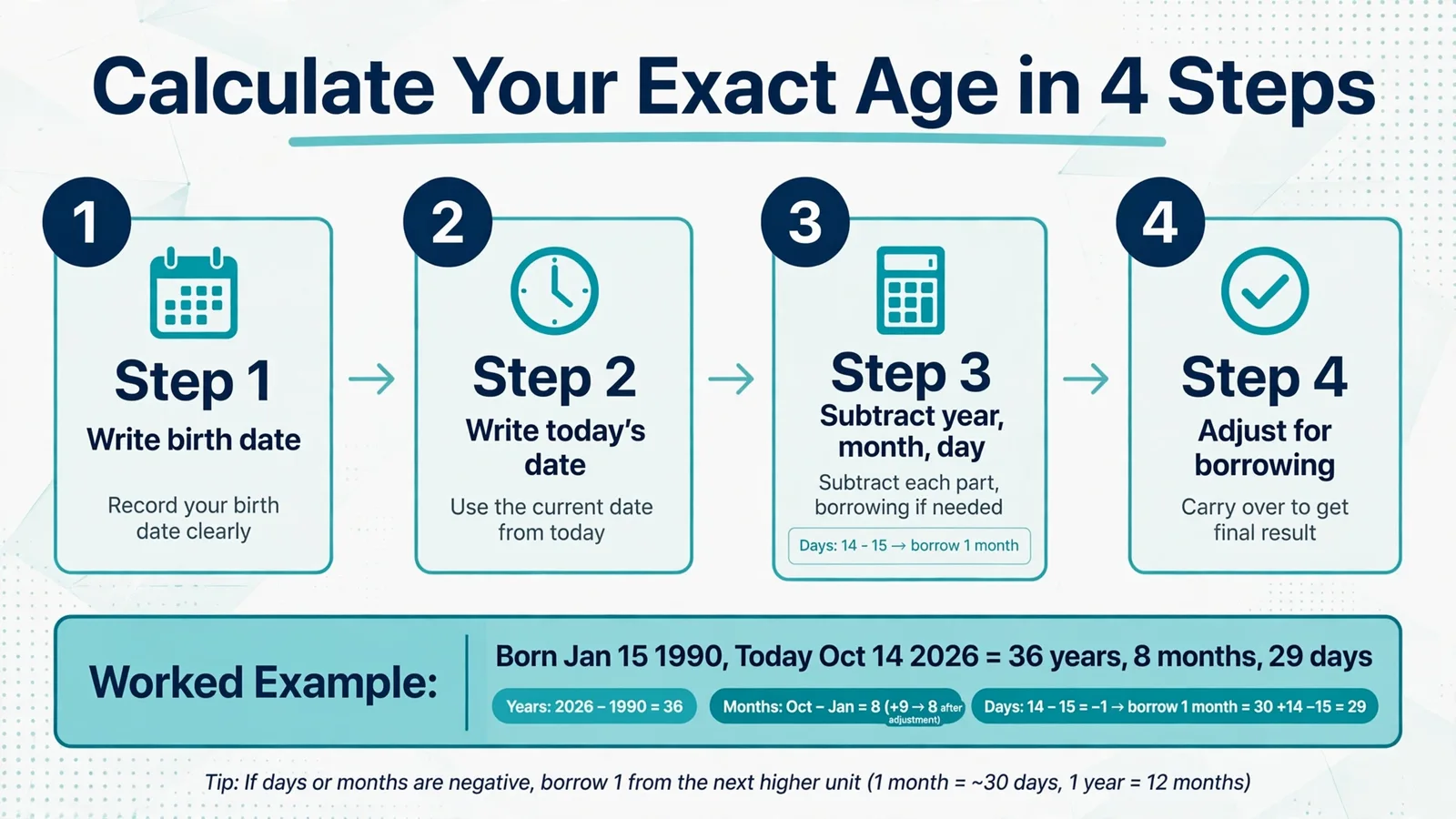
Your exact age is the time between your date of birth and today, measured in years, months, and days. An age calculator applies a small piece of calendar logic called the borrow method to get that breakdown right, and once you see how it works, you can do it on paper too.
Why does this detail matter? Forms ask for your age in years, but the real world often needs more. Parents track a baby’s age in months. Employers check eligibility cutoffs. Friends count down to milestone birthdays. Saying “24” and saying “24 years, 11 months, and 6 days” are very different answers, and only one is exact.
In this guide, you will learn what chronological age means, how to calculate it by hand in three steps, why leap years trip people up, and what else a date of birth calculator can tell you.
What is chronological age?
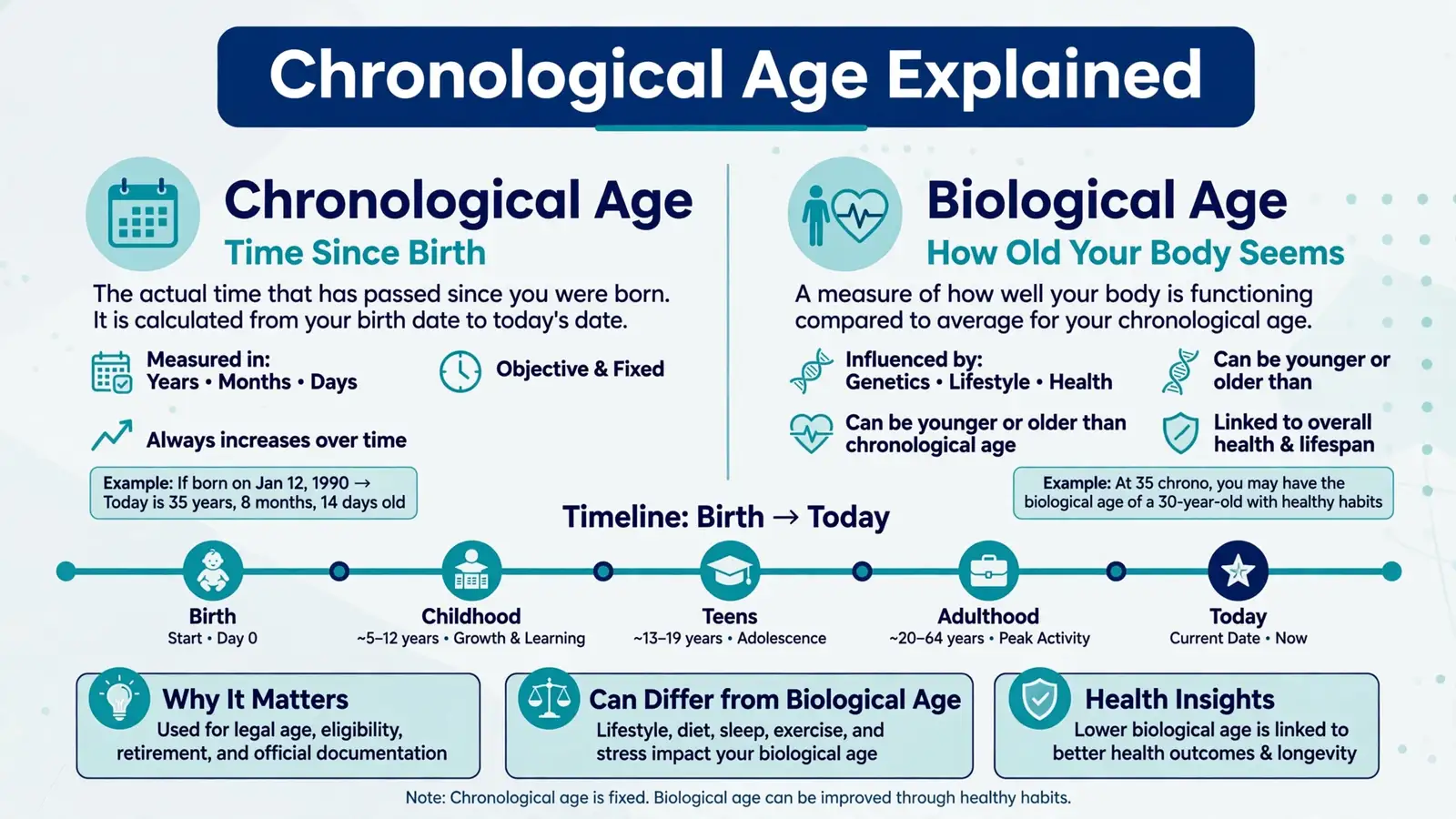
Chronological age is the exact amount of time that has passed since a person’s date of birth, expressed in years, months, and days. It is measured against a reference date, usually today. Unlike biological age, which estimates how old the body seems, chronological age is a pure calendar fact with no opinion in it.
Doctors, schools, insurers, and governments all rely on it because it never changes with mood or method. A chronological age calculator automates the subtraction between two dates, handling month lengths and leap years for you.
How do you calculate exact age by hand?
You subtract your birth date from the reference date, borrowing days first, then months, then years whenever the top number is smaller.
Here is the borrow method, step by step:
- Days first. If the reference day is smaller than the birth day, borrow the full length of the previous month (28, 29, 30, or 31 days, whichever is real) and add it to the reference day. Then subtract.
- Months next. If the reference month is now smaller than the birth month, borrow 12 months, add them to the reference month, then subtract.
- Years last. Subtract the birth year from the reference year, and subtract one more if you borrowed months in step 2.
Worked example
Say someone was born on 15 August 2001, and the reference date is 21 July 2026:
| Step | Calculation | Result |
|---|---|---|
| Days | 21 − 15 (no borrow needed) | 6 days |
| Months | 7 − 8, so borrow 12: (7 + 12) − 8 | 11 months |
| Years | 2026 − 2001 − 1 (for the borrowed months) | 24 years |
Final answer: 24 years, 11 months, 6 days.
Notice the years step: 2026 minus 2001 looks like 25, but the August birthday has not arrived yet by July, so the honest answer is 24. That single check is where most mental math goes wrong, and it is the step an online age calculator never skips.
Why do leap years make age math tricky?
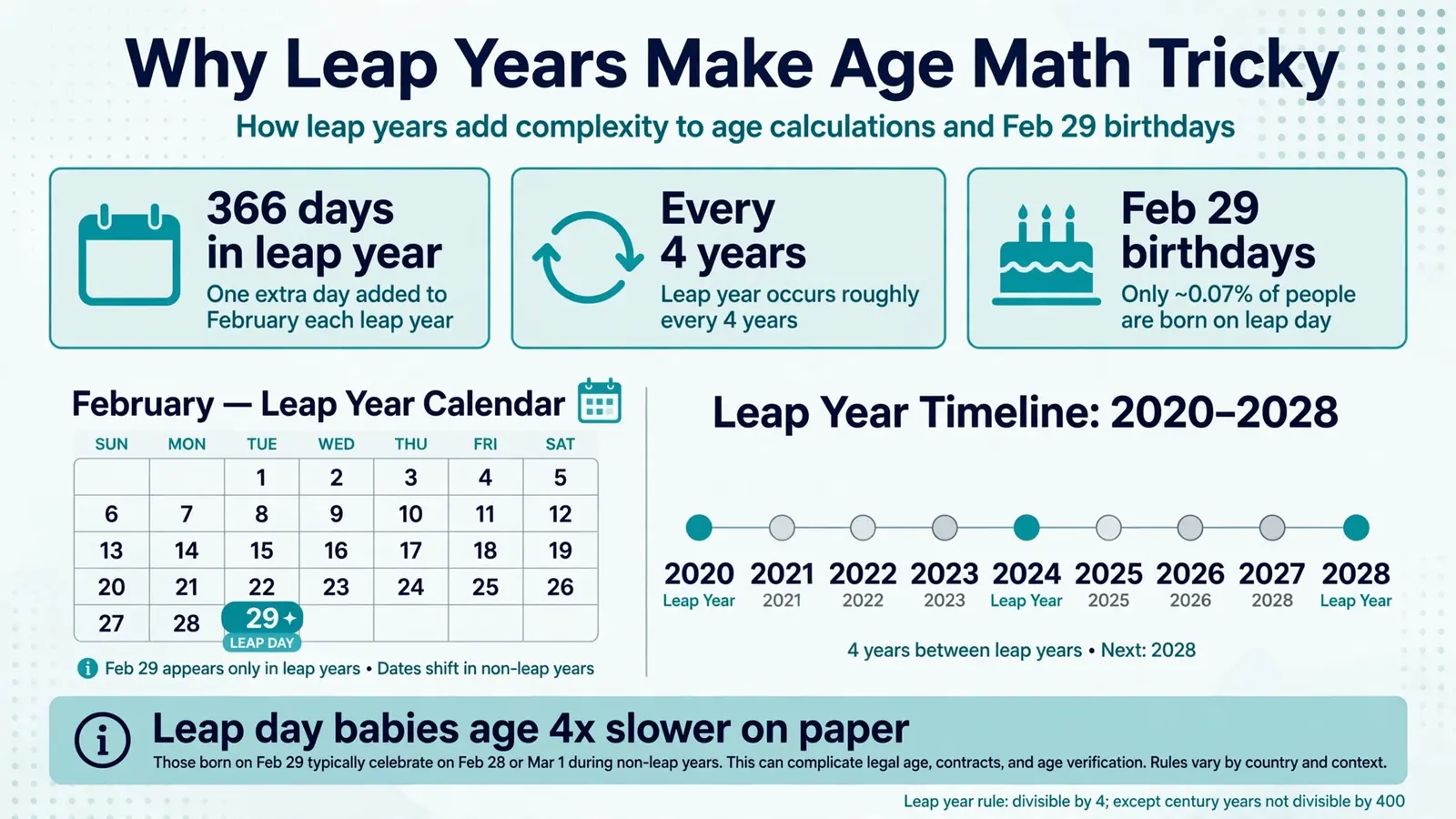
Every four years, February gains an extra day, and that one day quietly changes the subtraction. When your borrow step reaches back across February, the days you borrow depend on the year: 28 in a common year, 29 in a leap year. Borrow 28 when you should have borrowed 29 and your whole answer shifts by a day.
The trickiest case is a 29 February birthday. In non-leap years, most legal systems treat either 28 February or 1 March as the birthday for that year. A good age calculator handles this automatically by using real month lengths instead of assuming every month is 30 days.
Quick rule: whenever February sits between your two dates, check whether a leap day falls inside the interval. If it does, your totals for days and weeks lived will be one higher than a naive count.
What mistakes do people make when calculating age?
- Subtracting only the years. “2026 minus 2001 is 25” sounds right until you check the birthday. Fix: confirm whether this year’s birthday has passed; if not, take one year off.
- Treating every month as 30 days. Months are 28 to 31 days long, and the difference adds up fast. Fix: always borrow the real length of the previous month.
- Using the wrong reference date. People mix up “age today” with “age on the form’s deadline” or “age at the event.” Fix: decide the exact reference date before you do any math.
- Forgetting the February 29 edge case. Leap-day birthdays break naive subtraction in non-leap years. Fix: confirm how your system counts them, then borrow 28 or 29 days accordingly.
- Counting the birthday itself twice. Your age changes on your birthday, not the day before. Fix: remember the interval ends the day before the anniversary date.
Run through this list before trusting a hand calculation, or let an age calculator double-check you in seconds.
How do you calculate age on a specific past or future date?
You use the exact same borrow method, but you replace “today” with the date you care about. That target date is called the reference date, and everything else works identically: days first, then months, then years, with real month lengths.
When would you need this? Historians work out how old someone was at a famous event. Schools and sports leagues set cutoffs like “must be under 14 on 1 September.” Families ask when a child will turn 18. An online age calculator makes this painless: change the reference date with one click instead of redoing the whole subtraction.
One sanity check: if the reference date falls before the birth date, the result is meaningless. A quick glance at the years usually catches that mistake.
What else can an age calculator tell you?
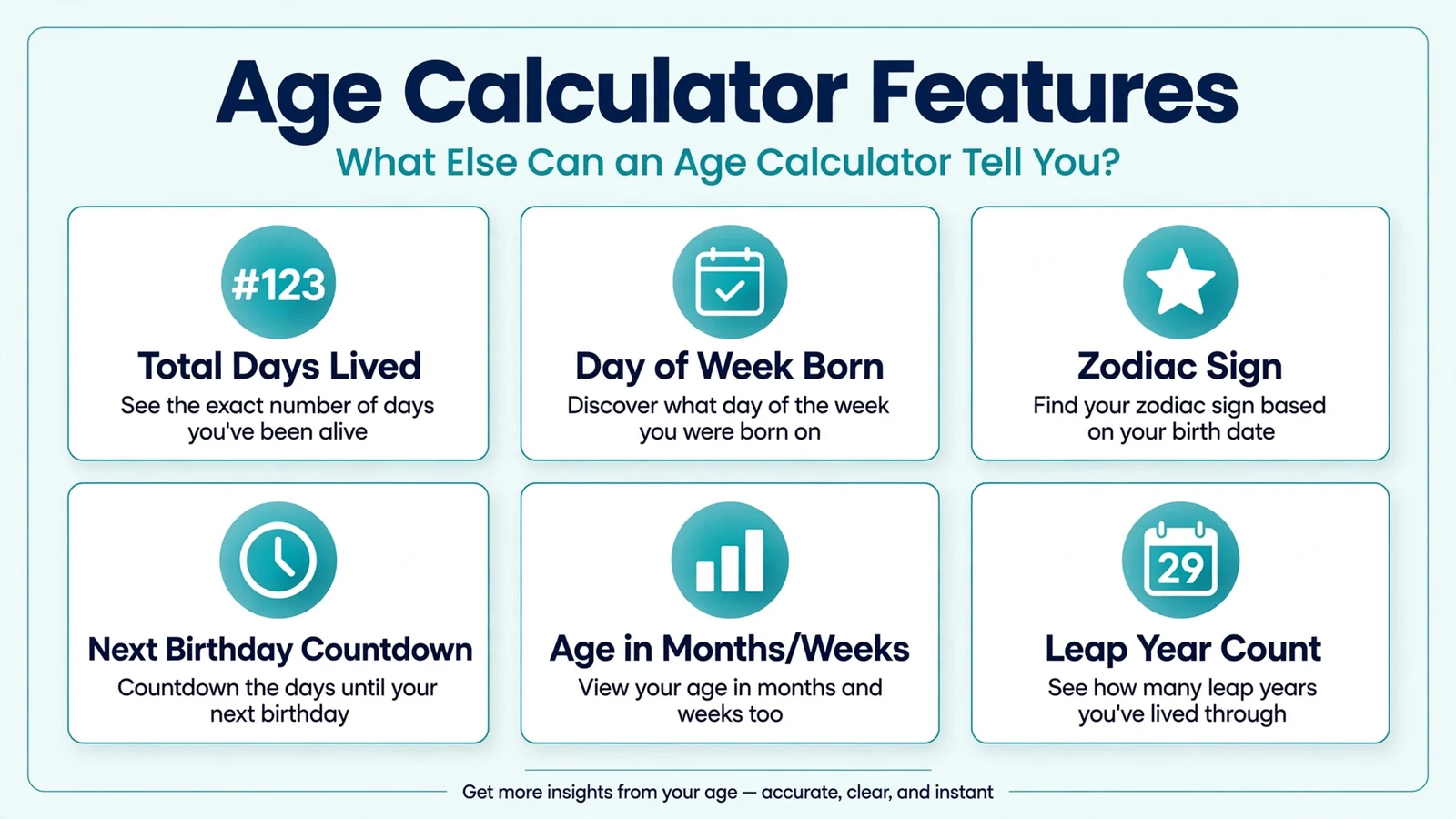
A date-of-birth tool can do far more than years, months, and days. That is where a free online age calculator earns its keep.
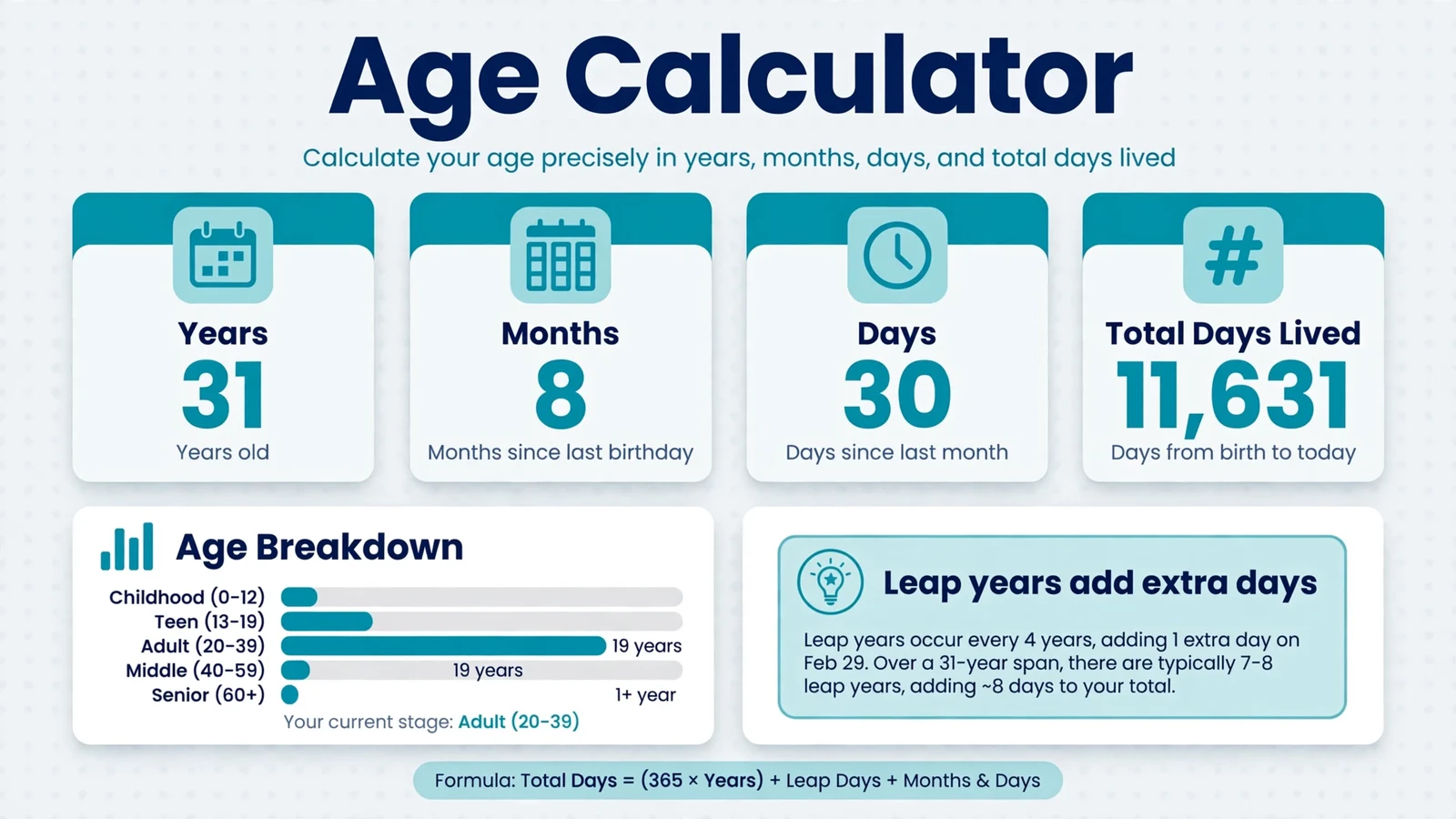
- Total time lived, expressed as total days, weeks, months, or even hours and minutes. Great for milestone posts and curiosity alike.
- Next-birthday countdown, showing exactly how many days, and sometimes hours, remain until the next one.
- Day of the week you were born, which is a small joy to discover and easy to verify.
- Zodiac sign, calculated from the birth date for the astrologically curious.
Want to calculate your exact age right now, with all of these extras included? CalcuNexa’s free age calculator runs the full borrow method for you and shows the breakdown instantly. And if you are already thinking about health numbers, the free BMI calculator sits one click away.
Frequently Asked Questions
How do I calculate my exact age from my date of birth?
Subtract your birth date from today’s date with the borrow method: borrow days first, then months, then years. Check whether this year’s birthday has passed, since that decides the final year count. If you’d rather skip the arithmetic, any reliable date of birth calculator will do it in one click.
What is the formula for calculating age?
There is no single-line formula because months have uneven lengths. The standard approach is a three-step subtraction: days, then months, then years, borrowing from the next unit whenever the top number is smaller. Most online age calculator tools implement exactly this logic behind a simple form.
How do leap years affect age calculation?
Leap years add a 29th day to February every four years, which changes how many days you borrow when the subtraction crosses February. Borrow 28 days in a leap year and your answer will be off by one. Any careful method uses the real month length for that specific year.
What if I was born on February 29?
You still age one year at a time like everyone else. In non-leap years, most systems and everyday practice treat either 28 February or 1 March as your birthday for that year. When calculating by hand, just pick the convention your form or country uses and stay consistent.
Can I calculate someone’s age on a past date?
Yes. Use the past date as your reference date and run the same borrow method against it. This is how historians pin down ages at events like weddings, elections, or record-breaking performances. Just make sure the reference date is not earlier than the birth date.
Why does my manual calculation differ from an online calculator?
The usual culprit is the month borrow: people assume 30 days instead of the real month length, or forget a leap day inside the interval. Double-check whether this year’s birthday has passed, too. When an age calculator disagrees with your hand math, recheck those two spots first.
Conclusion
Once you know the borrow method, exact age is just careful subtraction: days, then months, then years, with real month lengths and leap years respected. Skip the arithmetic any time with CalcuNexa’s free age calculator and get your answer in seconds. If you enjoy the background, read more about the concept of age and how leap years work on Wikipedia.
1 thought on “Age Calculator: Exact Age in Years, Months and Days”