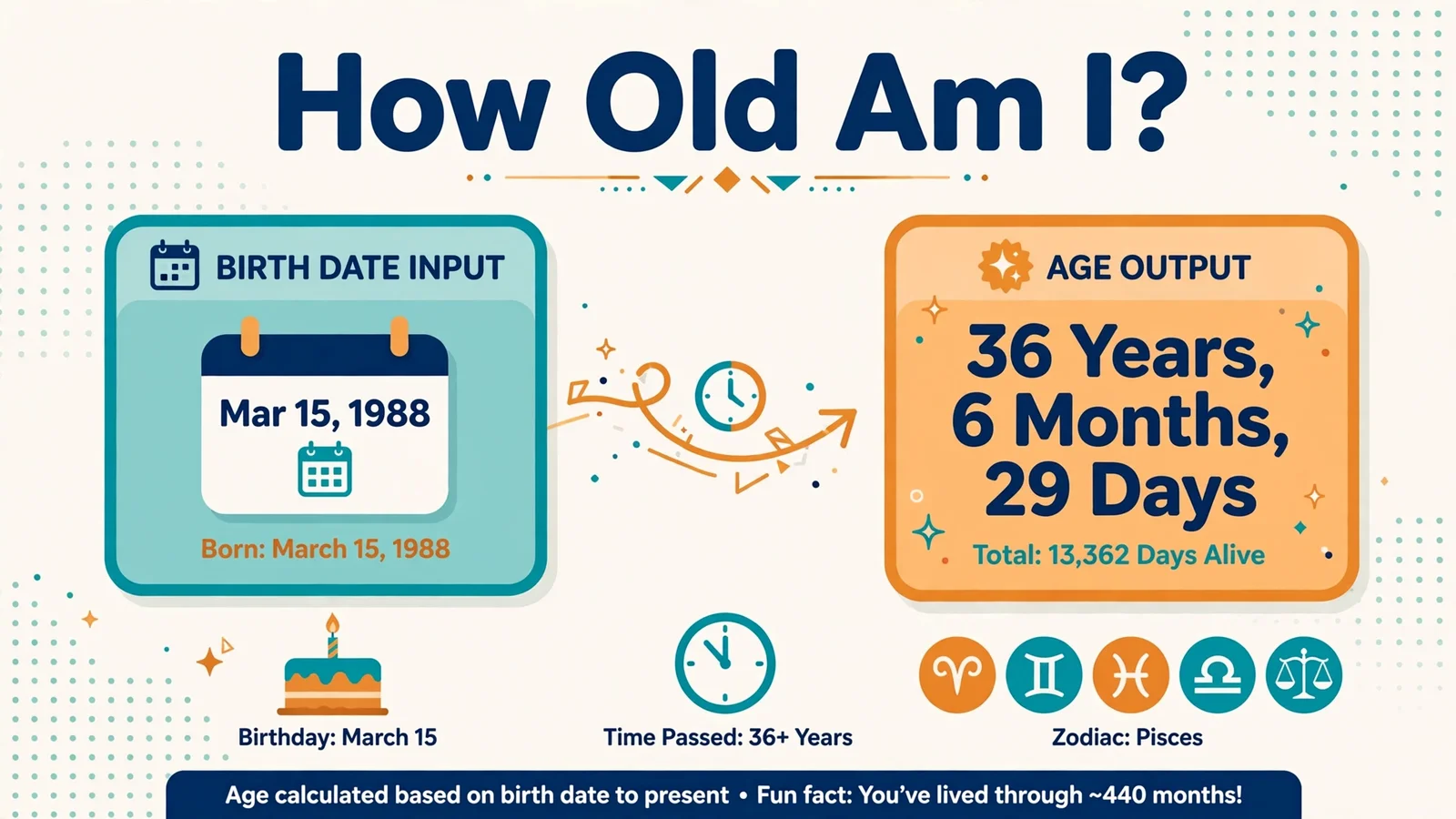
“How old am I?” sounds like a strange question until you need an exact answer. Your age in years is easy, but your exact age in years, months, days, and even total days lived takes real calculation, especially with leap years in the mix.
An age calculator does the math instantly. Enter your birth date and it returns your precise chronological age, plus fun extras like your day of birth, zodiac sign, and days until your next birthday.
How Do I Calculate How Old I Am?
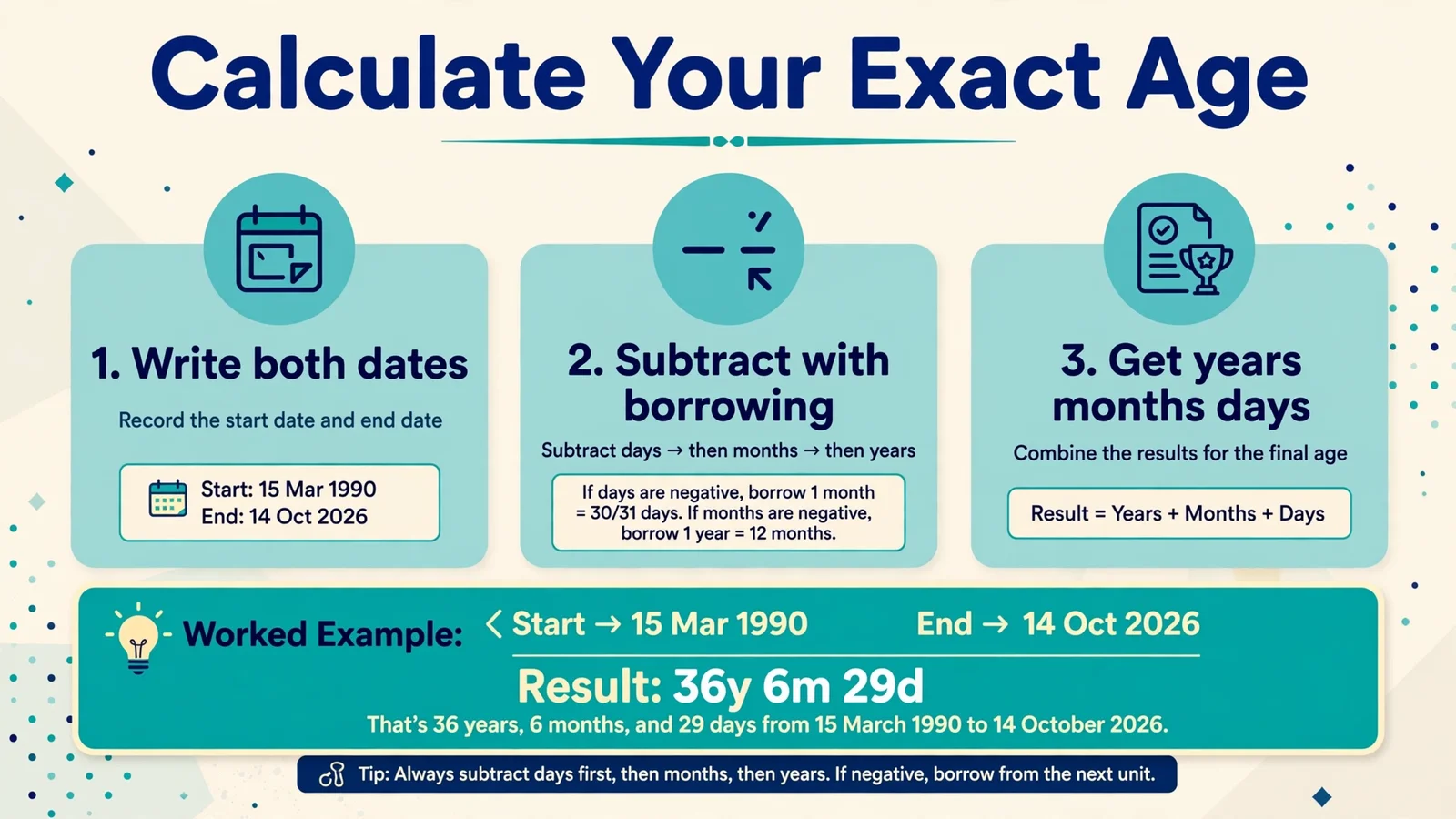
The basic idea is simple: subtract your birth date from today’s date. The tricky part is borrowing days and months correctly, because months have different lengths and leap years add extra days.
Here is the manual method in three steps:
- Write down both dates in day-month-year format
- Subtract day from day, borrowing from the month column if needed (borrow the number of days in the previous month)
- Subtract month from month, borrowing 12 months from the year column if needed, then subtract year from year
Example: born 15 March 1990, today is 14 October 2026.
- Days: 14 – 15 needs borrowing. September has 30 days, so 14 + 30 – 15 = 29 days
- Months: September (9) minus 1 borrowed = 8. 8 – 3 = 5 months… wait, we borrowed, so October becomes September: 9 – 1 – 3 = 5 months
- Years: 2026 – 1990 = 36 years
Result: 36 years, 6 months, 29 days.
Honestly, doing this by hand is error-prone. You can use our free age calculator to get the exact answer in one click, with zero borrowing mistakes.
Why Do Leap Years Make Age Math Tricky?
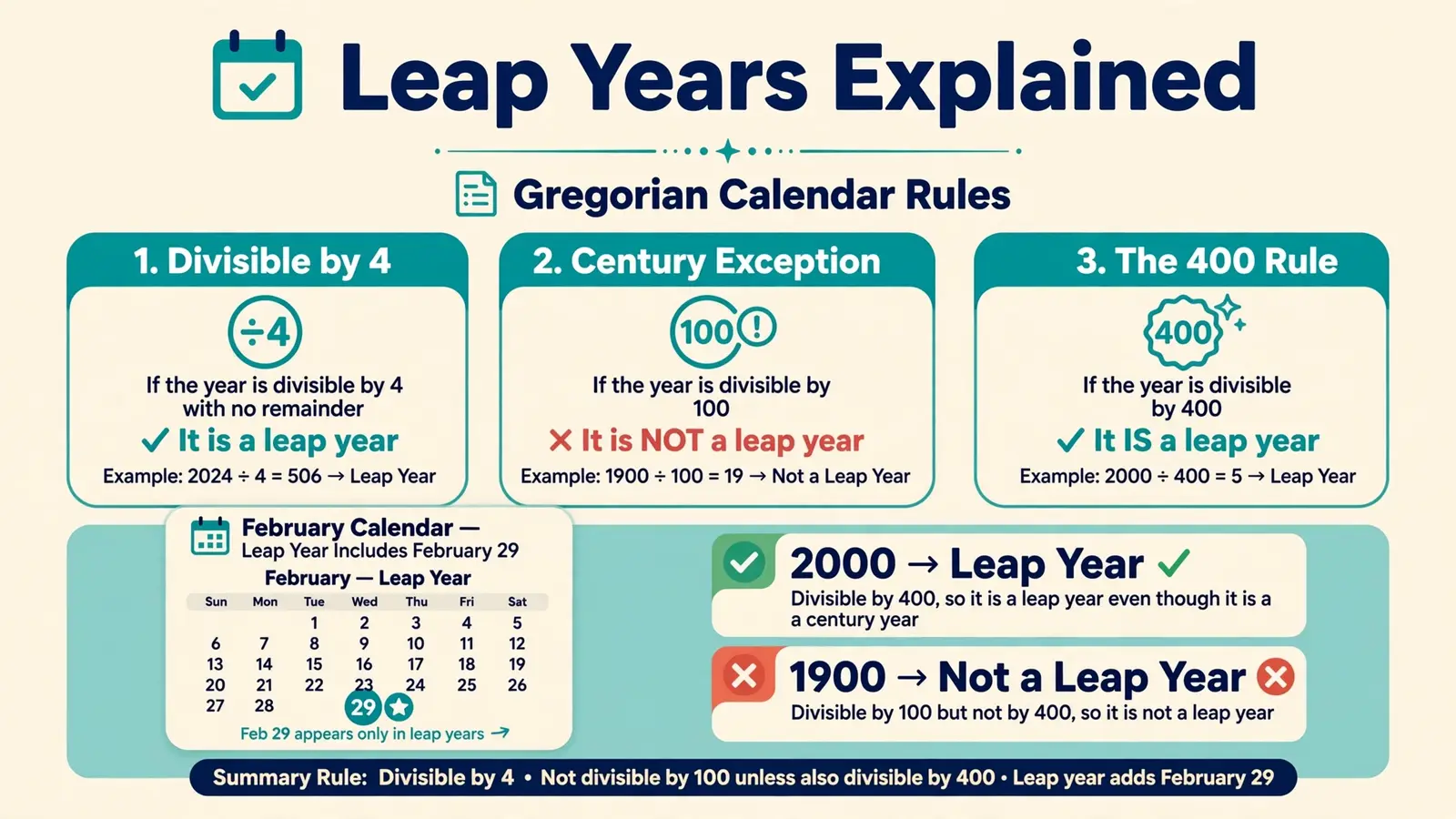
Leap years exist because Earth takes about 365.25 days to orbit the sun, not exactly 365. Without the extra day every four years, calendars would drift out of sync with the seasons.
The rules, set by the Gregorian calendar:
- A year is a leap year if divisible by 4
- Except century years, which must be divisible by 400
- So 2000 was a leap year, but 1900 was not
If you were born on February 29, you technically only get a calendar birthday every four years, though most leap-day babies celebrate on February 28 or March 1 in off years. An age calculator handles all of this automatically, counting the exact number of days including every leap day you have lived through.
What Else Can an Age Calculator Tell Me?
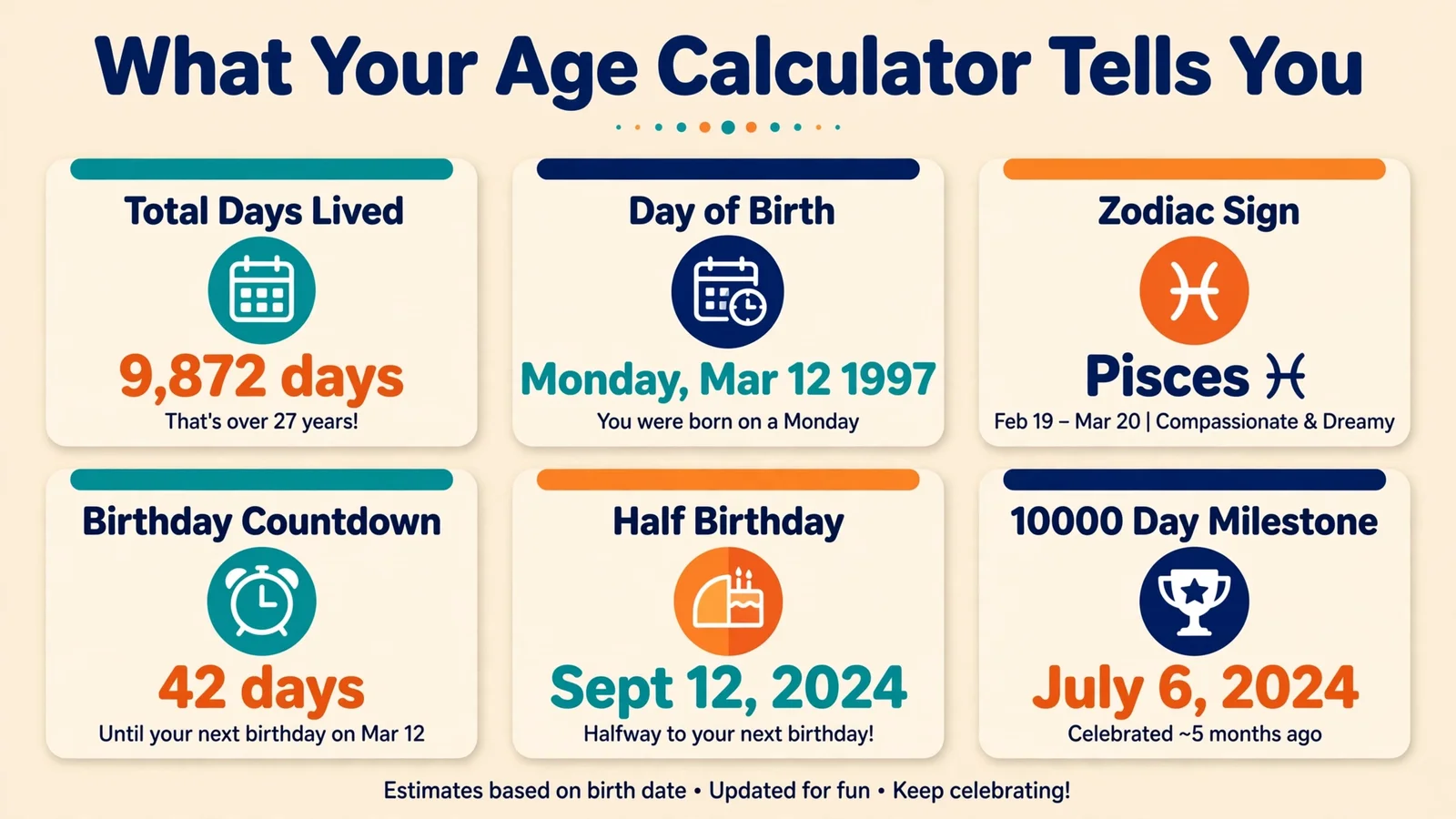
A good age calculator returns much more than years. Typical extras include:
| Detail | What it tells you |
|---|---|
| Total days lived | Your age expressed as a single day count |
| Total weeks and months | Alternative breakdowns of your lifespan |
| Day of birth | The weekday you were born on |
| Zodiac sign | Your Western sun sign from your birth date |
| Next birthday countdown | Days remaining until your next birthday |
| Half birthday | The date six months from your birth date |
| Milestone dates | When you hit 10,000 days, 1 billion seconds, etc. |
These extras make age calculators popular for birthday planning, genealogy research, and satisfying curiosity. The milestone dates are especially fun: knowing you will hit 10,000 days alive on a specific date gives an ordinary day a little sparkle.
How Old Will I Be on a Future Date?
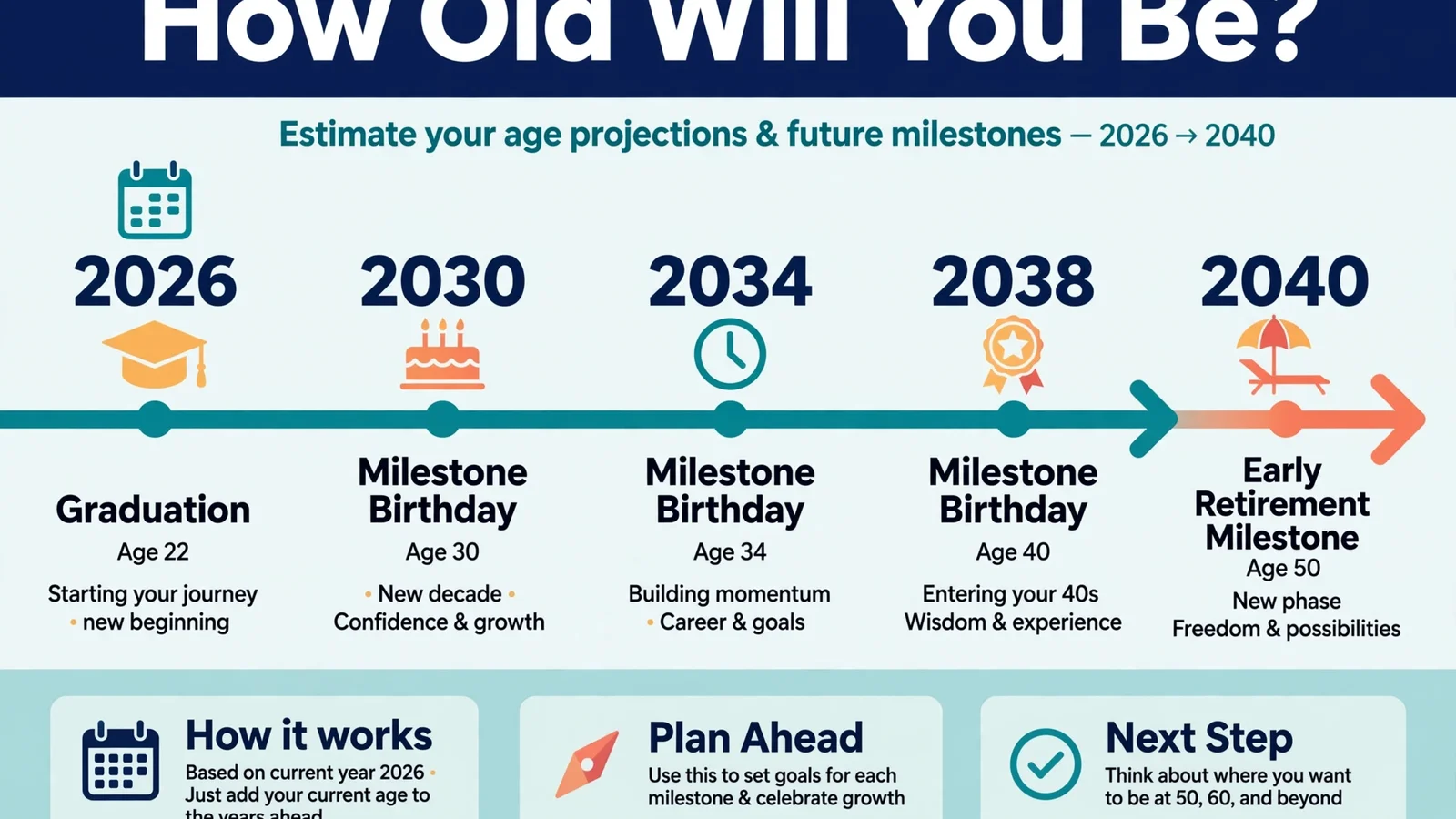
One handy use of age math is projecting forward. Want to know how old you will be when you graduate, retire, or hit a round-number birthday? Subtract your birth date from the future date using the same borrowing method.
Common projections people calculate:
- Retirement age: how old you will be in 2040, 2050, or any target year
- Milestone birthdays: when you turn 30, 40, 50, or 100
- Anniversaries: how long until your 10th or 25th wedding anniversary
- Kids’ milestones: how old your children will be at graduation
For year-specific lookups, a future age calculator saves time versus doing the subtraction yourself, particularly when leap years fall inside the range.
Why Does Your Exact Age Matter?
Most of the time, your age in years is enough. But plenty of real situations call for precision.
Official forms and eligibility. Insurance applications, retirement accounts, competition age brackets, and school enrollment cutoffs often depend on your exact age on a specific date. Being 17 years and 11 months is not the same as 18 when a cutoff is involved.
Medical and health tracking. Pediatric growth charts, vaccination schedules, and developmental milestones all use exact age in months. Doctors need precision, especially for children.
Legal milestones. Driving age, voting age, drinking age, and age of majority all hinge on the exact day. An age calculator removes any doubt about whether you have crossed the line.
Genealogy and records. Family historians constantly compute exact ages from birth and death dates on old records. Doing this across dozens of ancestors by hand is tedious; a calculator makes it trivial.
Personal curiosity. Sometimes you just want to know you have been alive for 12,000 days, or that your 10,000-day anniversary falls on a Tuesday. There is nothing wrong with a little numerical wonder.
What Is the Difference Between Age in Years and Total Days Lived?
Your age in years is a rounded summary. Total days lived is the precise count, and the two can tell different stories.
Someone who is “36 years old” could have lived anywhere from 13,149 to 13,514 days depending on where they fall in the year and how many leap days they have seen. That is a range of over a year in day terms, hidden behind a single number.
Total days is useful for milestone tracking and for anyone who likes precision. It is also the basis for fun calculations like “how many hours have I been alive” (multiply days by 24) or “how many seconds” (multiply by 86,400). A 36-year-old has been alive for roughly 1.1 billion seconds, a number that tends to surprise people.
Frequently Asked Questions
How old am I if I was born in 1990?
As of 2026, someone born in 1990 is 35 or 36 depending on whether their birthday has passed this year. Subtract 1990 from the current year, then subtract one more if your birthday has not happened yet.
How do I calculate my exact age in months?
Multiply your full years by 12 and add the extra months since your last birthday. Or use an age calculator, which handles the month-length and leap-year details for you.
What is my chronological age vs biological age?
Chronological age is the time since your birth, what we have been discussing. Biological age estimates how old your body seems based on health markers. They can differ significantly with lifestyle.
Why does my age differ on different calculators?
Usually because of time zones or whether the calculator counts the current day. Reputable calculators using your birth date and today's date should agree to the day.
How many days old am I?
Multiply your age in years by 365, add leap days lived through, then add days since your last birthday. An age calculator gives you this number instantly.
What day of the week was I born on?
Enter your birth date in any age calculator or check a perpetual calendar. The weekday of birth is a standard output of most age tools.
Conclusion
“How old am I?” has a simple answer and a precise one. The simple answer is your age in years. The precise answer, down to months and days, is what an age calculator delivers in seconds.
Whether you are planning a milestone birthday, filling out a form, or just curious, getting the exact number takes one click. For related life-date math, the Wikipedia article on age and the Wikipedia leap year explainer cover the calendar science behind the calculation.