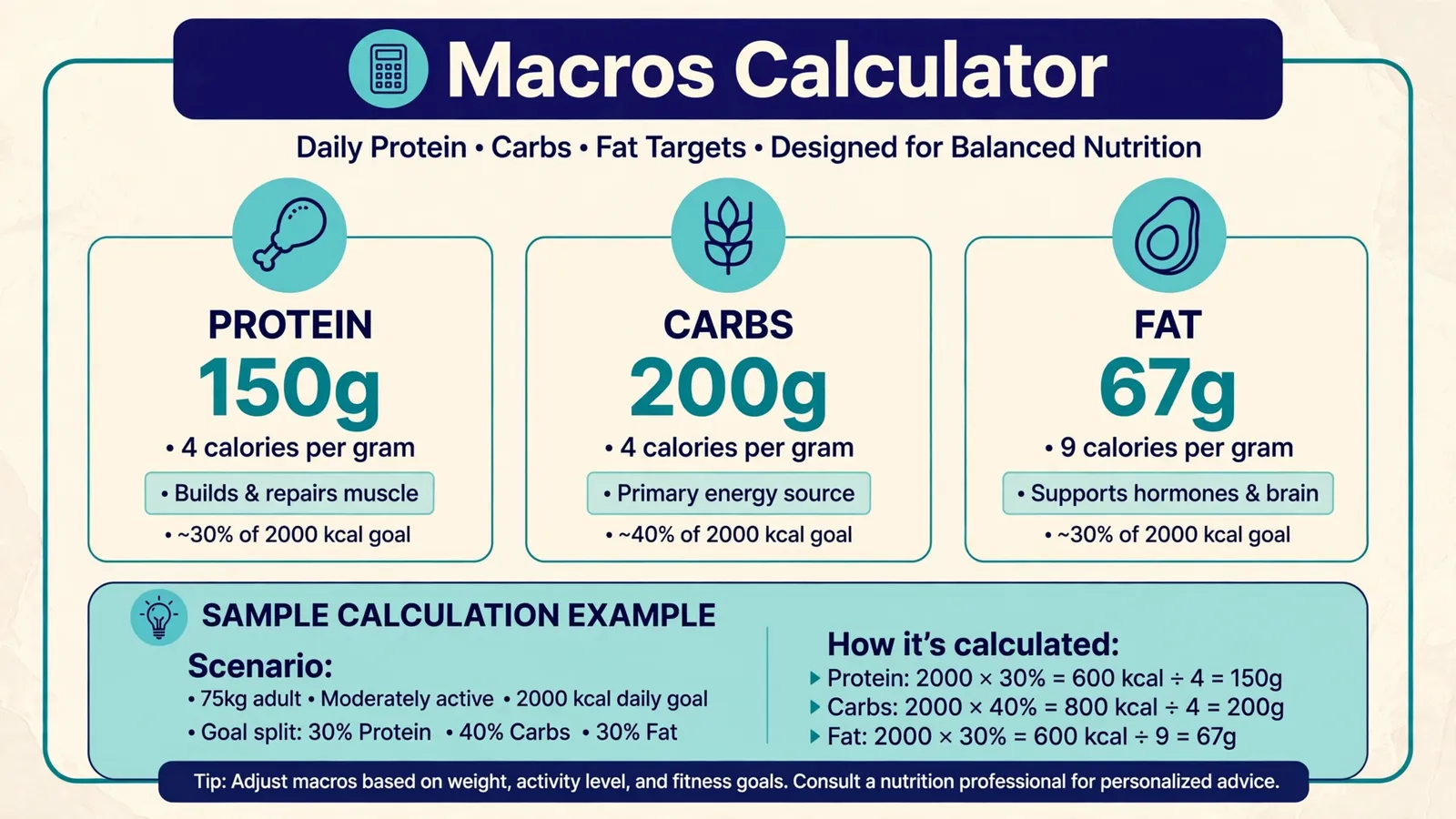
A macros calculator tells you how many grams of protein, carbohydrates, and fat to eat each day based on your calories, weight, and goal. For example, someone eating 2,000 calories with a 40/30/30 split would target 200 grams of protein, 150 grams of carbs, and 67 grams of fat.
If you have ever tracked calories but still felt stuck, macros are usually the missing piece. Two people can eat the same 2,000 calories and get completely different results depending on where those calories come from. This guide shows you exactly how a macros calculator works and how to set your own numbers.
What Is a Macros Calculator?
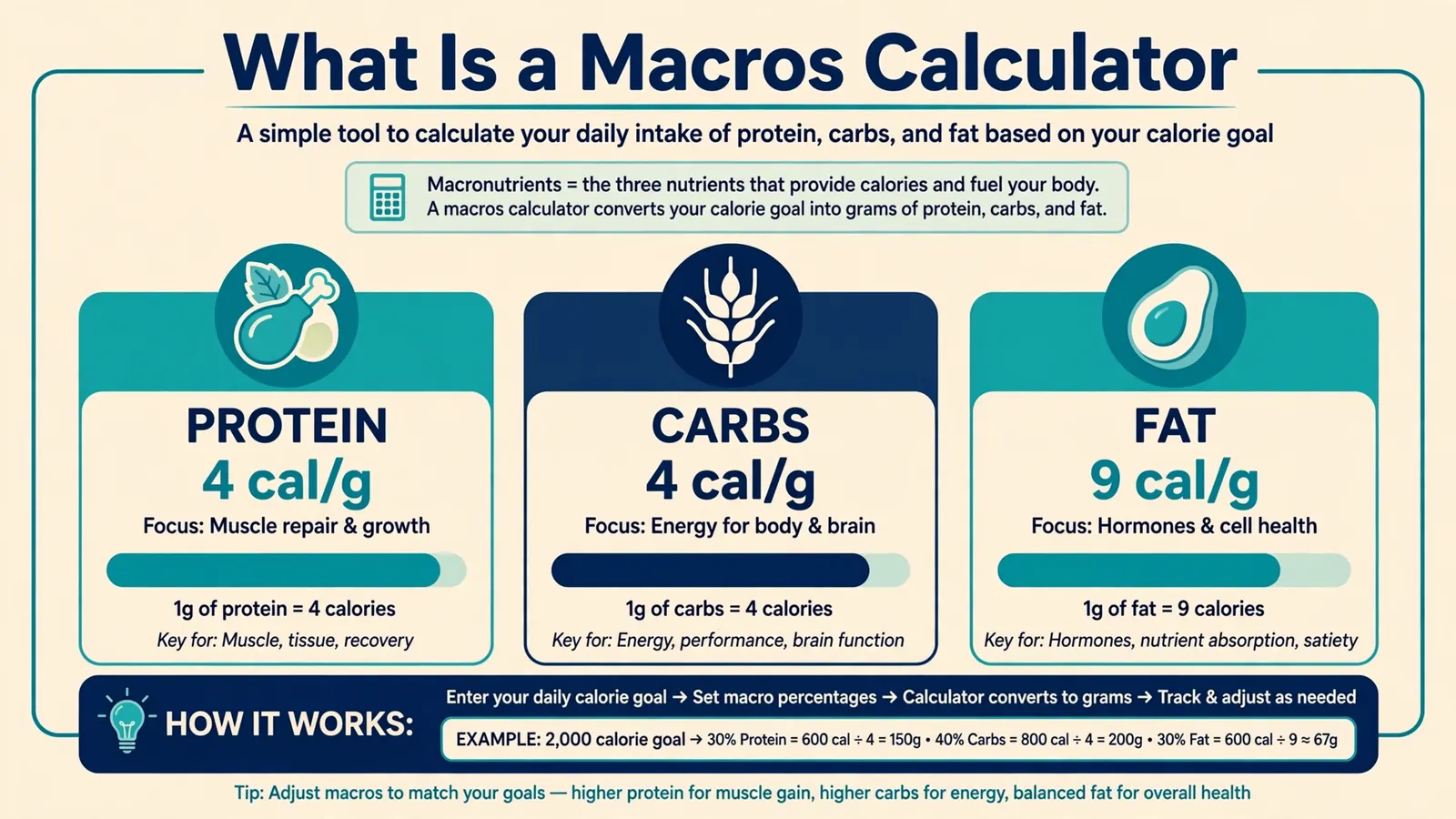
A macros calculator is a tool that converts your daily calorie target into gram targets for the three macronutrients: protein, carbohydrates, and fat. These three nutrients provide all the calories you eat, and each gram carries a fixed amount of energy.
The math behind it is simple. Protein and carbohydrates each provide 4 calories per gram, while fat provides 9 calories per gram. A macros calculator takes your total calories, applies a percentage split based on your goal, and divides by these values to give you daily gram targets.
For example, on a 2,200-calorie plan with 30 percent protein, 40 percent carbs, and 30 percent fat, you would eat 165 grams of protein, 220 grams of carbs, and 73 grams of fat per day.
How Does a Macros Calculator Work?
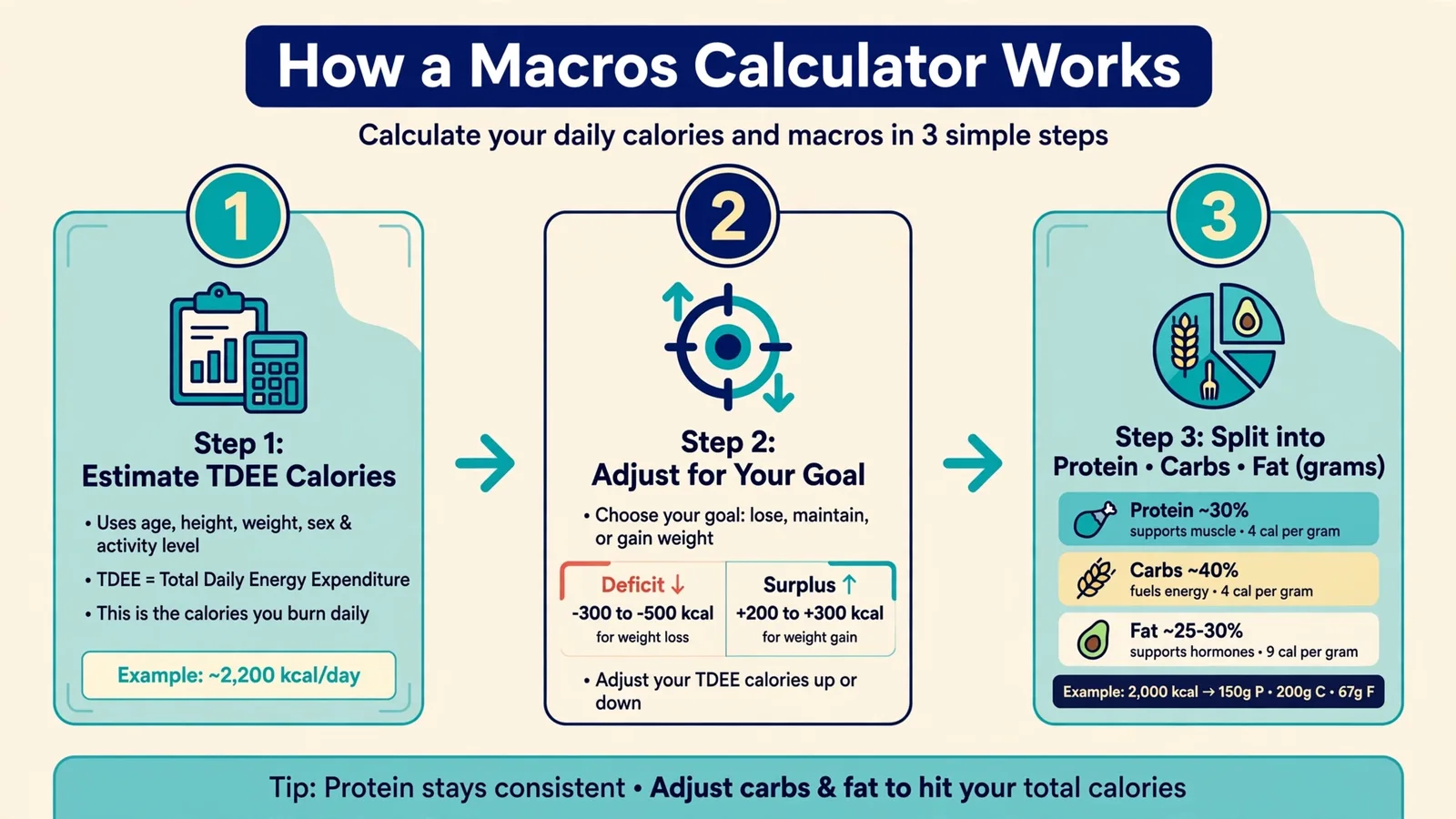
A macros calculator follows three steps to produce your targets.
Step 1: Estimate your calorie needs
Most macros calculators start with your Total Daily Energy Expenditure (TDEE), which is the number of calories you burn per day. This comes from your basal metabolic rate multiplied by an activity factor. You can use our free calorie calculator to find your TDEE in seconds.
Step 2: Adjust for your goal
Your calorie target shifts based on what you want to achieve. For fat loss, subtract 300 to 500 calories from your TDEE. For muscle gain, add 200 to 300 calories. For maintenance, eat at your TDEE.
Step 3: Split calories into macros
The calculator applies a macro ratio suited to your goal. A common starting split is 30 percent protein, 40 percent carbs, and 30 percent fat. Each macro’s calories are then divided by 4, 4, and 9 to get grams.
What Are the Best Macro Ratios for Different Goals?
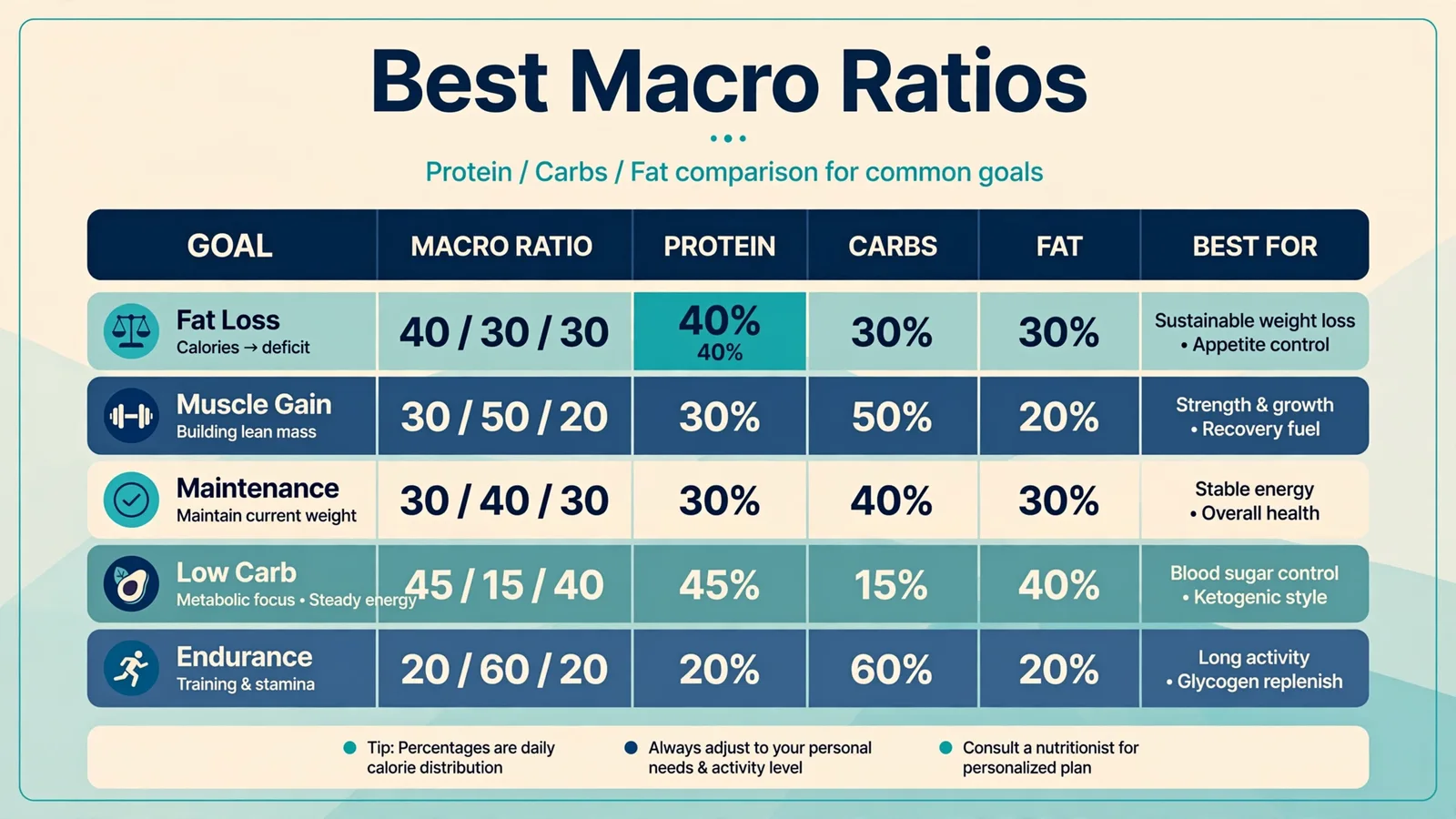
There is no single perfect ratio. The best split depends on your goal, training style, and food preferences.
| Goal | Protein | Carbs | Fat | Best for |
|---|---|---|---|---|
| Fat loss | 35-40% | 30-35% | 25-30% | Preserving muscle while dieting |
| Muscle gain | 25-30% | 45-55% | 20-25% | Fueling hard training sessions |
| Maintenance | 25-30% | 40-45% | 25-30% | Balanced everyday eating |
| Low carb | 30-35% | 10-20% | 45-55% | People who prefer fats over carbs |
| Endurance | 20-25% | 55-65% | 15-20% | Runners and cyclists |
Which ratio should beginners start with?
Start with 30 percent protein, 40 percent carbs, and 30 percent fat. This balanced split works for most people and most goals. Run it for two to three weeks, track your weight and energy, then adjust based on results.
Should protein always be the priority?
Yes. Protein is the one macro you should set first, because it preserves muscle, keeps you full, and has the highest thermic effect. A good rule is 1.6 to 2.2 grams of protein per kilogram of body weight per day, according to the International Society of Sports Nutrition.
How Do I Calculate My Macros Manually?
You can do it by hand in about five minutes.
- Find your daily calorie target (TDEE minus deficit or plus surplus).
- Set protein first: multiply your body weight in kilograms by 2.0. That is your protein grams.
- Convert protein grams to calories: multiply by 4.
- Set fat at 25 to 30 percent of total calories, then divide by 9 for grams.
- Fill the remaining calories with carbs: divide by 4 for grams.
Here is a worked example for a 75 kg person eating 2,300 calories:
- Protein: 75 x 2.0 = 150 g (600 calories)
- Fat: 2,300 x 0.28 = 644 calories, divided by 9 = 72 g
- Carbs: 2,300 – 600 – 644 = 1,056 calories, divided by 4 = 264 g
Final targets: 150 g protein, 264 g carbs, 72 g fat.
What Are Common Macro Tracking Mistakes?
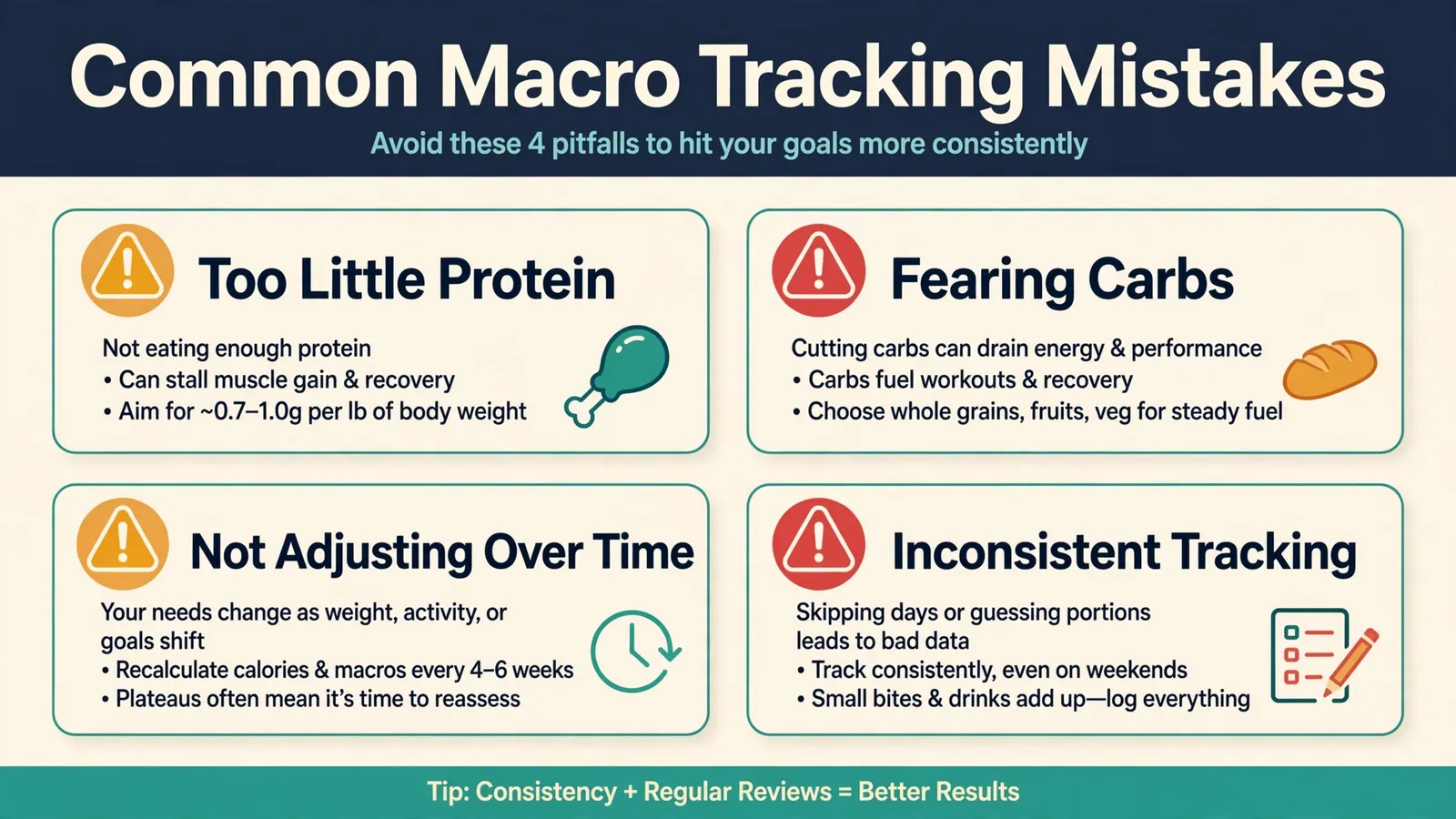
Eating too little protein
Most people under-eat protein. If your muscles feel flat and you are always hungry on a diet, protein is usually too low. Bump it to at least 1.6 grams per kilogram before changing anything else.
Fearing carbs or fat completely
Cutting an entire macro group rarely lasts. Carbs fuel training and brain function. Fats support hormones. The Harris-Benedict formula reminds us that energy needs are individual, and so are macro preferences.
Not adjusting over time
Your macros are not permanent. As you lose weight, your TDEE drops, so recalculate every 4 to 6 weeks or after every 3 to 5 kg of weight change.
Tracking inconsistently
One perfect day followed by three untracked days tells you nothing. Aim for 80 percent consistency rather than 100 percent perfection.
Ignoring fiber
Fiber is technically a carbohydrate, but it behaves differently. It feeds gut bacteria, slows digestion, and keeps you full. Most macros calculators count total carbs, so track fiber separately and aim for 25 to 35 grams daily. High-fiber foods like beans, oats, and vegetables make any macro split easier to follow.
Copying someone else’s macros
Your friend’s 220 grams of protein might be perfect for his 95 kg frame and terrible for your 60 kg body. Macros are personal. Use a calculator with your own numbers, or better yet, learn the manual method above so you understand what each number means.
Frequently Asked Questions
What does a macros calculator do?
A macros calculator converts your daily calorie target into specific gram targets for protein, carbohydrates, and fat. It uses your TDEE, your goal, and a macro ratio to produce numbers you can track each day.
How many grams of protein should I eat per day?
Most active adults do well with 1.6 to 2.2 grams per kilogram of body weight. A 70 kg person would target 112 to 154 grams daily. People dieting hard should stay near the top of that range to protect muscle.
Is 40/30/30 a good macro split?
It is a solid starting point for fat loss, with 40 percent protein, 30 percent carbs, and 30 percent fat. The high protein keeps you full and preserves muscle. Adjust carbs and fat to taste after two weeks.
Do I need to count macros to lose weight?
No, but it helps. A calorie deficit drives fat loss, and you can create one without tracking macros. However, tracking macros usually preserves more muscle and keeps hunger lower than tracking calories alone.
What is the difference between counting calories and counting macros?
Counting calories tracks total energy. Counting macros tracks where that energy comes from. Two diets at 2,000 calories can produce different body composition results if one has 200 grams of protein and the other has 80.
Can I use a macros calculator for keto?
Yes. Set carbs to 20 to 50 grams per day, protein to 1.2 to 1.6 grams per kilogram, and fill the rest with fat. Most keto macros calculators use a 70/25/5 fat/protein/carb split as a starting point.
How often should I recalculate my macros?
Every 4 to 6 weeks, or after gaining or losing 3 to 5 kg. Your energy needs change as your body weight changes, so stale macros slowly stop working.
Conclusion
A macros calculator takes the guesswork out of nutrition by turning your calorie target into clear daily gram goals for protein, carbs, and fat. Start with your TDEE, set protein first at around 2 grams per kilogram, then split the rest between carbs and fat based on your preferences.
Remember that the best macro split is the one you can follow consistently. Track honestly for two to three weeks, watch your weight trend and energy, then adjust. For reliable nutrition guidance, the USDA MyPlate guidelines offer evidence-based starting points, and the Academy of Nutrition and Dietetics provides professional resources on balanced eating.
1 thought on “Macros Calculator: How to Calculate Your Protein, Carbs, and Fat Targets”