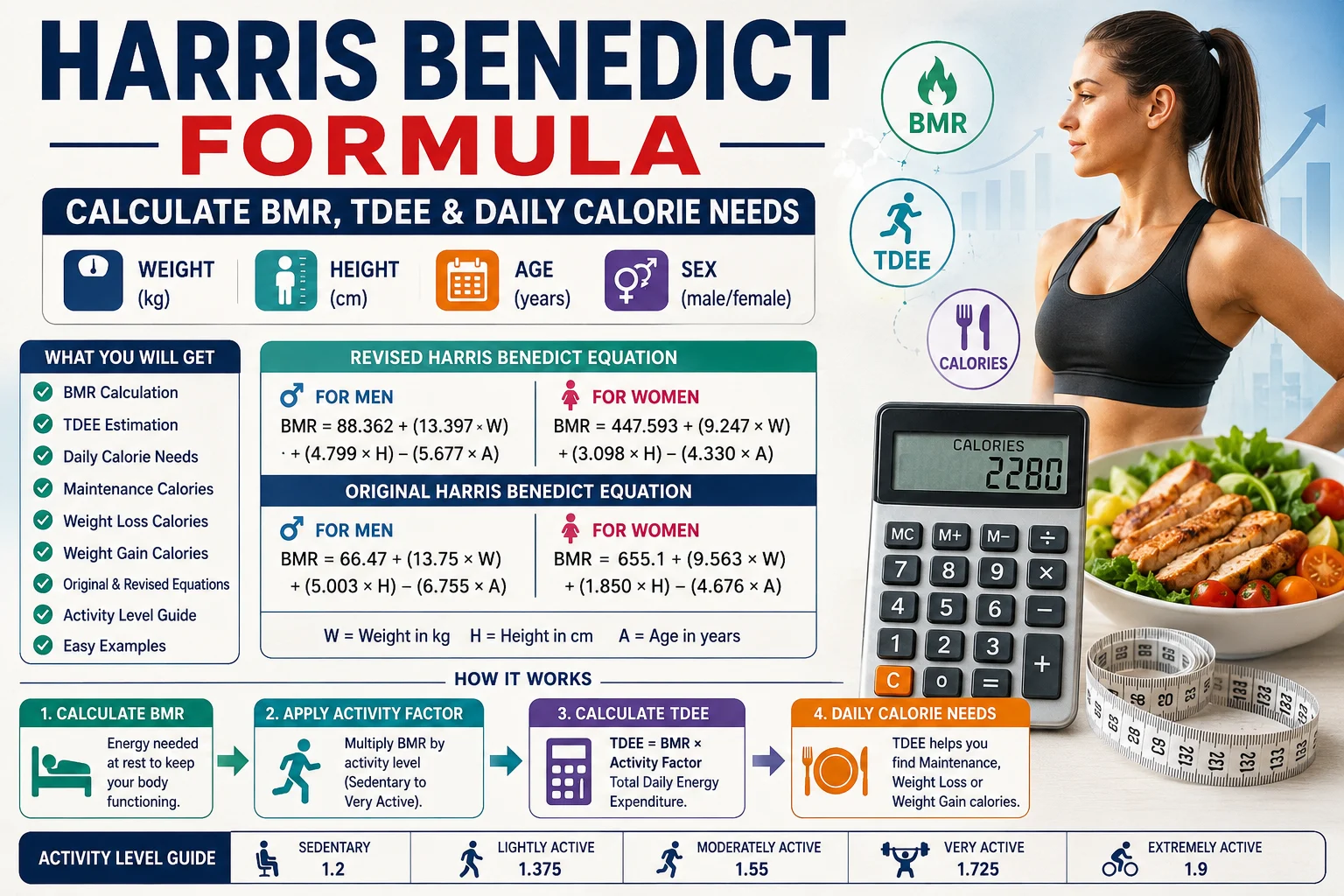
Have you ever wondered how many calories your body needs each day, even when you do nothing?
Your body uses energy for basic functions such as breathing, keeping your heart beating, maintaining body temperature, and supporting your organs. This energy need is called your Basal Metabolic Rate (BMR).
The Harris Benedict Formula is one of the best-known methods for estimating BMR. It uses your age, sex, body weight, and height to estimate how much energy your body needs at rest.
You can then combine your BMR with your activity level to estimate your Total Daily Energy Expenditure (TDEE). This can help you understand your maintenance calories and create a reasonable starting point for weight loss or weight gain.
Quick Answer: The Harris Benedict Formula is a mathematical equation used to estimate your Basal Metabolic Rate (BMR). Your BMR can then be multiplied by an activity factor to estimate your daily calorie needs or TDEE.
What Is the Harris Benedict Formula?
The Harris Benedict Formula, also called the Harris-Benedict Equation, is a method for estimating how many calories your body uses at rest.
The equation was developed from research into human energy expenditure. It has since become widely known in nutrition, fitness, calorie calculators, and weight-management tools.
Your BMR represents the energy your body needs to support basic physiological functions when you are at rest.
These functions include:
- Breathing
- Blood circulation
- Brain activity
- Organ function
- Cell maintenance
- Body temperature regulation
- Basic metabolic processes
Your body continues using energy even when you’re sleeping or sitting still.
That is why your daily calorie needs are usually much higher than your BMR.
Harris Benedict Formula vs BMR
These terms are closely connected, but they aren’t exactly the same.
The Harris Benedict Formula is the calculation method.
BMR is the estimated amount of energy your body needs at rest.
For example, if a calculation gives you a BMR of 1,600 calories, that does not necessarily mean you should eat only 1,600 calories per day.
You also burn calories through movement, exercise, digestion, and normal daily activities.
That is where TDEE becomes useful.
What Is BMR?
Basal Metabolic Rate (BMR) is the estimated number of calories your body needs to maintain essential functions while at rest.
Think of BMR as the energy cost of keeping your body running.
For example, your body needs energy to:
- Keep your heart pumping
- Keep your lungs working
- Maintain body temperature
- Support your nervous system
- Maintain tissues
- Power basic cellular processes
Your BMR is affected by several factors.
| Factor | How it affects BMR |
|---|---|
| Age | BMR generally changes as you get older |
| Sex | Men & women tend to have different average energy needs |
| Height | Taller bodies generally require more energy |
| Weight | Greater body mass often requires more energy |
| Body composition | Muscle tissue affects energy expenditure |
| Genetics | Individual metabolism varies |
| Hormones | Hormonal changes can influence metabolic rate |
The Harris Benedict equation uses age, sex, weight, and height as its main inputs.
Harris Benedict BMR Formula
There are two commonly discussed versions of the equation:
- Original Harris-Benedict Equation
- Revised Harris-Benedict Equation
The revised version updated the original calculations using additional research.
Original Harris Benedict Equation for Men
For men:
BMR = 66.47 + (13.75 × weight in kg) + (5.003 × height in cm) − (6.755 × age)
Original Harris Benedict Equation for Women
For women:
BMR = 655.1 + (9.563 × weight in kg) + (1.850 × height in cm) − (4.676 × age)
These equations estimate calories burned at rest.
Revised Harris Benedict Equation for Men
The revised equation is:
BMR = 88.362 + (13.397 × weight in kg) + (4.799 × height in cm) − (5.677 × age)
Revised Harris Benedict Equation for Women
The revised equation is:
BMR = 447.593 + (9.247 × weight in kg) + (3.098 × height in cm) − (4.330 × age)
For most modern applications, the revised Harris-Benedict equation is the version you will commonly see in calculators.
How to Calculate BMR Using the Harris Benedict Formula
Calculating BMR is simple once you know your basic measurements.
You need:
- Age
- Sex
- Weight
- Height
Let’s use an example.
Suppose a 30-year-old man weighs 80 kg and is 175 cm tall.
Using the revised Harris Benedict equation:
BMR = 88.362 + (13.397 × 80) + (4.799 × 175) − (5.677 × 30)
The estimated BMR is approximately 1,815 calories per day.
This means his body may require around 1,815 calories per day to support basic functions under the assumptions of the equation.
It does not mean 1,815 calories is his actual daily calorie requirement.
He will burn additional calories through movement and normal activities.
Harris Benedict Formula Calculator
A Harris Benedict Formula Calculator automates the calculation.
Instead of doing the equation manually, you enter your:
- Age
- Sex
- Weight
- Height
- Activity level
The calculator can then estimate your:
- BMR
- Daily calorie needs
- TDEE
- Maintenance calories
- Estimated calories for weight loss
- Estimated calories for weight gain
The first calculation is your BMR.
The second step is estimating your total daily energy expenditure.
How to Calculate TDEE With Harris Benedict
Total Daily Energy Expenditure (TDEE) estimates how many calories you burn throughout an entire day.
A simple approach is:
TDEE = BMR × Activity Factor
Your BMR represents resting energy needs.
The activity factor accounts for physical activity and normal movement.
Common activity multipliers include:
| Activity Level | Multiplier | Typical Description |
|---|---|---|
| Sedentary | 1.2 | Little or no exercise |
| Lightly active | 1.375 | Light exercise about 1 to 3 days weekly |
| Moderately active | 1.55 | Moderate exercise about 3 to 5 days weekly |
| Very active | 1.725 | Hard exercise about 6 to 7 days weekly |
| Extremely active | 1.9 | Very demanding physical activity |
Example TDEE Calculation
Let’s use the previous example.
BMR:
1,815 calories
Suppose the person is moderately active.
The calculation becomes:
TDEE = 1,815 × 1.55
TDEE ≈ 2,813 calories per day
This gives an estimated daily energy expenditure of around 2,813 calories.
If their actual energy expenditure is close to this estimate, eating around this level could maintain body weight over time.
Harris Benedict Formula for Daily Calorie Needs
Your daily calorie needs depend on more than your BMR.
Your body uses energy through several components.
1. Basal Metabolism
This is the energy required for essential functions.
It represents the largest component for many people.
2. Physical Activity
Walking, running, exercising, working, climbing stairs, and other movement increase energy expenditure.
3. Thermic Effect of Food
Your body also uses energy to digest, absorb, and process food.
4. Non Exercise Activity
Small movements can also contribute to energy expenditure.
Examples include:
- Standing
- Walking around the house
- Cleaning
- Shopping
- Moving around at work
Because of these factors, your TDEE is higher than your BMR.
Harris Benedict Formula for Weight Loss
People often use the Harris Benedict formula for weight loss because it provides an estimate of maintenance calories.
The basic process is:
Calculate BMR → Estimate TDEE → Create a calorie deficit
For example:
- BMR: 1,600 calories
- Estimated TDEE: 2,400 calories
- Maintenance intake: around 2,400 calories
- Calorie deficit: created by eating below maintenance
A calorie deficit means you consume fewer calories than your body uses over time.
However, the exact calorie deficit should be reasonable and sustainable.
The Harris Benedict equation is only an estimate. Your actual calorie requirements can differ.
Harris Benedict Formula for Weight Gain
The same approach can work in the opposite direction.
For weight gain, you generally need to consume more energy than you expend.
The process is:
Calculate BMR → Estimate TDEE → Add calories
For example:
- BMR: 1,700 calories
- TDEE: 2,600 calories
- Maintenance calories: around 2,600
- Weight-gain intake: above maintenance
The amount you should add depends on your goals, body composition, training, and individual circumstances.
Harris Benedict Formula for Maintenance Calories
Maintenance calories are the approximate number of calories needed to maintain your current body weight over time.
The Harris Benedict approach estimates maintenance calories by multiplying BMR by an activity factor.
For example:
BMR = 1,700
Activity factor = 1.55
Therefore:
TDEE = 1,700 × 1.55 = 2,635 calories
A person with these estimates might use approximately 2,635 calories per day as a starting estimate for maintenance.
Real-world maintenance needs can vary.
If body weight consistently changes despite eating around the calculated amount, the estimate may need adjustment.
Harris Benedict Formula for Men
The Harris Benedict formula for men uses four main measurements:
- Weight
- Height
- Age
- Sex
The revised equation is:
BMR = 88.362 + (13.397 × weight in kg) + (4.799 × height in cm) − (5.677 × age)
Example
A 25-year-old man:
- Weight: 75 kg
- Height: 180 cm
- Age: 25
His estimated BMR is approximately 1,797 calories per day.
His TDEE would then depend on his activity level.
This distinction is important because two men with the same BMR can have very different daily calorie requirements if their activity levels differ.
Harris Benedict Formula for Women
The revised Harris Benedict formula for women is:
BMR = 447.593 + (9.247 × weight in kg) + (3.098 × height in cm) − (4.330 × age)
Example
Suppose a 30-year-old woman:
- Weighs 65 kg
- Is 165 cm tall
- Is 30 years old
Her estimated BMR is approximately 1,413 calories per day.
Her estimated TDEE would depend on her activity level.
This is why simply comparing BMR values isn’t enough when estimating daily calorie requirements.
Original vs Revised Harris Benedict Equation
The original and revised equations use similar inputs but different coefficients.
| Version | Men | Women |
|---|---|---|
| Original | 66.47 + 13.75W + 5.003H − 6.755A | 655.1 + 9.563W + 1.850H − 4.676A |
| Revised | 88.362 + 13.397W + 4.799H − 5.677A | 447.593 + 9.247W + 3.098H − 4.330A |
Where:
- W = weight in kilograms
- H = height in centimeters
- A = age in years
The revised Harris-Benedict equation is widely used because it updates the original equation’s coefficients.
When using a calculator, always check which version it uses.
How Accurate Is the Harris Benedict Equation?
The Harris Benedict equation provides an estimate, not a direct measurement of your metabolism.
Your actual energy expenditure can differ because human metabolism varies.
Factors such as body composition, genetics, hormones, health status, physical activity, and measurement conditions can influence energy expenditure.
Therefore, you shouldn’t treat a Harris Benedict BMR calculation as an exact number.
For example, a calculator might estimate that you need 2,400 calories per day.
Your real maintenance requirement could be somewhat higher or lower.
A useful approach is to treat the calculation as a starting point and then observe your results over time.
Harris Benedict vs Mifflin St Jeor
The Mifflin-St Jeor Equation is another widely used method for estimating BMR.
Both equations use:
- Age
- Sex
- Weight
- Height
However, their coefficients differ.
The Mifflin-St Jeor equation is often used in modern calorie calculators and nutrition settings.
Why Are There Multiple BMR Equations?
No single equation works perfectly for every person.
Different equations were developed from different research populations and assumptions.
That’s why you may see different BMR results from different calculators.
For example:
Harris-Benedict BMR ≠ Mifflin-St Jeor BMR
This doesn’t automatically mean one calculator is broken.
It means the calculators are using different predictive equations.
Harris Benedict Activity Factor
The activity factor is important when converting BMR into TDEE.
Choosing the wrong activity level can significantly change your estimated daily calorie needs.
Sedentary
A sedentary person has little structured exercise and spends much of the day sitting.
Multiplier: 1.2
Lightly Active
This generally describes light exercise or sports several times per week.
Multiplier: 1.375
Moderately Active
This usually means moderate exercise several times per week.
Multiplier: 1.55
Very Active
This level involves frequent hard exercise or demanding physical activity.
Multiplier: 1.725
Extremely Active
This category is intended for very high physical activity, such as demanding training or physically intensive work.
Multiplier: 1.9
It’s better to choose the activity category that reflects your typical lifestyle rather than your best workout day.
Harris Benedict Calorie Calculation Example
Let’s walk through a complete example.
Imagine a 35-year-old woman:
- Weight: 70 kg
- Height: 165 cm
- Activity level: moderately active
Step 1: Calculate BMR
Using the revised Harris Benedict equation:
BMR = 447.593 + (9.247 × 70) + (3.098 × 165) − (4.330 × 35)
Estimated BMR:
≈ 1,469 calories per day
Step 2: Calculate TDEE
Moderately active:
TDEE = 1,469 × 1.55
Estimated TDEE:
≈ 2,277 calories per day
This gives an estimated maintenance level of around 2,277 calories per day.
The number is still an estimate and should not be treated as a guaranteed calorie requirement.
What Is the Difference Between BMR and TDEE?
This is one of the most important concepts to understand.
| BMR | TDEE |
|---|---|
| Energy needed at rest | Total estimated daily energy expenditure |
| Does not fully account for daily activity | Includes activity |
| Lower number | Usually higher number |
| Starting point for calorie calculations | Useful for estimating maintenance calories |
| Calculated from basic personal measurements | Often calculated from BMR and activity |
In simple terms:
BMR = calories your body needs at rest
TDEE = calories your body may use throughout the day
BMR, TDEE, and Calorie Intake
These three concepts work together.
Imagine your BMR is 1,600 calories.
Your activity level increases your estimated daily expenditure to 2,400 calories.
Then:
1,600 = BMR
2,400 = estimated TDEE
Your maintenance calorie intake would be around the TDEE estimate.
If you consistently eat below your energy expenditure, you may lose weight over time.
If you consistently eat above it, you may gain weight over time.
Actual changes depend on many factors, and short-term body-weight changes can also reflect water, glycogen, food volume, and other factors.
Harris Benedict Formula and Metabolism
People often use the word metabolism as if it means one fixed number.
It doesn’t.
Metabolism includes the many chemical processes that keep your body functioning.
Your metabolic rate can change over time.
For example, changes in:
- Body weight
- Body composition
- Physical activity
- Age
- Hormonal status
- Food intake
- Training
can influence energy expenditure.
The Harris Benedict equation provides a prediction based on selected variables.
It does not measure every part of your metabolism.
What Information Do You Need for a Harris Benedict Calculation?
Before using a Harris Benedict BMR Calculator, collect these four pieces of information:
Age
Enter your age in years.
Sex
The original equations use separate formulas for men & women.
Weight
The standard equations use kilograms.
If your weight is in pounds, convert it first:
kg = pounds ÷ 2.205
Height
The equations use centimeters.
If your height is given in inches:
cm = inches × 2.54
Using the correct units is essential.
Entering pounds where kilograms are required can produce a dramatically incorrect result.
Common Mistakes When Using the Harris Benedict Equation
Even a correct formula can produce a poor result when the inputs are wrong.
Using Pounds Instead of Kilograms
The equation expects weight in kilograms.
Always convert pounds to kilograms first.
Using Inches Instead of Centimeters
Height should be entered in centimeters.
Confusing BMR With Maintenance Calories
Your BMR isn’t automatically your daily calorie requirement.
Activity must be considered when estimating TDEE.
Overestimating Activity
Choosing “extremely active” because you exercise occasionally can inflate your calorie estimate.
Choose the activity level that best represents your normal routine.
Treating the Result as Exact
The equation estimates energy expenditure.
It doesn’t directly measure your metabolism.
Benefits of Using the Harris Benedict Formula
The Harris Benedict equation remains useful because it is simple and practical.
Easy to Calculate
You only need a few basic measurements.
Useful for Calorie Planning
It can provide a starting point for estimating daily calorie needs.
Helps Explain BMR
It gives beginners a practical way to understand basal energy expenditure.
Useful for TDEE Estimates
You can combine BMR with an activity multiplier.
Helpful for Weight Goals
It can provide a starting estimate for maintenance, weight loss, or weight gain planning.
Limitations of the Harris Benedict Formula
The formula also has limitations.
It doesn’t directly measure:
- Individual metabolic adaptation
- Exact body composition
- Hormonal conditions
- Every form of physical activity
- Individual differences in metabolism
- Day-to-day changes in energy expenditure
Two people with the same age, weight, height, and sex can still have different real-world energy requirements.
That’s why calculated calorie needs should be viewed as an estimate.
Harris Benedict Formula vs Other BMR Methods
The Harris Benedict equation isn’t the only BMR formula.
Other methods include:
- Mifflin-St Jeor Equation
- Katch-McArdle Formula
- Cunningham Equation
Some methods use additional information.
For example, equations based on lean body mass can account for body composition in ways that basic weight-based equations cannot.
For general calorie estimation, however, Harris Benedict and Mifflin-St Jeor remain common starting points.
Frequently Asked Questions
The Harris Benedict formula is an equation used to estimate Basal Metabolic Rate (BMR) from age, sex, weight, and height. BMR can then be combined with an activity factor to estimate TDEE.
It is mainly used to estimate BMR and daily calorie requirements. It can help estimate maintenance calories and provide a starting point for weight-loss or weight-gain planning.
It can provide a useful estimate, but it isn’t perfectly accurate for every individual. Actual energy expenditure can differ because metabolism and activity levels vary.
The revised Harris Benedict equation uses updated coefficients compared with the original equations. Both estimate BMR using age, sex, weight, and height.
First calculate your BMR. Then multiply your BMR by an appropriate activity factor.
Neither equation is universally perfect. The Mifflin-St Jeor equation is another widely used BMR prediction method. Results can differ because the equations use different coefficients.
Yes. You can use it to estimate BMR and TDEE, then use your estimated maintenance calories as a starting point for creating a calorie deficit.
Yes. The same approach can help estimate maintenance calories before adding calories to support weight gain.
Not directly. The BMR equation estimates resting energy needs. The activity multiplier is then used to estimate overall daily energy expenditure.
BMR stands for Basal Metabolic Rate. It is an estimate of the energy your body needs to support basic functions while at rest.
The Harris Benedict Formula provides a practical way to estimate your Basal Metabolic Rate using age, sex, weight, and height.
The calculation can then be combined with an activity factor to estimate your Total Daily Energy Expenditure.
The basic process is:
Harris Benedict Equation → BMR → Activity Factor → TDEE → Estimated Daily Calorie Needs
From there, TDEE can serve as a starting point for understanding maintenance calories, weight loss calories, or weight gain calories.
Remember that the result is an estimate rather than a direct measurement of your metabolism. Your real calorie needs can vary based on body composition, activity, lifestyle, and other individual factors.
For that reason, the best use of the Harris Benedict equation is as a starting point for understanding your energy needs, not as an exact number that applies forever.
40 thoughts on “Harris Benedict Formula | Calculate BMR, TDEE, and Daily Calories”