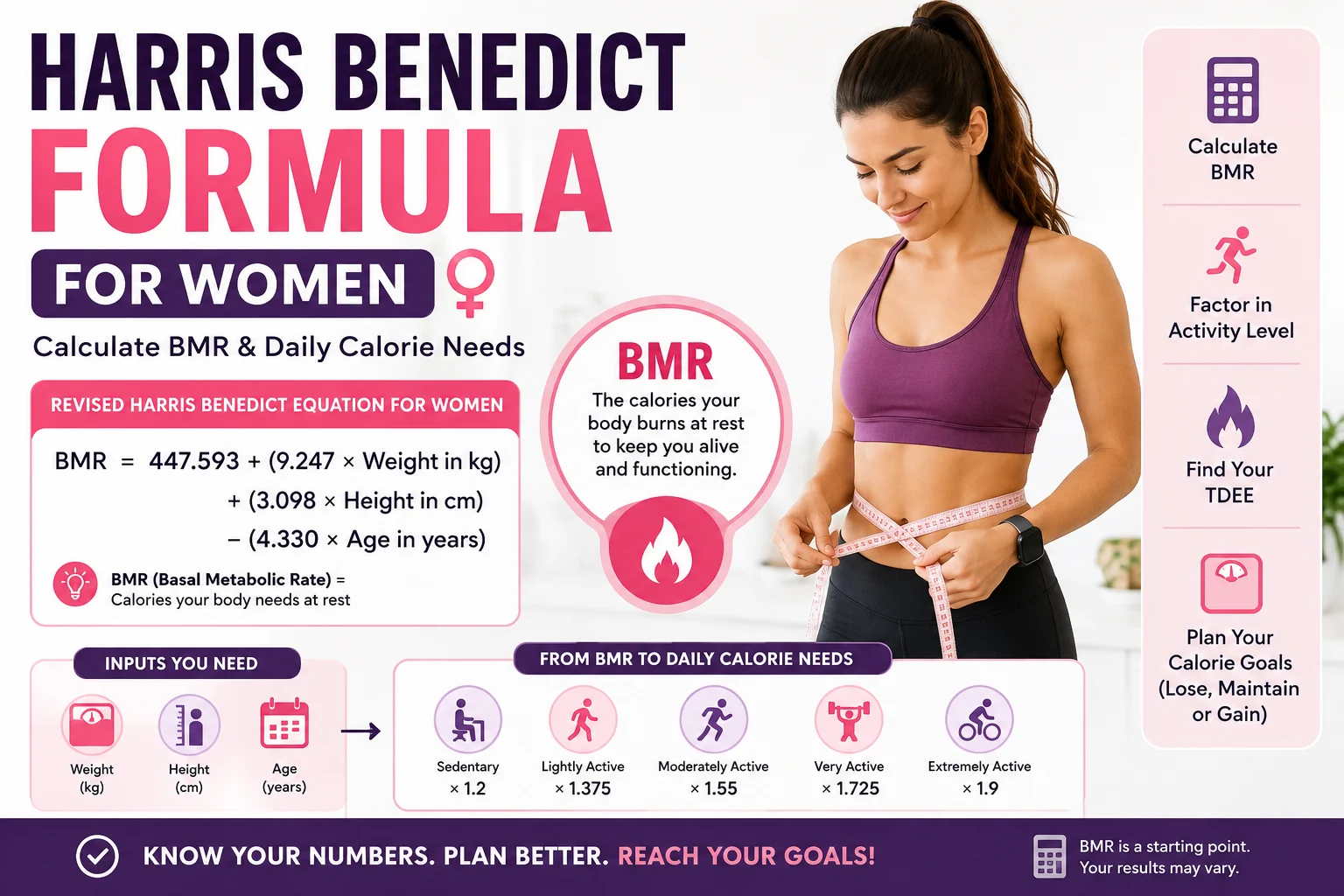
Have you ever wondered how many calories your body needs even when you spend the whole day resting? Your body still uses energy to breathe, pump blood, maintain body temperature, and support your organs. This basic energy need is called your Basal Metabolic Rate (BMR).
The Harris Benedict Formula for Women provides a way to estimate this number using your age, weight, and height. Once you know your BMR, you can combine it with your activity level to estimate your Total Daily Energy Expenditure (TDEE).
This guide explains the female Harris Benedict equation, shows how to calculate BMR, compares the original and revised formulas, and explains how BMR relates to daily calorie needs, weight loss, and weight maintenance.
Quick Answer: The Harris Benedict Formula for Women estimates a woman’s Basal Metabolic Rate (BMR) from her age, weight, and height. Your BMR can then be adjusted for physical activity to estimate your daily calorie requirements.
What Is the Harris Benedict Formula for Women?
The Harris Benedict Formula for Women is a mathematical equation used to estimate a woman’s Basal Metabolic Rate.
BMR represents the approximate amount of energy your body uses at rest to support essential functions. These functions include:
- Breathing
- Blood circulation
- Organ function
- Maintaining body temperature
- Basic cellular activity
Your body needs this energy even when you aren’t exercising.
The equation uses three main personal measurements:
- Age
- Body weight
- Height
The result is an estimated number of calories your body needs under resting conditions.
It is important to understand that BMR is not the same as the number of calories you should eat every day. Your actual daily energy expenditure is usually higher because you move, work, exercise, digest food, and perform normal daily activities.
What Is BMR for Women?
Basal Metabolic Rate (BMR) is the estimated amount of energy your body requires to maintain basic physiological functions while at rest.
For example, imagine a woman has a BMR of 1,400 calories per day. This does not mean she should eat only 1,400 calories.
Her body also uses energy when she:
- Walks around the house
- Goes to work
- Exercises
- Shops
- Climbs stairs
- Cooks
- Cleans
- Digests food
These activities increase her total energy expenditure.
This is why a BMR calculator for women is usually the first step rather than the final calorie calculation.
Harris Benedict Formula for Women
There are two commonly discussed versions of the Harris Benedict equation: the original equation and the revised Harris Benedict equation.
The original female equation is:
BMR = 655.0955 + (9.5634 × weight in kg) + (1.8496 × height in cm) − (4.6756 × age in years)
This formula produces an estimated BMR in calories per day.
Example
Suppose a woman is:
- 30 years old
- 60 kg
- 165 cm tall
Using the original Harris Benedict equation:
BMR = 655.0955 + (9.5634 × 60) + (1.8496 × 165) − (4.6756 × 30)
The estimated BMR is approximately 1,389 calories per day.
This means her estimated resting energy requirement is around 1,389 calories per day.
Revised Harris Benedict Equation for Women
The revised Harris Benedict equation uses updated coefficients.
For women, the revised equation is:
BMR = 447.593 + (9.247 × weight in kg) + (3.098 × height in cm) − (4.330 × age in years)
Using the same example:
- Age: 30
- Weight: 60 kg
- Height: 165 cm
The estimated BMR is approximately 1,391 calories per day.
The two versions can produce slightly different results because they use different coefficients.
For modern calorie estimation, it is useful to specify which version of the Harris Benedict equation for women you are using.
How to Calculate BMR for Women
Calculating female BMR is straightforward when you have the required measurements.
Step 1: Measure Your Weight
Enter your weight in kilograms if you’re using the metric version of the equation.
If you know your weight in pounds, convert it to kilograms first.
1 kilogram = 2.205 pounds
For example:
132 lb ÷ 2.205 = about 59.9 kg
Step 2: Measure Your Height
Enter your height in centimeters.
For example:
5 feet 5 inches = about 165 cm
Step 3: Enter Your Age
Use your current age in complete years.
Step 4: Apply the Formula
Put your weight, height, and age into the female Harris Benedict equation.
Step 5: Interpret the Result
The result represents your estimated basal metabolic rate, not your complete daily calorie requirement.
BMR Calculator for Women: What Information Do You Need?
A typical female BMR calculator needs only a few pieces of information.
| Information | Example |
|---|---|
| Sex | Female |
| Age | 30 years |
| Weight | 60 kg |
| Height | 165 cm |
| Formula | Harris Benedict |
| Estimated BMR | ~1,391 calories/day |
The calculator performs the mathematical steps automatically.
This makes a BMR calculator for women useful when you want a quick estimate without manually applying the equation.
What Does a Woman’s BMR Tell You?
Your BMR gives you a starting point for understanding your energy needs.
A higher or lower BMR does not automatically mean that your metabolism is healthy or unhealthy. BMR varies between individuals because bodies differ in size, composition, age, and other factors.
For example, two women of the same age can have different BMR values if their height and weight differ.
Your BMR can therefore help provide context for your overall calorie requirements.
Harris Benedict Formula for Women by Age
Age is one of the variables included in the equation.
As age increases, the estimated BMR from the equation generally decreases when other factors remain constant.
Consider two women with the same height and weight but different ages. The older woman will generally receive a lower BMR estimate from the Harris Benedict equation.
However, age is only one factor.
Body size and composition also influence energy expenditure. Therefore, you should not compare your BMR with another person’s BMR without considering the underlying measurements.
Harris Benedict Formula for Women by Weight
Body weight is another major component of the calculation.
When height and age remain constant, a higher body weight generally produces a higher estimated BMR using the Harris Benedict formula.
For example, a woman weighing 70 kg will usually have a higher calculated BMR than a woman weighing 55 kg if their age and height are identical.
However, body weight alone does not describe body composition.
Two women can have the same body weight while having different amounts of muscle and fat. This can affect actual energy expenditure.
Harris Benedict Formula for Women by Height
Height also appears directly in the equation.
A taller woman will generally have a higher estimated BMR than a shorter woman when age and weight are otherwise the same.
This happens because body size is related to the amount of energy required to support the body.
That’s why a BMR calculation for females should use accurate height and weight measurements.
BMR vs. TDEE for Women
One of the most important concepts to understand is the difference between BMR and TDEE.
BMR estimates energy used for basic functions at rest.
TDEE estimates your total daily energy expenditure after accounting for physical activity and other daily energy demands.
A simplified relationship is:
TDEE ≈ BMR × Activity Factor
Common activity categories include:
| Activity Level | Typical Description | Approximate Factor |
|---|---|---|
| Sedentary | Little exercise | 1.2 |
| Lightly active | Light exercise or activity | 1.375 |
| Moderately active | Moderate exercise | 1.55 |
| Very active | Hard exercise or active lifestyle | 1.725 |
| Extremely active | Very high physical activity | 1.9 |
These factors are estimates, not exact measurements.
Example TDEE Calculation
Suppose the woman’s BMR is approximately 1,391 calories.
If she is moderately active:
TDEE = 1,391 × 1.55
TDEE ≈ 2,156 calories per day
This means her estimated total daily energy expenditure is around 2,156 calories.
Her actual calorie needs can be higher or lower.
Daily Calorie Needs for Women
Your daily calorie needs depend on much more than BMR.
Your energy expenditure can include:
- Basal metabolism
- Physical activity
- Exercise
- Digestion
- Normal daily movement
- Other physiological processes
Therefore, your daily calorie requirements should be estimated from your overall activity and goals rather than your BMR alone.
A woman with a sedentary lifestyle may need considerably fewer calories than an equally sized woman who exercises frequently.
Harris Benedict Formula for Weight Loss
Many people use the Harris Benedict calorie calculator as part of a weight management plan.
The basic process is:
Calculate BMR → Estimate TDEE → Set an appropriate calorie target
For example, if estimated TDEE is about 2,150 calories, someone seeking weight loss might choose a moderate calorie deficit rather than simply eating at their BMR.
The size of a suitable calorie deficit depends on individual circumstances.
A very aggressive restriction is not automatically better. Sustainable weight management generally focuses on an appropriate calorie intake, adequate nutrition, physical activity, and long-term consistency.
Harris Benedict Formula for Weight Gain
The same approach can be used when someone wants to gain weight.
First estimate BMR.
Then estimate TDEE.
After that, a person may consume more calories than their estimated expenditure.
A calorie surplus can support weight gain when combined with appropriate nutrition and, where suitable, resistance training.
The exact amount should be individualized.
Original vs Revised Harris Benedict Formula
Both versions estimate BMR, but their coefficients differ.
| Feature | Original Formula | Revised Formula |
|---|---|---|
| Female BMR | Yes | Yes |
| Uses age | Yes | Yes |
| Uses weight | Yes | Yes |
| Uses height | Yes | Yes |
| Result | Estimated BMR | Estimated BMR |
| Coefficients | Original | Updated |
If you’re building a calculator or writing an article, clearly state which equation you’re using.
This prevents confusion when users compare their result with another calculator.
Harris Benedict vs. Other BMR Formulas
The Harris Benedict equation is not the only method available for estimating BMR.
Another widely used approach is the Mifflin St Jeor equation.
Different equations can produce different estimates for the same person because they were developed using different datasets and mathematical coefficients.
This does not necessarily mean one calculator is “wrong.”
It means the results are estimates.
For practical calorie planning, the calculated number should be treated as a starting point rather than an exact measurement of your metabolism.
Why Your Calculated BMR May Not Be Exact
A mathematical formula cannot capture every factor that affects an individual’s actual energy expenditure.
Your real energy needs can vary because of factors such as:
- Body composition
- Muscle mass
- Genetics
- Hormonal factors
- Physical activity
- Health status
- Environmental conditions
- Changes in body weight
The Harris Benedict formula therefore provides an estimated basal metabolic rate.
It should not be interpreted as a laboratory measurement.
Common Mistakes When Using a Female BMR Calculator
Using Pounds Instead of Kilograms
The metric Harris Benedict equation expects weight in kilograms.
Entering pounds directly can produce a major error.
Using Inches Instead of Centimeters
Height should be converted to centimeters when using the metric equation.
Confusing BMR With TDEE
Your BMR is not your complete daily calorie requirement.
Activity needs to be considered separately.
Assuming the Result Is Exact
A calculator provides an estimate.
Your actual energy expenditure can differ.
Using the Wrong Formula
Different BMR equations use different coefficients.
Always check whether you’re using the original or revised Harris Benedict equation.
Harris Benedict Formula for Women in Pounds and Inches
Some users prefer US measurements.
The female Harris Benedict formula can also be represented using pounds and inches.
For the original equation:
BMR = 655.0955 + (4.35 × weight in lb) + (4.7 × height in inches) − (4.7 × age)
For the revised equation:
BMR = 447.593 + (4.337 × weight in lb) + (4.799 × height in inches) − (4.330 × age)
Using the correct units is essential.
If you use a formula designed for kilograms and centimeters, don’t enter pounds and inches without conversion.
How Accurate Is the Harris Benedict Formula for Women?
The Harris Benedict equation can provide a useful estimate of BMR, but it cannot determine your exact metabolic rate.
Individual results can differ from calculated estimates.
For this reason, the equation works best as a starting point for calorie planning.
You can then observe changes in body weight, activity, and energy levels over time and adjust your calorie intake when appropriate.
If you have a medical condition, are pregnant or breastfeeding, or have specific nutritional needs, it’s better to discuss calorie requirements with a qualified healthcare professional.
Harris Benedict Formula and Weight Management
Understanding BMR can make calorie planning easier.
Instead of guessing your calorie needs, you can follow a structured process:
- Calculate your BMR.
- Identify your activity level.
- Estimate your TDEE.
- Consider your goal.
- Set a reasonable calorie target.
- Monitor your progress.
- Adjust your plan when needed.
This approach gives you a more useful picture than looking at BMR alone.
Frequently Asked Questions
The Harris Benedict Formula for Women is a mathematical equation that estimates a woman’s Basal Metabolic Rate using age, weight, and height.
There is no single normal BMR for every woman. BMR varies with age, height, weight, body composition, and other individual factors.
Enter your age, weight, and height into the female Harris Benedict equation. Make sure you use the correct measurement units.
It provides an estimate rather than an exact measurement. Individual energy expenditure can differ from the calculated value.
Not necessarily. BMR represents basic resting energy expenditure. Your total daily calorie needs are usually higher because you also move and perform daily activities.
BMR estimates calories needed for basic body functions at rest. TDEE estimates total daily energy expenditure after accounting for activity and other energy demands.
You should identify whether your calculator uses the original or revised equation. Both are versions of the Harris Benedict method, but their coefficients differ.
Yes. BMR can provide a starting point for estimating TDEE and creating a calorie plan. However, BMR alone does not determine an appropriate weight loss diet.
Final Takeaway
The Harris Benedict Formula for Women is a practical method for estimating female Basal Metabolic Rate from age, weight, and height.
The calculation gives you an estimated resting calorie requirement. You can then multiply your BMR by an activity factor to estimate TDEE and better understand your daily calorie needs.
Remember the basic pathway:
BMR → Activity Level → TDEE → Calorie Target
Whether your goal is weight loss, weight gain, or weight maintenance, the Harris Benedict equation can provide a useful starting estimate. However, the result is not a precise measurement of your metabolism.
For the most useful results, use accurate measurements, choose the correct equation, understand your activity level, and treat the final calorie number as an estimate rather than an absolute limit.
2 thoughts on “Harris Benedict Formula for Women | Calculate BMR and Daily Calorie Needs”