Have you ever calculated your BMI and then wondered, “Okay, but how many calories should I eat?” You’re not alone.
Many people search for calorie intake according to BMI because they want a simple number for weight loss, weight gain, or maintaining their current weight. But there’s an important detail to understand first: BMI does not directly determine your calorie needs.
BMI mainly compares your weight with your height. Your actual daily calorie needs also depend on your age, sex, height, weight, and physical activity level.
In this guide, you’ll learn how BMI and calorie intake are connected, how BMR and TDEE affect your calorie requirement, and how to estimate calories for weight loss, maintenance, or weight gain.
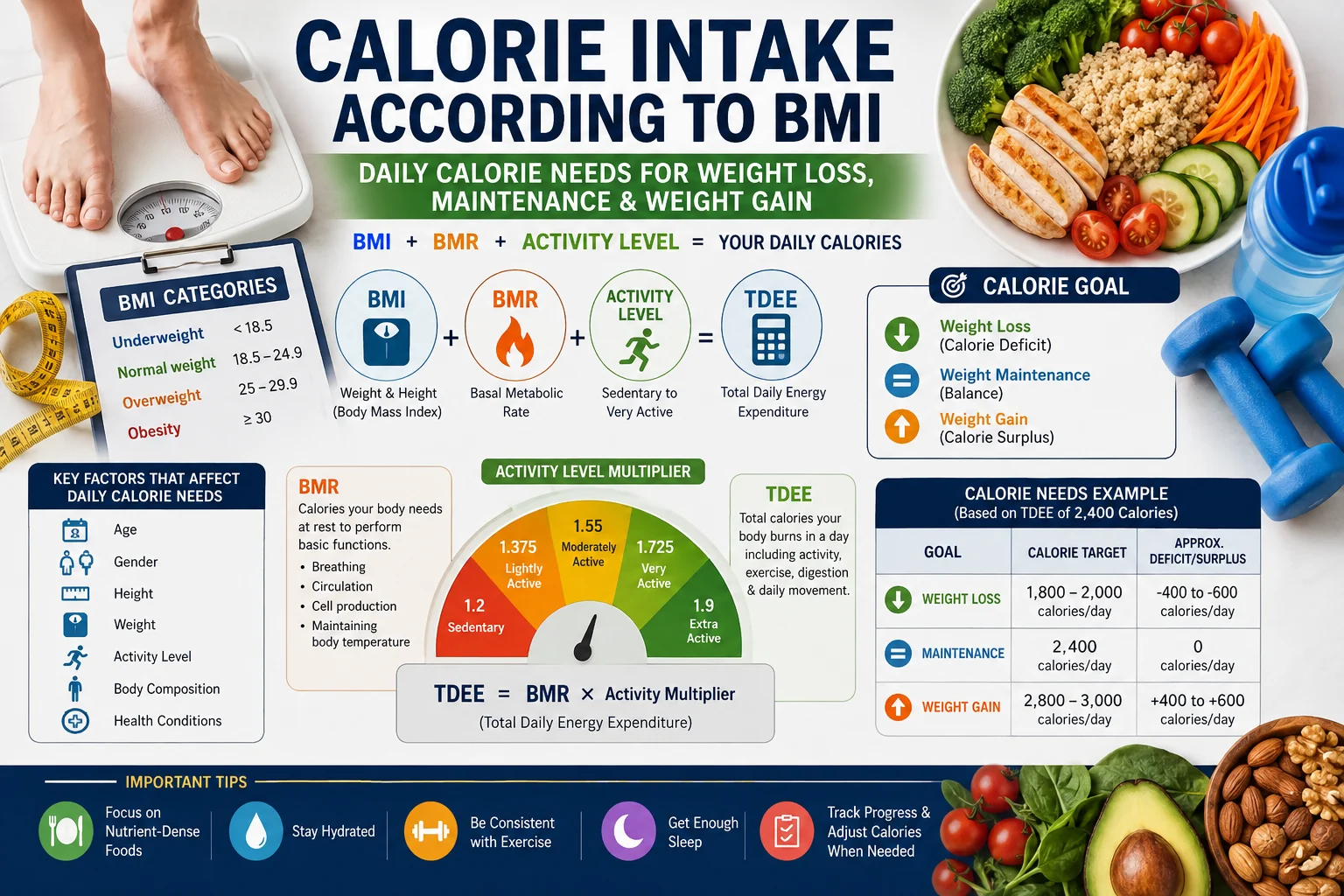
Quick Answer: Your BMI can help provide context for your weight, but it cannot determine your exact calorie intake. For a better estimate, calculate your BMR, factor in your activity level to estimate TDEE, and then adjust calories based on your weight goal.
What Does Calorie Intake According to BMI Mean?
Calorie intake according to BMI means estimating how many calories you should consume based on your BMI and other factors.
BMI, or Body Mass Index, is a screening measure based on your weight and height. It can place an adult into categories such as underweight, normal weight, overweight, or obesity.
However, BMI doesn’t tell you how much energy your body uses each day.
For example, two people can have the same BMI but need different amounts of food.
One person might be 25 years old and highly active. Another might be 55 and mostly sedentary. Their calorie needs can differ significantly.
That’s why a proper calorie intake based on BMI should also consider:
- Age
- Sex
- Height
- Weight
- Physical activity
- Weight goal
- Current energy expenditure
So, think of BMI as one piece of the puzzle, not the complete calorie calculator.
Does BMI Determine How Many Calories You Need?
No. BMI does not directly determine how many calories you need.
BMI is calculated from weight and height. It doesn’t directly measure metabolism, muscle mass, daily activity, or energy expenditure.
Your calorie requirement depends more closely on how much energy your body uses.
A useful process looks like this:
BMI → Weight category → BMR → Activity level → TDEE → Calorie target
Your BMR, or basal metabolic rate, estimates the energy your body needs for basic functions at rest.
Your TDEE, or total daily energy expenditure, estimates your overall daily energy use after accounting for activity.
This makes BMR and TDEE much more useful for estimating daily calorie intake.
Example
Imagine two adults have a similar BMI.
- Person A exercises five days a week.
- Person B spends most of the day sitting.
Person A may need considerably more calories because their activity level increases their total energy expenditure.
Therefore, simply using a BMI calorie chart may give you a rough starting point, but it shouldn’t be treated as a personalized prescription.
How to Calculate Calorie Intake From BMI
If you want to understand how to calculate calorie intake from BMI, use BMI as a starting point rather than the final calculation.
Step 1: Calculate Your BMI
BMI uses your body weight and height.
For adults using metric measurements:
BMI = weight in kilograms ÷ height in meters²
For example, if someone weighs 70 kg and is 1.75 m tall:
BMI = 70 ÷ (1.75 × 1.75) = 22.9
That falls within the commonly used normal-weight BMI range for adults.
Step 2: Estimate Your BMR
Your basal metabolic rate represents the approximate energy your body uses for basic functions while at rest.
BMR calculations commonly use factors such as:
- Age
- Sex
- Weight
- Height
Step 3: Estimate Your TDEE
Next, your BMR is adjusted according to your activity level.
This gives you an estimate of total daily energy expenditure.
Your TDEE can include energy used through:
- Resting metabolism
- Walking
- Exercise
- Work activities
- Digestion
- Normal daily movement
Step 4: Adjust for Your Goal
Your estimated TDEE becomes a useful starting point for deciding your calorie target.
For example:
| Goal | General approach |
|---|---|
| Maintain weight | Eat around estimated maintenance calories |
| Lose weight | Create a sustainable calorie deficit |
| Gain weight | Create a controlled calorie surplus |
This approach is more useful than trying to calculate calories from BMI alone.
BMI and Calorie Intake: What Is the Connection?
The connection between BMI and calorie intake is mainly about body weight and energy balance.
BMI can indicate whether your weight falls into a particular screening category. Your calorie intake influences whether your body weight tends to increase, decrease, or remain stable over time.
- If you consistently consume more energy than you use, body weight may increase.
- If you consistently consume less energy than you use, body weight may decrease.
- If intake and expenditure are roughly balanced, body weight may remain relatively stable.
This is the basic idea behind energy balance.
However, real-world weight change is more complicated. Metabolism, body composition, activity, appetite, medications, sleep, and other factors can affect the outcome.
Daily Calorie Needs Based on BMI
People often search for daily calorie needs based on BMI, but there isn’t one universal number for each BMI category.
For example, saying:
“BMI 25 means you need exactly 2,000 calories.”
would be misleading.
A person with that BMI could have very different calorie needs depending on their body size, age, sex, and activity.
Instead, use BMI to understand your current weight category, then estimate your calorie needs using BMR and TDEE.
Factors That Affect Daily Calorie Needs
Your daily calorie requirement can change based on:
- Age: Energy needs often change as people get older.
- Sex: Average energy requirements can differ between males and females.
- Height: Taller bodies generally require more energy.
- Weight: Body size influences energy expenditure.
- Activity level: Exercise and movement can substantially change calorie needs.
- Body composition: Muscle and fat tissue have different metabolic demands.
- Weight goal: Losing, maintaining, and gaining weight require different strategies.
That’s why a calorie calculator based on BMI should ideally ask for more than BMI.
Calories Based on BMI and Weight
Your calories based on BMI and weight should not be calculated from BMI alone.
BMI itself is derived from your weight and height. Once you know those measurements, you can use them alongside age, sex, and activity level to estimate your energy needs.
For example, someone who weighs 90 kg may have very different calorie needs from another 90 kg person.
Why?
Their:
- Height may differ.
- Age may differ.
- Sex may differ.
- Muscle mass may differ.
- Activity level may differ.
Therefore, calories needed based on BMI are better viewed as an estimate that requires additional personal information.
BMI Calorie Calculator: What Information Should It Use?
A useful BMI calorie calculator should ideally combine BMI information with a calorie needs calculation.
At minimum, it should consider:
| Information | Why it matters |
|---|---|
| Weight | Helps estimate energy requirements |
| Height | Used for BMI and BMR calculations |
| Age | Influences estimated metabolism |
| Sex | Used in common BMR equations |
| Activity level | Helps estimate TDEE |
| Goal | Helps establish a calorie target |
A BMI calorie calculator for adults can therefore provide more meaningful results when it connects BMI with BMR and TDEE.
Recommended Calorie Intake by BMI Category
There is no scientifically appropriate single calorie number for every BMI category.
Still, BMI categories can provide useful context.
Underweight BMI
If your BMI is below the commonly used healthy range, your goal may be weight gain rather than weight loss.
Your calorie target should support gradual weight gain while emphasizing nutrient-dense foods.
If you’re unintentionally losing weight or struggling to gain weight, it’s worth discussing the issue with a healthcare professional.
Normal BMI
A normal BMI does not automatically mean you need a specific number of calories.
Your maintenance calories still depend on your personal characteristics and activity level.
The goal is usually to maintain adequate nutrition and match energy intake with your body’s needs.
Overweight BMI
Someone with an overweight BMI may be interested in calories for weight loss.
A sustainable calorie deficit can support gradual weight loss.
However, the appropriate calorie target depends on your estimated TDEE and individual circumstances.
Obesity BMI
People with an obesity-range BMI may also consider weight loss.
But aggressive calorie restriction isn’t automatically better.
A sustainable approach should consider nutrition quality, physical activity, medical conditions, medications, and professional guidance when appropriate.
Calorie Intake for Weight Loss Based on BMI
One of the most common searches is calories to lose weight based on BMI.
But the correct approach is not:
BMI → fixed calorie number
Instead, think:
BMI → BMR → TDEE → calorie deficit → weight-loss target
If your estimated TDEE is your approximate maintenance level, consuming fewer calories than your TDEE creates a calorie deficit.
Over time, this can contribute to weight loss.
However, your calorie needs can change as your weight changes. Your body may also adapt to a prolonged calorie deficit.
That’s why weight loss isn’t always perfectly linear.
What Makes a Good Weight-Loss Calorie Plan?
A useful plan should focus on:
- A sustainable calorie deficit
- Adequate protein
- Fruits and vegetables
- Whole grains and other nutrient-rich carbohydrates
- Healthy fat sources
- Adequate hydration
- Regular physical activity
- Sufficient sleep
The objective isn’t simply to eat as little as possible.
It’s to create a sustainable energy deficit while supporting good nutrition.
Calorie Deficit Based on BMI
A calorie deficit based on BMI should be personalized.
BMI doesn’t tell you how large your calorie deficit should be.
Instead, your estimated maintenance calories provide a better reference point.
For example, if your estimated maintenance intake is 2,400 calories, reducing intake moderately could create a deficit.
But the appropriate target depends on the individual.
Very low-calorie diets can create nutritional problems and may not be suitable for everyone. People with certain medical conditions, children, teenagers, pregnant people, and others may need specific professional guidance.
Calories to Maintain Weight Based on BMI
If your goal is weight maintenance, you’re looking for your approximate maintenance calories.
These are closely related to your TDEE.
The basic concept is:
Maintenance calories ≈ TDEE
If your energy intake and expenditure remain relatively balanced, your weight may remain stable over time.
However, maintenance isn’t a fixed number forever.
Your calorie needs can change when you:
- Gain or lose weight
- Become more active
- Become less active
- Age
- Change your exercise routine
- Experience changes in body composition
Therefore, calories to maintain weight should be viewed as an estimate rather than an exact permanent number.
Calories to Gain Weight According to BMI
People with a low BMI may search for calories to gain weight.
Weight gain generally requires a sustained calorie surplus.
That means consuming more energy than your body uses.
A calorie surplus calculator can provide an estimated starting point, but food quality still matters.
Instead of relying heavily on highly processed foods, consider nutrient-dense options such as:
- Eggs
- Dairy or suitable alternatives
- Nuts and nut butters
- Seeds
- Beans
- Whole grains
- Lean meats
- Fish
- Avocado
- Fruits
- Vegetables
If you have unexplained weight loss or difficulty gaining weight, seek medical advice rather than relying only on a calorie calculator.
BMR and Calorie Intake
Your BMR and calorie intake are closely connected.
BMR represents the energy your body needs for essential functions when you’re at rest.
These functions include processes such as:
- Breathing
- Circulation
- Maintaining body temperature
- Supporting organs
- Basic cellular activity
But BMR isn’t your total daily calorie requirement.
You still use energy through normal movement and physical activity.
That’s why BMR is usually used as the starting point for estimating TDEE.
TDEE and BMI
TDEE and BMI serve different purposes.
BMI helps classify weight relative to height.
TDEE estimates how much energy you use throughout an average day.
This distinction is important.
BMI answers:
“How does my weight compare with my height?”
TDEE answers:
“Approximately how much energy do I use each day?”
When you’re trying to determine daily calorie needs, TDEE is generally more directly relevant than BMI.
How Activity Level Changes Your Calorie Requirement
Your activity level can have a major effect on your calorie needs.
Someone who exercises regularly may use considerably more energy than someone with a sedentary routine.
Common activity categories include:
- Sedentary
- Lightly active
- Moderately active
- Very active
Your activity level helps turn your BMR estimate into a TDEE estimate.
For example, someone with a physically demanding job may have substantially higher daily energy expenditure than someone who works at a desk.
This is why calorie intake based on age, height, weight, and activity level is more useful than BMI alone.
Calories Based on Age and BMI
Your calories based on age and BMI can vary considerably.
Age is important because estimated energy expenditure can change over a person’s lifetime.
Two people with the same BMI may therefore have different calorie requirements if their ages differ significantly.
This is another reason a simple BMI calorie chart cannot provide a personalized calorie target.
Use BMI for weight classification and use BMR and TDEE to estimate energy needs.
Calories Based on Height and Weight
Height and weight are important inputs for both BMI and calorie calculations.
However, calories based on height and weight still aren’t complete without other information.
Consider two people who are both 175 cm tall and weigh 75 kg.
If one is highly active and the other is sedentary, their daily calorie needs can differ.
Adding age, sex, and activity level makes the estimate more useful.
Daily Calorie Needs for Men & Women
People often search for daily calorie needs for men and daily calorie needs for women.
There isn’t one calorie number that applies to everyone within either group.
For example, a physically active young man may need substantially more energy than an older sedentary man.
The same applies to women.
A person’s calorie needs depend on:
- Age
- Height
- Weight
- Activity
- Body composition
- Individual metabolism
Therefore, sex is one input in the calculation, not the complete answer.
BMI and Energy Balance
Energy balance is central to understanding calorie intake.
Your body receives energy from food and beverages.
It uses energy for basic metabolism, physical activity, digestion, and other physiological processes.
When intake and expenditure differ over time, body weight can change.
However, energy balance isn’t simply a calculator equation that works identically every day.
Your body can adapt to changes in food intake and activity.
That’s why calorie estimates should be used as starting points, then evaluated against real-world progress.
Common Mistakes When Using BMI for Calories
1. Treating BMI as a calorie calculator
BMI isn’t designed to tell you your daily calorie requirement.
2. Ignoring activity
Two people with the same BMI can have very different energy needs because of their lifestyles.
3. Using one calorie number forever
Your calorie needs can change as your body weight and activity change.
4. Focusing only on calories
Food quality also matters.
Two diets with the same calorie intake can have very different nutritional profiles.
5. Choosing an extreme deficit
Eating dramatically fewer calories isn’t automatically a better weight-loss strategy.
6. Ignoring individual circumstances
Medical conditions, medications, pregnancy, age, eating disorders, and other factors can affect appropriate nutrition strategies.
BMI vs BMR vs TDEE
Understanding the difference between these terms makes calorie calculations much easier.
| Measure | What it tells you |
|---|---|
| BMI | Weight relative to height |
| BMR | Estimated energy needed at rest |
| TDEE | Estimated total daily energy expenditure |
| Maintenance calories | Approximate calories needed to maintain weight |
| Calorie deficit | Eating below energy expenditure |
| Calorie surplus | Eating above energy expenditure |
The most important point is simple:
BMI describes weight status. BMR estimates resting energy needs. TDEE estimates total energy needs.
Frequently Asked Questions
You can’t determine an exact calorie target from BMI alone. Use your age, sex, height, weight, and activity level to estimate BMR and TDEE, then adjust your intake according to your goal.
You can use BMI as part of the overall assessment, but BMI itself doesn’t calculate calorie needs. A better approach combines BMI with BMR and TDEE.
There is no single calorie intake for people with a normal BMI. Calorie needs depend on individual characteristics and activity level.
Your BMI can provide weight-related context, but your estimated TDEE is a better starting point for setting a calorie deficit. The appropriate deficit varies between individuals.
Not necessarily. Calorie requirements depend on several factors, including body size, age, sex, activity, and body composition.
The most useful calculator should combine BMI with BMR and TDEE rather than attempting to assign calories from BMI alone.
Your maintenance calories are approximately related to your TDEE. Your actual maintenance level can vary and should be adjusted based on your weight trend and activity.
BMI can be used as a screening measure, but it doesn’t provide a complete assessment of health. Factors such as body composition, medical history, and other health measurements also matter.
Final Takeaway
The idea of calorie intake according to BMI sounds simple, but BMI alone isn’t enough to determine how many calories you should eat.
A better approach is to use BMI to understand your weight relative to height, then estimate your BMR and TDEE using your age, sex, height, weight, and activity level.
From there, your goal determines the next step:
- Weight maintenance: Aim around your estimated maintenance calories.
- Weight loss: Use a sustainable calorie deficit.
- Weight gain: Use a controlled calorie surplus.
- Healthy nutrition: Focus on food quality as well as calories.
In short, BMI provides context, while BMR and TDEE provide a better foundation for estimating calorie needs. Use calorie calculations as estimates rather than exact numbers, and consider professional guidance when your nutritional needs are affected by a medical or other special circumstance.
2 thoughts on “Calorie Intake According to BMI: Daily Calorie Needs”