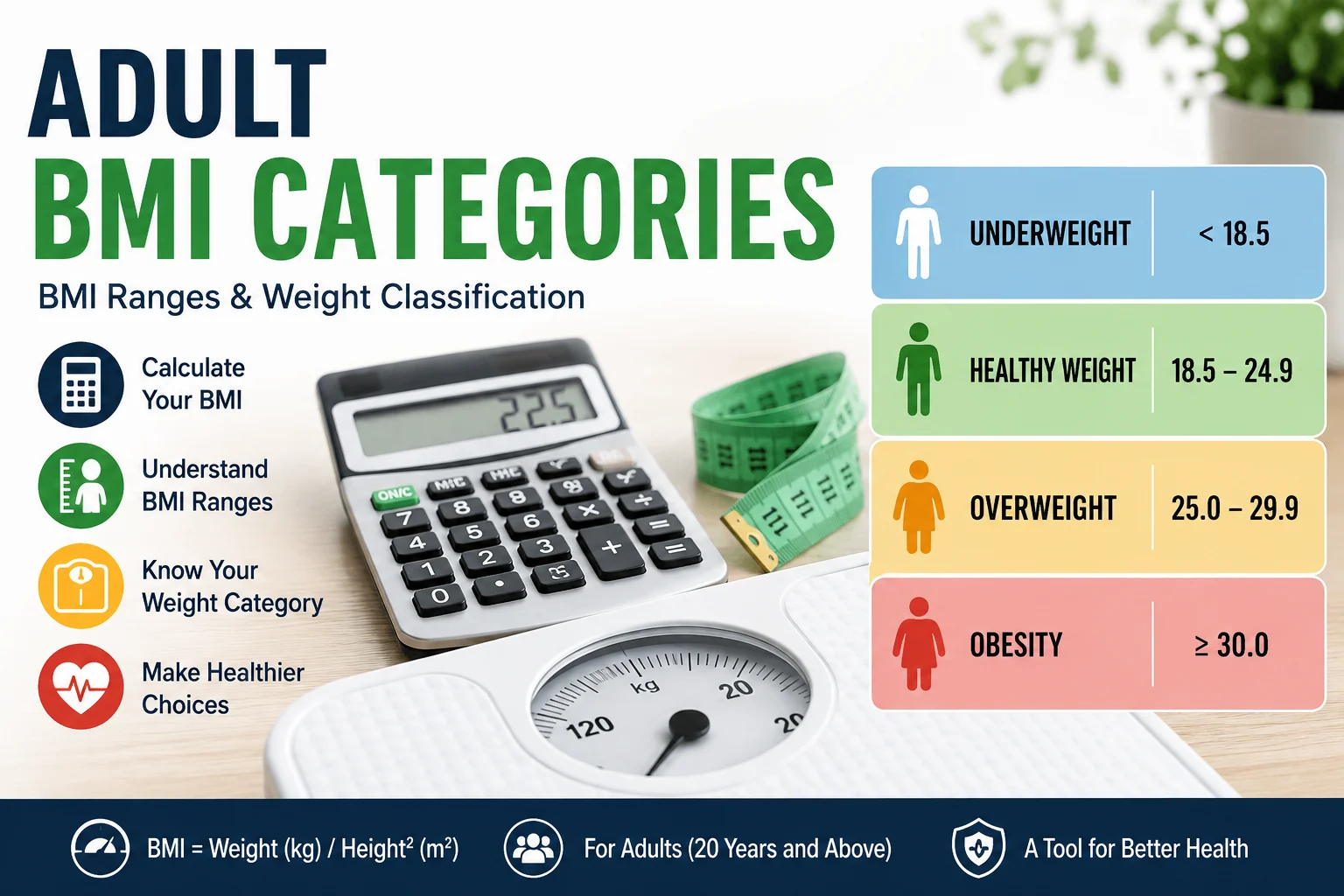
Body Mass Index (BMI) is a commonly used measurement for assessing weight in relation to height. Adult BMI categories help classify whether an adult is underweight, within the healthy weight range, overweight, or living with obesity.
Although BMI is not a direct measurement of body fat or overall health, it is widely used as a screening tool to identify potential weight-related health risks.
What Is BMI?
BMI, or Body Mass Index, is a numerical value calculated using a person’s weight and height.
For adults, BMI is calculated using:
BMI = weight (kg) ÷ height² (m²)
For example, if someone weighs 70 kg and is 1.75 meters tall:
BMI = 70 ÷ (1.75 × 1.75) = 22.9
A BMI of 22.9 falls within the healthy-weight category for adults.
For people using pounds and inches, the formula is:
BMI = [weight (lb) ÷ height² (in²)] × 703
A BMI calculator can perform this calculation automatically.
Adult BMI Categories
For most adults, BMI is classified into four primary categories:
| BMI | Adult weight category |
|---|---|
| Below 18.5 | Underweight |
| 18.5–24.9 | Healthy weight |
| 25.0–29.9 | Overweight |
| 30.0 or higher | Obesity |
These ranges are commonly used for adults and provide a standardized way to describe weight status.
1. Underweight: BMI Below 18.5
An adult with a BMI below 18.5 is generally classified as underweight.
A low BMI can sometimes be associated with inadequate nutrition, unintended weight loss, certain medical conditions, or other factors. However, BMI alone cannot determine why a person’s weight is low.
If someone has experienced unexplained or significant weight loss, discussing it with a healthcare professional may be appropriate.
2. Healthy Weight: BMI 18.5–24.9
A BMI from 18.5 through 24.9 is generally categorized as healthy weight for adults.
This range is associated with a lower risk of some weight-related health conditions compared with higher BMI categories. However, being within this range does not automatically mean that a person is healthy.
Other factors—including diet, physical activity, blood pressure, cholesterol, smoking, family history, and existing medical conditions—also influence health.
3. Overweight: BMI 25.0–29.9
Adults with a BMI from 25.0 through 29.9 are generally classified as overweight.
Being overweight can be associated with an increased risk of conditions such as cardiovascular disease, type 2 diabetes, and high blood pressure.
However, BMI does not distinguish between muscle, bone, and fat. A muscular person may therefore have a higher BMI without having excess body fat.
4. Obesity: BMI 30 or Higher
A BMI of 30 or higher falls within the obesity category.
Adult obesity is further divided into classes:
| BMI | Obesity classification |
|---|---|
| 30.0–34.9 | Class 1 obesity |
| 35.0–39.9 | Class 2 obesity |
| 40.0 or higher | Class 3 obesity |
These classifications help healthcare professionals describe the degree of obesity and assess potential health risks.
Adult BMI Chart
A simple adult BMI chart can be summarized as follows:
Underweight
BMI < 18.5
Healthy weight
BMI 18.5–24.9
Overweight
BMI 25.0–29.9
Obesity
BMI ≥ 30.0
The category is determined by the calculated BMI value rather than by age alone for most adults.
How Is Adult BMI Calculated?
Calculating BMI requires only two measurements:
- Body weight
- Height
For metric measurements:
BMI = weight in kilograms ÷ height in meters squared
Example
Suppose an adult weighs 80 kg and is 1.80 m tall.
First, square the height:
1.80 × 1.80 = 3.24
Then divide weight by the squared height:
80 ÷ 3.24 = 24.7
The resulting BMI is approximately 24.7, which falls within the healthy-weight category.
What Do BMI Categories Mean?
BMI categories are primarily a screening classification, not a diagnosis.
A BMI number can help identify adults who may have a higher or lower risk of certain health conditions, but it cannot provide a complete assessment of an individual’s health.
For example, two people can have exactly the same BMI but very different:
- Body-fat percentages
- Muscle mass
- Fat distribution
- Fitness levels
- Diets
- Medical histories
- Metabolic health
Consequently, BMI should be interpreted alongside other health measurements.
BMI and Body Fat
One limitation of BMI is that it does not directly measure body fat.
BMI is based only on height and weight. It does not determine how much of a person’s weight comes from:
- Fat
- Muscle
- Bone
- Water
- Other body tissues
This is particularly important for athletes and people with substantial muscle mass. Someone with a high amount of muscle may have a BMI in the overweight or obesity range despite having relatively low body fat.
Conversely, someone can have a BMI within the healthy range while carrying a relatively high percentage of body fat.
BMI and Health Risks
Higher BMI categories can be associated with an increased likelihood of various health problems, including:
- Type 2 diabetes
- High blood pressure
- Cardiovascular disease
- Sleep apnea
- Certain types of cancer
- Joint problems
- Metabolic disorders
A low BMI may also indicate potential nutritional or health concerns in some individuals.
Importantly, BMI is not itself a diagnosis of disease. Health risks depend on numerous factors and can vary substantially between individuals.
BMI Is Different for Children and Teenagers
The adult BMI categories described above should not be used to classify children and teenagers.
For people under 20, BMI is interpreted using age- and sex-specific growth charts and percentiles because body composition changes substantially during childhood and adolescence.
Therefore, an adult BMI chart is intended for the appropriate adult population rather than children.
Do Adult BMI Categories Depend on Age?
For standard adult BMI classification, the same basic BMI thresholds are generally used across adulthood.
However, age can influence how BMI relates to health and body composition. As people age, muscle mass and fat distribution can change, meaning that the same BMI may have different implications for different individuals.
Therefore, age is useful when interpreting BMI in context, even though it does not normally change the standard adult BMI cutoff points.
BMI Categories for Men & Women
The standard adult BMI categories are generally the same for men & women:
- Below 18.5: underweight
- 18.5–24.9: healthy weight
- 25.0–29.9: overweight
- 30 or higher: obesity
However, men & women can have different body compositions at the same BMI. BMI therefore should not be interpreted as a precise measurement of body fat.
BMI Thresholds and Cutoff Points
The commonly used adult BMI thresholds are:
- 18.5 — lower boundary of the healthy-weight category
- 25.0 — beginning of the overweight category
- 30.0 — beginning of the obesity category
- 35.0 — beginning of Class 2 obesity
- 40.0 — beginning of Class 3 obesity
These cutoff points make it possible to categorize BMI consistently across large populations.
How Accurate Is BMI?
BMI is useful because it is:
- Simple to calculate
- Inexpensive
- Non-invasive
- Easy to standardize
- Useful for population-level research
- Helpful as an initial screening measure
But it also has limitations.
BMI does not directly account for:
- Muscle mass
- Body-fat percentage
- Fat distribution
- Bone density
- Ethnic or population differences
- Individual medical history
For this reason, BMI should be viewed as one measurement among several, rather than a complete measure of health.
Other Measurements Used With BMI
Healthcare professionals may consider additional measurements when assessing weight and health, such as:
Waist circumference
Waist circumference can provide information about abdominal fat, which is associated with metabolic and cardiovascular risk.
Blood pressure
High blood pressure can occur alongside excess body weight and is an important independent health indicator.
Blood glucose
Blood glucose or related testing can help evaluate metabolic health and diabetes risk.
Cholesterol
Cholesterol measurements provide additional information about cardiovascular risk.
Body composition
Methods such as bioelectrical impedance, skinfold measurements, or specialized scanning can provide additional information about body composition, although each method has its own limitations.
Frequently Asked Questions
A BMI from 18.5 to 24.9 is generally categorized as healthy weight for adults.
A BMI from 25.0 to 29.9 is generally classified as overweight for adults.
A BMI of 30 or higher falls within the obesity category for adults.
Yes. Under the commonly used adult classification, 25.0 marks the beginning of the overweight category.
Yes. A BMI of 30.0 marks the beginning of the obesity category.
The standard adult BMI cutoff categories are generally the same for men & women, although body composition can differ between individuals.
Yes. BMI is only a screening measure. A person can have a BMI in the healthy range and still have conditions or risk factors unrelated to their BMI.
Yes. For example, people with substantial muscle mass may have a high BMI without having excessive body fat. A person’s overall health should therefore not be determined from BMI alone.
Key Takeaways
Adult BMI categories provide a standardized method for classifying weight based on height and weight.
The commonly used categories are:
- Below 18.5: Underweight
- 18.5–24.9: Healthy weight
- 25.0–29.9: Overweight
- 30.0 or higher: Obesity
BMI is useful as a screening tool, but it does not directly measure body fat or provide a complete picture of health. For a meaningful assessment, BMI can be considered alongside waist circumference, blood pressure, blood glucose, cholesterol, body composition, lifestyle, and medical history.
If BMI is being used to make decisions about an individual’s health or weight, it is best interpreted in the context of that person’s overall health rather than as a standalone diagnosis.
1 thought on “Adult BMI Categories | Complete Guide to BMI Ranges and Weight Classification”