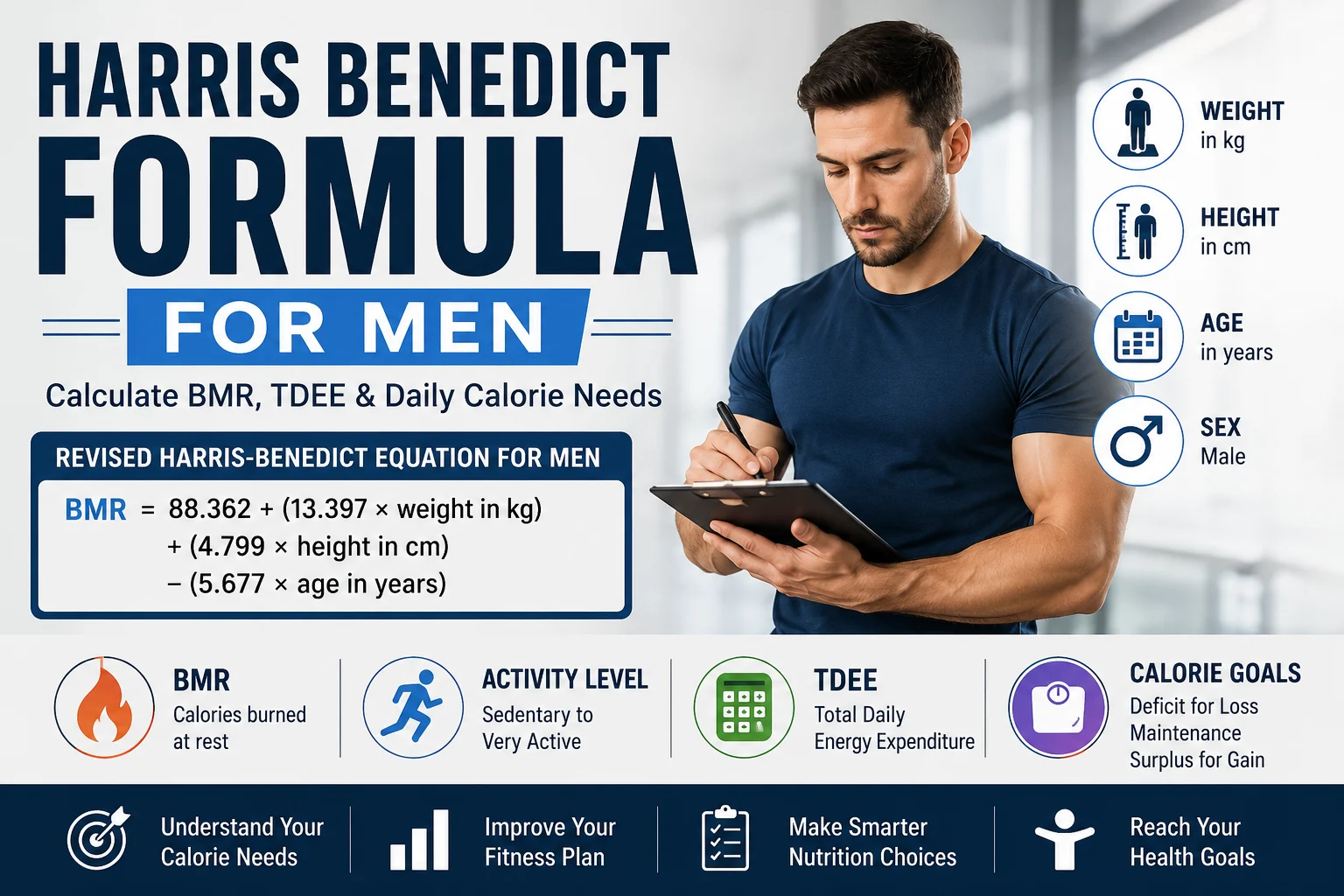
The Harris-Benedict Formula for Men is one of the most widely known methods for estimating a man’s Basal Metabolic Rate (BMR). BMR represents the approximate number of calories the body burns at rest to maintain essential functions such as breathing, circulation, temperature regulation, and organ function.
By calculating your BMR and then considering your activity level, you can estimate your Total Daily Energy Expenditure (TDEE) and better understand your daily calorie requirements.
Whether your goal is weight loss, weight maintenance, or weight gain, understanding your BMR and daily energy expenditure can provide a useful starting point for managing calorie intake.
What Is the Harris-Benedict Equation?
The Harris-Benedict Equation is a mathematical formula designed to estimate Basal Metabolic Rate from several basic personal measurements.
For men, the calculation takes into account:
- Age
- Body weight
- Height
- Sex
The result estimates how many calories per day your body would require if you were completely at rest.
The Harris-Benedict formula is therefore primarily a BMR formula, not a direct measure of your total daily calorie needs.
Your actual daily energy expenditure is higher because normal activities, exercise, digestion, and movement all require additional energy.
What Is BMR for Men?
BMR for men is the estimated amount of energy a man’s body needs to perform essential physiological functions while at rest.
Basal metabolism includes energy used for processes such as:
- Breathing
- Maintaining heart function
- Blood circulation
- Brain activity
- Maintaining body temperature
- Supporting organs and tissues
- Basic cellular processes
For example, if a man’s estimated BMR is 1,800 calories per day, that does not mean he should necessarily eat only 1,800 calories. It means his body may use approximately 1,800 calories per day under basal conditions.
His actual daily calorie requirements will normally be higher once physical activity and other energy expenditure are considered.
Harris-Benedict Formula for Men
The commonly used revised Harris-Benedict equation for men is:
BMR = 88.362 + (13.397 × weight in kg) + (4.799 × height in cm) − (5.677 × age in years)
This formula requires three measurements:
- Body weight
- Height
- Age
The sex-specific equation is important because the Harris-Benedict BMR calculation uses different coefficients for men & women.
Example
Suppose a man is:
- 30 years old
- 80 kg
- 180 cm tall
His estimated BMR would be:
BMR = 88.362 + (13.397 × 80) + (4.799 × 180) − (5.677 × 30)
The result is approximately 1,845 calories per day.
This means his estimated basal metabolic rate is about 1,845 kcal/day.
Original vs. Revised Harris-Benedict Equation
There are two versions of the Harris-Benedict formula that are commonly discussed: the original Harris-Benedict equation and the revised Harris-Benedict equation.
The original equation was developed from early research into human energy expenditure. Later researchers revised the equation to improve its estimates.
For men, the original Harris-Benedict formula is commonly represented as:
BMR = 66.47 + (13.75 × weight in kg) + (5.003 × height in cm) − (6.755 × age in years)
The revised version uses different coefficients:
BMR = 88.362 + (13.397 × weight in kg) + (4.799 × height in cm) − (5.677 × age in years)
Because the equations produce somewhat different estimates, it is important to identify which version a BMR calculator is using.
How to Calculate BMR for Men
Calculating your BMR using the Harris-Benedict equation involves four basic steps.
Step 1: Measure Your Weight
You can enter your body weight in kilograms when using the metric version of the equation.
If your weight is given in pounds, convert it to kilograms first.
1 kilogram = 2.205 pounds
Therefore:
Weight in kg = weight in pounds ÷ 2.205
Step 2: Measure Your Height
The revised Harris-Benedict equation uses height in centimeters.
If your height is provided in inches, convert it to centimeters.
1 inch = 2.54 centimeters
Therefore:
Height in cm = height in inches × 2.54
Step 3: Enter Your Age
Your age should be entered in years.
Age is included because metabolic requirements generally change as people get older.
Step 4: Apply the Formula
Insert your weight, height, and age into the male Harris-Benedict equation:
BMR = 88.362 + (13.397 × weight) + (4.799 × height) − (5.677 × age)
The result is an estimated number of calories per day.
BMR Calculator for Men
A male BMR calculator automates the mathematical process.
Instead of manually applying the equation, you typically enter:
- Sex: Male
- Age
- Weight
- Height
The calculator then estimates your Basal Metabolic Rate.
A useful Harris-Benedict BMR calculator should clearly tell you:
- Which Harris-Benedict equation it uses
- Whether it uses kilograms or pounds
- Whether height is entered in centimeters or inches
- Whether the result represents BMR or TDEE
This distinction matters because BMR and daily calorie requirements are not the same thing.
BMR vs. TDEE: What Is the Difference?
One of the most important concepts to understand is the difference between BMR and TDEE.
BMR
Basal Metabolic Rate estimates the energy your body requires to maintain essential functions at rest.
TDEE
Total Daily Energy Expenditure estimates your total energy expenditure throughout an entire day.
TDEE can include:
- BMR
- Exercise
- Walking
- Work-related movement
- Daily activities
- Thermic effect of food
- Other physical activity
In simplified terms:
TDEE ≈ BMR × Activity Multiplier
This means your BMR provides a starting point, while your activity level helps estimate your actual daily calorie needs.
Harris-Benedict Activity Levels
After calculating BMR, you can estimate TDEE using an activity multiplier.
Common activity categories include:
| Activity Level | Typical Description | Approximate Multiplier |
|---|---|---|
| Sedentary | Little or no exercise | 1.2 |
| Lightly active | Light exercise or activity 1–3 days/week | 1.375 |
| Moderately active | Moderate exercise around 3–5 days/week | 1.55 |
| Very active | Hard exercise around 6–7 days/week | 1.725 |
| Extremely active | Very hard training or highly physical lifestyle | 1.9 |
For example, if a man’s BMR is 1,845 calories and he is moderately active:
TDEE = 1,845 × 1.55
His estimated TDEE would be approximately 2,860 calories per day.
This is an estimate of his total daily energy expenditure, rather than his basal metabolic rate.
How Many Calories Does a Man Need Per Day?
There is no single calorie requirement that applies to every man.
Daily calorie requirements depend on several factors, including:
- Age
- Body weight
- Height
- Activity level
- Exercise
- Body composition
- Lifestyle
A physically active man generally requires more calories than a sedentary man of the same age, height, and weight.
The Harris-Benedict equation can help establish a starting estimate by calculating BMR and then adjusting that estimate according to physical activity.
Harris-Benedict Formula and Maintenance Calories
Maintenance calories are approximately the amount of energy required to maintain your current body weight over time.
A common approach is:
BMR → Activity Multiplier → TDEE → Maintenance Calorie Estimate
For example:
BMR = 1,845 kcal/day
If moderately active:
TDEE ≈ 1,845 × 1.55 = 2,860 kcal/day
Therefore, approximately 2,860 calories could serve as an initial estimate of maintenance calories for this hypothetical person.
Actual calorie needs can vary, so this number should be treated as an estimate rather than an exact metabolic measurement.
Using BMR for Weight Loss
If your goal is weight loss, understanding your TDEE can help you establish an appropriate calorie deficit.
A calorie deficit occurs when your energy intake is lower than your energy expenditure over time.
For example, if estimated maintenance calories are 2,800 kcal/day, consuming fewer calories than that may create an energy deficit.
However, the size of the deficit matters. A very aggressive restriction may be difficult to maintain and can negatively affect energy levels, training performance, and nutritional adequacy.
A better approach is generally to use BMR and TDEE as estimates and monitor changes in body weight and other outcomes over time.
Using BMR for Weight Gain
The same principles can be applied when the goal is weight gain.
If your goal is to gain weight, you generally need to consume more energy than you expend.
This creates a calorie surplus.
The basic progression is:
BMR → TDEE → Maintenance Calories → Calorie Surplus
For example, if estimated maintenance calories are 2,800 kcal/day, eating more than that consistently may support weight gain.
For individuals who exercise regularly, gaining weight with adequate protein and a structured resistance-training program can help support increases in lean body mass.
Factors That Affect a Man’s BMR
The Harris-Benedict equation uses age, weight, and height, but real-world metabolism is influenced by additional factors.
These can include:
Age
Metabolic requirements can change with age.
Body Size
Larger bodies generally require more energy to maintain basic physiological functions.
Body Composition
Muscle tissue is metabolically active, so differences in lean mass can affect energy expenditure.
Physical Activity
Exercise does not directly change the definition of BMR, but it substantially affects total daily energy expenditure.
Genetics
Individuals can have differences in metabolic characteristics even when their basic measurements are similar.
Because of these variables, a BMR calculation should be viewed as an estimate, not an exact measurement of metabolism.
Is BMR Different for Men & Women?
Yes. The Harris-Benedict equations use sex-specific formulas.
The male and female equations have different coefficients because the original research and subsequent equations account for differences in estimated energy requirements associated with sex.
However, sex is only one factor affecting energy expenditure. Age, height, weight, body composition, and physical activity also contribute significantly to an individual’s overall calorie needs.
Harris-Benedict Formula vs. Resting Metabolic Rate
You may also encounter the term Resting Metabolic Rate (RMR) or Resting Energy Expenditure (REE).
These concepts are closely related to BMR because they describe energy expenditure while the body is at rest.
However, BMR has a more specific physiological definition and is traditionally measured under tightly controlled conditions.
In everyday nutrition and fitness applications, BMR and RMR are often used somewhat interchangeably, but they are not technically identical measurements.
Common Mistakes When Calculating BMR
Several mistakes can lead to inaccurate calculations.
1. Confusing BMR With TDEE
BMR is not the same as your total daily calorie requirement.
2. Using the Wrong Units
The formula requires specific units.
For the revised metric equation:
- Weight = kilograms
- Height = centimeters
- Age = years
3. Mixing Formula Versions
The original Harris-Benedict equation and revised Harris-Benedict equation use different coefficients.
4. Assuming the Result Is Exact
A calculated BMR is an estimate. It should not be interpreted as a precise measurement of your metabolism.
5. Ignoring Activity Level
Someone who exercises regularly will usually have significantly higher total energy expenditure than their BMR alone suggests.
Frequently Asked Questions
What is the Harris Benedict formula for men?
The revised Harris-Benedict formula for men is:
BMR = 88.362 + (13.397 × weight in kg) + (4.799 × height in cm) − (5.677 × age)
It estimates basal metabolic rate from age, body weight, and height.
How do I calculate BMR for men?
Enter your weight in kilograms, height in centimeters, and age in years into the revised male Harris-Benedict equation.
BMR = 88.362 + (13.397 × weight) + (4.799 × height) − (5.677 × age)
How many calories does a man burn at rest?
The number varies by individual. A man’s estimated BMR depends primarily on factors such as body size, height, weight, age, and sex. The Harris-Benedict equation can provide an estimate.
Frequently Asked Questions
There is no universal number. Daily calorie requirements depend on BMR, physical activity, exercise, body size, age, and other factors. TDEE provides a more useful estimate of total daily energy expenditure than BMR alone.
There is no single BMR value that is considered universally “healthy.” BMR naturally varies according to body size, age, height, weight, and body composition.
BMR estimates the calories required to sustain essential functions at rest. TDEE estimates total daily energy expenditure after accounting for activity and other energy-consuming processes.
If you want to use the updated version, the revised Harris-Benedict equation is commonly used. However, different calculators may use different equations, so check which version is being applied.
Final Takeaway
The Harris Benedict Formula for Men provides a practical way to estimate Basal Metabolic Rate (BMR) using age, height, and body weight.
The basic process is:
Calculate BMR → Determine activity level → Estimate TDEE → Estimate maintenance calories → Adjust calorie intake according to your goal
For men interested in weight loss, weight maintenance, or weight gain, understanding the difference between BMR, TDEE, maintenance calories, calorie deficit, and calorie surplus is particularly useful.
Remember that the Harris-Benedict equation is an estimation tool. Your actual energy expenditure can differ from the calculated value, so real-world changes in body weight, activity, and calorie intake can provide useful feedback when evaluating your estimated calorie needs.
4 thoughts on “Harris Benedict Formula for Men | Calculate BMR, Daily Calorie Needs, and TDEE”