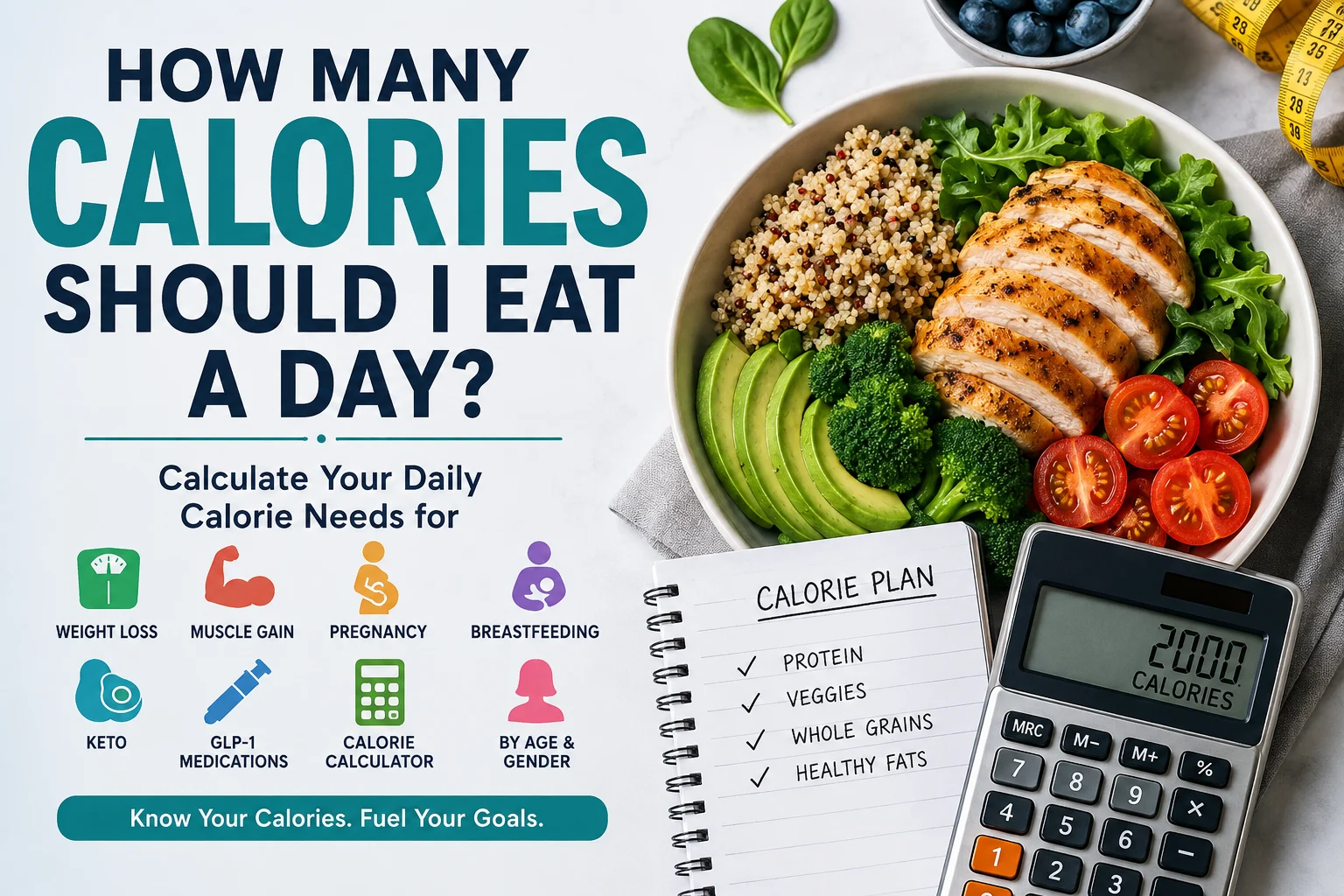
If you’re wondering how many calories should I eat a day, there isn’t one calorie number that works for everyone. Your daily calorie needs depend on your age, sex, height, weight, activity level, body composition, metabolism, and health or fitness goal.
Someone who spends most of the day sitting may need far fewer calories than an athlete who trains several hours each week. Likewise, a person trying to lose weight will generally need a different calorie target from someone trying to gain muscle.
Calories are simply a measure of energy. Your body uses that energy to keep your heart beating, maintain body temperature, breathe, digest food, move, exercise, and perform everyday activities.
The goal isn’t to eat as few calories as possible. It’s to find an intake that supports your specific goal while providing enough nutrients, protein, vitamins, minerals, fiber, and other essentials.
How Many Calories Should I Eat a Day?
For many adults, daily calorie requirements commonly fall somewhere around 1,600 to 3,000+ calories per day, but individual needs can fall outside this range.
As a broad reference:
| Adult | Approximate daily calorie range |
|---|---|
| Less-active adult woman | 1,600–2,000 |
| Moderately active adult woman | 1,800–2,200 |
| Active adult woman | 2,000–2,400+ |
| Less-active adult man | 2,000–2,400 |
| Moderately active adult man | 2,200–2,800 |
| Active adult man | 2,400–3,000+ |
These are general estimates, not personalized prescriptions. Your actual calorie requirement can be significantly different.
For example, two 30-year-old women can have very different calorie needs if one weighs 55 kg, works at a desk, and rarely exercises while the other weighs 80 kg and trains five days per week.
That’s why a good calorie estimate considers more than age and sex.
What Determines How Many Calories You Need?
Several factors influence your total daily energy needs.
1. Age
Calorie requirements generally change as you get older. Children and teenagers need energy for growth and development, while adults primarily need energy for maintaining body functions and physical activity.
Older adults may require fewer calories because energy expenditure and activity levels often decline.
This doesn’t mean older adults need less nutrition. In fact, nutrient-dense foods become especially important when calorie requirements are lower.
2. Sex
Average calorie requirements differ between men & women because body size, body composition, and metabolic demands tend to differ.
This is why searches such as “how many calories should I eat a day woman” and “how many calories should I eat a day women” don’t have one universal answer.
A woman’s calorie needs also change during pregnancy and breastfeeding.
3. Height
Taller people generally have more body mass to support and may therefore require more energy.
Height is one of the variables used by many calorie and BMR equations.
4. Body Weight
Body weight affects energy expenditure. A larger body generally requires more energy to move and maintain.
However, body weight alone isn’t enough to calculate calorie requirements accurately.
5. Activity Level
Physical activity can make a major difference.
Someone who walks occasionally may have much lower energy requirements than someone who works a physically demanding job and exercises regularly.
Common activity categories include:
- Sedentary
- Lightly active
- Moderately active
- Very active
- Extremely active
6. Your Goal
Your calorie target should also reflect what you’re trying to accomplish.
Goal might be:
- Maintain your current weight
- Lose body fat
- Gain weight
- Build muscle
- Improve athletic performance
- Support pregnancy
- Support breastfeeding
A maintenance calorie target isn’t necessarily appropriate for a weight-loss or muscle-building phase.
How Many Calories Should I Eat a Day by Age?
If you’re searching for “how many calories should I eat a day by age,” remember that age is only one part of the equation.
General adult calorie requirements vary according to sex and activity level.
A simplified overview looks like this:
| Age group | General calorie considerations |
|---|---|
| 18–25 | Often higher with greater activity |
| 26–35 | Varies substantially with lifestyle |
| 36–45 | Depends heavily on activity and body size |
| 46–55 | Energy needs may gradually decline |
| 56–65 | Activity level becomes increasingly important |
| 65+ | Often lower calorie needs but high nutrient needs |
There’s no scientifically useful rule such as “everyone over 40 should eat exactly 1,500 calories.”
Instead, use age as one input alongside height, weight, sex, and activity level.
How Many Calories Should I Eat a Day Calculator?
A calorie calculator estimates your daily energy requirement using information such as:
- Age
- Sex
- Height
- Weight
- Activity level
- Goal
Most calculators work through two main concepts: BMR and TDEE.
What Is BMR?
BMR stands for Basal Metabolic Rate.
It represents the approximate amount of energy your body needs at rest to support essential physiological functions.
Your body continues to burn energy even when you’re sleeping.
BMR supports functions such as:
- Breathing
- Circulation
- Brain activity
- Maintaining body temperature
- Cellular processes
- Organ function
BMR isn’t your total daily calorie requirement.
You also burn calories through movement, digestion, exercise, and normal daily activities.
What Is TDEE?
TDEE means Total Daily Energy Expenditure.
It represents the total energy you use during an average day.
A simplified model is:
TDEE = BMR + physical activity + thermic effect of food + other daily movement
Your TDEE is therefore more useful than BMR alone when estimating how many calories you should eat each day.
Example
Suppose someone’s estimated BMR is 1,500 calories.
If their daily activity brings total expenditure to approximately 2,000 calories, then eating around 2,000 calories may maintain their weight over time, assuming the estimate is reasonably accurate and other factors remain stable.
Eating below that level may create an energy deficit.
Eating above it may create an energy surplus.
How Many Calories Should I Eat a Day to Lose Weight?
If you’re asking “how many calories should I eat a day to lose weight,” the answer depends on your maintenance calorie requirement.
Weight loss generally requires a sustained calorie deficit, meaning you consume less energy than your body uses.
For example:
Estimated maintenance: 2,300 calories
Food intake: 1,900 calories
Estimated deficit: 400 calories
The actual rate of weight loss won’t always match a mathematical prediction because body weight is affected by water, glycogen, digestive contents, metabolic adaptation, and changes in activity.
A moderate calorie deficit is usually more practical than trying to create an extremely large deficit.
Don’t Automatically Choose the Lowest Number
Eating fewer calories doesn’t always mean better results.
Very aggressive restriction can make it harder to:
- Get enough protein
- Get enough fiber
- Meet micronutrient needs
- Maintain training performance
- Preserve lean mass
- Stick with the diet
- Manage hunger
A sustainable calorie deficit is usually more useful than a crash diet.
How Many Calories Should I Eat on a Cut?
The phrase “cut” usually refers to a period of intentionally reducing calorie intake to decrease body fat while trying to preserve muscle.
If you’re asking “how many calories should I eat a day on a cut,” start with an estimate of your maintenance calories.
For example:
Maintenance: 2,500 calories
Cutting intake: approximately 2,000–2,250 calories
The appropriate deficit depends on your starting body composition, training, goal, timeline, and ability to maintain performance.
If you’re resistance training, protein intake and strength training become particularly important because the goal isn’t simply to make the number on the scale smaller.
The goal is usually to reduce fat while preserving as much lean tissue as possible.
How Many Calories Should I Eat a Day to Gain Muscle?
Muscle growth requires more than simply eating extra calories.
Resistance training provides the stimulus, while sufficient calories and protein provide resources for recovery and growth.
If you’re asking “how many calories should I eat a day to gain muscle,” you may need a modest calorie surplus rather than a large one.
For example:
Estimated maintenance: 2,500 calories
Muscle-building intake: approximately 2,650–2,800 calories
The exact target varies.
A very large surplus can result in unnecessary fat gain. A very small surplus may be difficult to detect because calorie estimates aren’t perfectly accurate.
Your program should combine:
- Progressive resistance training
- Adequate protein
- Sufficient calories
- Adequate carbohydrates
- Dietary fats
- Sleep and recovery
How Many Calories Should I Eat a Day to Bulk?
A bulk is generally a muscle-building phase where someone intentionally consumes more calories than they expend.
Therefore, “how many calories should I eat a day to bulk” depends on your maintenance calories.
A common practical approach is to begin with a modest surplus rather than dramatically increasing food intake.
For example:
| Estimated maintenance | Possible starting bulk intake |
|---|---|
| 2,000 | 2,150–2,300 |
| 2,300 | 2,450–2,600 |
| 2,500 | 2,650–2,800 |
| 2,800 | 2,950–3,100 |
| 3,000 | 3,150–3,300 |
These are examples, not universal prescriptions.
Track your body weight, waist measurement, gym performance, recovery, and progress over several weeks rather than changing calories based on one day’s scale reading.
How Many Calories Should a Woman Eat a Day?
The question “how many calories should I eat a day as a woman” can’t be answered with one number.
Adult women’s calorie requirements can vary considerably.
For example, a sedentary woman may need considerably fewer calories than an active woman of the same age and height.
Women’s calorie needs can also change because of:
- Pregnancy
- Breastfeeding
- Menstrual cycle-related changes in appetite and water retention
- Physical activity
- Body weight
- Muscle mass
- Age
- Weight-management goals
For general planning, calorie calculators should use individual measurements instead of relying on a single “women’s calorie number.”
How Many Calories Should I Eat a Day Pregnant?
Pregnancy is different from ordinary weight-loss or weight-gain planning.
If you’re searching “how many calories should I eat a day pregnant,” don’t simply take your usual weight-loss calorie target and add a random number.
Energy needs change throughout pregnancy.
In general, additional energy requirements are relatively small during the first trimester and increase later in pregnancy. Common U.S. guidance often uses approximately:
- First trimester: generally no additional calories
- Second trimester: about 340 additional calories/day
- Third trimester: about 450 additional calories/day
Individual recommendations can differ based on pre-pregnancy weight, rate of weight gain, activity, pregnancy complications, and other factors.
Pregnancy isn’t an appropriate time for intentional calorie restriction unless specifically directed and monitored by a qualified healthcare professional.
How Many Calories Should I Eat a Day While Breastfeeding?
If you’re searching “how many calories should I eat a day while breastfeeding” or “how many calories should I eat a day breastfeeding,” your needs can be higher than before pregnancy because producing breast milk requires energy.
Breastfeeding calorie requirements vary according to:
- Milk production
- Whether you’re exclusively breastfeeding
- Activity level
- Body size
- Whether you are trying to return gradually to your pre-pregnancy weight
- How long it has been since delivery
A commonly used U.S. reference is approximately 330–400 additional calories per day for breastfeeding women, although individual requirements vary.
The quality of the diet matters too.
Focus on nutrient-dense foods such as:
- Eggs
- Fish low in mercury
- Lean meat
- Beans
- Lentils
- Whole grains
- Fruits
- Vegetables
- Dairy or fortified alternatives
- Nuts and seeds
Avoid aggressive calorie restriction during breastfeeding without professional guidance.
How Many Calories Should I Eat a Day on Keto?
Keto doesn’t automatically determine how many calories you should eat.
A ketogenic diet changes the proportion of carbohydrates, protein, and fat in your diet, but your calorie requirements still depend on your energy expenditure and goal.
So “how many calories should I eat a day on keto” should be answered using the same basic process:
- Estimate maintenance calories.
- Decide whether you want to lose, maintain, or gain weight.
- Set an appropriate calorie target.
- Allocate protein appropriately.
- Keep carbohydrate intake low enough to meet your chosen ketogenic approach.
- Get the rest of your calories from dietary fat.
Keto isn’t a special exemption from energy balance.
You can gain weight on a ketogenic diet if you consistently consume more calories than you use.
How Many Calories Should I Eat a Day on GLP-1?
People taking GLP-1 medications often experience reduced appetite and may naturally eat less.
If you’re asking “how many calories should I eat a day on glp 1,” the answer shouldn’t simply be “eat as little as possible.”
GLP-1 medications are used for conditions including type 2 diabetes and obesity, and some medications in this class are approved specifically for weight management.
Examples include medications such as:
- Wegovy
- Zepbound
- Mounjaro
- Ozempic
However, these medications aren’t interchangeable, and their approved indications and dosing schedules differ.
Because appetite may decrease substantially, food quality becomes especially important.
Try to prioritize:
- Protein
- Vegetables
- Fruits
- Whole grains when appropriate
- Healthy fats
- Adequate fluids
- Nutrient-dense meals
If appetite becomes so low that you’re struggling to eat enough protein, fluids, or essential nutrients, speak with your prescriber or a registered dietitian.
How Many Calories Should I Eat a Day on Wegovy?
Wegovy contains semaglutide and is used as part of a medical approach to weight management for eligible patients.
If you’re wondering “how many calories should I eat a day on wegovy,” don’t assume that the medication creates a fixed calorie target.
Your calorie needs still depend on your:
- Age
- Sex
- Height
- Weight
- Activity
- Metabolic needs
- Weight-loss goal
The medication may reduce appetite, which can make maintaining a balanced diet more challenging for some people.
Rather than focusing only on eating less, prioritize nutritional adequacy.
How Many Calories Should I Eat a Day on Zepbound?
Zepbound contains tirzepatide and is used for weight management in appropriate patients.
The answer to “how many calories should I eat a day on zepbound” should be individualized.
The medication can reduce appetite, but that doesn’t mean you should deliberately consume extremely low calories.
A sensible plan should account for:
- Your estimated energy requirements
- Your weight-loss target
- Protein intake
- Hydration
- Nutrient intake
- Exercise
- Medication effects
- Side effects
Your healthcare professional can help determine whether your calorie intake is appropriate, especially if you’re experiencing significant nausea, vomiting, poor appetite, or difficulty maintaining adequate nutrition.
How Many Calories Should I Eat a Day on Mounjaro?
Mounjaro contains tirzepatide and is primarily used in the management of type 2 diabetes; tirzepatide is also marketed under other brand names for obesity/weight management.
If you’re asking “how many calories should I eat a day on mounjaro,” don’t use a generic calorie target simply because you’re taking the medication.
Your calorie needs remain individual.
If your appetite has dropped substantially, focus on nutrient density rather than trying to achieve the lowest possible calorie intake.
A smaller meal containing adequate protein, vegetables, fruit, and other nutrient-dense foods may be more useful than filling your reduced appetite with foods that provide calories but few nutrients.
Why Protein Matters When You’re Losing Weight
Calories determine energy balance, but food quality still matters.
Protein is especially important during weight loss because it helps support lean tissue and provides satiety.
Good protein sources include:
- Chicken
- Turkey
- Fish
- Eggs
- Greek yogurt
- Cottage cheese
- Milk
- Beans
- Lentils
- Tofu
- Tempeh
- Lean beef
Your exact protein requirement depends on factors such as body size, training, age, and health status.
People who strength train may have higher protein needs than sedentary individuals.
Calories vs. Nutrients: Why Both Matter
Two diets can contain exactly 2,000 calories but have completely different nutritional profiles.
Diet A
- Sugary drinks
- Refined snacks
- Fried foods
- Desserts
- Highly processed foods
Diet B
- Lean protein
- Vegetables
- Fruit
- Whole grains
- Beans
- Nuts
- Seeds
- Healthy fats
Both diets could theoretically provide the same calories.
But they won’t necessarily provide the same amount of:
- Protein
- Fiber
- Vitamins
- Minerals
- Essential fatty acids
That’s why calorie counting shouldn’t become the only measure of a healthy diet.
How to Calculate Your Daily Calorie Needs
A practical calculation has several steps.
Step 1: Estimate BMR
One widely used approach is the Mifflin-St Jeor equation.
For men:
BMR = (10 × weight in kg) + (6.25 × height in cm) − (5 × age) + 5
For women:
BMR = (10 × weight in kg) + (6.25 × height in cm) − (5 × age) − 161
These equations provide an estimate rather than a laboratory measurement.
Step 2: Account for Activity
Your BMR doesn’t include all the energy you use throughout the day.
You then estimate activity to arrive at a rough TDEE.
A simplified activity approach might use:
| Activity level | Example multiplier |
|---|---|
| Sedentary | ~1.2 |
| Lightly active | ~1.375 |
| Moderately active | ~1.55 |
| Very active | ~1.725 |
| Extremely active | ~1.9 |
These multipliers are estimates and shouldn’t be treated as exact physiological measurements.
Step 3: Adjust for Your Goal
For maintenance:
Calories ≈ TDEE
For weight loss:
Calories < TDEE
For weight gain:
Calories > TDEE
For muscle gain:
Small calorie surplus + resistance training + adequate protein
How Many Calories Should I Eat a Day Quiz?
A “how many calories should I eat a day quiz” can provide a rough estimate if it asks for meaningful information.
A useful quiz should ask about:
- Age
- Sex
- Height
- Weight
- Activity level
- Exercise frequency
- Primary goal
A quiz that asks only your age and sex can’t provide a highly personalized calorie target.
Example
A useful calorie quiz might produce:
Age: 30
Sex: Female
Height: 165 cm
Weight: 70 kg
Activity: Moderate
Goal: Weight loss
The result should be treated as an estimate and then adjusted according to real-world progress.
How Accurate Are Calorie Calculators?
Calorie calculators are useful starting points, but they’re not perfect.
Two people with identical:
- Age
- Height
- Weight
- Sex
can still have different energy requirements.
Why?
Because metabolism and daily movement vary.
For example, one person may unconsciously move more throughout the day. Another may sit for long periods. Their actual TDEE can therefore differ even when their basic measurements are identical.
This is why calorie calculations should be treated as starting estimates.
Your weight trend over several weeks can provide useful real-world information about whether your estimated maintenance intake is close to reality.
What Is a Calorie Deficit?
A calorie deficit occurs when your energy intake is lower than your energy expenditure.
For example:
Energy expenditure: 2,400 calories
Energy intake: 2,000 calories
Deficit: 400 calories
Over time, a sustained deficit can lead to weight loss.
But the body isn’t a perfectly predictable calculator.
Changes in body water, glycogen, digestion, activity, appetite, and metabolism can affect short-term weight changes.
Don’t judge your calorie plan based on a single day’s weight.
What Is a Calorie Surplus?
A calorie surplus occurs when calorie intake exceeds energy expenditure.
For example:
Energy expenditure: 2,500 calories
Energy intake: 2,750 calories
Surplus: 250 calories
A surplus can support weight gain and muscle-building when combined with appropriate resistance training and adequate protein.
However, a larger surplus doesn’t automatically produce faster muscle growth.
Excess calories can also increase fat gain.
Why Your Weight Can Change Even When Calories Stay the Same
The scale doesn’t measure body fat alone.
Your weight can change because of:
- Water
- Glycogen
- Sodium intake
- Carbohydrate intake
- Food volume
- Digestive contents
- Hormonal changes
- Exercise-related inflammation
For example, eating a high-carbohydrate meal can increase stored glycogen, and glycogen is stored alongside water.
As a result, the scale can move upward even without a meaningful increase in body fat.
This is why trends are more useful than individual weigh-ins.
How to Build a Healthy Daily Calorie Plan
Once you’ve estimated your calorie target, divide your food across meals in a way that fits your lifestyle.
A balanced day might include:
Breakfast
- Eggs or Greek yogurt
- Oatmeal or whole-grain toast
- Fruit
Lunch
- Chicken, fish, beans, or tofu
- Rice, potatoes, or whole grains
- Vegetables
Snack
- Fruit
- Yogurt
- Nuts
Dinner
- Lean protein
- Vegetables
- Whole grains or another carbohydrate source
- Healthy fat
The exact foods aren’t mandatory. The goal is to create a diet that provides sufficient energy and nutrients while fitting your preferences.
Common Mistakes When Counting Calories
1. Eating Too Little
Extreme restriction may make a diet difficult to maintain and can make it harder to meet nutritional needs.
2. Ignoring Liquid Calories
Soft drinks, sweetened coffee, juices, shakes, and alcoholic beverages can contribute significant calories.
3. Forgetting Cooking Oils
Oil, butter, sauces, and dressings can add calories even when the main food appears low-calorie.
4. Overestimating Exercise Calories
Fitness trackers can estimate calorie expenditure, but their estimates aren’t necessarily exact.
Avoid automatically “eating back” every calorie your device says you burned.
5. Focusing Only on the Scale
Weight is only one measurement.
Consider:
- Waist circumference
- Strength
- Energy
- Fitness
- Clothing fit
- Body composition when reliably measured
6. Changing Calories Too Quickly
Give a plan enough time to evaluate the trend.
Daily fluctuations don’t necessarily mean your calorie target is wrong.
How Many Calories Should I Eat a Day? Quick Answer
If you need a simple answer to “how many calories should I eat a day?”, start with your estimated maintenance calories.
For many adults, daily needs fall somewhere between roughly 1,600 and 3,000 calories, but individual requirements can be lower or higher.
Then adjust according to your goal:
- Maintain weight: eat around maintenance
- Lose weight: create a sustainable calorie deficit
- Gain weight: create a modest calorie surplus
- Gain muscle: combine resistance training, adequate protein, and a modest surplus
- Pregnancy: follow pregnancy-specific guidance
- Breastfeeding: account for increased energy and nutrient needs
- GLP-1 medication: avoid assuming that appetite suppression means you should eat as little as possible
Frequently Asked Questions
Your weight-loss calorie target depends on your maintenance calories. A moderate calorie deficit is generally more practical than extreme restriction. Your age, sex, height, weight, activity, and goal should be considered.
There isn't one calorie target for every woman. Requirements vary according to age, height, weight, activity, body composition, pregnancy, breastfeeding, and goals.
You generally need enough calories to support training and recovery, along with adequate protein and progressive resistance training. A modest surplus is often more appropriate than a very large surplus.
Start by estimating maintenance calories and then consider a modest surplus. Monitor weight and training progress over several weeks and adjust if necessary.
Keto doesn't determine your calorie requirement. Estimate your maintenance calories first, then adjust your calorie intake according to whether you're trying to lose, maintain, or gain weight.
There is no universal GLP-1 calorie target. Appetite may decrease with these medications, so maintaining adequate protein, fluids, and nutrients is important. Your healthcare professional can help determine an appropriate intake.
Your calorie target should be based on your individual energy needs and weight-management plan rather than the medication alone. Don't intentionally reduce calories to extremely low levels simply because your appetite has decreased.
Zepbound doesn't create a universal calorie requirement. Your target depends on your energy needs, weight-management goal, activity, and ability to maintain adequate nutrition.
Your calorie requirements remain individual while taking Mounjaro. If reduced appetite makes it difficult to consume enough protein, fluids, or nutrients, discuss your diet with your healthcare professional.
Breastfeeding generally increases energy requirements, but the exact amount depends on factors such as milk production, activity, body size, and whether breastfeeding is exclusive. Avoid aggressive calorie restriction without professional guidance.
Pregnancy calorie needs change by trimester and individual circumstances. General U.S. guidance commonly uses no additional calories in the first trimester, about 340 additional calories per day in the second trimester, and about 450 additional calories per day in the third trimester.
Yes. BMR can provide a starting point, but BMR isn't your total daily calorie expenditure. You need to account for physical activity and other energy expenditure to estimate TDEE.
It depends on the person. For some adults, 2,000 calories may maintain weight; for others, it may cause weight loss or weight gain. Your individual energy expenditure determines the answer. Final Takeaway The answer to “how many calories should I eat a day” isn't a universal number. Your ideal calorie intake depends on your: Age + sex + height + weight + activity + metabolism + goal Use BMR and TDEE calculations to establish a starting estimate. Then consider your real-world progress over time. If your goal is weight loss, focus on a sustainable calorie deficit rather than extreme restriction. If your goal is muscle gain, combine a modest calorie surplus with resistance training and adequate protein. And if you're pregnant, breastfeeding, or taking medications such as Wegovy, Zepbound, or Mounjaro, calorie targets should be considered in the context of your medical and nutritional needs rather than copied from a generic diet plan. Most importantly, calories are only one part of nutrition. Food quality, protein, fiber, micronutrients, hydration, activity, sleep, and long-term consistency all matter.
5 thoughts on “How Many Calories Should I Eat a Day | Calculate Your Daily Calorie Needs”