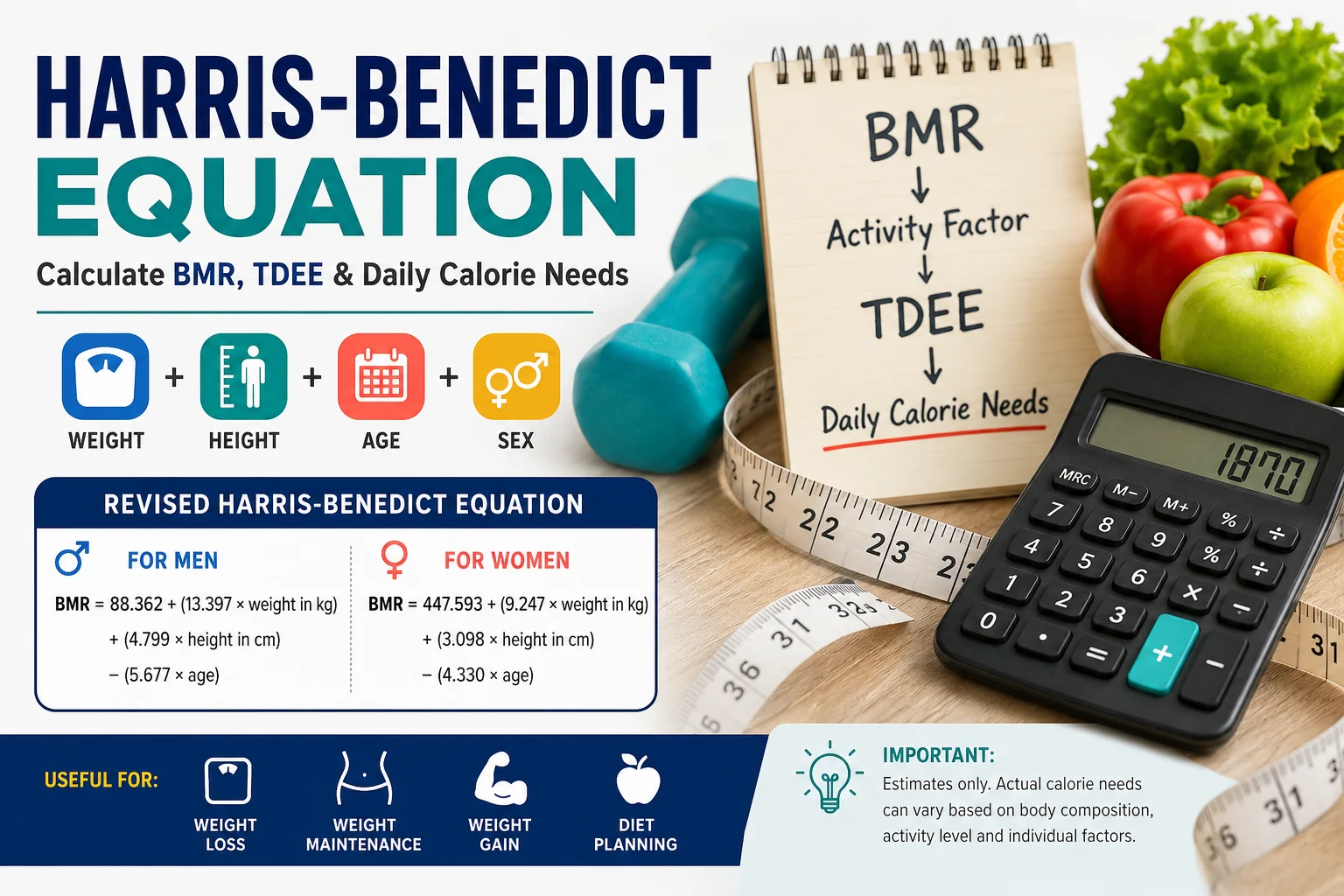
The Harris-Benedict Equation is one of the best-known mathematical formulas used to estimate Basal Metabolic Rate (BMR). BMR represents the approximate number of calories your body needs to perform essential functions while at complete rest.
By combining BMR with your physical activity level, the Harris-Benedict formula can also be used to estimate Total Daily Energy Expenditure (TDEE). This makes it useful for estimating daily calorie requirements for weight loss, weight maintenance, or weight gain.
In this guide, you’ll learn what the Harris-Benedict Equation is, how it works, which formulas to use, how to calculate BMR and TDEE, and how it compares with other methods such as the Mifflin-St Jeor Equation.
What Is the Harris-Benedict Equation?
The Harris-Benedict Equation is a predictive equation designed to estimate a person’s basal metabolic rate from several basic characteristics:
- Age
- Sex
- Body weight
- Height
Your BMR is the amount of energy your body is estimated to use to support essential physiological processes while at rest. These processes include breathing, circulation, temperature regulation, and maintaining normal organ function.
The equation does not directly measure metabolism. Instead, it provides an estimated BMR based on statistical relationships between body characteristics and energy expenditure.
Once BMR is estimated, it can be adjusted according to physical activity to calculate TDEE, or an estimate of how many calories you burn during an average day.
The basic relationship is:
BMR → Physical Activity → TDEE → Estimated Daily Calorie Needs
This is why the Harris-Benedict formula is commonly associated with BMR calculators, TDEE calculators, and calorie calculators.
What Is BMR?
Basal Metabolic Rate (BMR) is an estimate of the energy your body requires to maintain basic physiological functions at rest.
Even if you spent an entire day lying still, your body would still require energy to:
- Keep your heart beating
- Maintain breathing
- Support brain activity
- Regulate body temperature
- Maintain cellular functions
- Support vital organs
- Circulate blood
BMR therefore forms the foundation for estimating your overall energy requirements.
However, your actual daily calorie expenditure is normally higher than your BMR because you also expend energy through movement, exercise, digestion, and everyday activities.
Harris-Benedict Equation Formula
There are two important versions of the formula: the original Harris-Benedict Equation and the revised Harris-Benedict Equation.
The revised version is commonly used in modern calculators.
Revised Harris-Benedict Equation
The revised Harris-Benedict equations published by Roza and Shizgal in 1984 are:
For men
BMR = 88.362 + (13.397 × weight in kg) + (4.799 × height in cm) − (5.677 × age)
For women
BMR = 447.593 + (9.247 × weight in kg) + (3.098 × height in cm) − (4.330 × age)
The result is expressed approximately in kilocalories per day (kcal/day).
Original Harris-Benedict Equation
The original equations were developed by James Arthur Harris and Francis Gano Benedict and published in 1918.
For men
BMR = 66.473 + (13.7516 × weight in kg) + (5.0033 × height in cm) − (6.755 × age)
For women
BMR = 655.0955 + (9.5634 × weight in kg) + (1.8496 × height in cm) − (4.6756 × age)
The original equation remains historically important, while the revised equation is frequently used in contemporary applications.
How to Calculate BMR Using the Harris-Benedict Equation
Calculating your BMR requires four pieces of information:
- Sex
- Age
- Body weight
- Height
Your measurements should be entered using the units required by the formula.
The revised Harris-Benedict equation uses:
- Weight in kilograms (kg)
- Height in centimeters (cm)
- Age in years
Let’s look at an example.
Example: BMR Calculation for a Man
Suppose a man is:
- 30 years old
- 80 kg
- 180 cm tall
Using the revised Harris-Benedict formula:
BMR = 88.362 + (13.397 × 80) + (4.799 × 180) − (5.677 × 30)
After performing the calculation, the estimated BMR is approximately:
1,858 kcal/day
This means the equation estimates that his body would require roughly 1,858 calories per day at basal conditions.
This does not mean that 1,858 calories is necessarily his recommended daily calorie intake. His actual calorie requirements depend on activity and other factors.
How to Calculate TDEE Using Harris-Benedict
Total Daily Energy Expenditure (TDEE) estimates how many calories you expend throughout an average day.
A common way to estimate TDEE from the Harris-Benedict BMR is:
TDEE = BMR × Activity Factor
The activity factor represents your typical level of physical activity.
Common activity factors
| Activity Level | Multiplier |
|---|---|
| Sedentary | 1.20 |
| Lightly active | 1.375 |
| Moderately active | 1.55 |
| Very active | 1.725 |
| Extremely active | 1.90 |
These categories are approximations, so choosing an activity level that accurately reflects your normal lifestyle is important.
TDEE Example
Using the previous example:
BMR = approximately 1,858 calories/day
If the person is moderately active:
TDEE = 1,858 × 1.55
TDEE ≈ 2,880 calories/day
This gives an estimated daily energy expenditure of approximately 2,880 calories.
In practical terms, consuming around this amount might theoretically maintain body weight if the estimate accurately reflects the person’s actual energy expenditure.
Actual calorie needs can differ substantially between individuals.
Harris-Benedict Equation for Weight Loss
The Harris-Benedict Equation can be used as a starting point for developing a calorie target for weight loss.
The general process is:
1. Calculate BMR
↓
2. Estimate TDEE
↓
3. Create an appropriate calorie deficit
For example, if someone’s estimated TDEE is 2,500 calories per day, a calorie target below that level could create an energy deficit.
However, there is no single calorie deficit that is appropriate for everyone. Factors such as body size, activity level, nutritional status, training demands, and individual goals should be considered.
A calorie deficit that is too aggressive may make it harder to maintain adequate nutrition and physical performance.
Harris-Benedict Equation for Weight Maintenance
For weight maintenance, TDEE is often used as an approximate reference point.
If your estimated TDEE is:
2,400 kcal/day
then consuming approximately 2,400 calories per day would theoretically result in energy balance.
However, this is only an estimate. Your actual energy expenditure can change because of:
- Changes in body weight
- Changes in physical activity
- Exercise volume
- Metabolic adaptation
- Changes in daily movement
- Individual differences in metabolism
Therefore, actual body-weight trends can be useful when evaluating whether an estimated maintenance-calorie level is appropriate.
Harris-Benedict Equation for Weight Gain
The same framework can be used when planning for weight gain.
The general approach is:
BMR → TDEE → calorie surplus
If estimated TDEE is 2,500 calories per day, consuming more energy than the amount required for maintenance can produce a calorie surplus.
For healthy weight gain, calorie intake should be accompanied by an appropriately balanced diet and, where appropriate, resistance training to support muscle development.
Harris-Benedict Equation vs. Mifflin-St Jeor Equation
The Mifflin-St Jeor Equation is another widely used predictive equation for estimating resting energy requirements.
Both formulas use variables such as:
- Age
- Sex
- Height
- Body weight
However, they use different coefficients and were developed from different populations and datasets.
Mifflin-St Jeor Equation for men
BMR = (10 × weight in kg) + (6.25 × height in cm) − (5 × age) + 5
Mifflin-St Jeor Equation for women
BMR = (10 × weight in kg) + (6.25 × height in cm) − (5 × age) − 161
Mifflin-St Jeor is widely used in modern nutrition and clinical contexts and is often considered a useful alternative to the Harris-Benedict equation.
Neither predictive equation can perfectly determine an individual’s actual energy expenditure.
Which Is More Accurate: Harris-Benedict or Mifflin-St Jeor?
There is no universal formula that produces a perfectly accurate BMR for every individual.
Predictive equations estimate energy requirements from population-level relationships. Individual energy expenditure can vary because of differences in:
- Body composition
- Muscle mass
- Genetics
- Hormonal factors
- Physical activity
- Health status
- Environmental conditions
- Measurement conditions
Research has often found the Mifflin-St Jeor equation to perform well among commonly used predictive equations, but that does not mean it will be the most accurate estimate for every person.
For a more precise measurement of resting energy expenditure, specialized methods such as indirect calorimetry can be used.
Factors That Affect BMR
The Harris-Benedict Equation primarily considers age, sex, height, and body weight. However, actual metabolic rate is influenced by many additional factors.
1. Body Size
Larger bodies generally require more energy to maintain basic physiological functions.
2. Body Composition
Lean tissue is metabolically active, so differences in muscle mass and body composition can affect resting energy expenditure.
3. Age
Metabolic requirements can change as people age. Changes in body composition and activity can also contribute to changes in energy expenditure.
4. Sex
The Harris-Benedict equations use different coefficients for men & women because average relationships between body characteristics and energy expenditure differ between the populations used to develop the equations.
5. Physical Activity
Exercise and everyday movement can substantially increase total daily energy expenditure.
6. Health and Physiological Conditions
Illness, hormonal changes, medications, and other physiological factors can affect energy expenditure. A basic BMR equation cannot account for all of these variables.
BMR vs. RMR
Basal Metabolic Rate (BMR) and Resting Metabolic Rate (RMR) are related concepts, but they are not technically identical.
BMR refers to energy expenditure measured under strict basal conditions, while RMR is generally measured under less restrictive resting conditions.
In everyday calorie calculators, the terms may sometimes be used interchangeably. However, researchers and clinicians may distinguish between the two.
The Harris-Benedict Equation is traditionally described as a method for estimating BMR, although its practical use is often discussed alongside resting energy expenditure.
What Is an Activity Factor?
An activity factor is a multiplier used to convert estimated BMR into an approximation of TDEE.
For example:
- BMR × 1.20 = sedentary TDEE estimate
- BMR × 1.55 = moderately active TDEE estimate
- BMR × 1.725 = very active TDEE estimate
The challenge is selecting the correct multiplier.
Someone who exercises several times per week may not necessarily belong in the “very active” category if the rest of the day is mostly sedentary. Conversely, someone with a physically demanding occupation may have substantially higher daily energy expenditure even without structured exercise.
Therefore, physical activity should be evaluated across the entire day.
Harris-Benedict Equation and Calorie Calculators
Many online BMR calculators and calorie calculators use predictive equations to estimate energy requirements.
A typical Harris-Benedict calculator follows these steps:
- Collect age, sex, weight, and height.
- Calculate estimated BMR.
- Ask for physical activity level.
- Multiply BMR by an activity factor.
- Display estimated TDEE.
- Optionally provide calorie targets for weight loss, maintenance, or weight gain.
The calculator simplifies the mathematical process, but the underlying result remains an estimate, not a direct measurement of metabolism.
Why Your Actual Calorie Needs May Differ
Two people can have the same age, height, weight, and sex but still have different actual calorie requirements.
This happens because predictive equations cannot fully capture every determinant of energy expenditure.
For example, two people may have identical body weights but different proportions of:
- Muscle
- Fat mass
- Bone mass
- Organ tissue
They may also have different levels of spontaneous physical activity.
For this reason, a BMR or TDEE estimate should generally be treated as a starting point rather than an exact prescription.
How to Use a BMR Estimate in Real Life
A practical approach is to use the calculated TDEE as an initial reference point and then monitor changes over time.
For example:
- Step 1: Calculate BMR using the Harris-Benedict equation.
- Step 2: Multiply BMR by an appropriate activity factor.
- Step 3: Use the resulting TDEE as an estimated maintenance level.
- Step 4: Adjust calorie intake according to your goal.
- Step 5: Monitor body-weight trends and other relevant outcomes.
If your actual results consistently differ from the expected results, your estimated maintenance calories may need to be adjusted.
Limitations of the Harris-Benedict Equation
Although the Harris-Benedict formula is useful, it has important limitations.
It is an estimate
The equation predicts energy expenditure rather than directly measuring it.
It does not measure body composition
Two people with the same weight can have substantially different amounts of lean mass and fat mass.
It cannot account for every physiological factor
Health status, medications, hormonal conditions, and other factors can affect metabolism.
Activity multipliers are also estimates
TDEE depends partly on how accurately physical activity is classified.
Individual accuracy varies
A formula that provides a reasonable estimate for one person may overestimate or underestimate another person’s actual energy expenditure.
Frequently Asked Questions
The Harris-Benedict Equation is primarily used to estimate Basal Metabolic Rate (BMR). BMR can then be combined with physical activity estimates to calculate Total Daily Energy Expenditure (TDEE) and estimate daily calorie needs.
It can provide a useful estimate, but it is not perfectly accurate for every individual. Predictive equations have inherent limitations because they cannot account for every factor affecting metabolism.
Yes. A common approach is to estimate BMR, calculate TDEE, and then establish an appropriate calorie deficit. The resulting calorie target should be considered an estimate and adjusted based on real-world progress.
BMR estimates the energy required to maintain basic physiological functions at rest. TDEE estimates total daily energy expenditure after accounting for physical activity and other daily energy demands.
No. The Harris-Benedict equation estimates BMR. TDEE is commonly estimated by multiplying BMR by an activity factor.
The revised formula requires:
Mifflin-St Jeor is a widely used alternative and is often considered a strong general-purpose predictive equation. However, neither formula is guaranteed to accurately predict the energy requirements of every individual.
Common activity multipliers include 1.20 for sedentary, 1.375 for lightly active, 1.55 for moderately active, 1.725 for very active, and 1.90 for extremely active. These values are approximations.
Key Takeaways
The Harris-Benedict Equation is a mathematical formula used to estimate Basal Metabolic Rate from age, sex, height, and body weight.
The most important concepts to understand are:
- BMR = estimated energy expenditure under basal resting conditions
- TDEE = estimated total daily energy expenditure
- Activity factor = multiplier used to estimate TDEE from BMR
- Calorie needs = can be estimated using TDEE as a starting point
- Calorie deficit = generally used to support weight loss
- Calorie surplus = generally used to support weight gain
- Mifflin-St Jeor = another widely used BMR/RMR predictive equation
- Indirect calorimetry = a method that can directly measure resting energy expenditure more precisely than predictive equations
Ultimately, the Harris-Benedict Equation is best viewed as a starting point for estimating energy requirements, rather than an exact measurement of an individual’s metabolism. Real-world changes in body weight, activity, and energy balance can help determine whether the initial estimate is appropriate.
5 thoughts on “Harris Benedict Equation | How to Calculate BMR, TDEE, and Daily Calorie Needs”