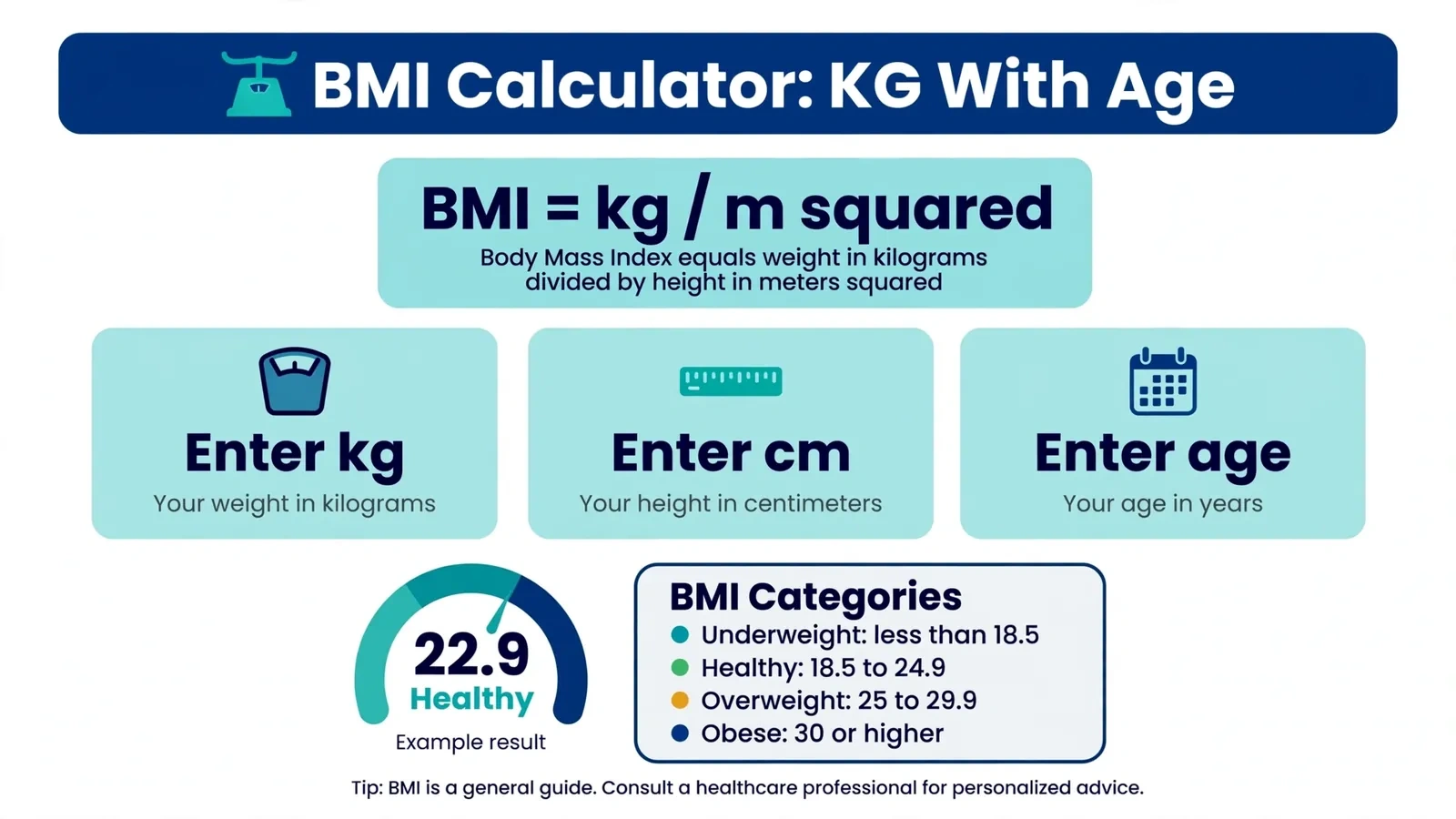
If you search for a “bmi calculator kg with age,” you want a tool that takes your weight in kilograms, your height in centimeters, and your age, then computes your body mass index with the metric formula and interprets it using adult cutoffs. The calculation takes seconds, but reading the result well takes a little context, because the same BMI number can mean different things at 25 and at 65.
Most of the world weighs in kilograms and measures height in centimeters, so a metric-first calculator is the natural choice. Below: the exact formula, a cm-to-m conversion table, worked metric examples, and how age changes what your result means. Prefer to skip the math? Our free BMI calculator takes kg and cm directly.
What Is the BMI Formula in KG and CM?
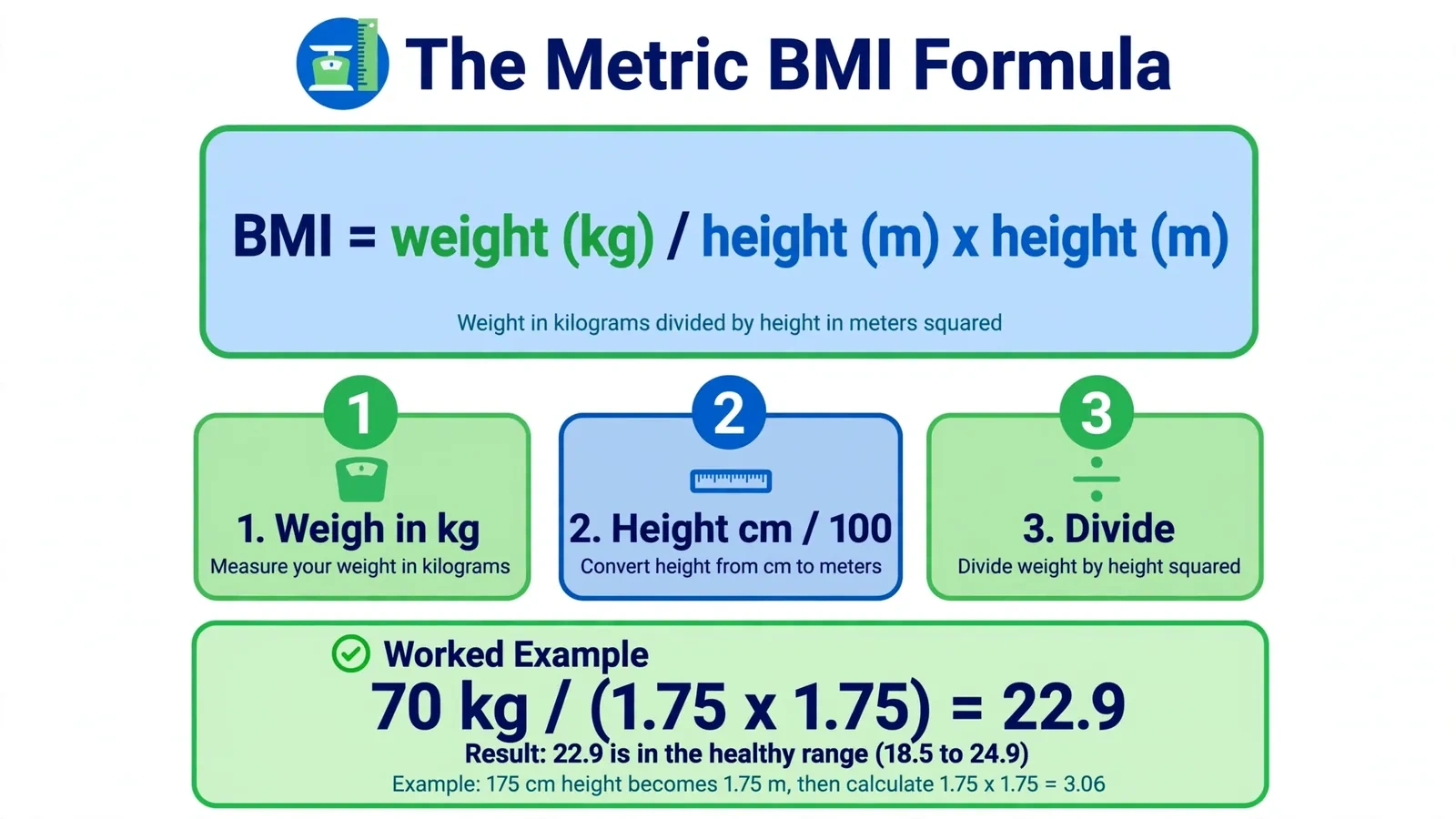
Every bmi calculator kg with age starts from one equation. BMI is simply your weight in kilograms divided by the square of your height in meters. Since most people know their height in centimeters, divide that figure by 100 first.
Body mass index (BMI) is a person’s weight in kilograms divided by the square of their height in meters (kg/m2). The World Health Organization uses BMI as a population-level screening tool: 18.5 to 24.9 is classified as a healthy range for adults, 25 to 29.9 as overweight, and 30 or above as obesity.
Written as an equation: BMI = weight (kg) / [height (m)] squared. There is no separate age version of this formula. A bmi calculator kg with age uses this exact equation for everyone, then adjusts the interpretation for your age group.
One caveat: BMI is a screening tool, not a diagnosis. It cannot tell muscle from fat, which is exactly where age starts to matter.
How Do I Convert Centimeters to Meters for BMI?
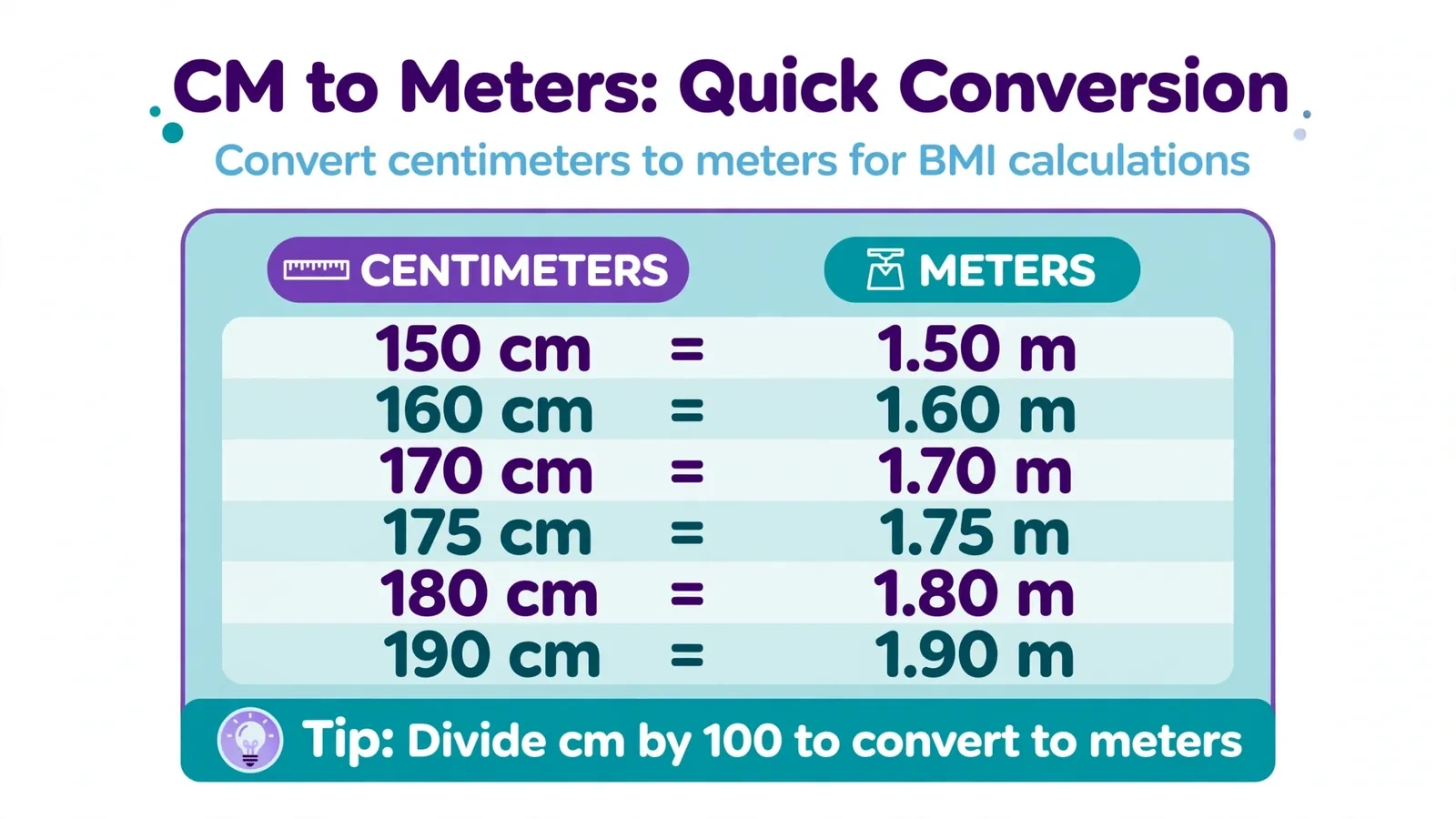
Divide centimeters by 100. That is the whole conversion. The classic mistake is dividing kilograms by centimeters squared, which produces a nonsense number roughly ten thousand times too small. Here is a quick reference:
| Height (cm) | Height (m) |
|---|---|
| 150 | 1.50 |
| 160 | 1.60 |
| 170 | 1.70 |
| 175 | 1.75 |
| 180 | 1.80 |
| 190 | 1.90 |
If your calculator accepts centimeters directly, it handles this division for you.
How Do I Calculate BMI With Kilograms and Centimeters?
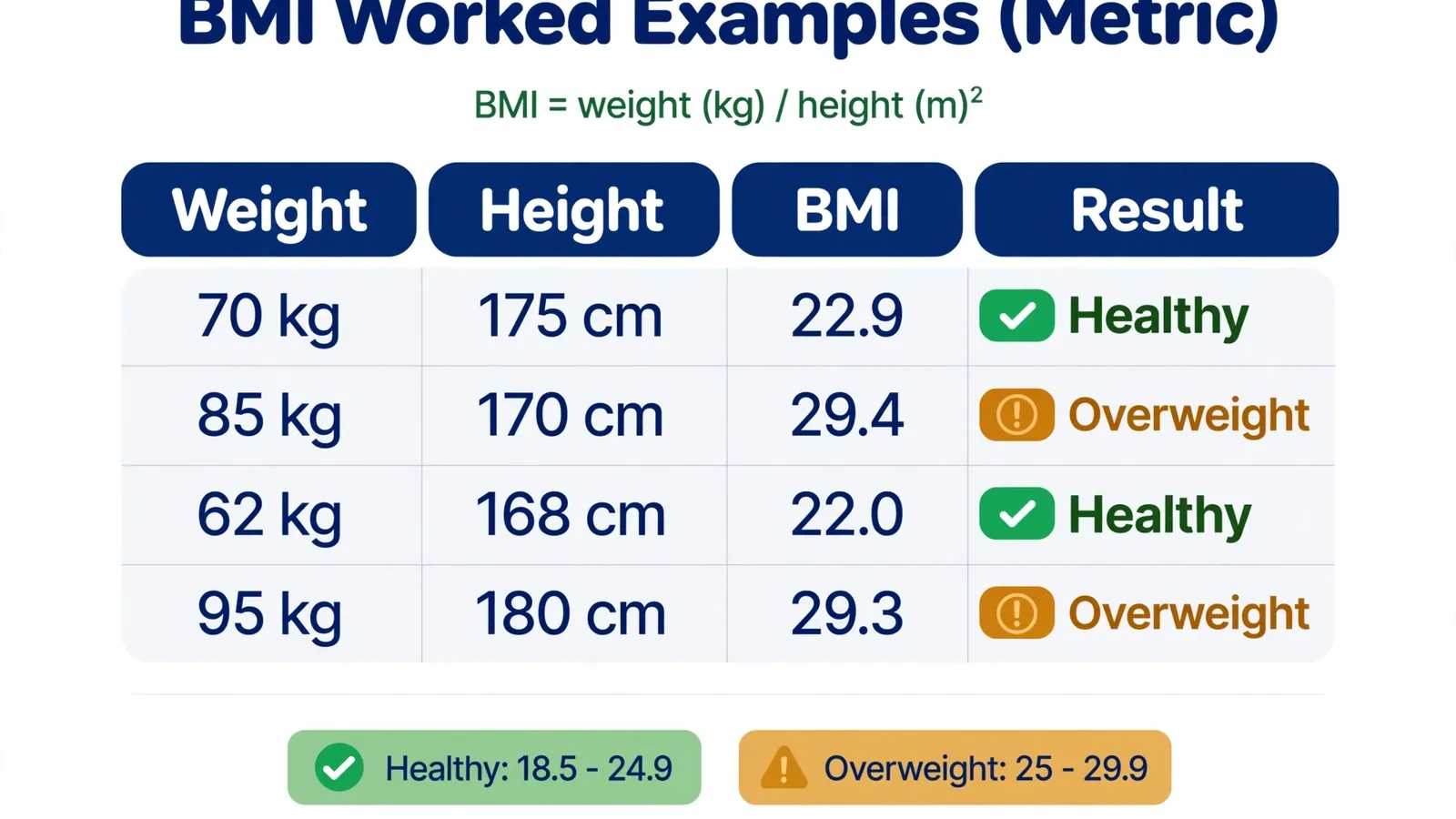
Three steps, about thirty seconds with a phone calculator:
- Convert height from centimeters to meters (divide by 100).
- Square the height in meters (multiply it by itself).
- Divide your weight in kilograms by that squared height.
Example: you weigh 70 kg and stand 175 cm tall. Height in meters is 1.75, squared is 3.0625, and 70 / 3.0625 = 22.9. That is the full manual method behind any bmi calculator kg with age. More worked examples:
| Weight (kg) | Height (cm) | BMI | Category |
|---|---|---|---|
| 70 | 175 | 22.9 | Healthy |
| 85 | 170 | 29.4 | Overweight |
| 62 | 168 | 22.0 | Healthy |
| 95 | 180 | 29.3 | Overweight |
| 55 | 160 | 21.5 | Healthy |
Notice how much height matters: the 85 kg person at 170 cm and the 95 kg person at 180 cm land at nearly the same BMI.
What Are the Adult BMI Categories?
The WHO defines the same four adult categories worldwide, expressed in kg/m2. Every bmi calculator kg with age applies these cutoffs to adults:
| BMI (kg/m2) | Category | What it suggests |
|---|---|---|
| Below 18.5 | Underweight | May need to gain weight; worth discussing with a doctor |
| 18.5 to 24.9 | Healthy weight | Linked to the lowest risk of weight-related disease |
| 25.0 to 29.9 | Overweight | Elevated risk; modest lifestyle changes usually help |
| 30.0 and above | Obesity | Higher health risk; medical guidance is a good idea |
These cutoffs apply from age 20 upward. They are population averages, so treat your category as a starting signal, not a final verdict.
Why Does a BMI Calculator Ask for My Age?
If the formula never changes, why does a bmi calculator kg with age ask how old you are? Because the number means different things across life stages. For children and teens, age is essential: their BMI goes onto percentile growth charts, a completely different system from adult cutoffs.
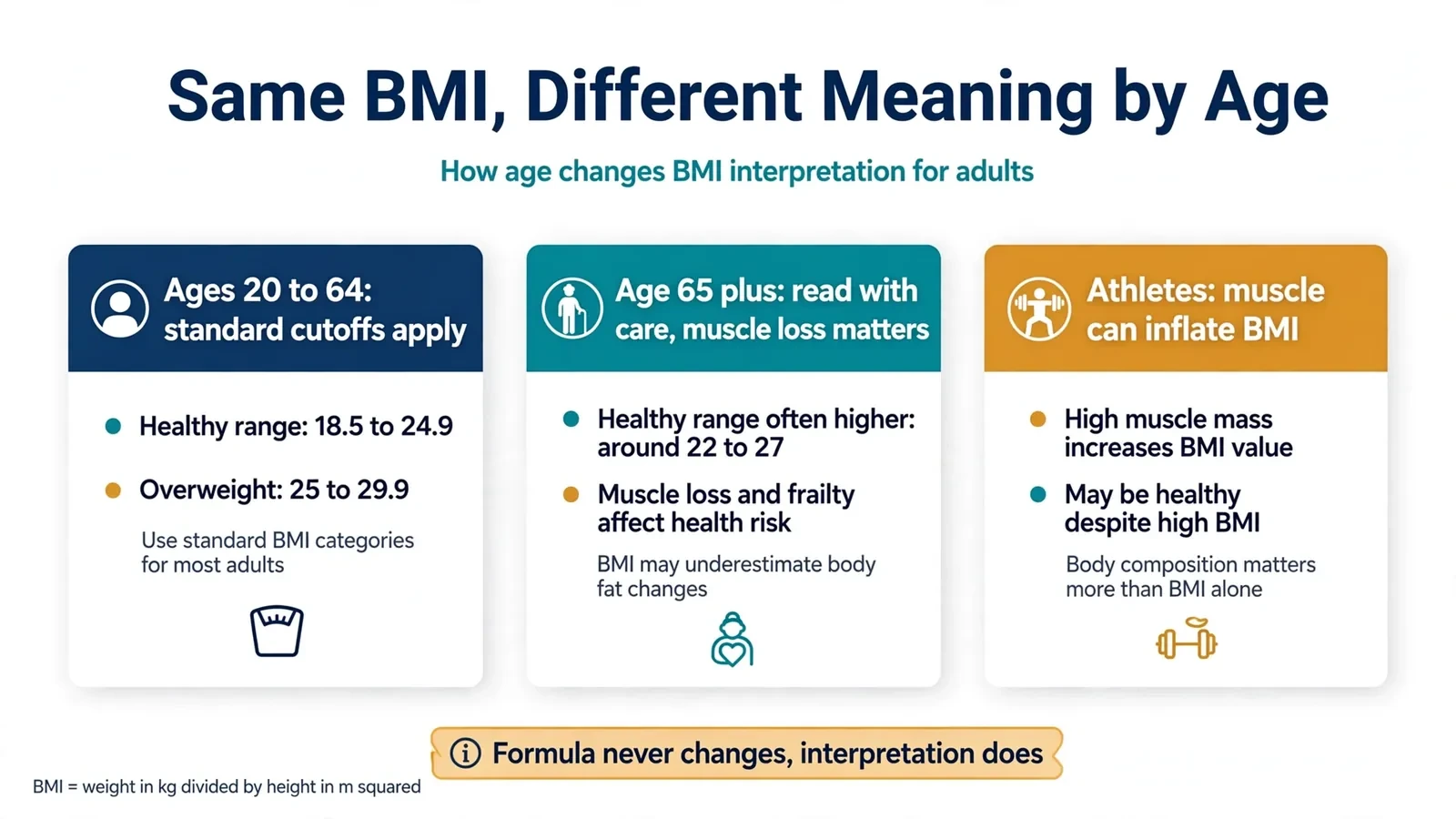
For adults between 20 and 64, the standard cutoffs apply as written, but age adds context. Muscle mass tends to decline while fat mass rises over the decades, even when the scale stays put. Two people can share a BMI of 26 with very different body fat percentages, and age is one of the biggest reasons why.
Around 65 and older, interpretation gets more careful. Research finds the BMI linked to the lowest mortality creeps slightly upward in older age, and unintentional weight loss in seniors is often a bigger concern than a BMI of 27. A calculator that knows your age can flag this nuance directly.
How Accurate Is BMI for Older Adults?
Reasonably useful, with one known blind spot. After about 60, most people lose muscle (sarcopenia) while gaining fat. Since muscle is denser than fat, BMI can look fine while body fat quietly climbs. An older adult at a healthy BMI of 23 can still carry excess visceral fat.
It remains a quick, free screening number, and large studies still link very high or very low BMI in older adults to worse outcomes. It just deserves a companion measure, like waist circumference or a simple strength check, for the full picture. The same caution applies to very muscular adults at any age, since BMI cannot distinguish a kilogram of muscle from a kilogram of fat.
Why Use a BMI Calculator KG With Age?
Because metric inputs remove the most common error source, unit conversion, and age adds the interpretation context the raw number lacks. A bmi calculator kg with age takes your kilograms, centimeters, and age, then returns your BMI with the right category and age-appropriate notes. Our free BMI calculator accepts metric inputs directly, so there is no manual conversion.
Once you have your number, give it context. If your BMI sits above the healthy range, a calorie calculator can set a realistic daily target, and the Harris Benedict formula page explains how daily energy burn is estimated. Numbers only help when they lead to a plan.
Frequently Asked Questions
How do I convert cm to meters for the BMI formula?
Divide centimeters by 100: 175 cm becomes 1.75 m. Square that value and divide your weight in kilograms by the result. Most online calculators convert automatically.
Does the BMI formula change with age?
No. Weight in kilograms divided by height in meters squared is identical for every adult. What changes with age is interpretation: children use percentile charts, and older adults need context around muscle loss. The math is constant; the meaning shifts.
What is a healthy BMI for a 60 year old?
The official 18.5 to 24.9 range applies to all adults 20 and over, including at 60. Research suggests slightly higher BMIs carry less extra risk after about 65, and keeping muscle matters more than chasing a low number. Ask your doctor about your personal target.
Can I use pounds and inches in a metric BMI calculator?
Convert first: multiply pounds by 0.4536 for kilograms and inches by 2.54 for centimeters. Or use the imperial formula, BMI = 703 x weight (lb) / [height (in)] squared. Both give the same answer when done right.
Why do BMI calculators ask for age if the adult formula is the same?
Age lets the calculator frame your result. It sends children and teens to percentile charts, applies standard cutoffs for ages 20 to 64, and adds caution about muscle loss for older adults. Without age it can compute BMI but cannot interpret it well.
Is BMI accurate for muscular or older adults?
Partly. It cannot separate muscle from fat, so it overstates fatness in muscular people and can understate it in older adults who have lost muscle. Treat it as a first screening step, paired with a waist measurement for the full picture.
Conclusion
A bmi calculator kg with age does two jobs: it runs the simple metric formula, weight in kilograms divided by height in meters squared, and it uses your age to interpret the result with the right context. For most adults the standard cutoffs apply; children need percentile charts and older adults deserve a more careful read.
Run your numbers through our free BMI calculator, note your category, and if the result surprises you, use our calorie calculator to build a realistic plan. For the science, the WHO’s obesity and overweight fact sheet defines the global cutoffs, and the CDC’s adult BMI page explains how the number should, and should not, be used.