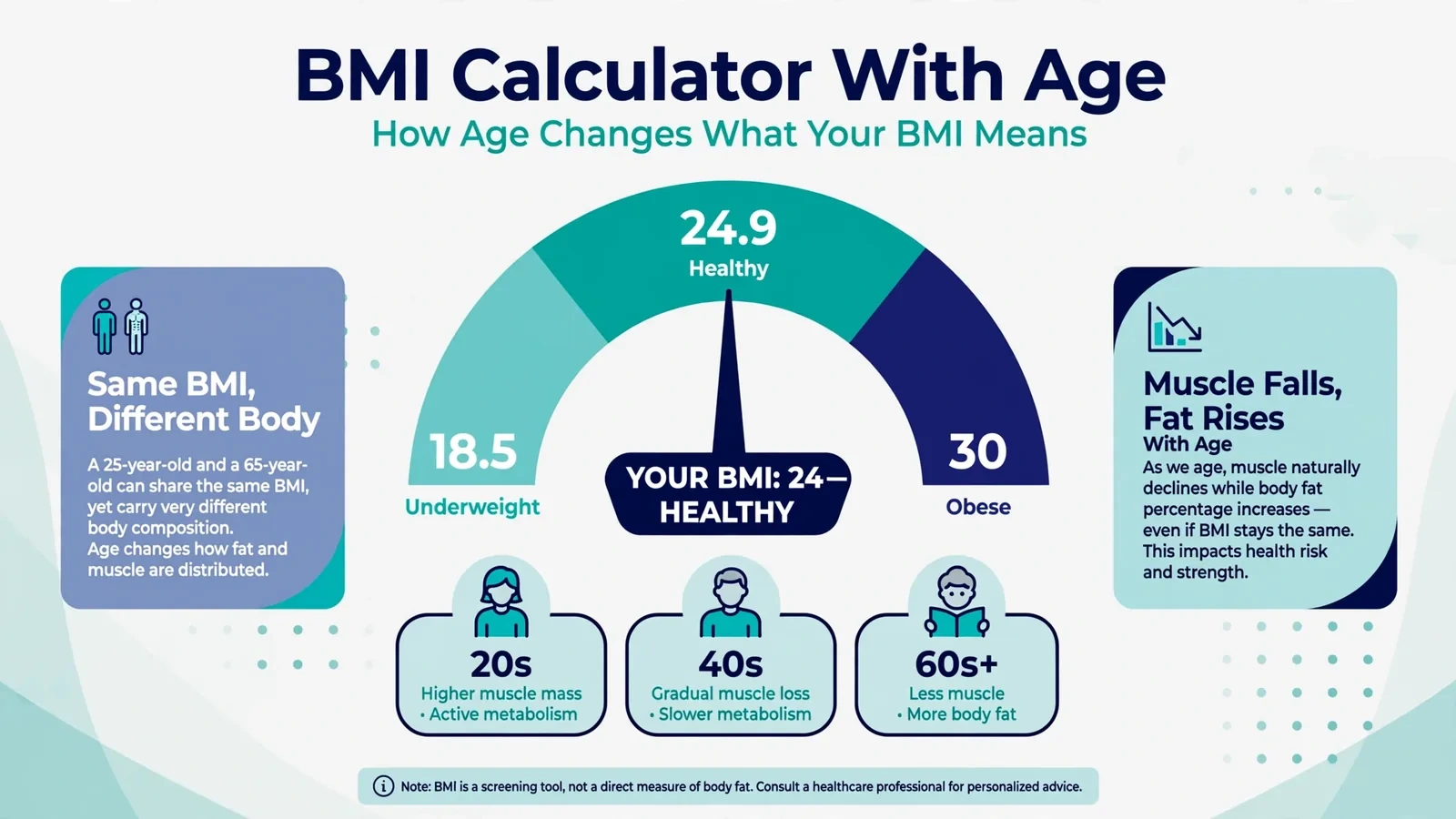
Yes. A BMI calculator with age gives you the same number as any standard calculator, but reads it against what is happening in your body at your stage of life. A BMI of 24 at age 25 and a BMI of 24 at age 65 describe two very different bodies. The formula never changes. Your body does, every decade, whether the scale moves or not.
Most people see a verdict like “healthy” or “overweight” and stop there. That works in your twenties. By your forties, and especially past sixty, the verdict misses a lot: muscle shrinks, fat settles around the middle, and weight can stay the same while your composition rearranges itself.
What Does a BMI Calculator With Age Actually Do?
A BMI calculator with age computes your Body Mass Index from your height, weight, and age, then interprets the result against age related changes in body composition. It uses the standard formula, weight in kilograms divided by height in meters squared, and adds context about muscle loss, fat redistribution, and the healthy ranges most relevant to your decade of life.
The math is identical; only the interpretation differs. A basic tool uses fixed cutoffs: 18.5 to 24.9 “healthy,” 25 to 29.9 “overweight,” 30-plus “obese.” A BMI calculator with age asks whether the number is healthy for a person your age, with your muscle and activity level. Get the raw number from the BMI Calculator – CalcuNexa.com first, then come back to read what it means for your age.
Why Does the Same BMI Mean Something Different at 25 and 65?
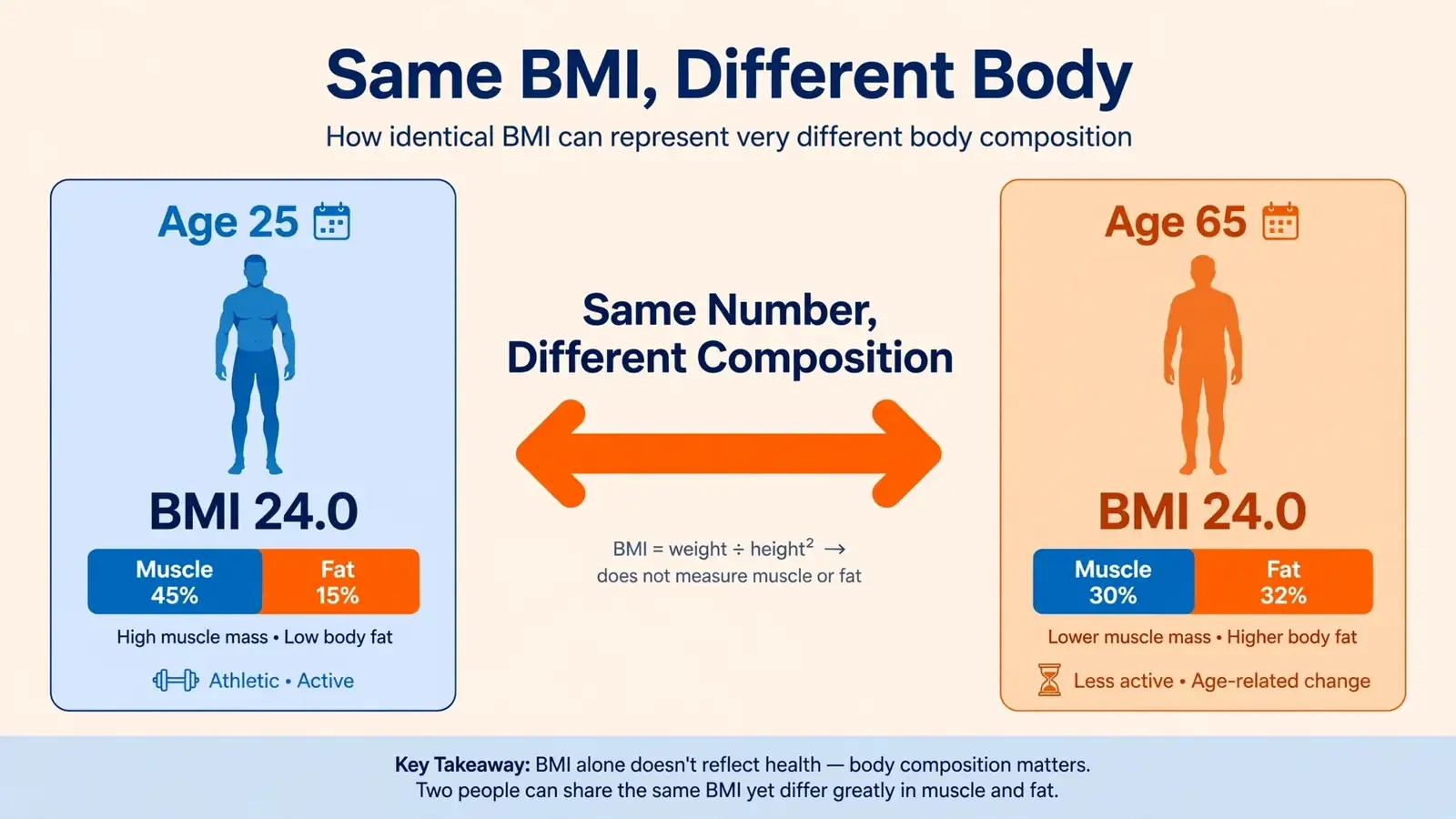
Because BMI only sees weight and height. Picture two men, both 178 cm and 76 kg, both BMI 24.0: the 25-year-old lifts weights, the 65-year-old has lost leg muscle. Their body fat percentages might differ by ten points. That is normal aging. From around 30, adults lose muscle and gain fat even when the scale barely moves, so a stable BMI can hide a body getting fatter and weaker.
Fat also changes address, migrating to the abdomen as visceral fat, the type most linked to heart disease, diabetes, and stroke. BMI is blind to this. The CDC agrees: older adults generally have more body fat than younger adults with the same BMI. See the CDC page about BMI for adults.
Does the Healthy BMI Range Shift as You Get Older?
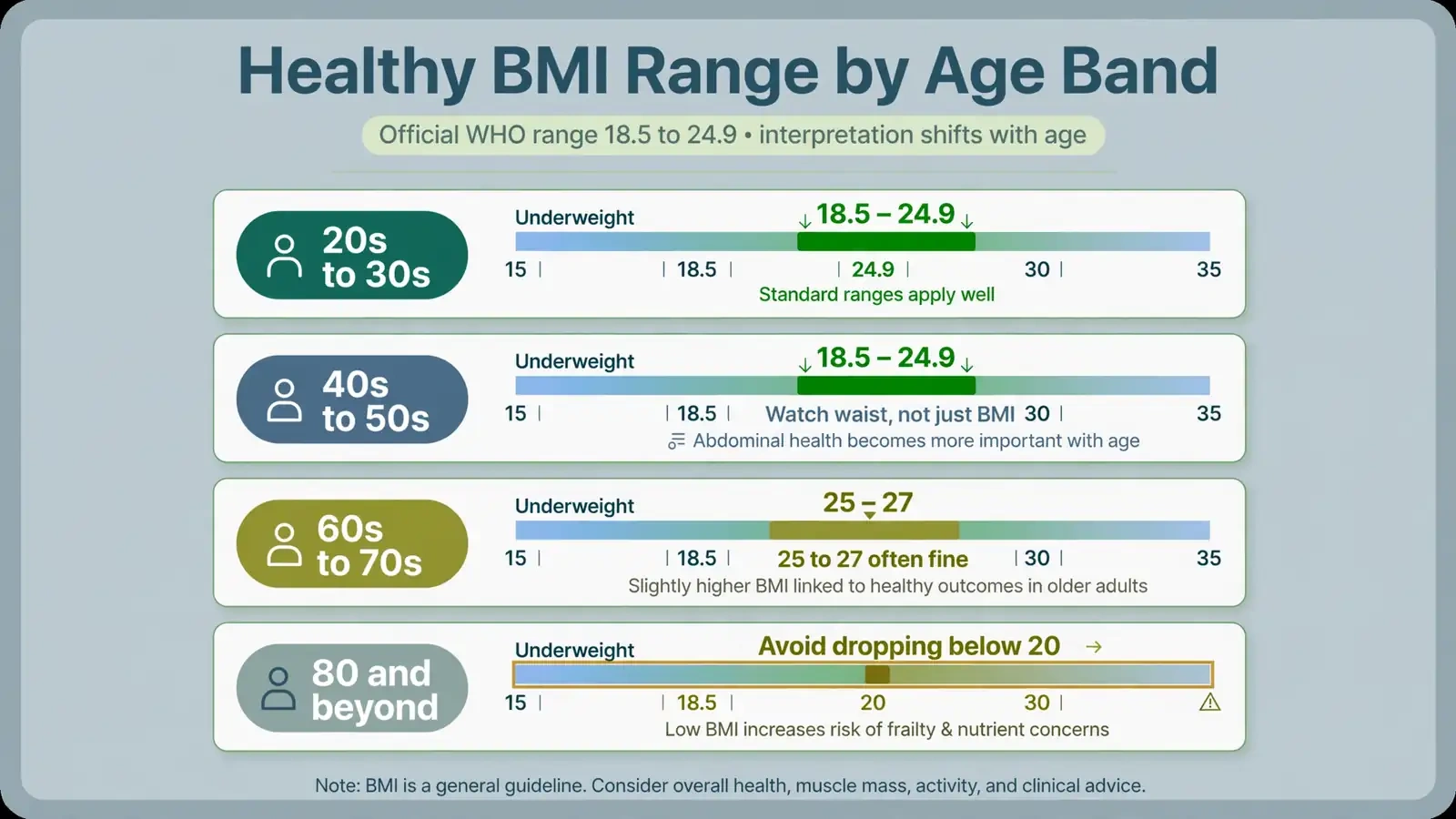
Officially, no. The World Health Organization keeps the same adult cutoffs for everyone aged 20 and over: 18.5 to 24.9 is the healthy range. Those are screening lines for populations, not personal targets. The WHO fact sheet on obesity and overweight is the reference most calculators use.
In practice, the “healthiest” BMI drifts upward with age. Large studies show adults over 65 have the lowest mortality risk around BMIs of 25 to 27, as a little reserve weight protects against frailty, falls, and illness-related wasting. A BMI of 26 carries less penalty at 70 than at 30, while the penalty for being underweight grows much larger.
How a BMI calculator with age reads each band:
| Age Band | What Is Happening in the Body | How to Read Your BMI |
|---|---|---|
| 20s to 30s | Muscle near its peak, fat relatively low | Standard ranges apply well |
| 40s to 50s | Muscle loss begins, visceral fat rises | Read with context; a healthy BMI plus a growing waist deserves attention |
| 60s to 70s | Muscle loss accelerates, bones thin | 25 to 27 is often fine; avoid drifting below 20 |
| 80 and beyond | Frailty and undernutrition dominate | Holding weight matters more than hitting 22 |
The takeaway: the same number carries different risk at different ages. The danger of being too light grows as you age, while the danger of being slightly heavy shrinks.
What Is Sarcopenia and How Does It Skew BMI in Older Adults?
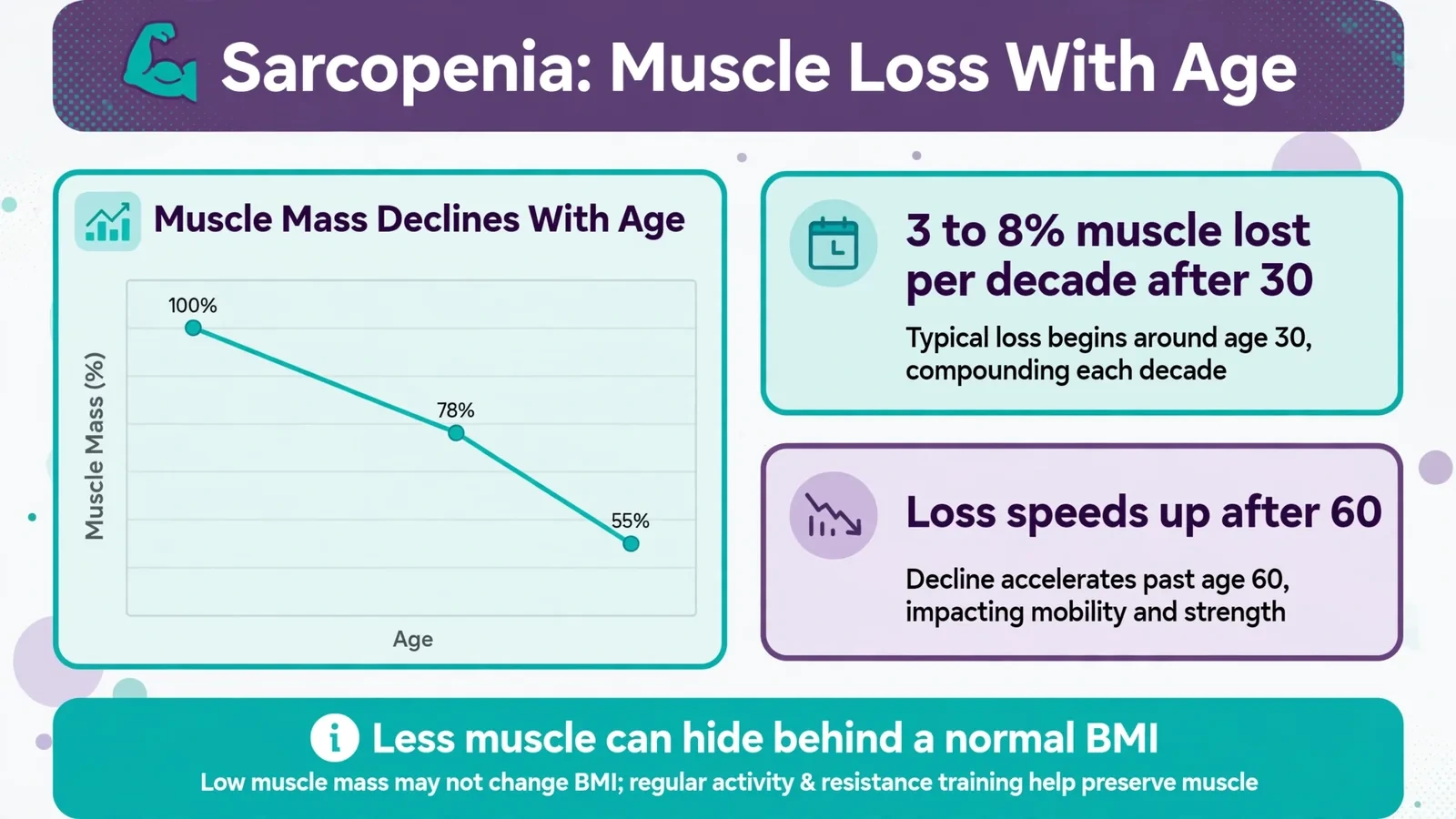
Sarcopenia is the age related loss of muscle mass and strength. It often starts in the thirties and speeds up after sixty, with adults losing roughly 3 to 8 percent of their muscle per decade after 30.
Sarcopenia skews BMI sneakily: when dense muscle is replaced by bulkier fat, weight can stay the same or drop. Your BMI says “healthy” while your body fat says otherwise, a pattern called normal weight obesity.
This is the biggest reason a BMI calculator with age matters more after sixty: the older you are, the more likely your BMI flatters you. A sedentary 68-year-old with a BMI of 23 may be worse off than an active one at 27. The fix is not on the chart: resistance exercise and enough protein build strength at any age.
How Should You Read Your BMI in Your 20s, 40s, and 60s?
Here is the decade by decade reading a BMI calculator with age would give you.
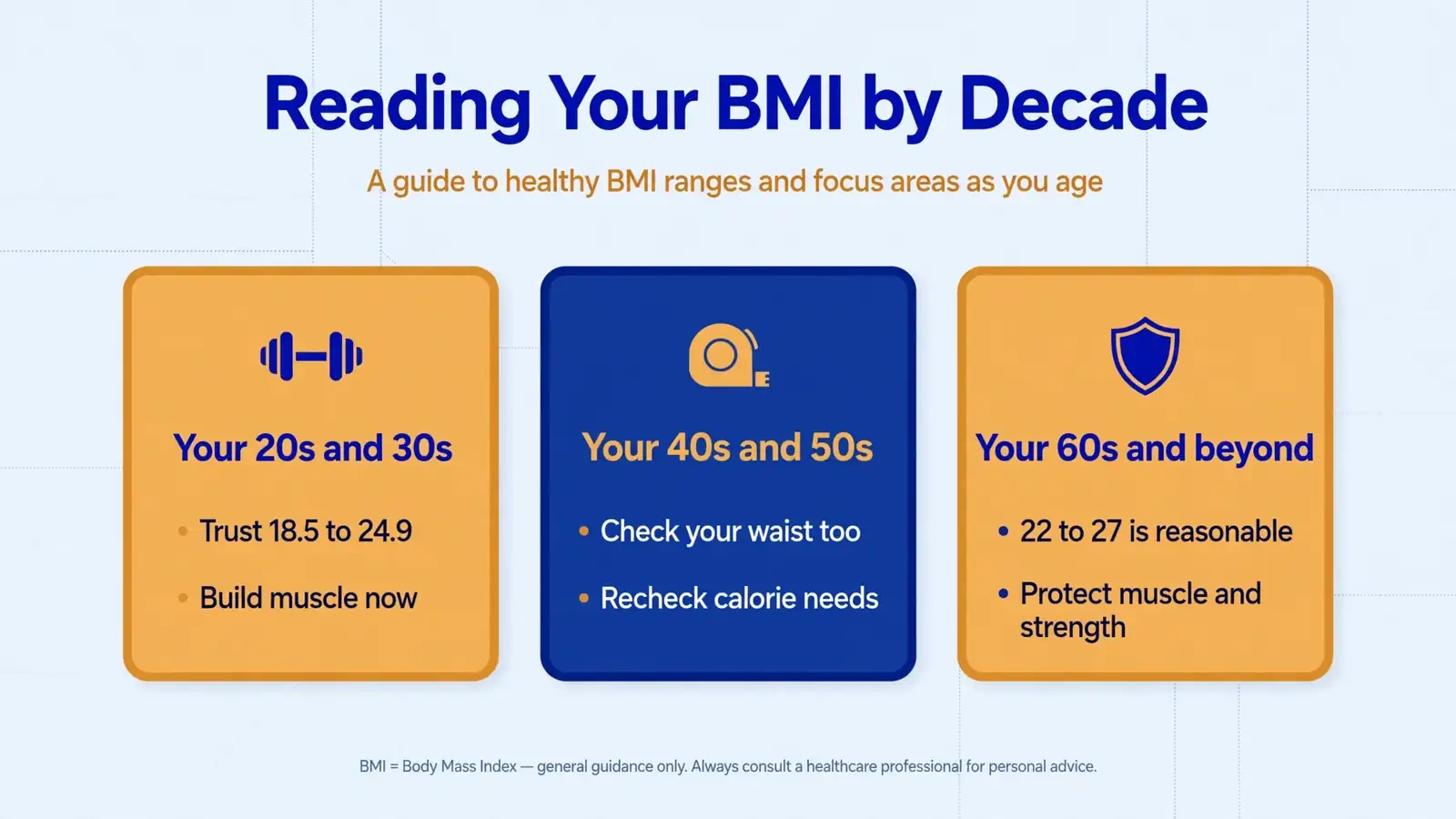
In your 20s and 30s, trust the standard ranges: 18.5 to 24.9 with reasonable activity means you are in good shape. Build the muscle and habits now that will protect you later.
In your 40s and 50s, read the number with context. Most people gain a kilogram or two a year without noticing. If your BMI crept from 23 to 27 over a decade, address it: midlife weight gain strongly predicts later metabolic disease. Also check your waist: a BMI of 24 with a 100 cm waist is worse than 26 with an 85 cm waist. Recheck your targets with the Calorie Calculator | Calculate Daily Calories, BMR & TDEE every few years, as calorie needs fall with muscle.
In your 60s and beyond, stop chasing the low end of the range: 22 to 27 is reasonable. Worry instead about unintentional weight loss, shrinking strength, and a BMI sliding toward 20. The Harris Benedict Formula | Calculate BMR, TDEE, and Daily Calories page shows how age lowers your baseline burn.
When Should Older Adults Look Beyond BMI?
For adults past sixty, look past the number when any of these are true.
Stable weight, changing shape. Bigger belly, thinner limbs means muscle is being replaced by fat, which BMI never flags.
“Healthy” BMI, unhealthy waist. Keep your waist under half your height; abdominal fat accumulates with age regardless of BMI.
Unintentional weight loss. After sixty this is a red flag, not a victory. It often signals muscle loss or an underlying issue. See a doctor.
Declining strength and function. Trouble rising from a chair, weaker grip, slower walking. These predict health outcomes better than BMI in older adults.
Blood work tells a different story. Blood pressure, glucose, and cholesterol measure real metabolic health, which no body measurement can replace.
Frequently Asked Questions
Does a BMI calculator with age use a different formula?
No. The formula never changes; only the interpretation does. The guidance accounts for typical muscle loss, fat redistribution, and shifting risk at your age.
Is a BMI of 27 bad for a 65 year old?
Probably not. Research repeatedly finds the lowest mortality risk for older adults around BMIs of 25 to 27. At 65, muscle loss and frailty matter far more than a couple of points above 25.
Why does my BMI stay the same while I look fatter?
You are likely losing muscle and gaining fat at the same time. Muscle is denser than fat, so the swap barely moves the scale while visibly changing your shape.
What is normal weight obesity?
A BMI in the healthy range (18.5 to 24.9) paired with unhealthy body fat and low muscle mass. It is common in older, sedentary adults and carries metabolic risks similar to overt obesity, despite the reassuring BMI.
Should older adults aim for the same healthy range as younger adults?
Not necessarily. Evidence suggests adults over 65 do well around 22 to 27 and face real danger below 20. After sixty, avoiding frailty and preserving muscle matter more than hitting the middle of the chart.
What should I track instead of BMI after 60?
Waist circumference (under half your height), grip strength, walking speed, and how easily you rise from a chair, plus regular blood pressure, blood sugar, and cholesterol checks.
Conclusion
A BMI calculator with age does not change your number. It changes what your number means, and that matters more with every passing decade. In your twenties the standard ranges work fine. By your forties, read them alongside your waistline. Past sixty, protect muscle and a stable weight instead of chasing the low end of the chart.
Your next step: get your number from a reliable calculator, measure your waist, and compare the two. If they tell different stories, believe the fuller picture and talk to your doctor about what it means for you.
1 thought on “BMI Calculator With Age: How Your Number Changes Meaning Across Decades”