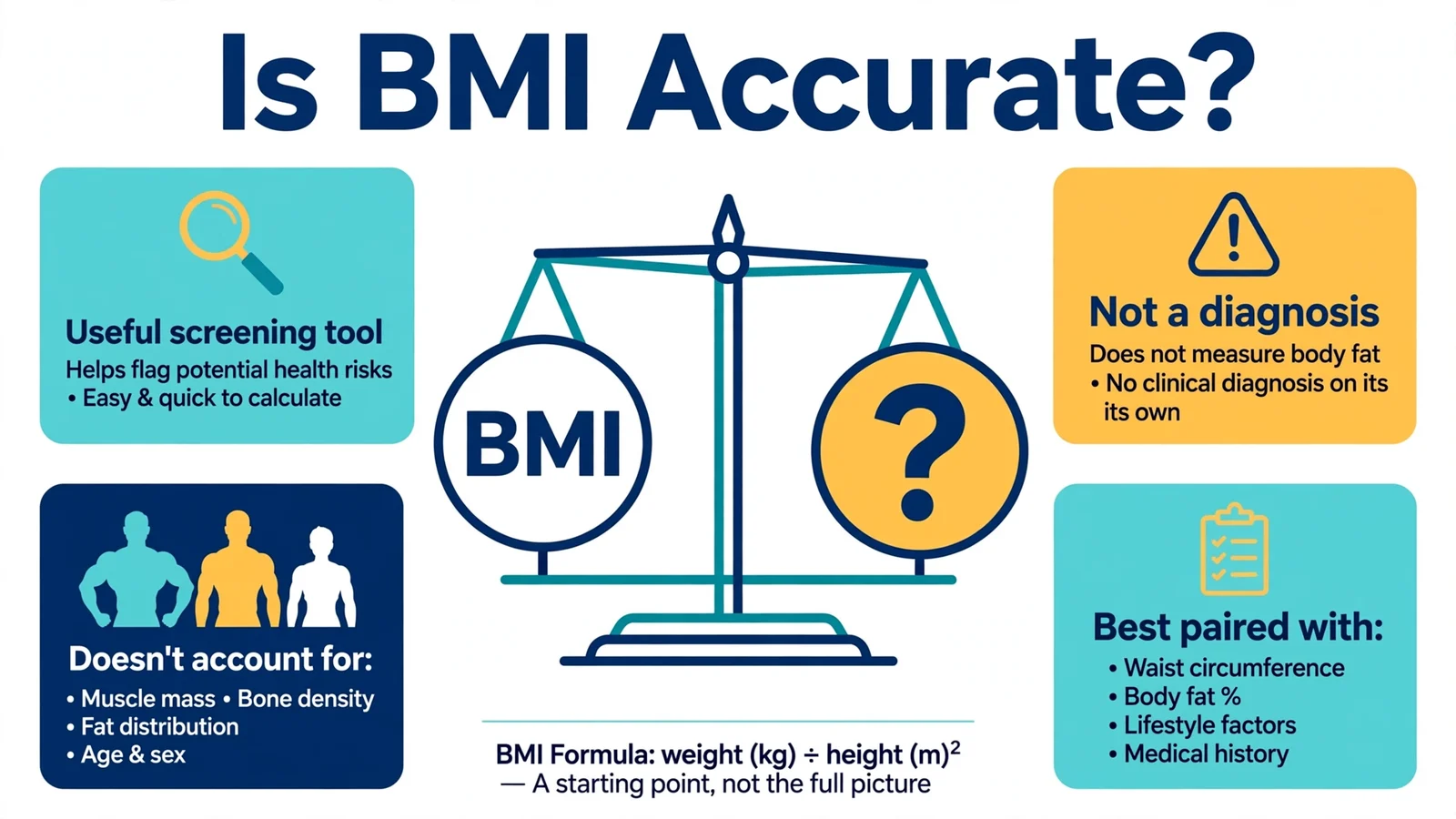
BMI is accurate as a population screening tool but often misleading for individuals. It correctly flags weight related health risk across large groups, yet it can’t tell muscle from fat, ignores where fat sits on your body, and was never designed to diagnose any single person’s health. Here’s an honest breakdown of what BMI gets right, where it goes wrong, and what to use instead.
What Does "Accurate" Mean for BMI?
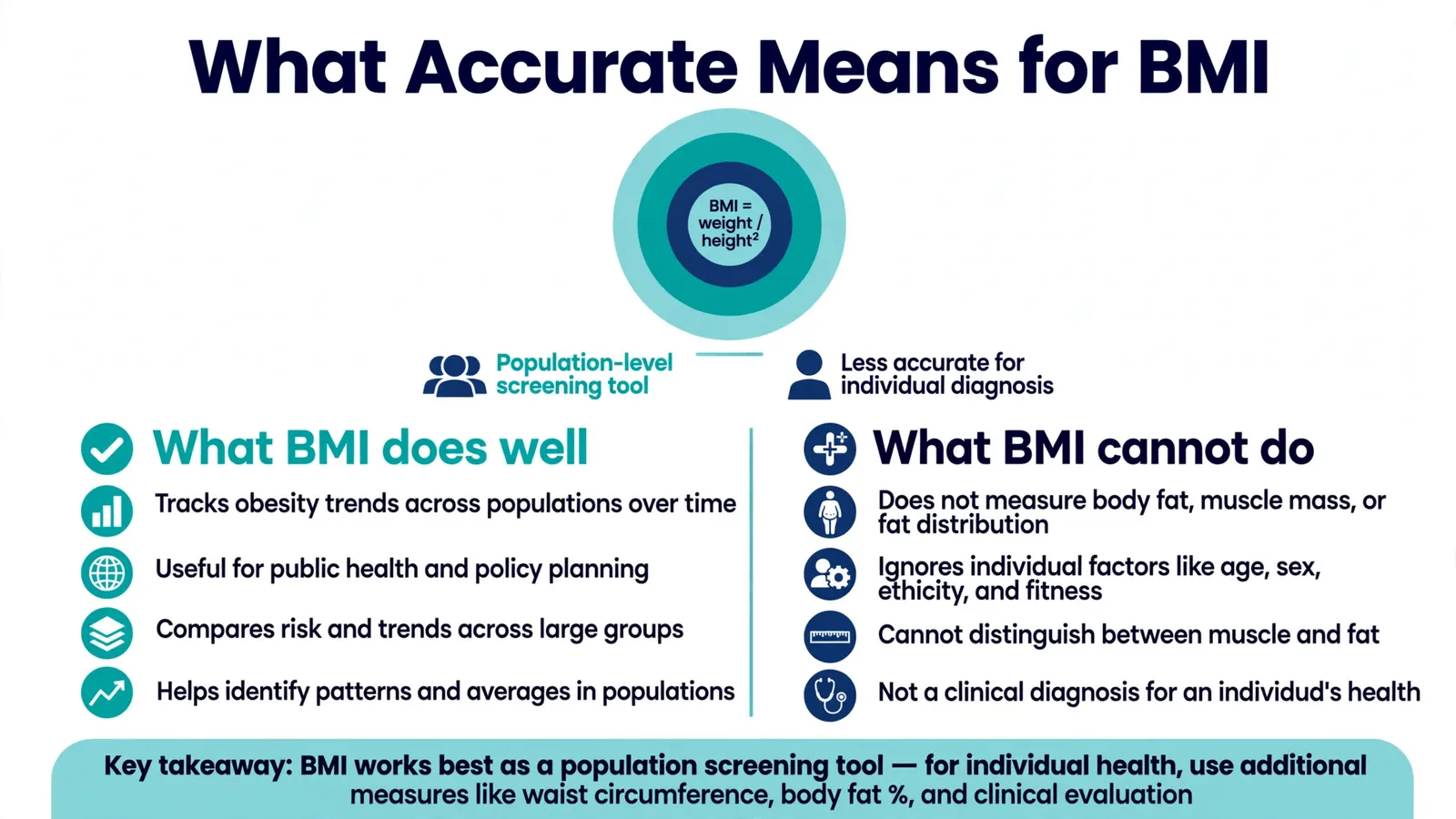
Accuracy depends on what you’re asking BMI to do. As a quick, cheap screening measure across populations, BMI is remarkably accurate. Large studies consistently show that as BMI rises above 25, rates of type 2 diabetes, hypertension, heart disease, and certain cancers climb with it. Insurance companies and public health agencies rely on it precisely because the population level correlation is strong.
But “accurate for populations” and “accurate for you” are different claims. BMI estimates body fat indirectly from height and weight alone. It never measures fat directly. For any given individual, the estimate can be off by a lot, because two people with identical BMIs can have very different amounts of actual body fat.
So the fair answer: BMI is accurately measuring what it measures (weight relative to height). It’s just that weight relative to height is an imperfect proxy for the thing you actually care about, which is body composition and metabolic health.
Who Does BMI Misclassify Most Often?
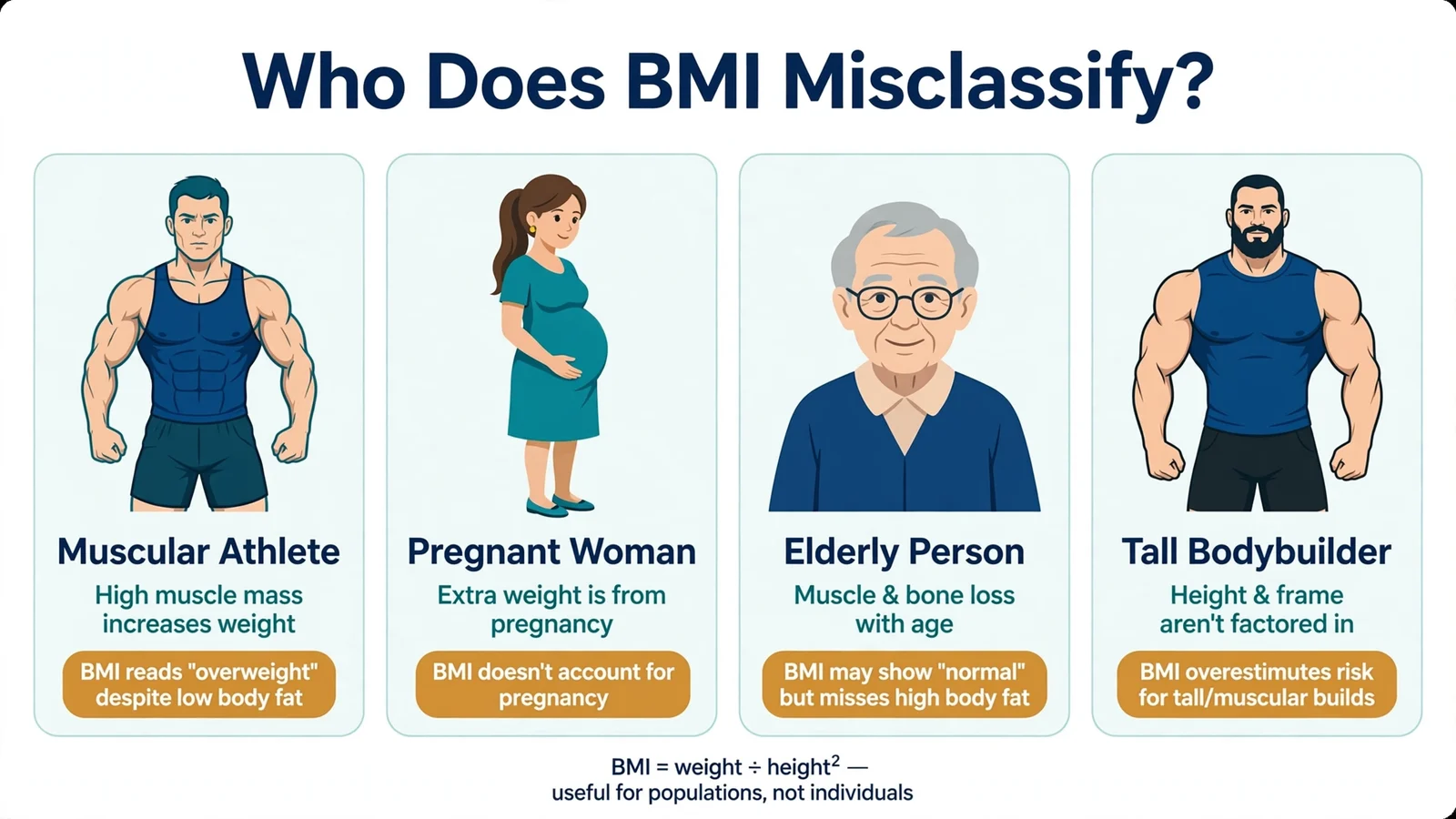
Certain groups get the worst deal from BMI, and if you’re in one of them, you should interpret your number with extra skepticism.
Athletes and muscular people. This is the classic case. Muscle tissue is denser than fat, so someone with significant muscle mass can have a BMI of 27 or 28 (“overweight”) while carrying very little body fat. Professional rugby players, bodybuilders, and even regular weightlifters routinely land in categories that don’t reflect their actual health.
Older adults. After about age 30, most people gradually lose muscle and gain fat even if their weight stays stable, a process called sarcopenia. An older adult with a “healthy” BMI of 23 might actually have high body fat and low muscle, a condition researchers call normal weight obesity. The number looks fine; the composition isn’t.
Very short or very tall people. The BMI formula doesn’t scale perfectly at height extremes. Very short adults may get slightly inflated BMIs and very tall adults slightly deflated ones, relative to their actual body fat.
Pregnant women. BMI is meaningless during pregnancy, when weight gain is expected and healthy. Doctors use pregnancy specific weight gain guidelines instead.
Certain ethnic groups. The standard cutoffs were derived mainly from European populations. Research indicates that South Asian, Chinese, and some other Asian populations tend to develop metabolic problems at lower BMIs, while some Pacific Islander populations may be healthy at higher BMIs. The WHO has acknowledged this with suggested lower thresholds for Asian adults, but they aren’t universally applied.
What Can't BMI Tell You?
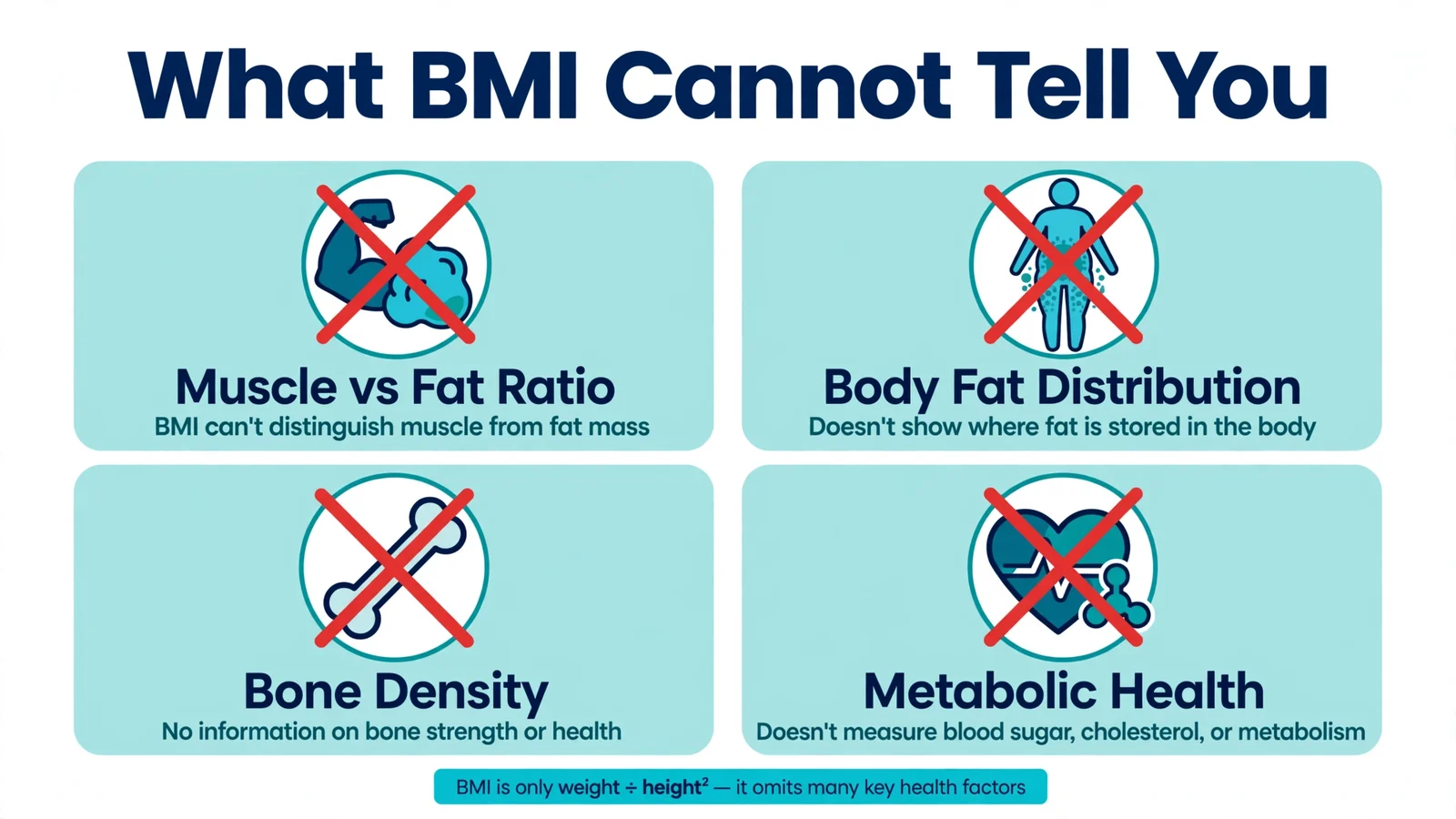
Quite a lot, it turns out. Here’s the list of things your BMI number is silent about.
Body composition. The big one. BMI can’t distinguish a pound of muscle from a pound of fat. It also can’t tell you your body fat percentage, which is arguably the more meaningful number.
Fat distribution. Where fat lives matters enormously. Visceral fat packed around your organs drives far more metabolic risk than subcutaneous fat under the skin on your hips and thighs. Two people with a BMI of 29 can have dramatically different risk profiles depending on distribution. BMI sees none of this.
Metabolic health. Some people with “obese” BMIs have normal blood pressure, cholesterol, and blood sugar (the “metabolically healthy obese” phenotype), while some with “normal” BMIs have the full cluster of metabolic problems. BMI doesn’t measure a single blood marker.
Fitness and lifestyle. A BMI of 26 in someone who exercises daily, sleeps well, and eats sensibly means something very different from 26 in someone sedentary with poor habits. BMI captures none of your behaviors.
Bone density and frame size. People with naturally larger frames or denser bones weigh more at the same body fat level. BMI penalizes them for skeleton, not fat.
What Should You Use Instead of (or With) BMI?
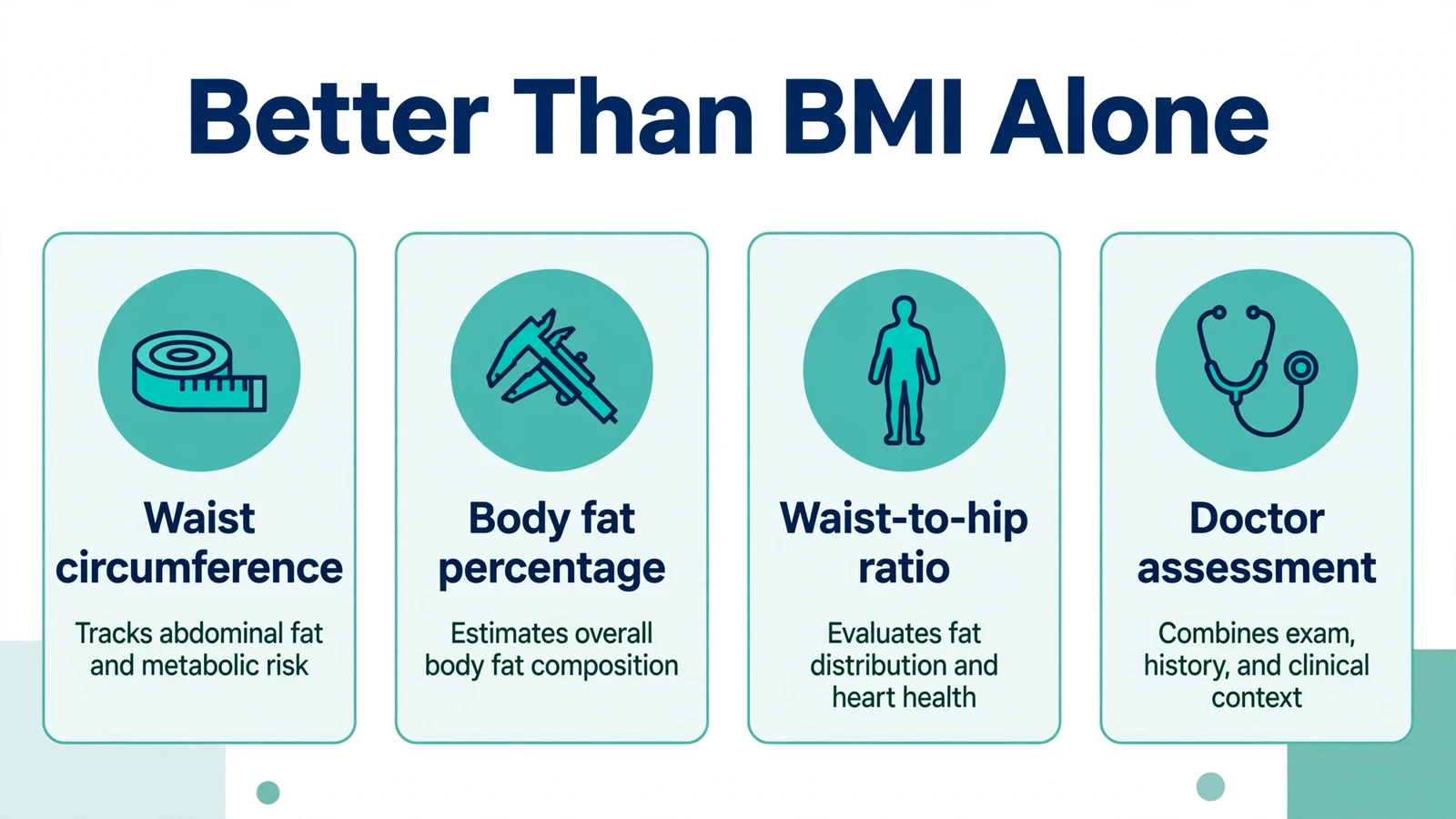
You don’t have to throw BMI out. You just need to pair it with better companions.
Waist circumference. The single best low tech companion. Measure around your navel with a tape measure. Under 35 inches for women and under 40 inches for men is the standard target. Waist size captures abdominal fat directly, which is the type most tied to disease. Many researchers now argue waist to height ratio (keep your waist under half your height) is the superior simple metric.
Waist to hip ratio. Divide waist by hip circumference. Below 0.85 for women and 0.90 for men is generally considered healthy. This adds information about fat distribution pattern.
Body fat percentage. The gold standard concept, though measurement quality varies wildly. Calipers are cheap but technique dependent. Bioelectrical impedance scales are convenient but swing with hydration. DEXA scans are the most accurate but cost money and require a clinic visit.
Basic blood work. Blood pressure, fasting glucose, HbA1c, cholesterol panel, and triglycerides tell you about actual metabolic health in a way no body measurement can. If these are all excellent, a borderline BMI is far less concerning.
How you feel and function. Can you climb stairs without gasping? Do you sleep well? Do you have energy through the day? These functional signals matter, and no formula captures them.
The practical approach most doctors recommend: start with BMI as a screen, add waist measurement, and let blood work and symptoms guide what happens next.
Frequently Asked Questions
Is BMI still used by doctors?
Yes, widely. Despite its flaws, BMI remains the standard first screen because it’s fast, free, and works well enough at the population level. Good doctors treat it as a conversation starter, not a diagnosis, and follow up with waist measurements, blood work, and clinical judgment.
Why is BMI criticized so much?
Mainly because it’s frequently misused as a definitive health verdict rather than a rough screen. The criticism isn’t that BMI is useless, it’s that a single number from height and weight can’t capture body composition, fat distribution, fitness, or metabolic health, yet it’s often treated as if it can.
What is a better alternative to BMI?
Waist to height ratio is the strongest simple alternative: keep your waist circumference under half your height. For a fuller picture, combine it with body fat percentage (via calipers or a DEXA scan) and basic metabolic blood work.
Can you be obese by BMI but healthy?
Yes, this is documented as “metabolically healthy obesity.” Some people with BMIs over 30 have normal blood pressure, blood sugar, and cholesterol. That said, long term studies suggest the protection often fades with time, so it still warrants monitoring rather than complacency.
Does BMI underestimate body fat?
For many people, yes, especially older adults and those with low muscle mass. Because BMI can’t see composition, someone with a “healthy” BMI of 23 but very little muscle can actually have an unhealthy body fat percentage. This is sometimes called normal weight obesity or skinny fat.
Should athletes ignore BMI completely?
Pretty much. If you train seriously and carry visible muscle, BMI will almost certainly overstate your body fat. Track body fat percentage, performance metrics, and how your clothes fit instead. BMI was never designed for athletic bodies.
Conclusion
So, is BMI accurate? It’s accurate at what it was built for: cheaply screening large populations for weight related risk. It’s inaccurate when stretched into a personal health verdict, because it can’t see muscle, fat distribution, metabolic markers, or any of the things that actually determine how healthy you are.
Use it for what it is: a starting point. Check your number with our free BMI calculator, then grab a tape measure and check your waist too. If either number concerns you, bring both to your doctor along with recent blood work, and you’ll have a far more honest conversation than BMI alone could ever start. And if you’re working toward a healthier weight, our calorie calculator can help you set a realistic daily target.
For the official perspective, the CDC explains both the uses and limits of BMI for adults, and a well known review in the journal Obesity has examined where BMI helps and where it misleads.
3 thoughts on “Is BMI Accurate? | What Your Number Misses About Your Health”