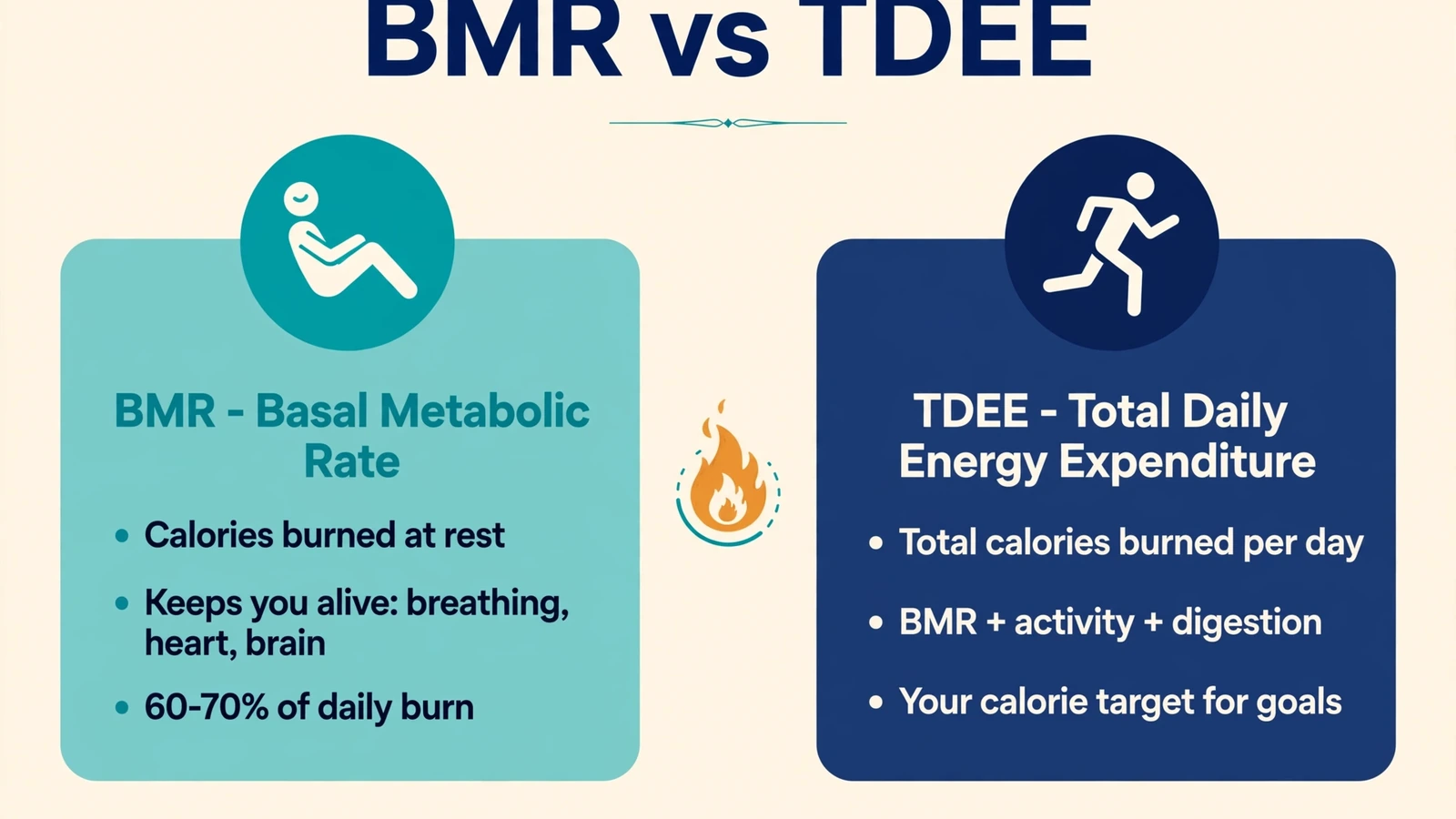
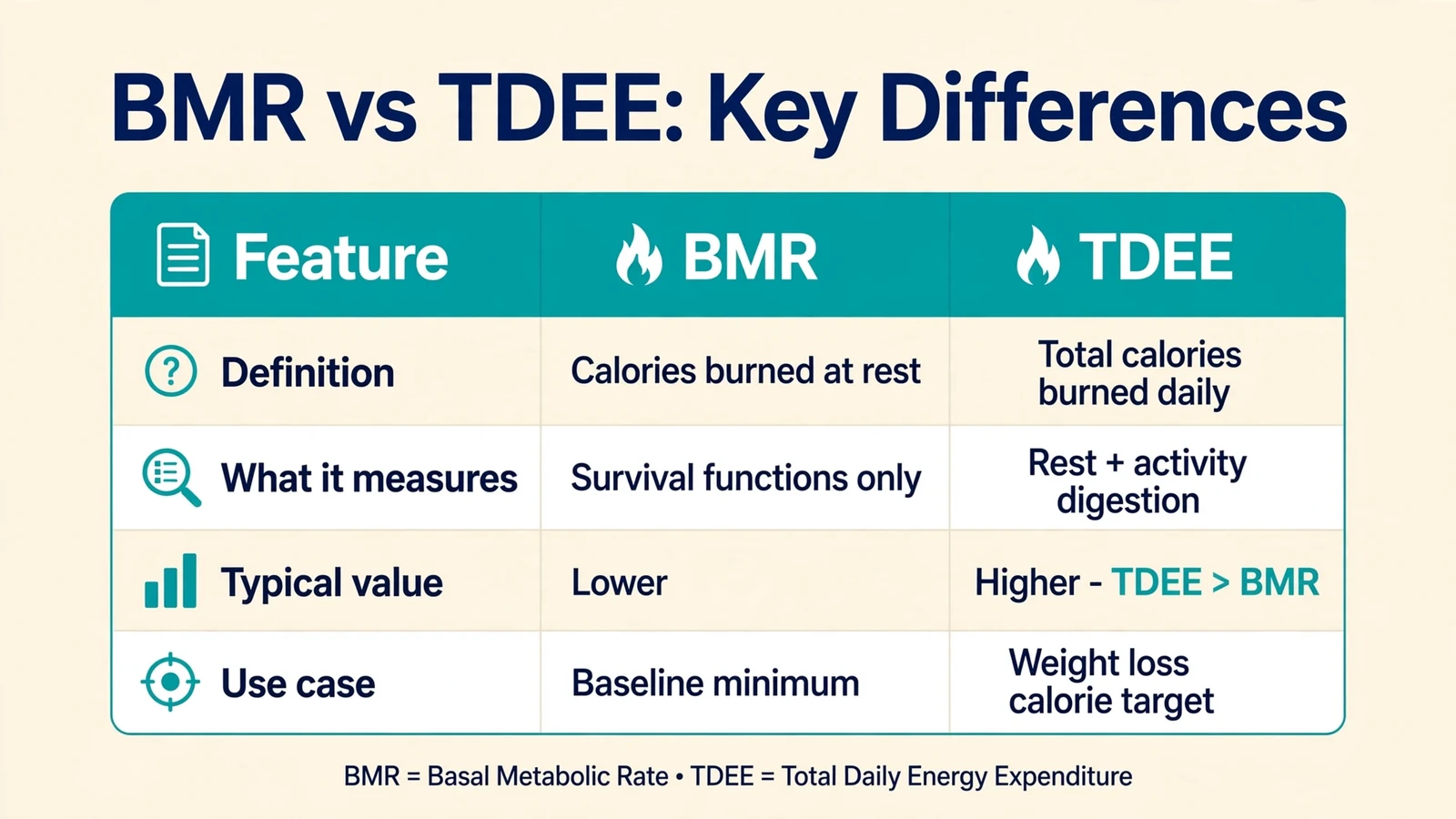
BMR vs TDEE comes down to one simple idea: BMR is the calories you burn at total rest, TDEE is the calories you burn across a full day of real life. BMR (basal metabolic rate) covers the basics: heartbeat, breathing, temperature control, and cell repair. TDEE (total daily energy expenditure) adds everything else: walking, working, exercising, and digesting food.
The BMR vs TDEE question confuses many people, and the mistake costs them: eating at your BMR when you meant a modest deficit can leave you 500 to 1,000 calories short, bringing fatigue and stalled progress. This guide explains what each number measures, how to calculate both, and which one your calorie target should come from.
Skip the arithmetic and run the same math in seconds with a free calorie calculator.
What Is BMR?
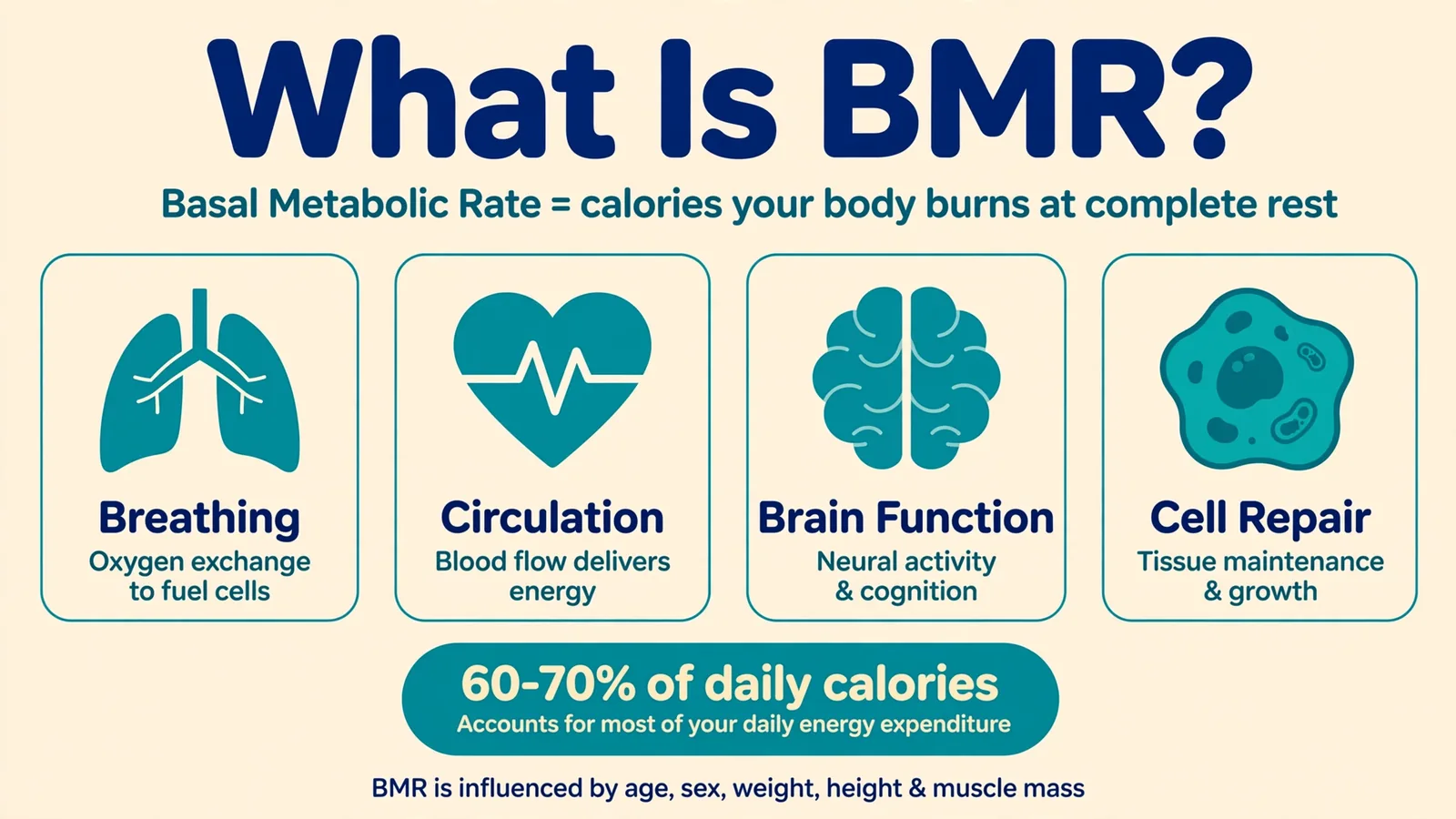
BMR is the calories your body burns at complete rest, just to stay alive: even lying in bed, your heart pumps, lungs move air, and cells repair tissue. All of that costs energy.
For most adults, BMR is roughly 60 to 70 percent of daily calories. A bigger body burns more at rest, muscle burns more than fat, and age pushes it down over time. In the BMR vs TDEE picture, BMR is the fixed anchor that barely moves day to day.
One note: true BMR is measured in a lab after an overnight fast. Resting metabolic rate (RMR) is measured under relaxed conditions and runs about 10 percent higher. Most calculators use the two interchangeably, which is fine for planning.
What Is TDEE?
TDEE is the total calories your body burns in a full 24-hour day: the number that tells you how much you can eat to hold your weight steady.
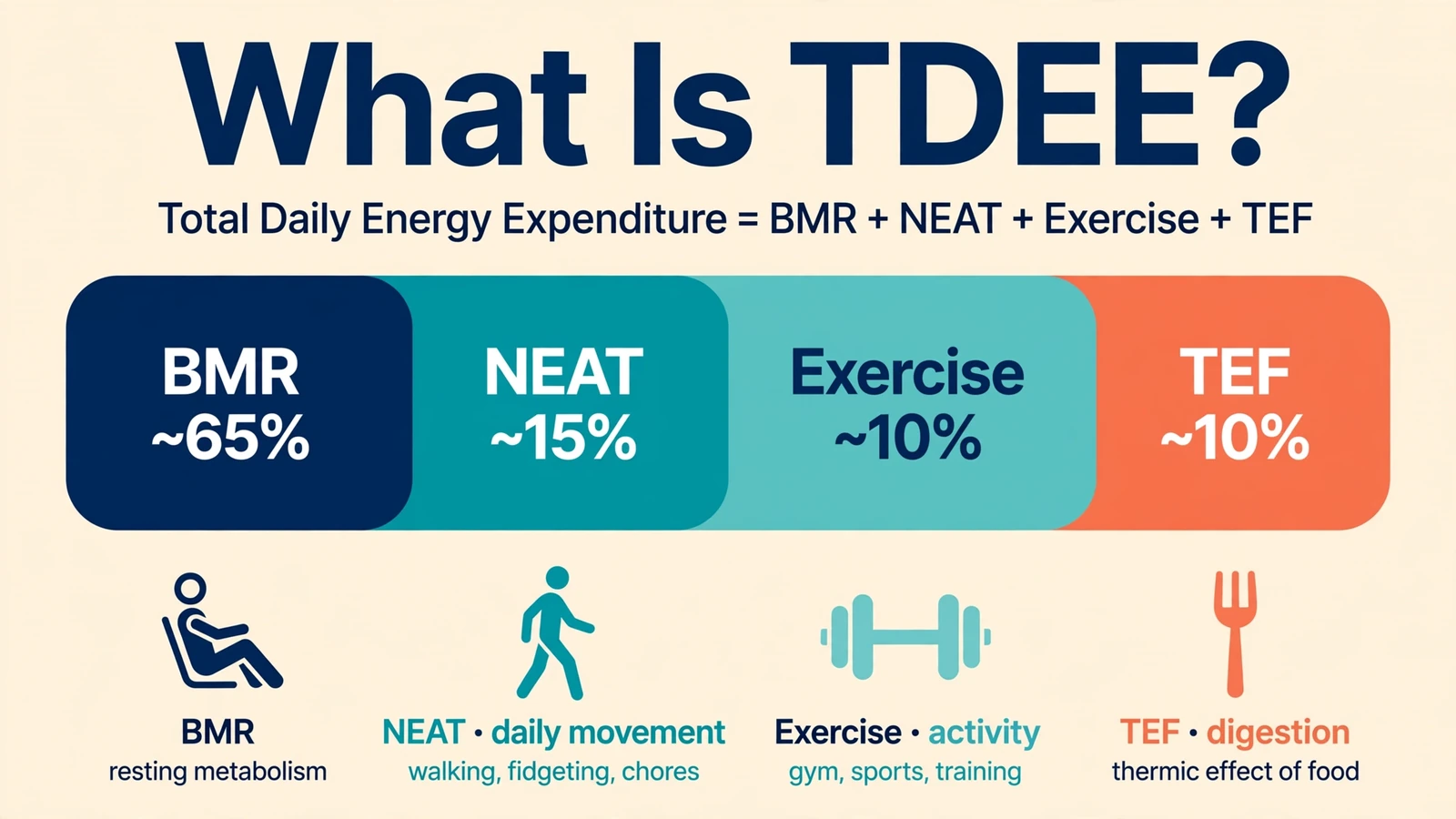
TDEE has four parts:
- **BMR:** the resting baseline, roughly 60 to 70 percent of the total.
- **NEAT (non-exercise activity thermogenesis):** everyday movement like fidgeting, walking, and cooking: 15 to 30 percent of your burn, varying hugely between people.
- **EAT (exercise activity thermogenesis):** planned workouts and sports, usually a small slice.
- **TEF (thermic effect of food):** the energy spent digesting and absorbing food, about 10 percent of what you eat. Protein costs the most to process.
In any BMR vs TDEE comparison, TDEE is always the larger number. It is also your maintenance level. Eat at it and your weight holds. Eat below it and you lose. Eat above it and you gain.
What Is the Difference Between BMR and TDEE?
Simply put, BMR covers survival and TDEE covers living. BMR counts only the energy of keeping your body running at rest. TDEE adds every extra calorie spent on movement, exercise, and digestion. The BMR vs TDEE table below lays it out side by side.
| BMR | TDEE | |
|---|---|---|
| **Definition** | Calories burned at complete rest | Total calories burned in 24 hours |
| **What it includes** | Breathing, circulation, temperature, cell repair | Everything in BMR, plus movement, exercise, and digestion |
| **Typical size** | 1,200 to 2,000 kcal/day for most adults | 1,800 to 3,500+ kcal/day, depending on activity |
| **How to calculate** | Mifflin-St Jeor, Harris-Benedict, or Katch-McArdle | BMR times an activity multiplier (1.2 to 1.9) |
| **How to use it** | Your floor: avoid eating below this for long | Your target: set calorie goals from this number |
For a moderately active person, TDEE runs about 1.55 times BMR. The classic BMR vs TDEE mistake is dieting at your BMR: with a BMR of 1,400 and a TDEE of 2,200, eating 1,400 calories is an 800-calorie deficit, not a gentle one.
How Do You Calculate BMR?
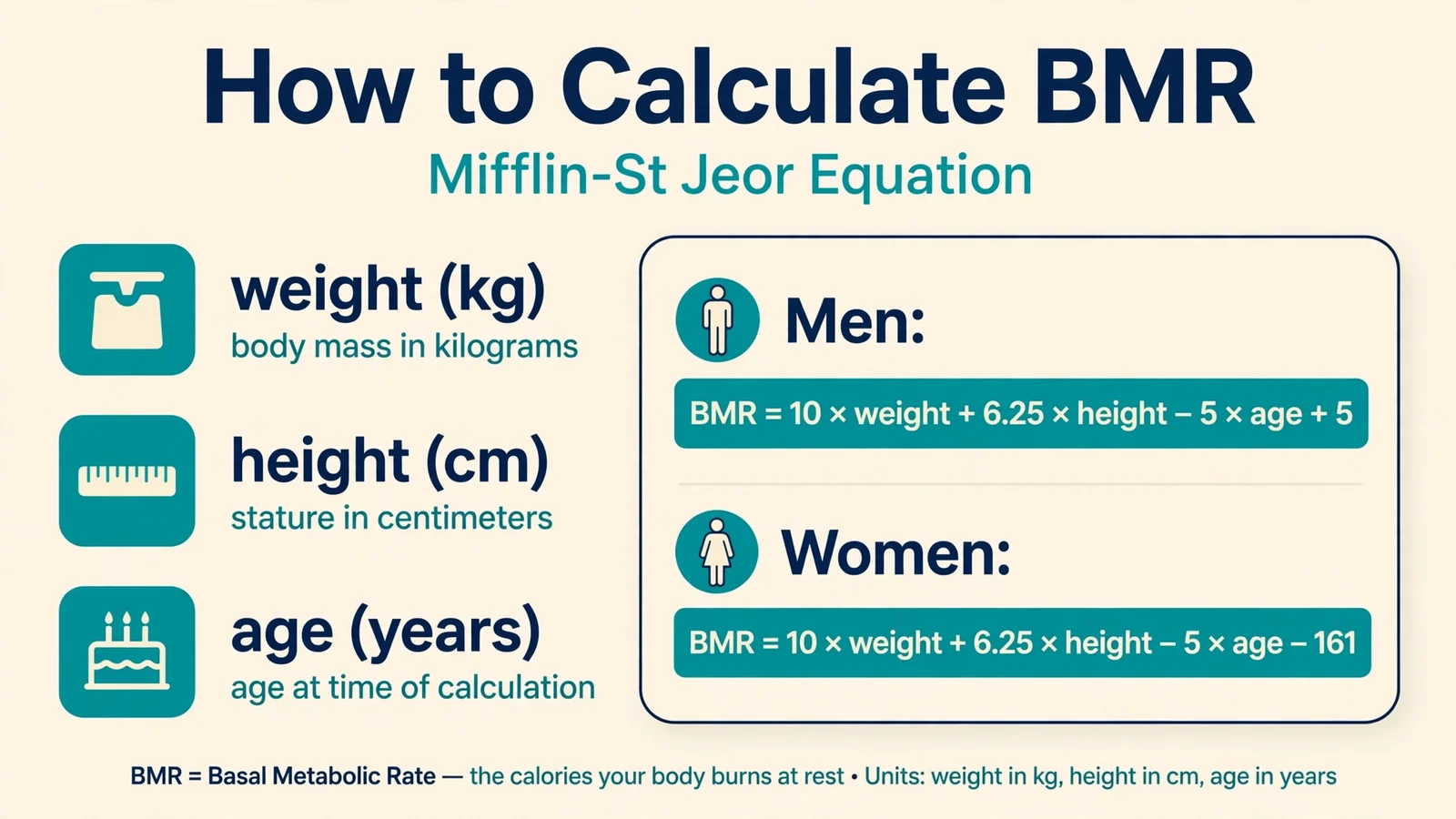
You need weight in kilograms, height in centimeters, and age in years, plus one of the three standard equations below. This is step one of the BMR vs TDEE calculation.
Mifflin-St Jeor (1990)
The modern default. A 2005 review by Frankenfield and colleagues found it landed within 10 percent of measured values in about 82 percent of subjects, the best score of any major formula.
- **Men:** BMR = (10 x weight in kg) + (6.25 x height in cm) – (5 x age) + 5
- **Women:** BMR = (10 x weight in kg) + (6.25 x height in cm) – (5 x age) – 161
Harris-Benedict (1919, revised 1984)
The classic equation, built from a much leaner century-old population. It still gives a rough estimate but overestimates BMR by about 5 percent in modern sedentary adults. Read the full breakdown of the Harris-Benedict formula on our formula page.
Katch-McArdle
BMR = 370 + (21.6 x lean body mass in kg). It uses lean mass directly, so it suits lean athletes best. It is only as good as your body fat measurement, so with a guessed lean mass, use Mifflin-St Jeor.
Worked example
A 30-year-old man, 81.6 kg, 178 cm tall. With Mifflin-St Jeor:
BMR = (10 x 81.6) + (6.25 x 178) – (5 x 30) + 5
BMR = 816 + 1,112.5 – 150 + 5
BMR = 1,783.5 calories per day
That is his resting baseline. Next comes the activity layer.
How Do You Calculate TDEE?
TDEE is one multiplication: BMR times your activity multiplier, picked for your average week, not your best one. This is the second half of the BMR vs TDEE calculation.
| Activity level | Multiplier | Who it describes |
|---|---|---|
| Sedentary | x 1.2 | Desk job, little or no exercise |
| Lightly active | x 1.375 | Light exercise 1 to 3 days per week |
| Moderately active | x 1.55 | Moderate exercise 3 to 5 days per week |
| Very active | x 1.725 | Hard exercise 6 to 7 days per week |
| Extra active | x 1.9 | Physical job plus daily hard training |
Our 30-year-old trains moderately four days a week:
TDEE = 1,783.5 x 1.55 = 2,764 calories per day
Treat this as a starting estimate. If your weight holds steady for two to three weeks, the number is close; if it drifts, adjust by 100 to 200 calories.
How Do You Use BMR and TDEE to Lose or Gain Weight?
Set your calorie target from TDEE, not BMR. BMR is the floor. TDEE is the number every goal is measured against:
- **Maintain weight:** eat at your TDEE.
- **Lose fat:** eat 300 to 500 calories below your TDEE, a pace of roughly a quarter to half a kilo per week that protects muscle.
- **Gain muscle:** eat 200 to 300 calories above your TDEE, with enough protein and resistance training so the surplus builds muscle.
Do not stay below your BMR for long stretches: chronic intakes at or under BMR bring fatigue and muscle loss, and the weight usually returns. Unsure where your weight sits? Check with a BMI calculator first.
Recalculate after real weight change. Losing 5 kg lowers your BMR, which is why plateaus happen: the equation is just updating its inputs.
Frequently Asked Questions
Should I eat at my BMR or my TDEE to lose weight?
Eat below your TDEE, your maintenance level: a deficit means 300 to 500 calories under it. This is the most common BMR vs TDEE question, and the answer is always TDEE.
Which BMR formula is the most accurate?
Mifflin-St Jeor (1990): within 10 percent of measured values in about 82 percent of people in a 2005 review. Harris-Benedict tends to overestimate, while Katch-McArdle wins only for people who know their lean body mass.
What is NEAT, and why does it matter?
NEAT is non-exercise activity thermogenesis: calories burned through everyday movement like fidgeting, walking, and cooking. At 15 to 30 percent of your daily burn, it explains why two people with the same BMR can have very different TDEEs.
Does my TDEE change from day to day?
Yes. BMR is stable, but TDEE moves with your activity, so the multiplier gives an average day. Judge by your weight trend over two to three weeks, not any single day.
What is the thermic effect of food?
TEF is the energy spent digesting, absorbing, and storing nutrients, roughly 10 percent of your intake, with protein costing the most. You do not add it separately: activity multipliers already include it.
Is BMR the same as RMR?
Almost. BMR is measured under strict lab conditions; resting metabolic rate is measured under relaxed conditions and runs about 10 percent higher. For everyday planning, the terms are interchangeable.
How often should I recalculate my numbers?
Every four to six weeks, or after a change of about 3 to 5 kg, since your BMR drops as you lose weight and old targets become new maintenance levels.
Conclusion
BMR vs TDEE does not have to be confusing. BMR is your resting baseline, TDEE is the full picture of a real day, and every calorie target starts from TDEE, with BMR as the floor you should not stay under for long. Your next step: calculate both numbers, then set a target 300 to 500 calories below your TDEE to lose fat, or 200 to 300 above it to build muscle. For background reading, see the NHS guidance on calorie counting and the CDC tips for maintaining a healthy weight.