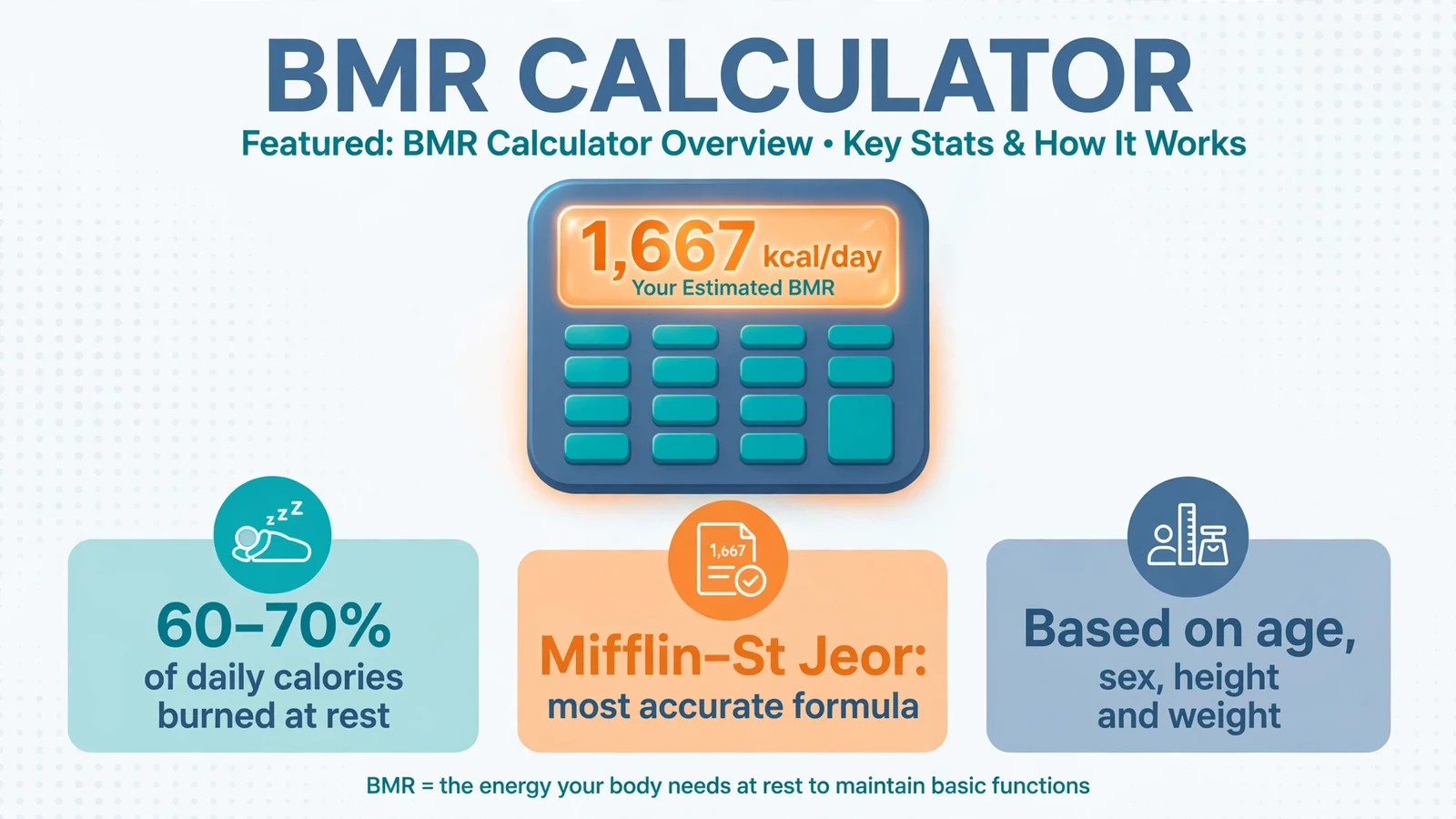
A BMR calculator estimates how many calories your body burns at complete rest to keep you alive: powering your brain, heart, lungs and digestion. If two people eat the same meals but gain weight at different rates, the difference often starts with basal metabolic rate, or BMR. This guide covers what it measures, the formulas behind it, how BMR differs from TDEE, and how to turn your number into a daily calorie target.
What Is a BMR Calculator?
A BMR calculator is a free online tool that estimates your basal metabolic rate from four inputs: age, sex, height and weight. It runs those numbers through a validated equation, most often Mifflin-St Jeor, and returns your estimated calorie burn per day at rest.
Think of it as the starting line for any calorie plan. Add your daily activity on top to find total daily energy expenditure (TDEE), the number that decides whether you lose, maintain or gain weight.
What Is BMR? Basal Metabolic Rate Explained
BMR stands for basal metabolic rate: the calories your body needs over 24 hours to perform basic life-sustaining functions while you do nothing. That covers breathing, circulation, cell repair, brain function and stable body temperature.
For most people, BMR accounts for 60 to 70 percent of all calories burned each day. It is sometimes confused with resting metabolic rate (RMR), measured under more relaxed conditions and usually about 10 percent higher. For everyday calorie planning, most calculators treat them the same way.
How Does a BMR Calculator Work?
Every BMR calculator runs on one of a few research-tested equations: you enter your stats, the tool applies the math, and you get an instant estimate. Here are the three worth knowing.
The Mifflin-St Jeor Equation
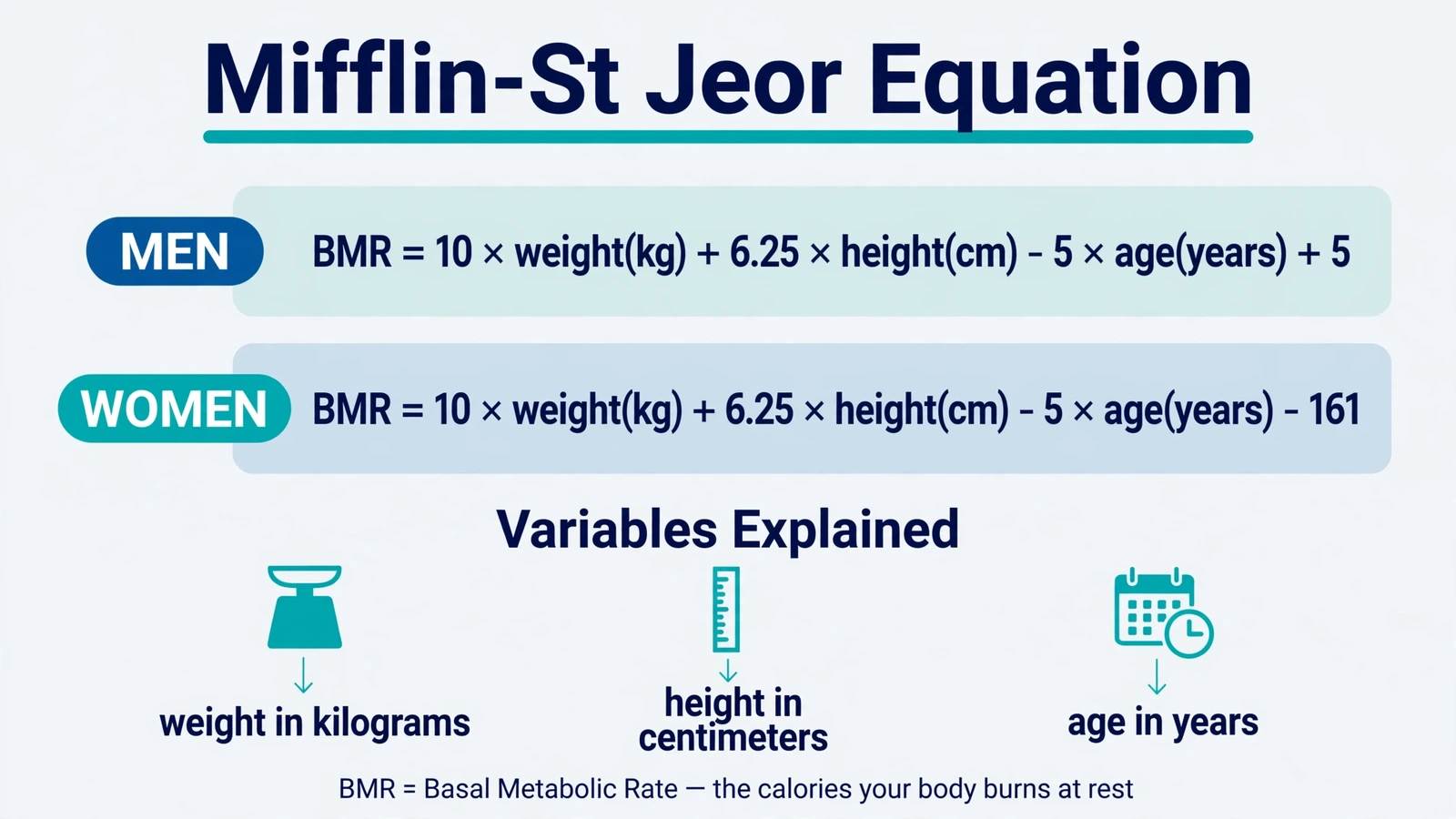
Published in 1990, the Mifflin-St Jeor equation is widely regarded as the most accurate BMR formula for the general population without lab equipment. A well-known systematic review found it predicts resting metabolic rate within 10 percent of the measured value about 82 percent of the time.
Men: BMR = (10 x weight in kg) + (6.25 x height in cm) – (5 x age in years) + 5
Women: BMR = (10 x weight in kg) + (6.25 x height in cm) – (5 x age in years) – 161
The Harris-Benedict Equation
The original dates back to 1919, with a revised version published in 1984. It uses the same four inputs but was built from a leaner, century-old population, so it overestimates BMR by about 5 percent in modern, mostly sedentary adults. If two calculators disagree, the formula choice is usually why. Read the full breakdown in our guide to the Harris-Benedict formula.
The Katch-McArdle Formula
When you know your body fat percentage, Katch-McArdle can be more precise because it works from lean body mass instead of total weight: BMR = 370 + (21.6 x lean body mass in kg). Since muscle burns far more calories at rest than fat, it is a favorite among athletes.
What Is the Difference Between BMR and TDEE?
Your BMR is the at-rest number, but you do not spend your day lying in bed. Total daily energy expenditure (TDEE) adds everything else: walking, workouts, fidgeting, standing and digesting food. Multiply your BMR by an activity multiplier, from 1.2 for sedentary up to 1.9 for very active, to get TDEE: the number that drives weight loss, maintenance or gain.
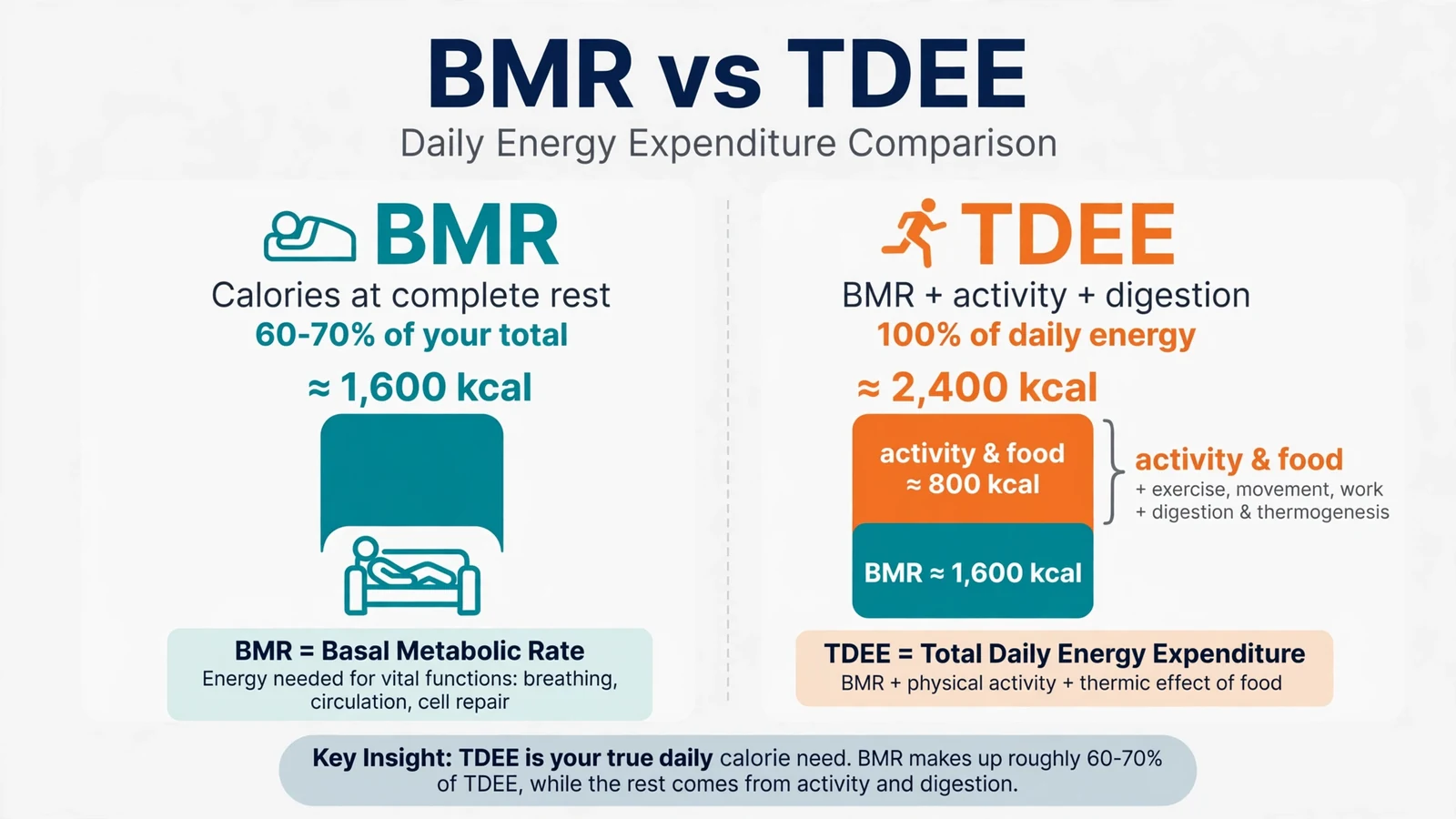
| Feature | BMR | TDEE |
|---|---|---|
| What it measures | Calories burned at complete rest | Total calories burned in a full day |
| Typical share of daily burn | 60 to 70 percent | 100 percent |
| Inputs needed | Age, sex, height, weight | BMR plus activity level |
| Best used for | Understanding your metabolic baseline | Setting calorie targets for your goals |
| Changes with | Age, muscle mass, hormones | Exercise, daily movement, lifestyle |
Skip the arithmetic and run the same math in seconds with our free calorie calculator, which turns your BMR into a full TDEE target.
What Factors Affect Your BMR?
Your BMR is not fixed. Several forces push it up or down over your lifetime:
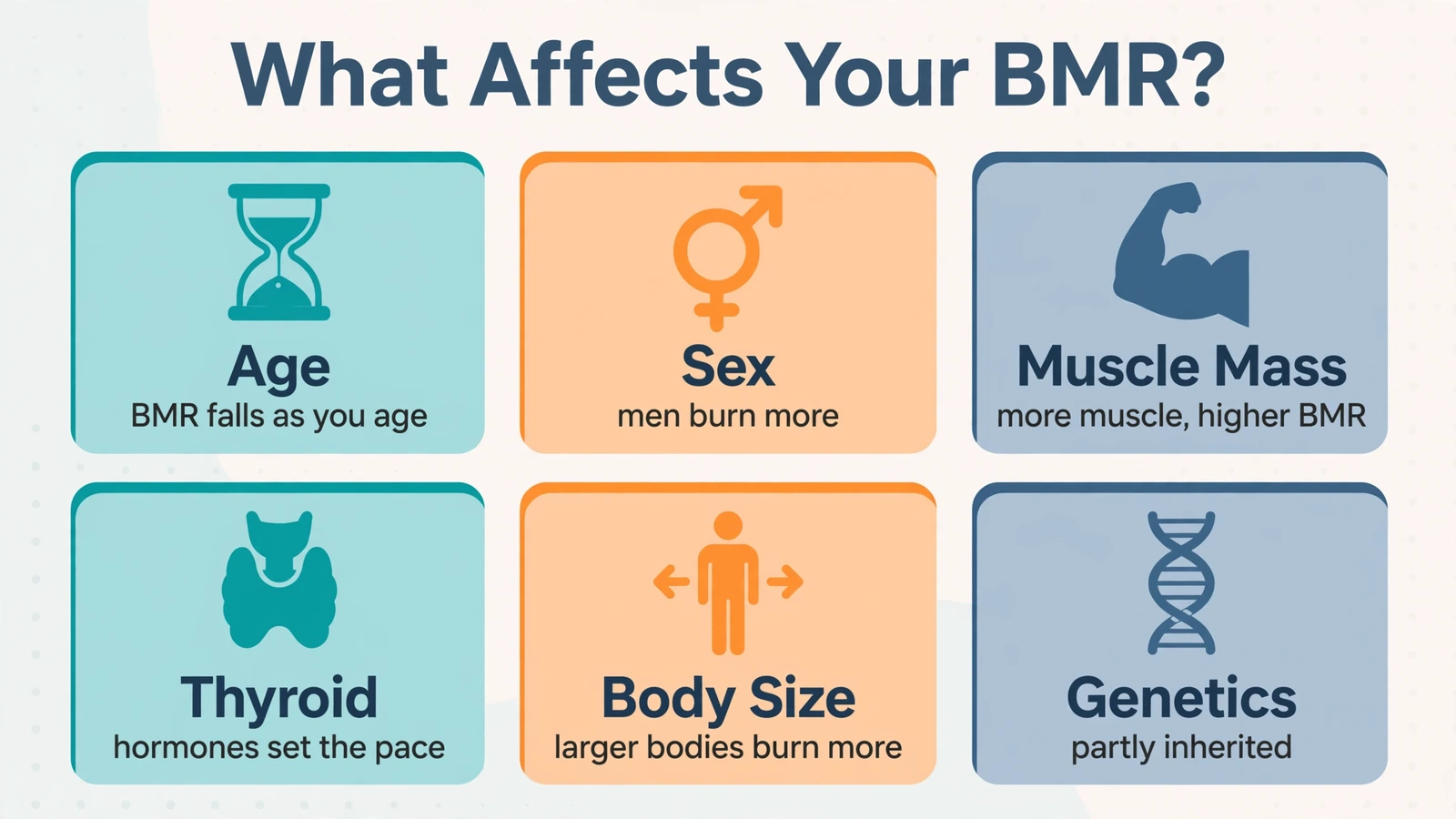
- Age: BMR falls roughly 1 to 2 percent per decade after early adulthood, largely because muscle mass declines.
- Sex: men typically have a higher BMR than women of the same weight, mostly because they carry more muscle.
- Muscle mass: muscle tissue burns noticeably more calories at rest than fat, so strength training can nudge BMR upward.
- Thyroid hormones: your thyroid sets the pace of metabolism, and thyroid conditions can shift BMR significantly.
- Body size and weight: larger bodies need more energy to maintain themselves, so BMR rises with body weight.
- Genetics: a meaningful share of BMR variation is inherited, which partly explains why metabolism feels naturally fast or slow.
- Dieting history: long, aggressive calorie deficits can temporarily lower BMR, a phenomenon called adaptive thermogenesis.
How Do You Calculate BMR? A Worked Example
Let us run the Mifflin-St Jeor equation by hand for a 30-year-old man who weighs 70 kg and is 178 cm tall. Follow these steps:
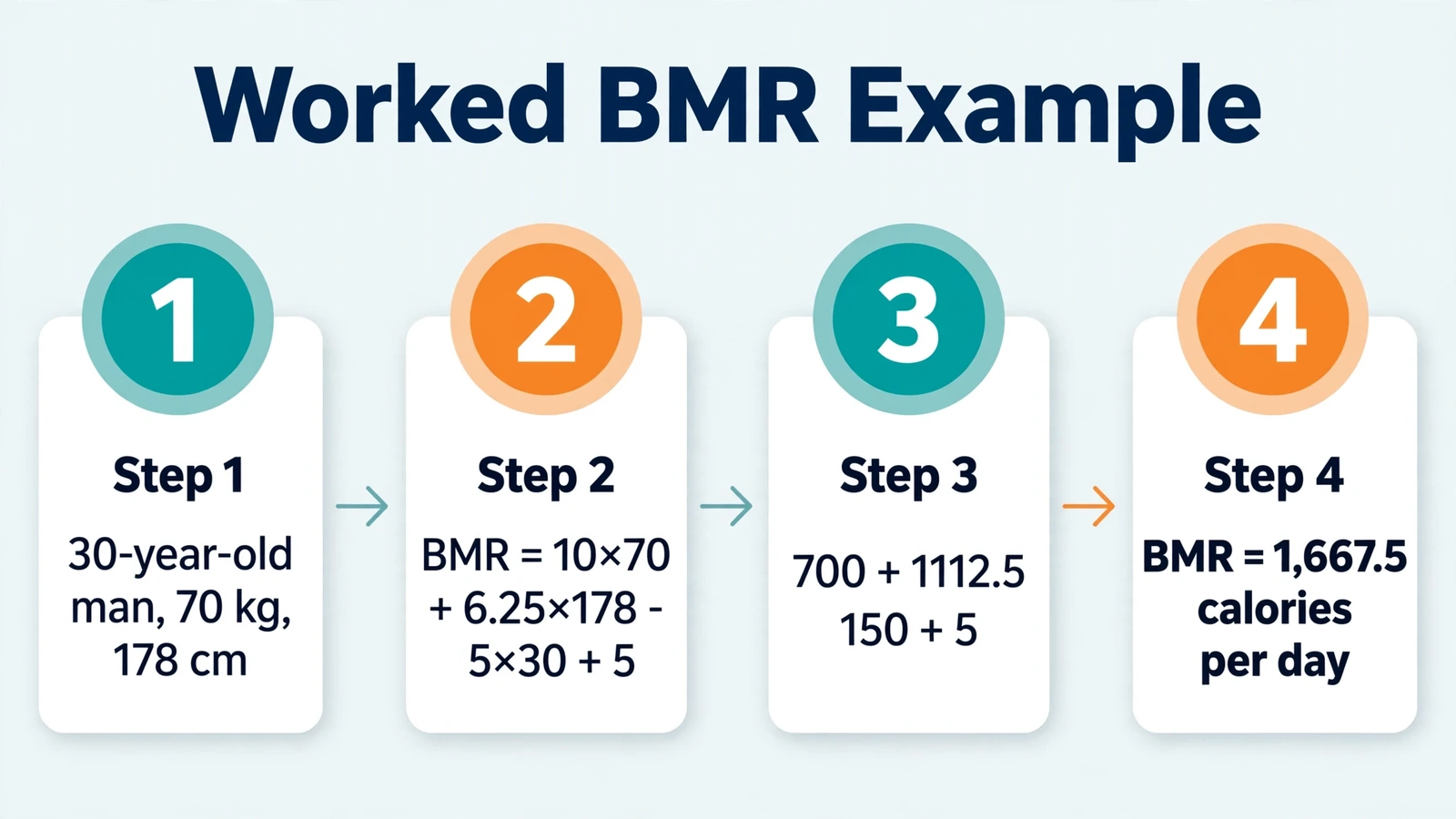
- Multiply weight by 10: 10 x 70 = 700
- Multiply height by 6.25: 6.25 x 178 = 1112.5
- Multiply age by 5: 5 x 30 = 150
- Combine the parts for a man: 700 + 1112.5 – 150 + 5 = 1667.5
His estimated BMR is about 1,668 calories per day at rest. If he is moderately active, multiply by 1.55 to get his TDEE: 1667.5 x 1.55 = 2585 calories per day, the practical number he would plan his eating around.
How Accurate Is a BMR Calculator?
For most healthy adults, a good BMR calculator lands within about 10 percent of what a lab would measure with indirect calorimetry, and Mifflin-St Jeor performs best, predicting within that range for roughly 8 out of 10 people.
Accuracy drops for groups the formulas were not built on: very muscular athletes, people with obesity and anyone with a thyroid condition. Treat your result as a strong estimate, not a medical measurement, and use our BMI calculator as a quick companion check.
How Can You Use Your BMR Result?
A BMR number only matters if you act on it. Here is the standard playbook once you know yours:
- Lose weight: eat below your TDEE by a moderate deficit, commonly 300 to 500 calories per day.
- Maintain weight: eat roughly at your TDEE, then adjust after two to three weeks of stable weight.
- Gain muscle: eat slightly above TDEE, around 200 to 300 calories, while strength training so the surplus builds muscle rather than fat.
- Recheck regularly: recalculate your BMR whenever your weight changes by more than a few kilograms, since your baseline moves with your body.
Frequently Asked Questions
What is a good BMR?
There is no universal "good" BMR because the number depends on your age, sex, height and weight. For an average adult man it often falls between 1,500 and 1,800 calories per day, and for an average adult woman between 1,200 and 1,500. What matters most is not the absolute number but how you use it to set realistic calorie targets.
Is BMR the same as metabolism?
Not exactly. Your metabolism is the entire set of chemical processes that keep you alive, including digestion and movement. BMR is one measured slice of it: the energy burned at complete rest, and it varies less between similar people than most expect.
Should I eat fewer calories than my BMR?
Generally, no. Eating below your BMR for long stretches can leave you fatigued, disrupt your hormones and slow your metabolism further. Safe weight loss usually comes from eating below your TDEE while staying at or above your BMR, and very low calorie diets should only be done under medical supervision.
Does BMR change as I age?
Yes. BMR typically declines by about 1 to 2 percent per decade after early adulthood, mainly because muscle mass shrinks and daily activity often drops. Regular strength training is the most effective way to slow that decline, so recalculate your BMR every few years to keep your calorie targets honest.
Why does muscle mass raise BMR?
Muscle tissue is metabolically active even when you are not using it, burning noticeably more calories per kilogram than fat tissue. Adding muscle through resistance training raises the amount of energy your body needs at rest. That is why two people of identical weight can have quite different BMR values.
Is the Mifflin-St Jeor equation the most accurate?
Among formulas that only need age, sex, height and weight, yes, it is the most validated choice. A widely cited systematic review found it predicted resting metabolic rate within 10 percent of measured values about 82 percent of the time. If you know your body fat percentage, the Katch-McArdle formula based on lean mass can be even more precise.
Can a BMR calculator help me lose weight?
Yes, as a starting point. Your BMR lets you estimate TDEE, and your TDEE tells you how many calories to eat for a deficit. Pair the number with consistent tracking for two to three weeks and adjust based on real results, since no calculator replaces that feedback loop.
Conclusion
A BMR calculator gives you the single most useful number in weight management: the calories your body burns just by existing. Once you know it, every decision gets easier, from setting a safe calorie deficit to choosing a maintenance target.
Run your numbers, turn your BMR into a TDEE target, track your results for a few weeks and adjust as your body changes. For background reading, see the Mayo Clinic guide to metabolism and calorie burning and the CDC tips for balancing food and activity.
1 thought on “BMR Calculator: What It Is, How It Works and How to Calculate Yours”