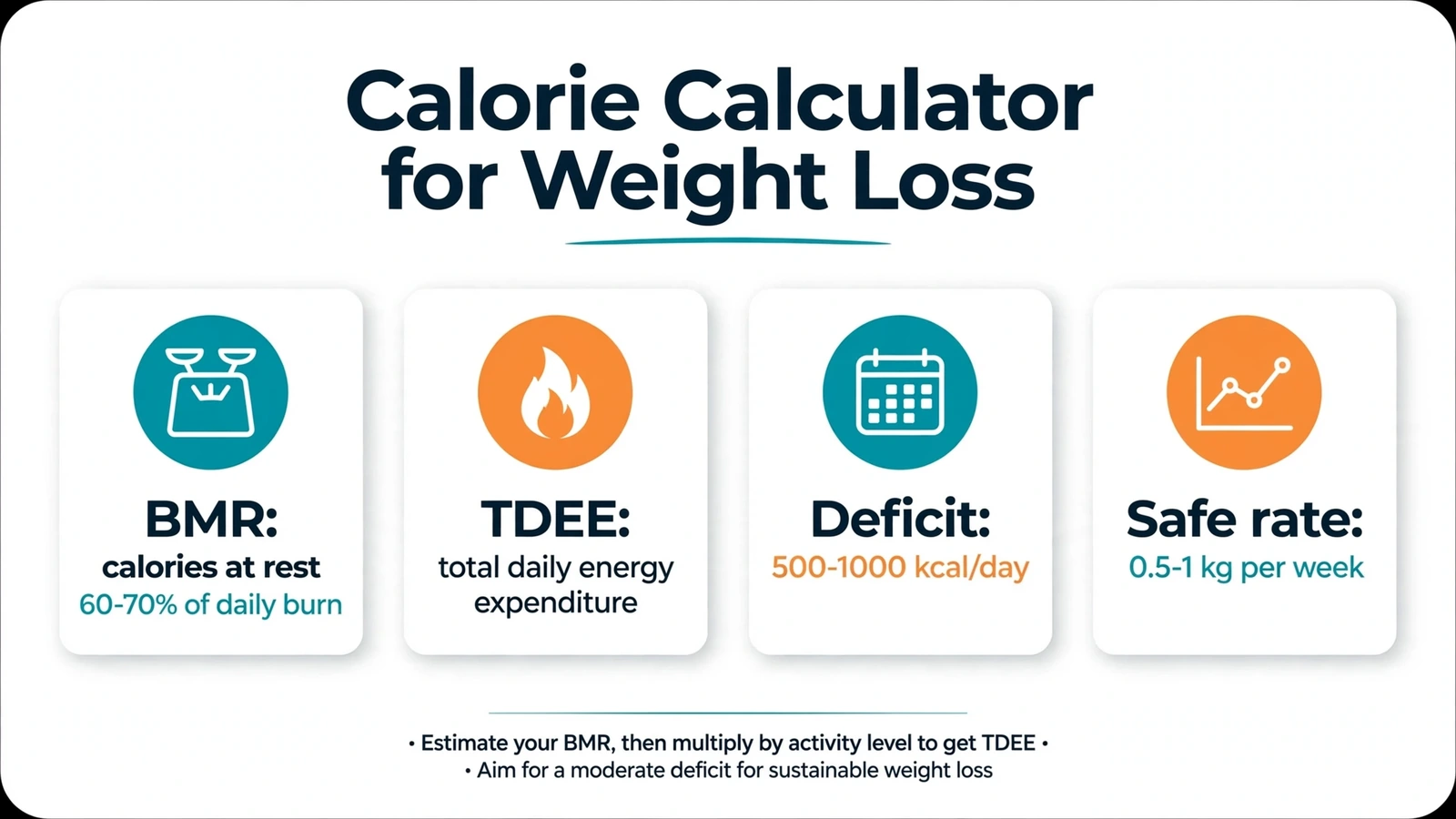
A calorie calculator for weight loss tells you exactly how many calories to eat each day to lose fat at a safe, steady pace. It estimates your daily energy burn from your age, sex, height, weight, and activity level, then subtracts a sensible deficit for a personal target. This guide explains how the calculator works, what a safe deficit looks like, and how to turn your result into a plan you can keep for months.
What Is a Calorie Calculator for Weight Loss?
A calorie calculator for weight loss is an online tool that estimates your daily energy needs and applies a weight-loss deficit to produce a target intake. You enter your age, sex, height, weight, and activity level. The calculator first estimates your basal metabolic rate (BMR), the calories you burn at complete rest. It then multiplies BMR by an activity factor to get your total daily energy expenditure (TDEE), the calories that keep your weight stable. Finally, it subtracts a deficit, usually 500 to 1,000 calories, to set your target. Try our free calorie calculator to see your own numbers in seconds. Learn more here.
Two people can eat the same food and get different results, because their TDEE differs. The calculator personalizes the math so your deficit fits your body, not an average.
How Does a Calorie Calculator for Weight Loss Work?
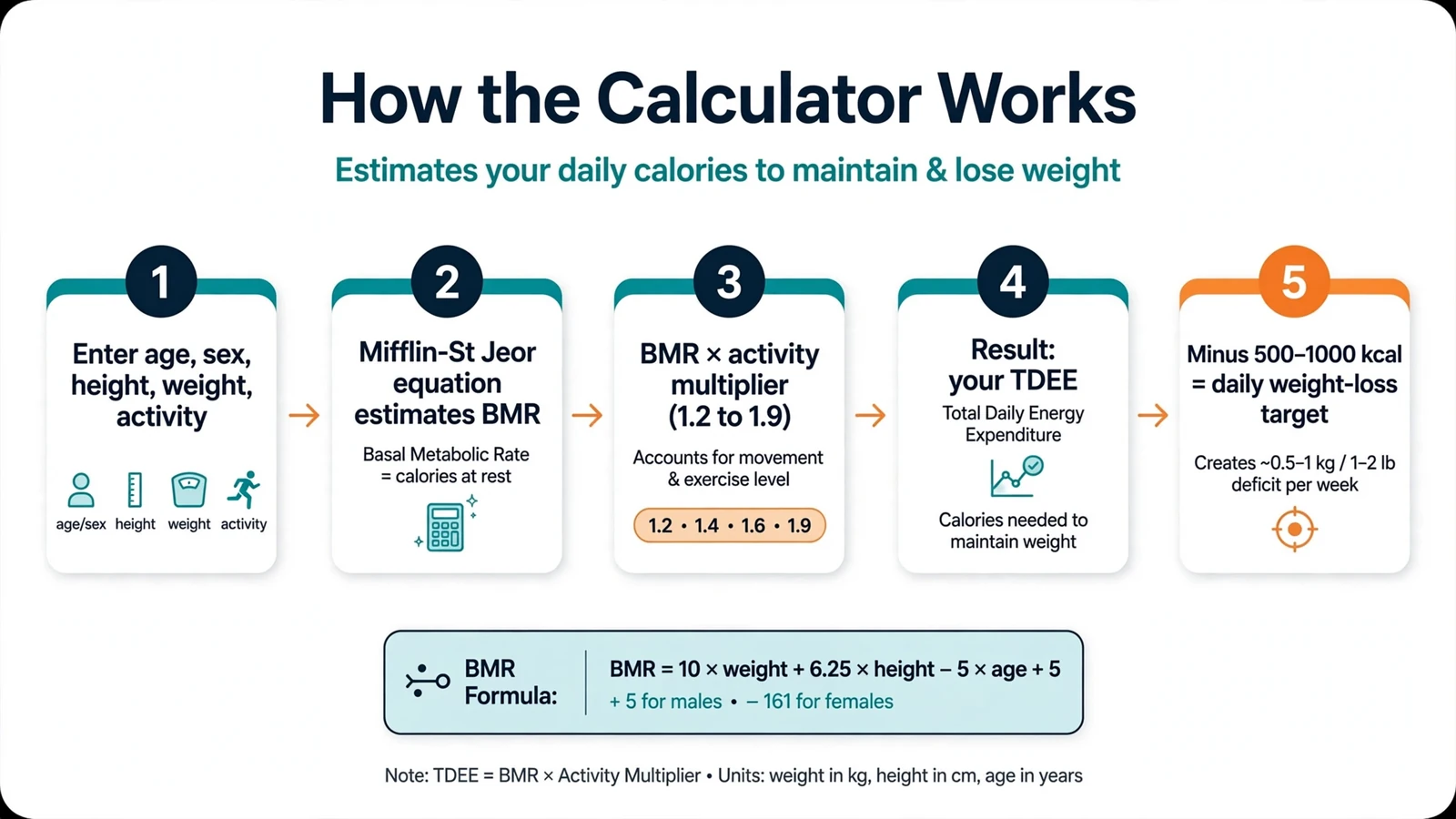
Under the hood, a calorie calculator for weight loss runs two formulas: the first estimates BMR, and the second scales it for activity. Understanding both helps you trust the result and know when to adjust it.
How does the Mifflin-St Jeor equation estimate BMR?
BMR is the energy your body needs at rest: breathing, circulation, brain function, and cell repair. It usually accounts for 60 to 70 percent of your total daily burn.
Most calculators use the Mifflin-St Jeor equation, published in 1990 and widely considered the most accurate formula for the general population:
Men: BMR = 10 x weight (kg) + 6.25 x height (cm) – 5 x age (years) + 5
Women: BMR = 10 x weight (kg) + 6.25 x height (cm) – 5 x age (years) – 161
Each term reflects real biology: heavier bodies cost more energy to maintain, taller bodies have more tissue to run, and metabolic rate declines with age.
How do activity multipliers turn BMR into TDEE?
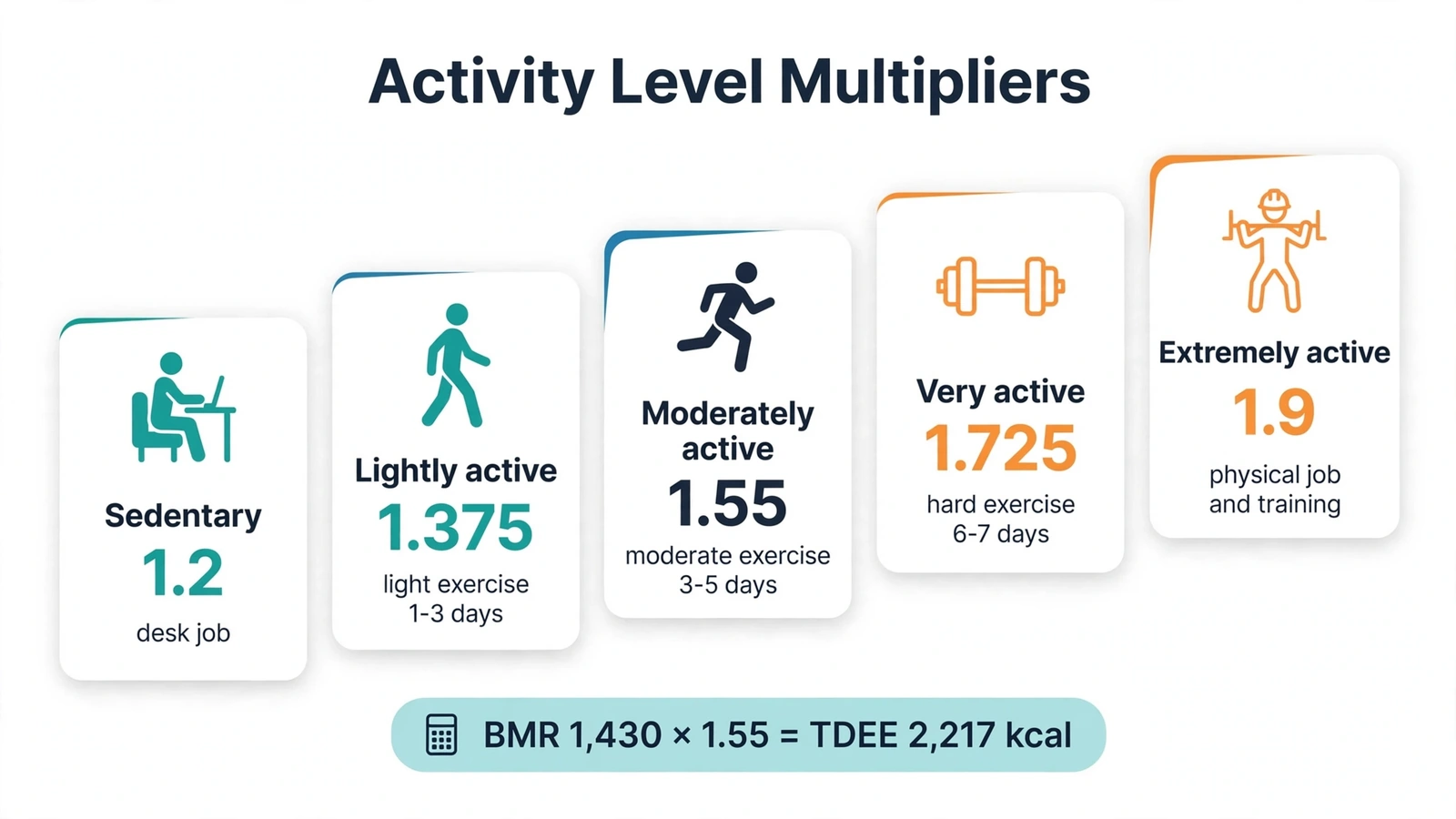
BMR is only the starting point. The calculator multiplies it by an activity factor to estimate TDEE, your full daily burn including movement, exercise, and digestion. These are the standard multipliers:
| Activity level | Multiplier | What it means |
|---|---|---|
| Sedentary | 1.2 | Desk job, little or no exercise |
| Lightly active | 1.375 | Light exercise, 1 to 3 days a week |
| Moderately active | 1.55 | Moderate exercise, 3 to 5 days a week |
| Very active | 1.725 | Hard exercise, 6 to 7 days a week |
| Extremely active | 1.9 | Very hard exercise plus a physical job |
Pick the level that matches your honest average, not your best week. Overestimating activity is the most common way people get an inflated target. Take a 35-year-old woman at 75 kg with a BMR of 1,430. Sedentary, she burns roughly 1,716 calories (1,430 x 1.2); extremely active, about 2,468 (1,430 x 1.9). Same body, completely different budget.
How Many Calories Should I Eat to Lose Weight?
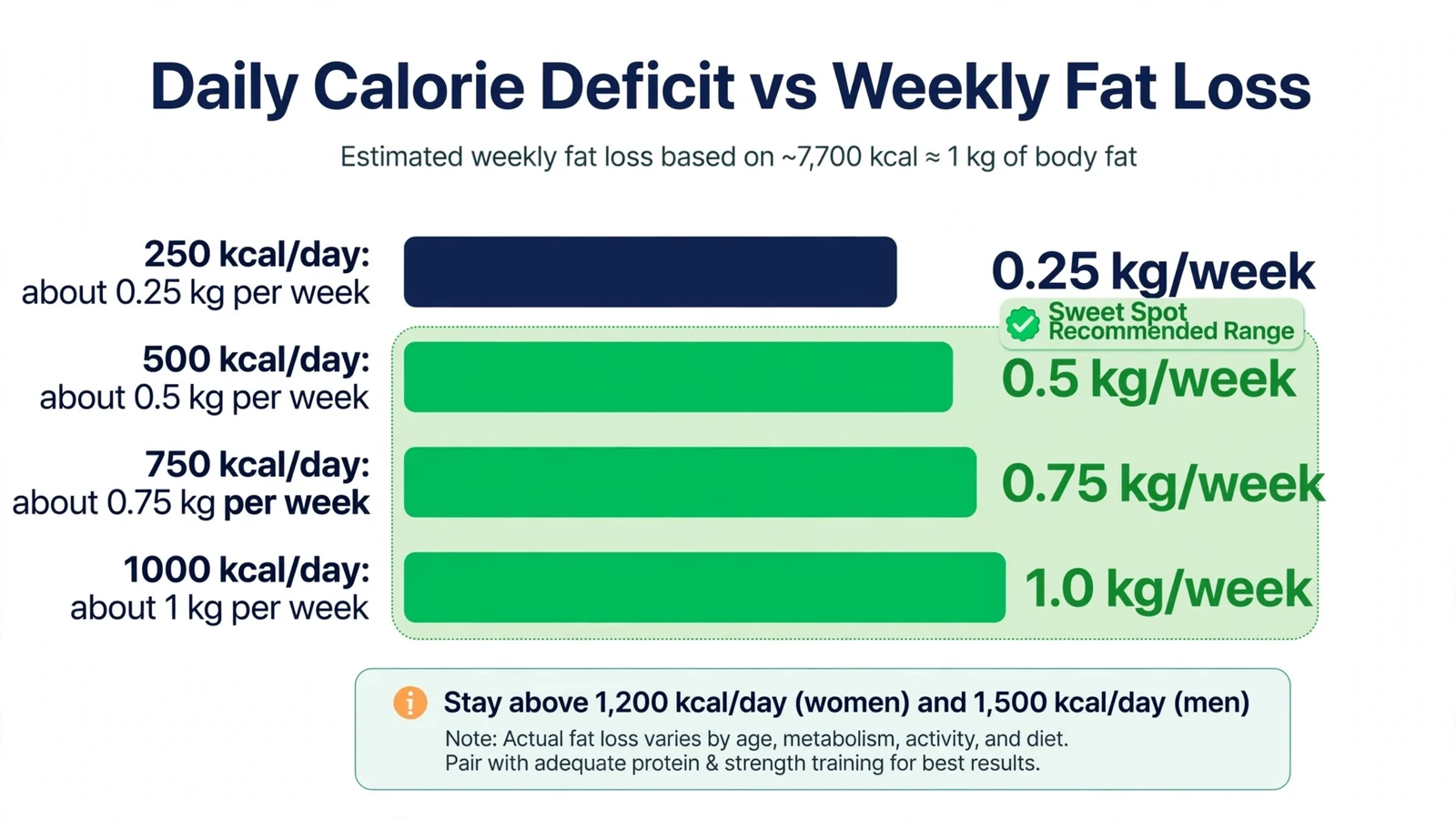
Once the calculator knows your TDEE, the weight-loss part begins: subtracting a daily deficit. Most experts recommend 500 to 1,000 calories per day, which translates roughly to 0.5 to 1 kg of fat loss per week. Here is how common deficit levels compare:
| Daily deficit | Weekly gap | Approximate fat loss | Best for |
|---|---|---|---|
| 250 kcal | 1,750 kcal | ~0.25 kg (0.5 lb) | Slow, comfortable loss; protecting gym performance |
| 500 kcal | 3,500 kcal | ~0.5 kg (1 lb) | Most people; the classic safe range |
| 750 kcal | 5,250 kcal | ~0.75 kg (1.5 lb) | More weight to lose; still manageable |
| 1,000 kcal | 7,000 kcal | ~1 kg (2 lb) | Shorter phases; not for small or lean bodies |
Guardrails apply at every level. Clinical guidance sets a floor near 1,200 calories per day for women and 1,500 for men without medical supervision. And bigger is not always better: a 1,000-calorie gap moves faster but brings stronger hunger, lower energy, and more muscle loss.
For most people, a 500-calorie deficit is the sweet spot: fast enough to see the scale move, gentle enough to keep for months. To sanity check your starting point, our BMI calculator shows where your weight sits relative to the healthy range.
How Do Activity Levels Change Your Calorie Target?
Your TDEE is not fixed: move more, and your calorie target rises with it. A daily 45-minute brisk walk adds 250 to 350 calories to your TDEE, and a physical job adds far more.
Widen your deficit two ways: eat a little less or move a little more. Most people do best with a mix, since cutting food alone gets harder as portions shrink. Adding 3,000 to 5,000 daily steps or two to three training sessions a week often lets you keep eating comfortably while holding the same deficit.
What Is the Safe Rate of Weight Loss?
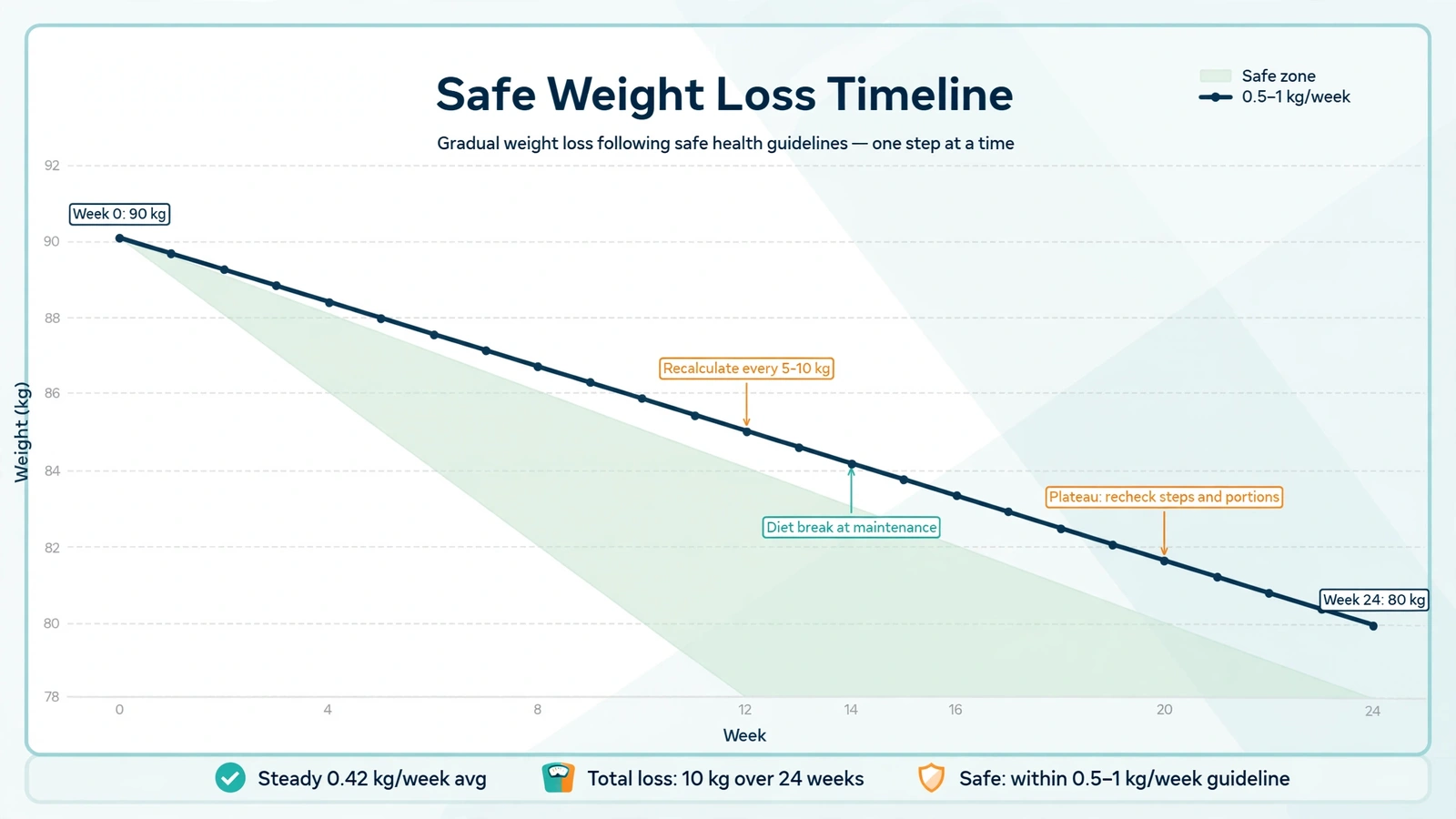
A calorie calculator for weight loss can give you any number you ask for, but too fast a rate backfires. The CDC recommends 0.5 to 1 kg (1 to 2 pounds) per week, noting gradual losers keep weight off more successfully. Faster loss costs more muscle, tanks energy, and triggers stronger hunger hormones.
You may have heard the 3,500-calorie rule. One pound of fat holds about 3,500 calories, so a 500-calorie daily deficit should equal one pound a week. It is a decent planning estimate, not a promise. As you get lighter, your body needs fewer calories, so the same intake creates a shrinking deficit. NIH research suggests a 500-calorie daily cut yields roughly half the simple rule’s prediction in the first year, and lost pounds are rarely pure fat: each is a mix of fat, water, and lean tissue.
At a 500-calorie daily deficit, losing 10 kg takes roughly 20 to 25 weeks, with the pace slowing toward the end. Treat the scale as a weekly average, not a daily verdict.
When Should I Adjust My Calorie Intake?
Your calculator result is a starting point, not a lifetime prescription. A good rule with any calorie calculator for weight loss: recalculate your numbers every 5 to 10 kg lost, or whenever progress stalls for three to four weeks.
Stalls usually come from three places. Your smaller body burns fewer calories, daily movement quietly drops when you diet, and portion tracking drifts optimistic over time. Before cutting calories, recheck the easy fixes: weigh food for a week, add 2,000 to 3,000 daily steps, and re-run the calculator with your new weight.
After 8 to 12 weeks of steady dieting, a planned diet break helps: eat at maintenance for one to two weeks, then resume the deficit. Breaks lower diet fatigue and settle hunger hormones. To compare a second BMR estimate against your original, try the Harris-Benedict formula calculator.
Frequently Asked Questions
How accurate is a calorie calculator for weight loss?
Good within a useful margin. The Mifflin-St Jeor equation estimates BMR within about 10 percent for most people, though misjudging activity adds error. Track your trend for three to four weeks, then adjust by 100 to 200 calories.
Should I eat back the calories I burn during exercise?
Only if you plan for it. Most calculators already include average activity in your TDEE, so adding exercise calories back double counts them. Trackers overestimate burn too, often by 20 to 30 percent, so eat back half of what yours claims at most.
Can I use a calorie calculator for weight loss if I have a medical condition?
With caution, and ideally with your doctor's input. Thyroid disorders, diabetes, and PCOS affect metabolism and safe intake levels, and standard formulas are less accurate during pregnancy or breastfeeding. Use the calculator for education, then let a professional set your target.
How often should I recalculate my calorie target?
Every 5 to 10 kg lost, or about every 8 to 12 weeks. Your TDEE drops as you get lighter, so an old target slowly becomes your maintenance number. Recalculating keeps the deficit open without guessing.
Is it better to cut carbs or fat to hit my calorie target?
For fat loss, the total deficit matters far more than the macro split. Low-carb and low-fat diets show similar weight loss when calories match. Choose the mix that keeps you full, with protein at 1.6 to 2.2 grams per kilogram to protect muscle.
Why has my weight loss stopped even though I am still in a deficit?
Plateaus usually mean your deficit shrank: you may be lighter, moving less without noticing, or tracking portions optimistically. Weigh food for a week, add daily steps, and re-run the calculator with your current weight before cutting more.
What is the minimum calories I should eat while losing weight?
Clinical guidance commonly sets a floor near 1,200 calories per day for women and 1,500 for men without medical supervision. Below those levels, meeting nutrient needs from food alone is very difficult, so slow your pace instead of going under a floor.
Conclusion
A calorie calculator for weight loss turns a vague goal into a concrete daily target: estimate BMR with the Mifflin-St Jeor equation, scale it by activity to get TDEE, and subtract a 500 to 1,000 calorie deficit for safe, steady fat loss of about 0.5 to 1 kg per week. Recalculate as your weight drops, and pair the numbers with enough protein and resistance training to keep the loss mostly fat.
Your next step is simple: get your personal numbers with our free calorie calculator, then hold the target for three weeks and watch your trend. For authoritative background, the CDC’s guide to losing weight covers safe rates and habits, and Mayo Clinic’s overview of calories and weight loss explains why the simple math is only part of the story.