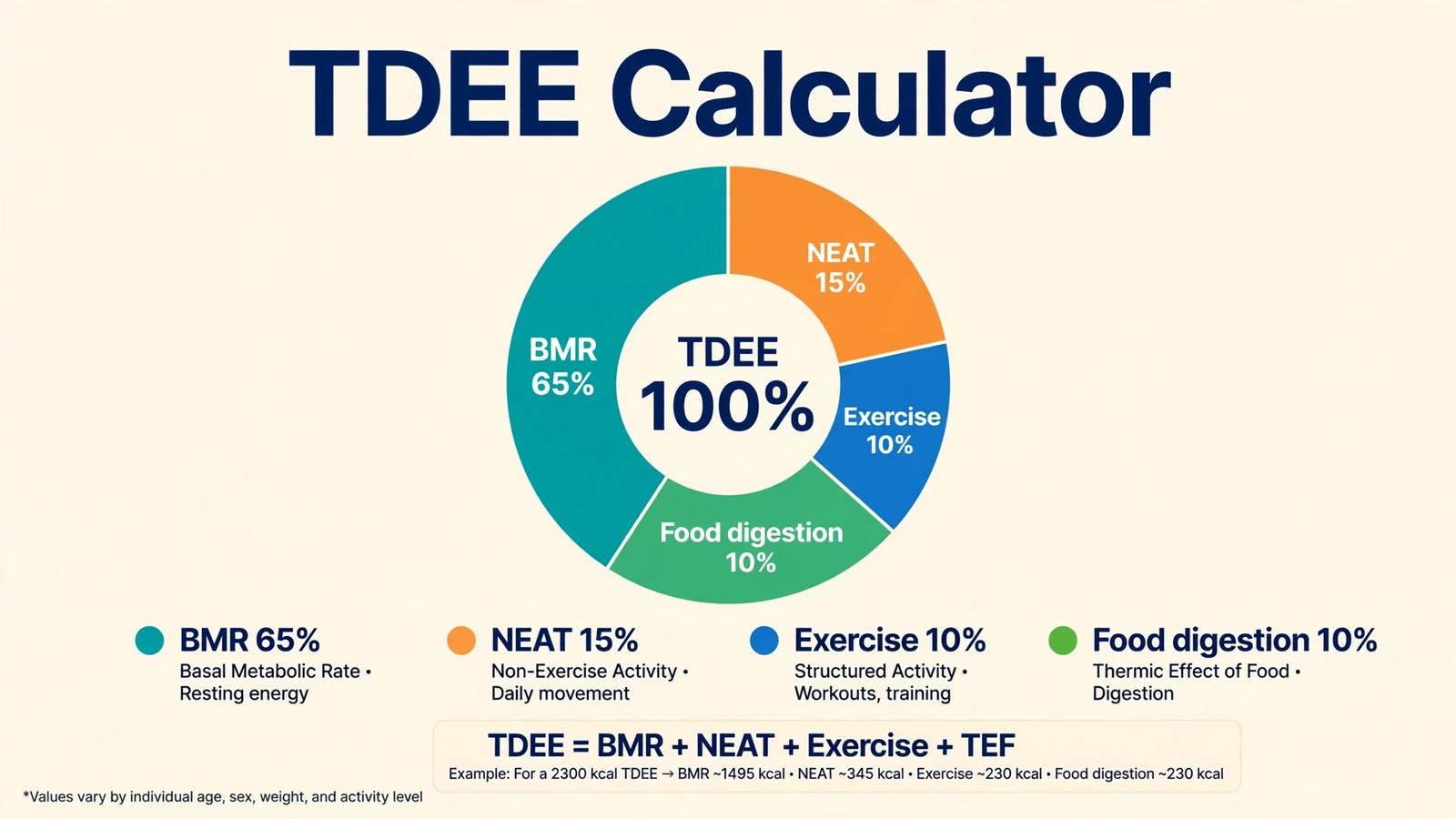
A TDEE calculator estimates how many calories your body burns in a full day, and that number is the single most useful starting point for any weight goal. TDEE stands for Total Daily Energy Expenditure. It adds up everything: the energy you burn at rest, the calories you use digesting food, and every bit of movement from workouts to fidgeting.
Most adults are surprised the first time they see their number. Someone who sits at a desk all day might burn 1,800 calories, while a very active person of the same size could burn 3,000 or more. Knowing your TDEE takes the guesswork out of eating for your goal, whether that is losing fat, maintaining weight, or building muscle.
What Is TDEE?
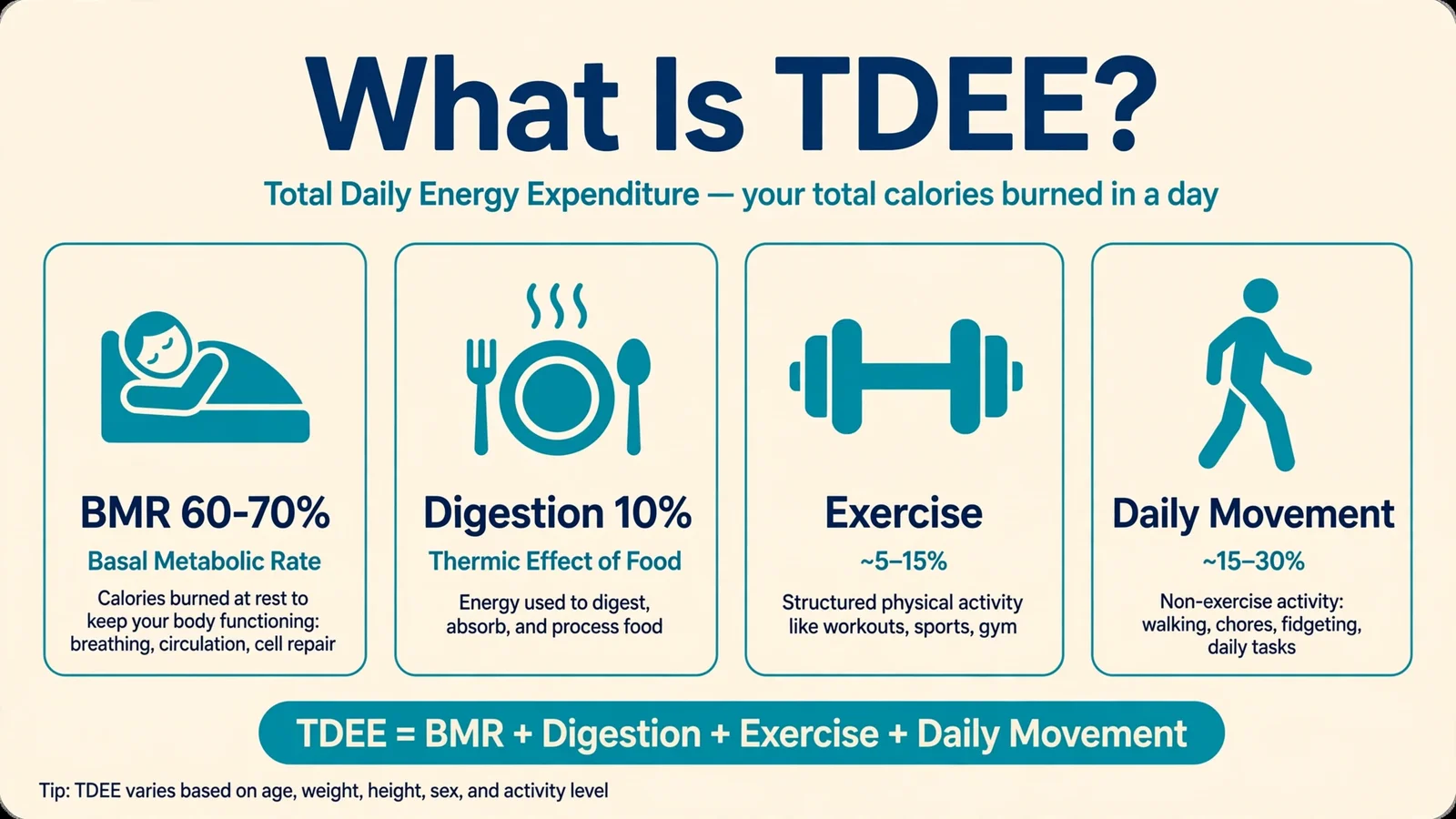
Total Daily Energy Expenditure (TDEE) is the total number of calories your body uses in 24 hours. It combines your basal metabolic rate, the thermic effect of food, exercise activity thermogenesis, and non-exercise activity thermogenesis into one daily calorie figure that represents your maintenance level.
Think of TDEE as your break-even point. Eat at your TDEE and your weight stays roughly the same. Eat below it and you lose weight. Eat above it and you gain. Every effective diet, from keto to intermittent fasting, works by moving you to one side of this number.
TDEE has four components:
- Basal metabolic rate (BMR): the calories burned at complete rest, usually 60 to 70 percent of TDEE
- Thermic effect of food (TEF): the energy cost of digesting meals, roughly 10 percent of TDEE
- Exercise activity thermogenesis (EAT): calories burned during planned workouts
- Non-exercise activity thermogenesis (NEAT): calories burned through daily movement like walking, standing, and fidgeting
How Does a TDEE Calculator Work?
A TDEE calculator takes your personal measurements and runs them through validated equations to estimate your daily calorie burn. You enter your age, sex, height, weight, and activity level, and the calculator does the rest in seconds.
Here is what happens behind the scenes:
- It estimates your BMR using the Mifflin-St Jeor equation, which researchers consider the most accurate for most people
- It multiplies your BMR by an activity factor that matches your lifestyle
- It returns your TDEE, your estimated maintenance calories
You can use our free calorie calculator to get your TDEE instantly. It uses the same validated formulas and takes less than a minute.
What Is the Difference Between BMR and TDEE?
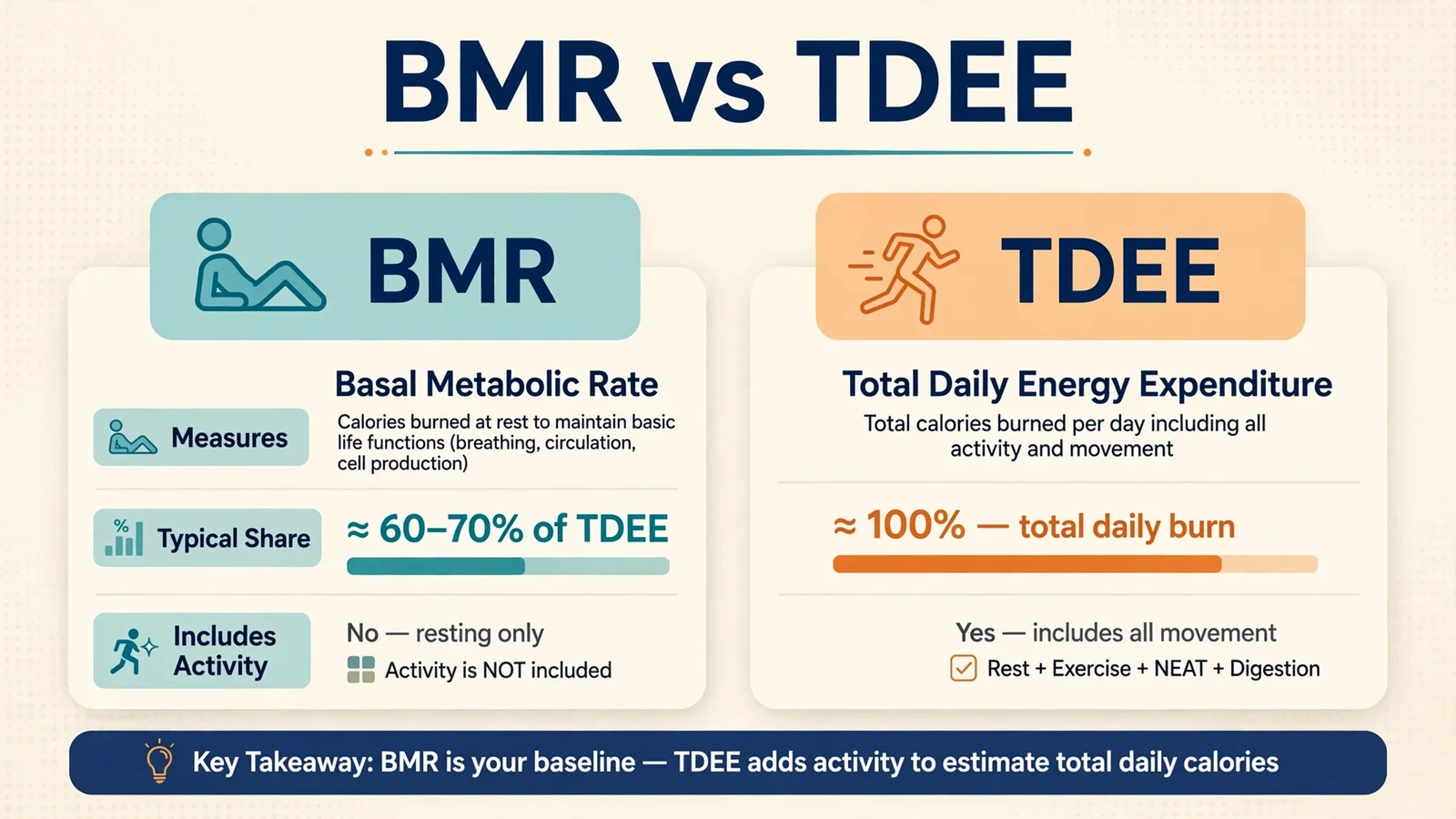
BMR and TDEE measure different things, and mixing them up is one of the most common nutrition mistakes. BMR is your at-rest burn. TDEE is your total burn including all activity.
| BMR | TDEE | |
|---|---|---|
| What it measures | Calories burned at complete rest | Total calories burned in a day |
| Typical share | 60 to 70% of TDEE | 100% (the full picture) |
| Includes activity | No | Yes |
| Use it for | Understanding your baseline | Setting calorie targets |
Here is a practical example. A 35-year-old woman who weighs 70 kg and is 165 cm tall has a BMR of about 1,400 calories. That is what she burns lying in bed all day. But she works, walks, and exercises three times a week, so her TDEE is around 2,170 calories. If she ate only 1,400 calories, she would be in an aggressive deficit without realizing it.
For a deeper breakdown of both numbers, read our guide on how BMR formulas work.
How Do I Calculate My TDEE Manually?
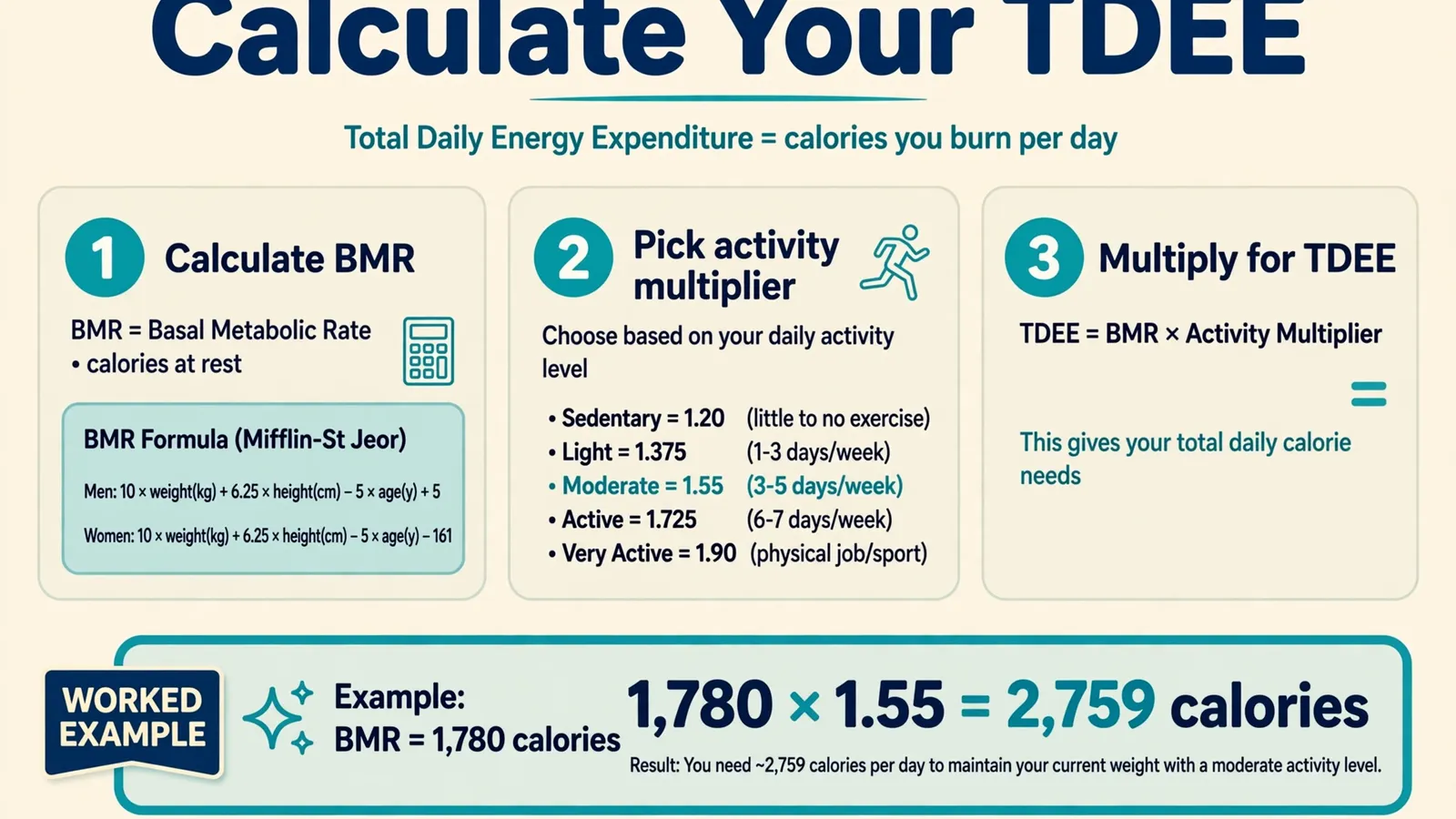
You can calculate TDEE by hand in about five minutes. The method below uses the Mifflin-St Jeor equation, the same one most online calculators rely on.
Step 1: Calculate Your BMR
Use the Mifflin-St Jeor formula:
- Men: BMR = (10 x weight in kg) + (6.25 x height in cm) – (5 x age) + 5
- Women: BMR = (10 x weight in kg) + (6.25 x height in cm) – (5 x age) – 161
Step 2: Pick Your Activity Multiplier
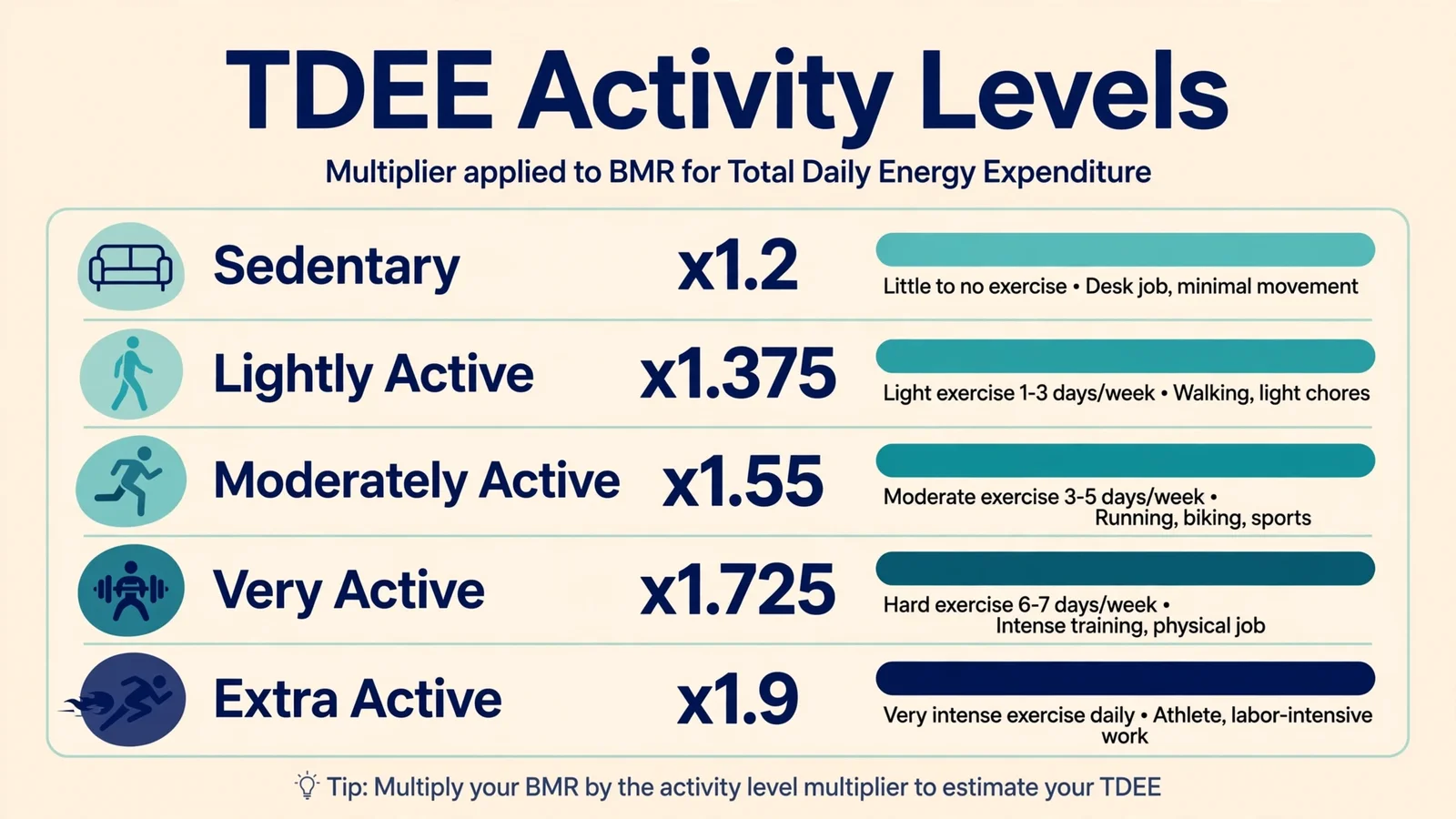
Multiply your BMR by the factor that best describes your typical week:
| Activity Level | Description | Multiplier |
|---|---|---|
| Sedentary | Desk job, little or no exercise | x 1.2 |
| Lightly active | Light exercise 1 to 3 days per week | x 1.375 |
| Moderately active | Moderate exercise 3 to 5 days per week | x 1.55 |
| Very active | Hard exercise 6 to 7 days per week | x 1.725 |
| Extra active | Physical job plus daily training | x 1.9 |
Step 3: Do the Math
Example: a 30-year-old man, 80 kg, 180 cm, moderately active.
BMR = (10 x 80) + (6.25 x 180) – (5 x 30) + 5 = 800 + 1,125 – 150 + 5 = 1,780
TDEE = 1,780 x 1.55 = 2,759 calories per day.
That is his estimated maintenance level. To lose weight, he would eat below 2,759. To gain, above it.
How Accurate Is a TDEE Calculator?
TDEE calculators are good estimates, not exact measurements. Research suggests they land within 10 to 15 percent of your true expenditure for most people, which is accurate enough to set a starting calorie target.
Several things can shift your real number away from the estimate:
- Body composition: two people at the same weight can have different TDEEs if one carries more muscle
- NEAT variation: fidgeting and daily movement differ enormously between people
- Metabolic adaptation: prolonged dieting can lower TDEE slightly
- Tracking errors: most people overestimate their activity level
The smart approach is to use your calculated TDEE as a starting point, eat at that level for two to three weeks, and watch the scale. If your weight holds steady, the estimate was right. If it drifts, adjust by 100 to 200 calories and reassess.
How Do I Set a Calorie Target From My TDEE?
Once you know your TDEE, setting a target is straightforward arithmetic. Your goal determines which side of maintenance you eat on and by how much.
For fat loss: subtract 300 to 500 calories from your TDEE. A 500-calorie daily deficit leads to roughly 0.5 kg of fat loss per week, which is the sweet spot most dietitians recommend. Larger deficits work faster but come with more hunger, lower energy, and higher risk of muscle loss.
For maintenance: eat at your TDEE. This sounds simple, but most people have never actually eaten at true maintenance because they have never known the number. Give it two to three weeks and watch the trend on the scale.
For muscle gain: add 200 to 300 calories above your TDEE. This modest surplus, often called lean bulking, supports muscle growth while limiting fat gain. Bigger surpluses mostly add fat, not muscle.
A few practical notes make this work better. Recalculate your TDEE every few months or after significant weight change, since a smaller body burns less. Track intake honestly for at least a week before judging results, because memory-based estimates are notoriously optimistic. And remember that TDEE is a starting point: real-world feedback from the scale and the mirror always wins over any calculator.
Frequently Asked Questions
What is a good TDEE for weight loss?
Your TDEE itself is not for weight loss, it is your maintenance level. For fat loss, eat 300 to 500 calories below your TDEE. That creates a sustainable deficit without the downsides of crash dieting.
Should I use BMR or TDEE to lose weight?
Use TDEE. BMR only covers your at-rest burn, so eating at BMR usually means a very aggressive deficit once activity is factored in. TDEE gives you the full picture.
Why is my TDEE so high?
If your TDEE seems surprisingly high, check your activity selection. Choosing "very active" when you are actually "lightly active" is the most common cause. Be honest about a typical week, not your best week.
Does TDEE change as I lose weight?
Yes. A smaller body burns fewer calories, so your TDEE drops as you lose weight. Recalculate every 5 kg or so to keep your targets accurate.
What is the most accurate TDEE formula?
The Mifflin-St Jeor equation is generally considered the most accurate for the general population. The Harris-Benedict equation is an older alternative that tends to overestimate slightly.
Can I increase my TDEE?
Yes. Building muscle raises BMR modestly, regular exercise adds EAT, and simply moving more during the day boosts NEAT. Of the three, daily movement is the most underrated lever.
Conclusion
A TDEE calculator gives you the most important number in nutrition: your daily calorie burn. With it, you can set precise targets for losing, maintaining, or gaining weight instead of guessing.
Calculate your TDEE, pick a goal, and adjust based on real results over two to three weeks. For reference, the CDC’s guidance on balancing food and activity and the NHS calorie counting guide both emphasize starting from an honest estimate of your energy needs.