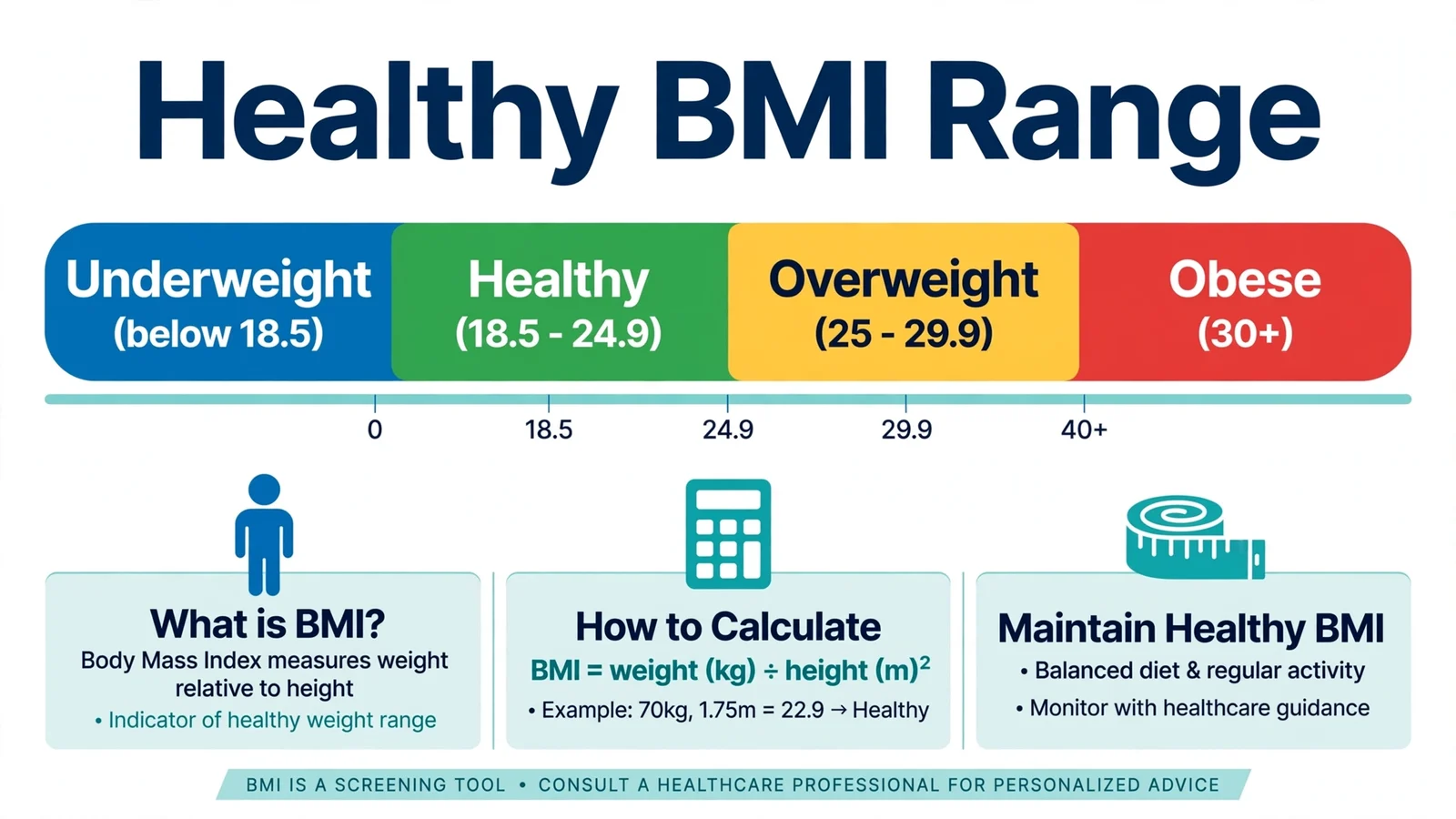
A healthy BMI for most adults falls between 18.5 and 24.9, regardless of your exact age or height. That range comes from the World Health Organization and it’s the same whether you’re 25 or 55, five foot two or six foot one. Your height is already baked into the calculation, and for adults, age doesn’t shift the healthy range.
That said, the number on its own doesn’t tell your whole story. Let’s break down what a healthy BMI actually means for you, how age and height factor in, and when you should look beyond BMI.
What Is BMI and How Is It Calculated?
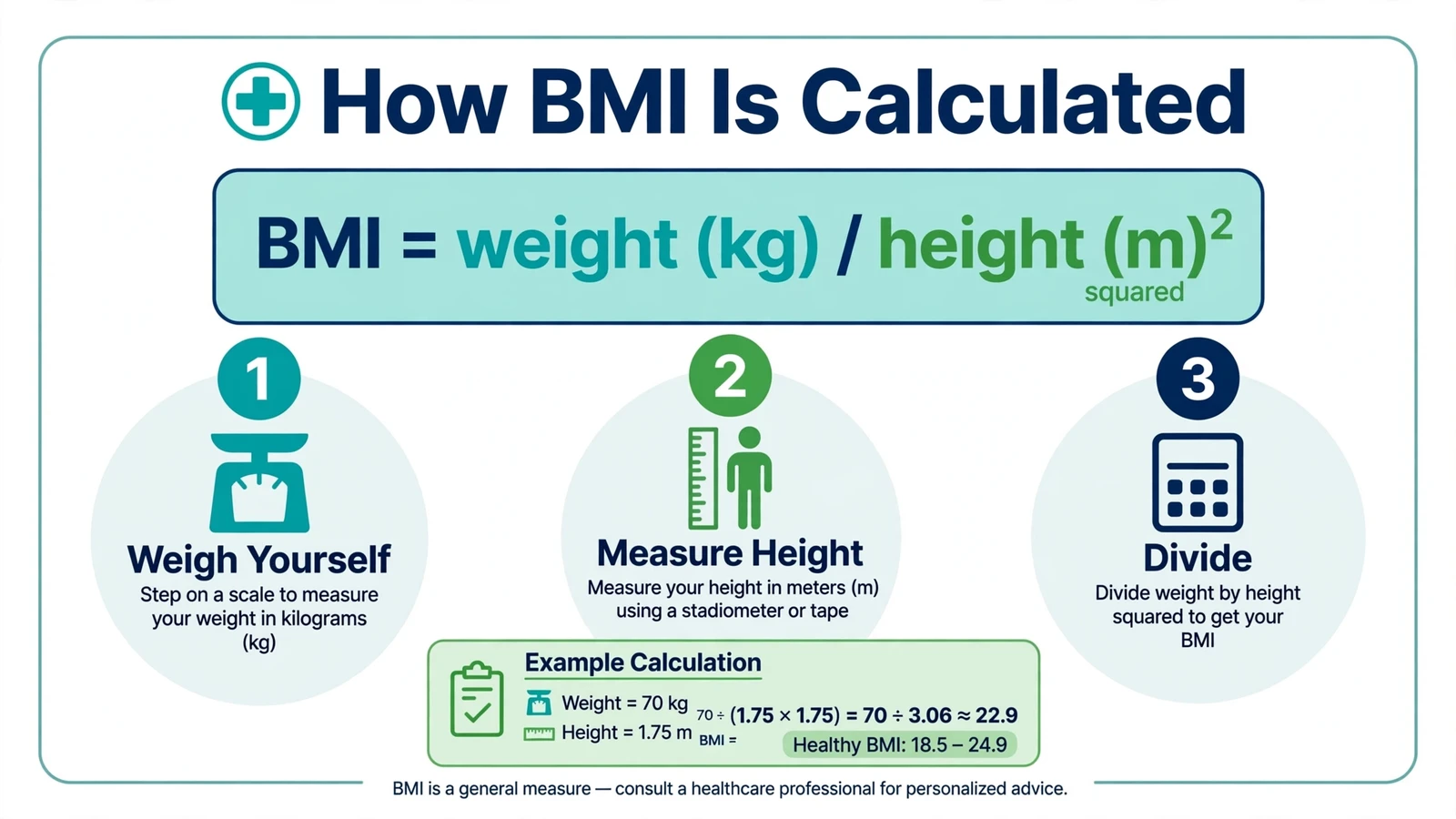
Body Mass Index, or BMI, is a simple screening measure that estimates body fat based on your height and weight. The formula divides your weight in kilograms by the square of your height in meters.
BMI = weight (kg) / height (m)²
If you use pounds and inches, the formula is: BMI = 703 x weight (lbs) / height (in)².
The result puts you in one of four standard categories. Under 18.5 is underweight, 18.5 to 24.9 is the healthy range, 25 to 29.9 is overweight, and 30 or above is obese. These cutoffs were developed from large population studies linking BMI ranges to health risks like heart disease, type 2 diabetes, and high blood pressure.
BMI isn’t a diagnostic tool. It’s a starting point, a quick way for you and your doctor to gauge whether your weight might be putting your health at risk.
Does a Healthy BMI Change With Age?
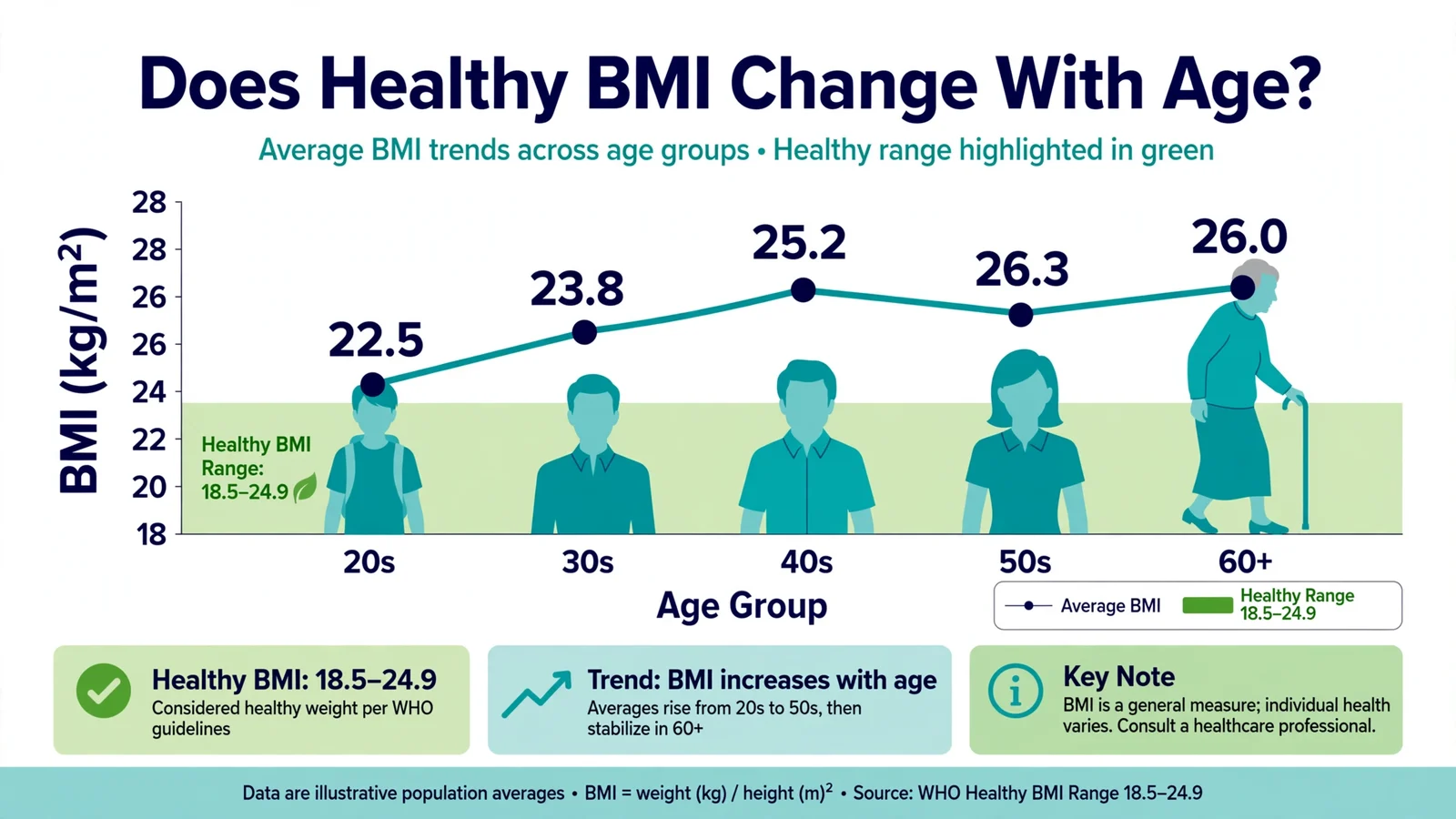
For adults aged 20 and older, no. The healthy BMI range of 18.5 to 24.9 stays the same whether you’re 22 or 62.
This surprises a lot of people. You’d think the target would shift as your metabolism slows or your body composition changes with age, and in a practical sense, maintaining a healthy BMI does get harder as you get older. Muscle mass tends to decline after 30, and fat can redistribute around the midsection. But the official healthy range doesn’t move.
There are two exceptions worth knowing about.
First, children and teens. BMI for anyone under 20 is interpreted using age and sex specific percentiles, not the adult cutoffs. A 12 year old with a BMI of 22 might be perfectly healthy while an adult with the same number would be near the top of the range.
Second, older adults. Some research suggests that for people over 65, a slightly higher BMI (up to around 27 or 28) may be associated with lower mortality risk. This is sometimes called the “obesity paradox” in geriatrics. But major health organizations haven’t changed the official guidance, so 18.5 to 24.9 remains the target unless your doctor says otherwise.
How Does Height Affect What a Healthy BMI Means for Me?
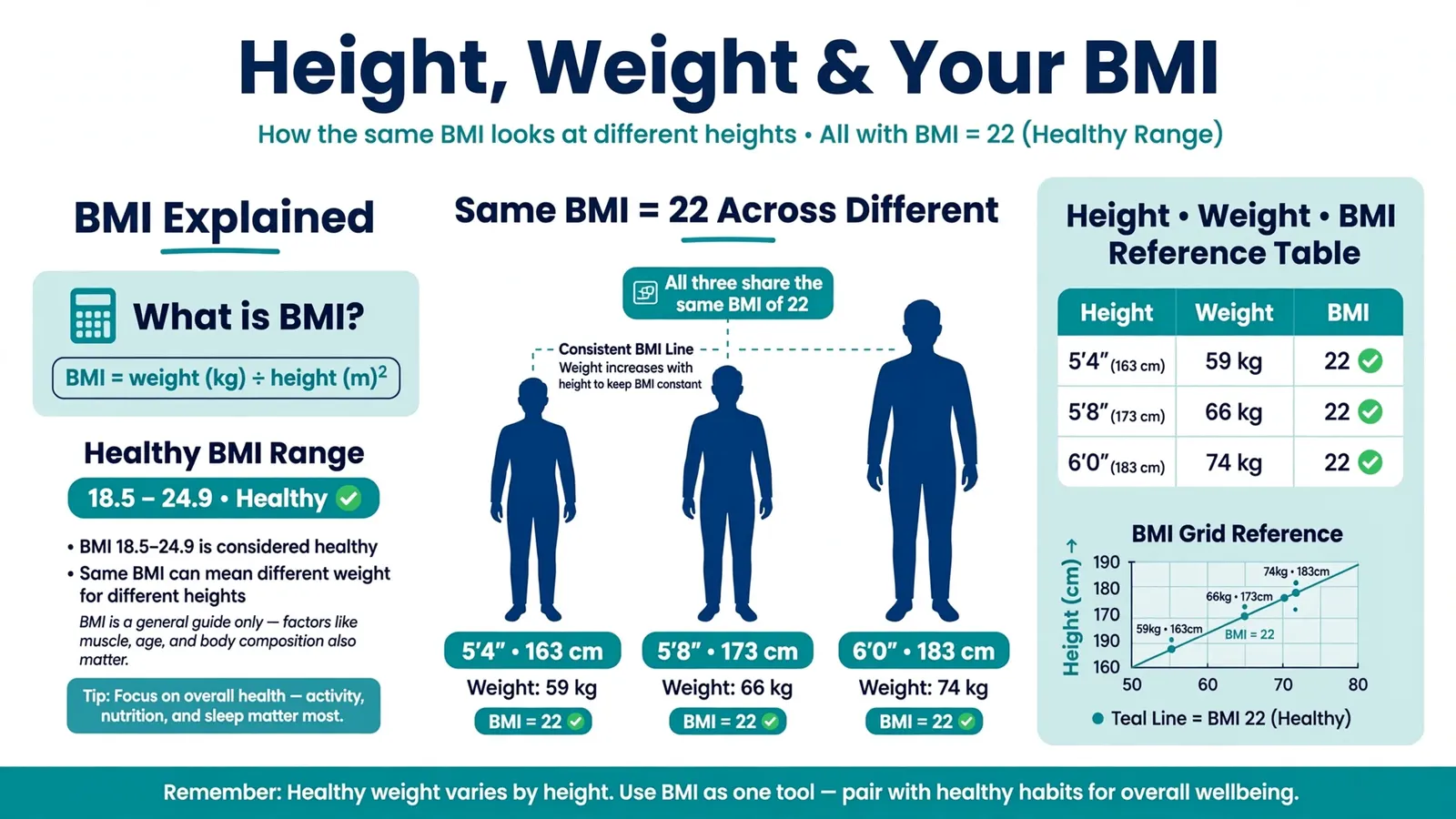
Height doesn’t change the healthy range, but it completely changes what weight puts you in that range. That’s the whole point of the BMI formula: it adjusts for height so a tall person and a short person can use the same scale.
Here’s what the healthy weight range looks like at different heights:
| Height | Healthy Weight Range (BMI 18.5-24.9) |
|---|---|
| 5’0″ (152 cm) | 95-127 lbs (43-58 kg) |
| 5’4″ (163 cm) | 108-145 lbs (49-66 kg) |
| 5’8″ (173 cm) | 122-164 lbs (55-74 kg) |
| 6’0″ (183 cm) | 136-183 lbs (62-83 kg) |
If you’re on the shorter side, even small weight changes move your BMI more noticeably. A 5 pound gain shifts BMI more for someone who’s 5’2″ than for someone who’s 6’1″. That’s not a flaw in the system, it’s just math. Shorter people have less “room” in absolute pounds within the healthy range.
The easiest way to find your personal numbers is to plug your height and weight into a BMI calculator and see exactly where you land.
What Should I Do If My BMI Is Outside the Healthy Range?
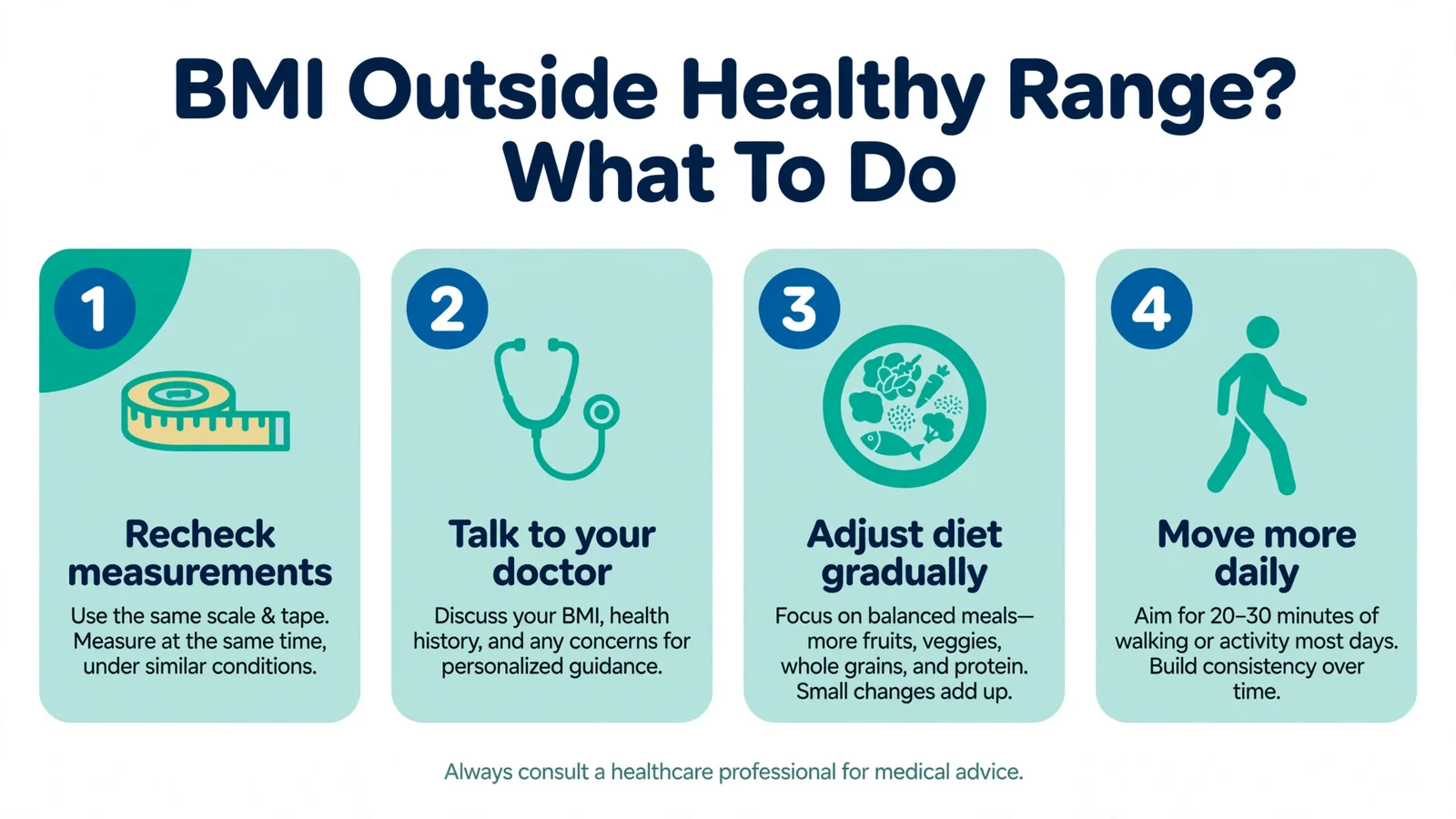
First, don’t panic. A BMI slightly above 25 or below 18.5 is a signal to pay attention, not a diagnosis of poor health.
If your BMI is in the overweight range (25-29.9), the standard advice is modest, sustainable weight loss. Losing just 5 to 10 percent of your body weight can meaningfully reduce health risks, even if you don’t reach the “healthy” range. Focus on a moderate calorie deficit, regular movement you actually enjoy, and enough sleep. Crash diets almost always backfire.
If your BMI is 30 or above, it’s worth talking to your doctor. They can check blood pressure, cholesterol, blood sugar, and other markers that matter more than the BMI number alone. They might also screen for conditions like sleep apnea or joint issues that are more common at higher weights.
If your BMI is below 18.5, the concern runs the other way: nutrient deficiencies, weakened immunity, bone loss, and hormonal disruption. Unexplained weight loss always deserves a medical checkup.
In every case, BMI is one data point. Waist circumference, blood work, fitness level, and how you actually feel all matter too.
When Is BMI Not the Best Measure?
BMI has real limitations, and it’s honest to name them. It can’t tell muscle from fat, so a muscular athlete can land in the “overweight” category with very low body fat. Doesn’t account for where fat is stored, and belly fat carries more health risk than fat on hips or thighs. It also wasn’t developed with diverse populations in mind; some research suggests the standard cutoffs may not fit all ethnic groups equally well.
That’s why many doctors now pair BMI with waist circumference. For most adults, a waist under 35 inches for women and under 40 inches for men is the target. If your BMI is borderline but your waist is well within range and your blood work looks good, your doctor may not be concerned at all.
Body fat percentage is another useful companion metric, though it requires calipers, a smart scale, or a DEXA scan to measure accurately.
Frequently Asked Questions
What is a healthy BMI for a 50 year old woman?
The same as for any adult: 18.5 to 24.9. Age doesn’t change the official healthy range for adults. That said, women going through menopause often notice fat redistributing to the abdomen, so waist circumference becomes an especially useful second metric alongside BMI.
What is a healthy BMI for a 6 foot man?
A 6 foot man is in the healthy BMI range at roughly 136 to 183 pounds (62 to 83 kg). The range is wide because healthy bodies come in different builds. Where you feel strongest and most energetic within that range matters more than hitting a specific number.
Can I be healthy with a BMI over 25?
Possibly, yes. BMI is a screening tool, not a verdict. If you’re muscular, active, and your blood pressure, cholesterol, and blood sugar are all normal, a BMI of 26 or 27 may not concern your doctor. The key is looking at the full picture, not one number.
Does BMI work the same for all ethnicities?
Not perfectly. Research has found that at the same BMI, some Asian populations tend to carry more body fat and face higher metabolic risk, while some Pacific Islander populations may carry less risk at higher BMIs. The WHO has suggested lower cutoffs for Asian populations (overweight at 23, obese at 27.5), though these aren’t universally adopted.
How often should I check my BMI?
For most adults, checking every few months is plenty. Weight fluctuates day to day with water, food, and hormones, so daily checks just create noise. Weigh yourself under consistent conditions, calculate BMI, and look at the trend over weeks, not days.
What is more important, BMI or waist size?
They measure different things and work best together. BMI estimates overall body fat relative to height; waist circumference captures abdominal fat specifically, which is more strongly linked to heart disease and diabetes. If you track only one, many experts now lean toward waist size, but using both gives the clearest picture.
Conclusion
A healthy BMI sits between 18.5 and 24.9 for just about every adult, whatever your age or height. Your height determines what weight lands you in that range, and your age doesn’t move the goalposts (with the exception of children, teens, and possibly the very elderly).
But remember what BMI is: a useful starting point, not the final word on your health. Pair it with waist measurements, regular checkups, and honest attention to how you feel. If you want to know exactly where you stand right now, try our free BMI calculator and see your number in seconds. And if you’re thinking about weight goals, our calorie calculator can help you figure out a sensible daily target.
For a deeper look at how BMI is officially defined, the World Health Organization’s BMI page lays out the categories and their basis. The CDC’s adult BMI page is another solid reference with practical guidance on interpreting your result.
4 thoughts on “Healthy BMI Range by Age and Height | Find Your Ideal Range”