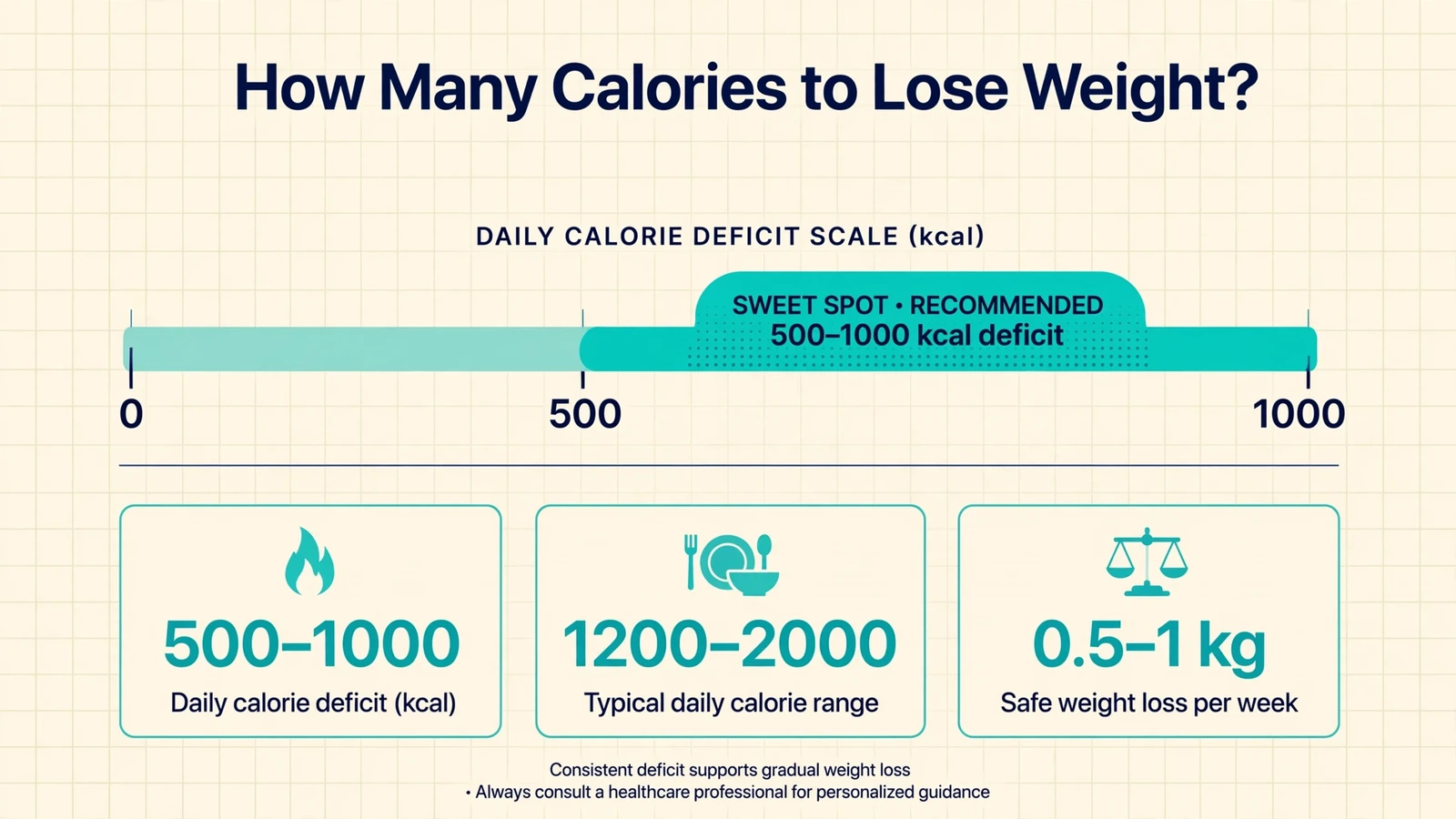
The short answer to how many calories to lose weight is this: eat 500 to 1,000 fewer calories each day than your body burns. For most adults, that lands between 1,200 and 2,000 calories a day, depending on your size, sex, age, and activity level.
Online advice loves to hand you one magic number. That never works, because a 55 kg sedentary woman and a 100 kg active man burn very different amounts. What works is calculating your own target from your own numbers. The method below takes about five minutes. Learn more here.
What is BMR, and why does it matter for weight loss?
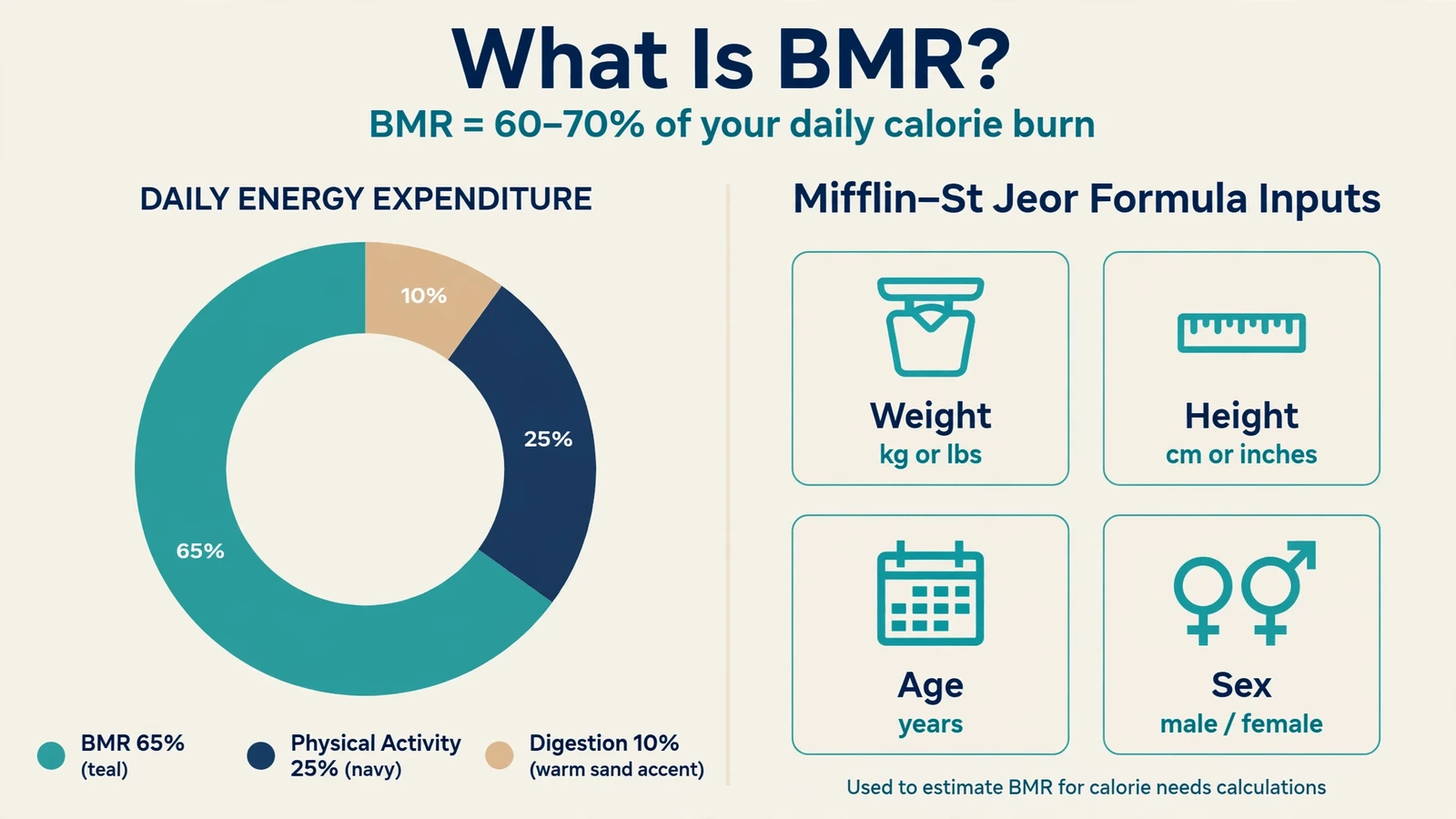
Your basal metabolic rate (BMR) is the calories your body burns at complete rest. Breathing, circulating blood, running your brain, repairing cells: all of that costs energy even on a lazy day. BMR is the biggest slice of your daily burn, roughly 60 to 70 percent, according to dietitians at Harvard-affiliated Massachusetts General Hospital.
Think of BMR as the floor of your calorie needs. It is the starting point for figuring out how many calories to lose weight, and your target should never drop below it.
Which formula should I use: Mifflin-St Jeor or Harris-Benedict?
The Mifflin-St Jeor equation is the modern standard and the one dietitians generally trust most:
- Men: BMR = (10 x weight in kg) + (6.25 x height in cm) – (5 x age) + 5
- Women: BMR = (10 x weight in kg) + (6.25 x height in cm) – (5 x age) – 161
The Harris-Benedict equation is the older option, dating to 1919 and revised in 1984. A 2005 review by Frankenfield, Roth-Yousey, and Compher found it overestimates BMR by about 50 to 80 calories a day in modern populations. Use Mifflin-St Jeor for your own numbers.
How many calories do I burn each day in total?
BMR is only your at-rest burn. Your total daily energy expenditure (TDEE) adds everything else: walking to the bus, digesting food, workouts, even fidgeting. TDEE is your maintenance level, so it is the key number behind how many calories to lose weight. Eat at your TDEE and your weight holds steady.
How do I calculate my TDEE from my BMR?
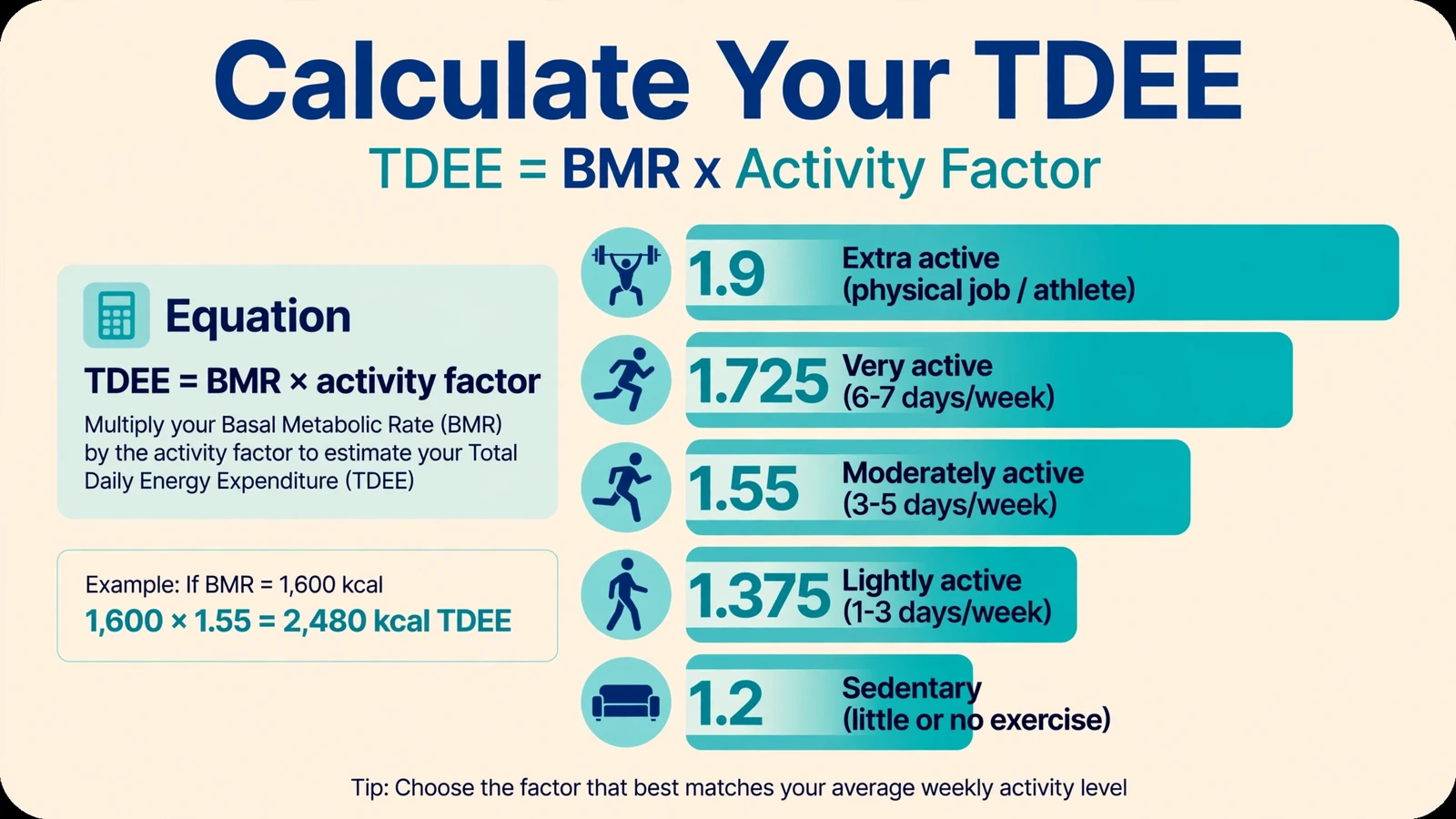
Multiply your BMR by the activity factor that matches your lifestyle:
- Sedentary (desk job, little or no exercise): BMR x 1.2
- Lightly active (light exercise 1 to 3 days per week): BMR x 1.375
- Moderately active (moderate exercise 3 to 5 days per week): BMR x 1.55
- Very active (hard exercise 6 to 7 days per week): BMR x 1.725
- Extra active (physical job plus daily training): BMR x 1.9
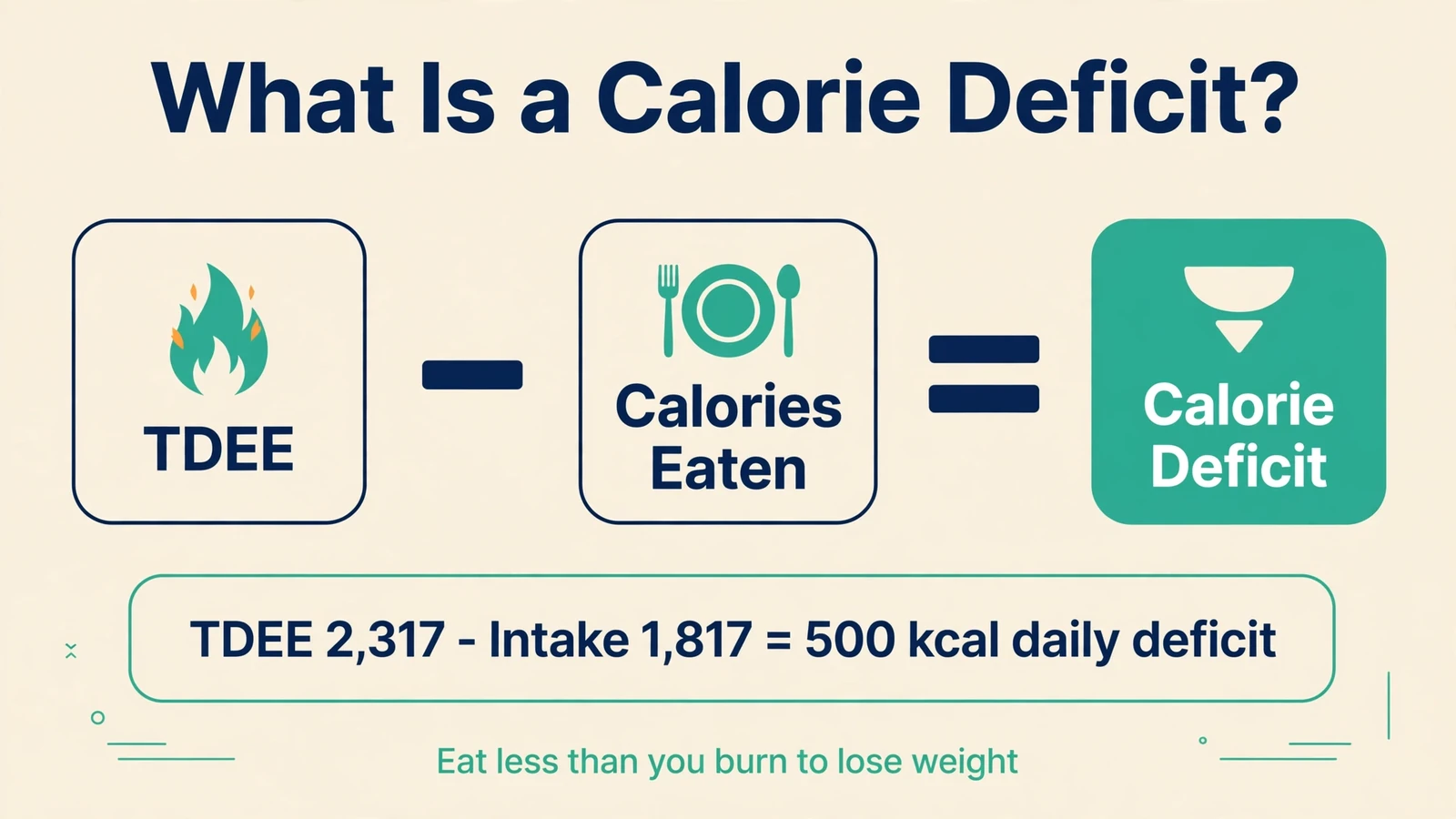
A quick example: a 35-year-old woman, 75 kg, 165 cm, moderately active. Her BMR is (10 x 75) + (6.25 x 165) – (5 x 35) – 161 = 1,495. Her TDEE is 1,495 x 1.55 = 2,317 calories a day. Eating below 2,317 would start fat loss.
Doing this by hand is fine, but a shortcut helps. You can use our free calorie calculator to get your TDEE in seconds. Be honest about your activity level: most people overestimate it, and that is the biggest source of error.
What is a calorie deficit, and how big should mine be?
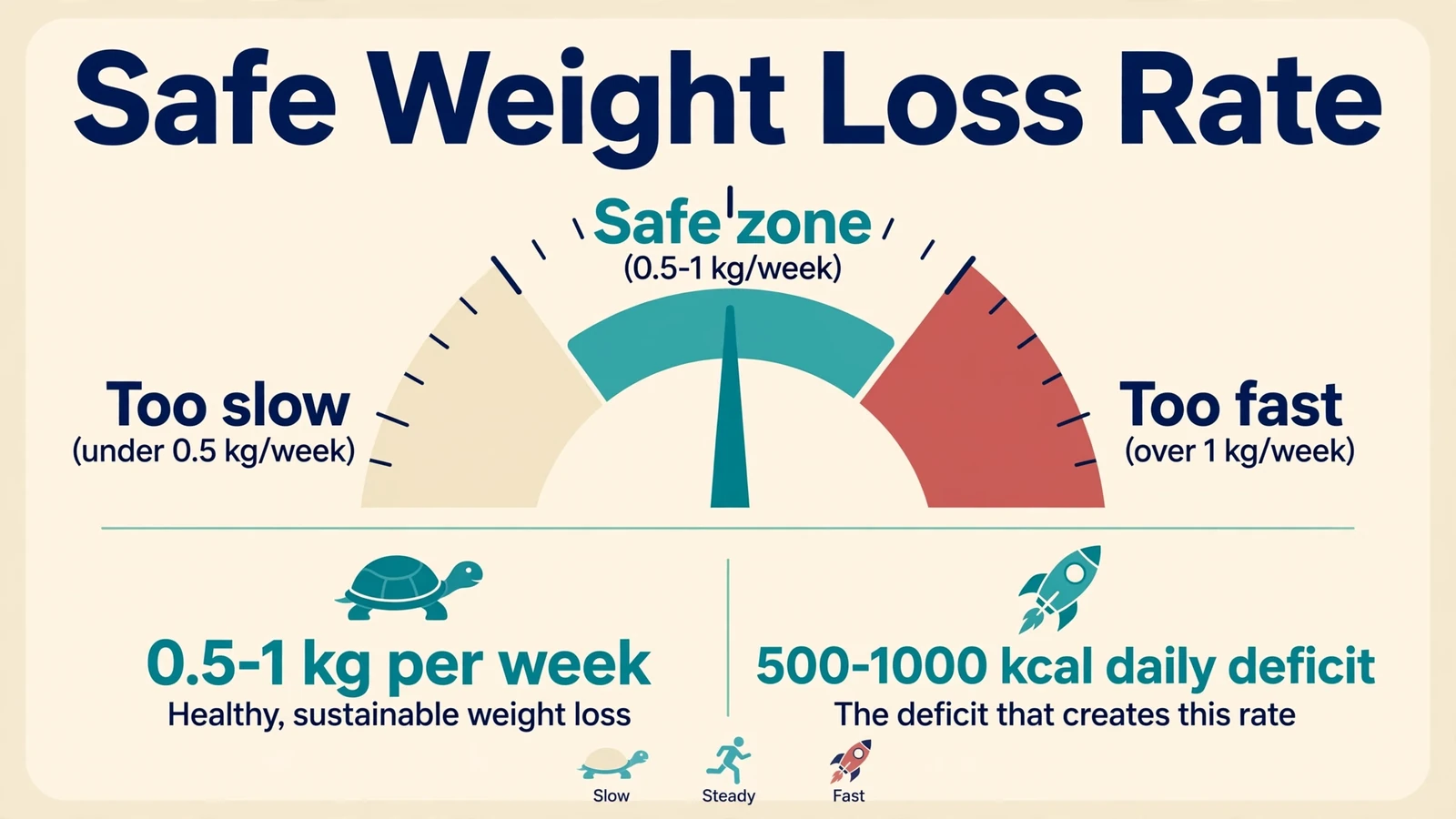
A calorie deficit means eating fewer calories than your TDEE. Your body covers the gap by burning stored fat. That is the whole mechanism of weight loss, whatever diet you follow.
Deficit size sets the speed of your results. Based on the classic rule that about 7,700 calories equals one kilogram of body fat, different daily deficits roughly produce:
| Daily deficit | Expected weekly loss | Pace |
|---|---|---|
| 250 calories | About 0.25 kg (0.5 lb) | Slow and steady |
| 500 calories | About 0.5 kg (1 lb) | Moderate |
| 750 calories | About 0.75 kg (1.5 lb) | Brisk |
| 1,000 calories | About 1 kg (2 lb) | Fast, upper safe limit |
A 500-calorie daily deficit is the sweet spot for most beginners. It moves the scale, keeps hunger manageable, and sits inside the safe range health authorities recommend. To see how many calories to lose weight in practice, subtract your chosen deficit from your TDEE.
If you are new to dieting, our beginner calorie deficit plan walks through the first two weeks. A Mayo Clinic tip: you do not need the whole deficit from food. A smaller food cut plus a daily walk often feels easier.
How fast can I safely lose weight?
Health authorities, including the CDC, Mayo Clinic, and the NHS, consistently recommend 0.5 to 1 kg per week (1 to 2 pounds). This pace preserves more muscle, causes fewer side effects, and is easier to keep off.
Faster is not better. Crash weight loss takes muscle along with fat, and since muscle burns calories at rest, losing it slows your metabolism and invites regain. Harvard dietitians also warn that aggressive deficits raise ghrelin, the hunger hormone, which makes dieting much harder to stick with.
There are hard floors. Do not drop below 1,200 calories a day (women) or 1,500 (men) without medical supervision. Below those levels, nutrient deficiencies become a real risk. Before setting your target, check your BMI to see where you are starting from.
How much protein should I eat while losing weight?
In a deficit, your body can break down muscle for energy. Protein is your main defense. Research shows higher protein intake during calorie restriction preserves lean muscle and keeps you fuller between meals.
The widely cited range is 1.2 to 2.0 grams per kilogram of body weight per day while dieting. For an 80 kg person, that is roughly 95 to 160 grams daily. A palm-sized cooked chicken breast (about 150 g) carries around 45 grams, so eggs at breakfast, Greek yogurt as a snack, and fish or lentils at dinner get most people to the lower end without supplements.
Spread protein across every meal rather than loading it at dinner. That pattern steadies hunger through the day, which makes any answer to how many calories to lose weight easier to live with.
How do I track my progress and adjust my target?
Your TDEE is not fixed. As you lose weight, your smaller body burns fewer calories, so a target that worked in month one can stall in month three. That is normal, not failure.
Follow this simple routine:
- Weigh yourself 3 to 4 mornings a week under the same conditions, and note the weekly average.
- Track your food for at least the first two weeks.
- Losing 0.5 to 1 kg per week? Change nothing.
- Stalled for two to three weeks? Recalculate your TDEE at your new weight and adjust down slightly.
- Recheck your activity level too. Moving more is often easier than eating less.
Do not slash calories every time the scale pauses for a few days. Water shifts can mask fat loss for a week or more, especially after salty meals or hard workouts. Give each adjustment at least two weeks before judging it.
Frequently Asked Questions
How many calories to lose weight per day for a woman?
A common range is 1,200 to 1,600 calories per day, which creates a 500 to 1,000 calorie deficit from a typical TDEE. Smaller or sedentary women may start lower; taller or active women can eat more. Calculate your own TDEE for a precise answer.
How many calories to lose weight per day for a man?
Most men lose weight at 1,500 to 2,000 calories per day, depending on TDEE. A 500-calorie daily deficit is the standard starting point. Do not go below 1,500 calories without medical supervision.
Does my daily calorie intake for weight loss change as I get lighter?
Yes. Your TDEE drops as your body shrinks, so your target needs updating. Recalculate every 4 to 6 kg of weight loss, or when progress stalls for over two weeks. A small cut of 100 to 150 calories usually restarts progress.
Is a 1,000-calorie deficit safe?
For some people, yes. It is the upper edge of the recommended range and produces about 1 kg of loss per week. It leaves less room for nutrients, so keep protein high, add strength training, and ease off if you feel constantly tired or irritable. Below 1,200 calories (women) or 1,500 (men), talk to a clinician first.
How accurate are online calorie calculators?
Good ones using the Mifflin-St Jeor equation land within about 10 percent of your true needs for most people. That is close enough to start. Treat the number as a hypothesis, track your weight for two to three weeks, then adjust.
Can I lose weight without counting calories?
Yes. Weight loss comes from eating less than you burn, and some people manage that with portion control or cutting sugary drinks. But counting is the most reliable way to find your calorie needs for fat loss at the start. Even a few weeks of tracking builds lasting portion awareness.
Why am I not losing weight in a calorie deficit?
The usual culprits: an overstated activity level, forgotten calories (oils, drinks, weekend meals), and water retention hiding fat loss. Re-check your TDEE with conservative settings, track everything for one full week, and compare weekly averages before concluding the deficit is wrong.
Conclusion
Figuring out how many calories to lose weight is simpler than the diet industry makes it look: find your TDEE, subtract 500 calories, protect your protein, and adjust as your body changes. A loss of 0.5 to 1 kg per week keeps muscle, energy, and sanity intact.
Your next step takes two minutes. Run your numbers through Calcunexa’s calorie calculator, write down your daily target, and start tracking tomorrow morning. Small, steady deficits beat dramatic ones every time.
For more on the science, see Mayo Clinic’s guide to counting calories and Harvard’s explanation of a safe calorie deficit.
3 thoughts on “How Many Calories to Lose Weight | Find Your Sweet Spot for Safe, Lasting Results”