Here is the honest truth about how to start weight loss: you do not need a 30-day challenge, a detox, or a total kitchen overhaul. You need a small calorie deficit, enough protein, daily movement, decent sleep, and a system you can repeat on a boring Tuesday.
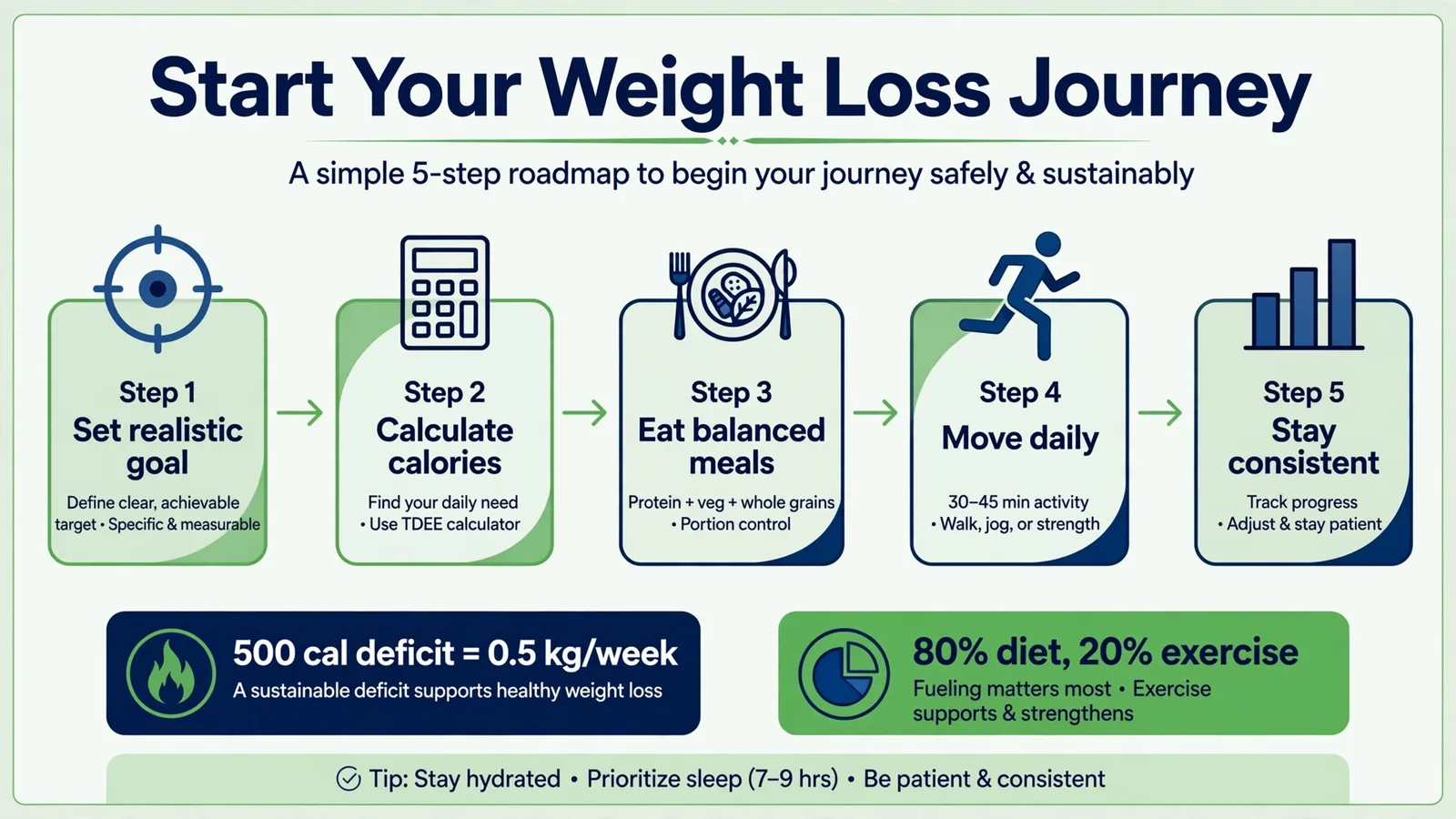
Most people fail at how to start weight loss not because they lack willpower but because they try to change everything on day one. That approach burns out in a week. This guide takes the opposite path: five simple steps you stack one at a time, each one building on the last. Start with your numbers, set a safe calorie target, eat in a way you actually enjoy, move a little more each day, and build routines that hold up when motivation fades.
This is a beginner-friendly plan, not medical advice. If you have a health condition or take medication that affects weight, talk to a doctor before changing your diet. Everyone else can begin right here, today, with what you already have.
What is a weight loss journey?
A weight loss journey is the sustained process of losing body weight through diet, activity, and lifestyle changes over weeks or months. It is not a crash diet or a 30-day sprint. Think of it as a series of small, repeatable habits that create a modest calorie deficit while keeping your energy, muscle, and sanity intact.
Step 1: Where do I actually start?
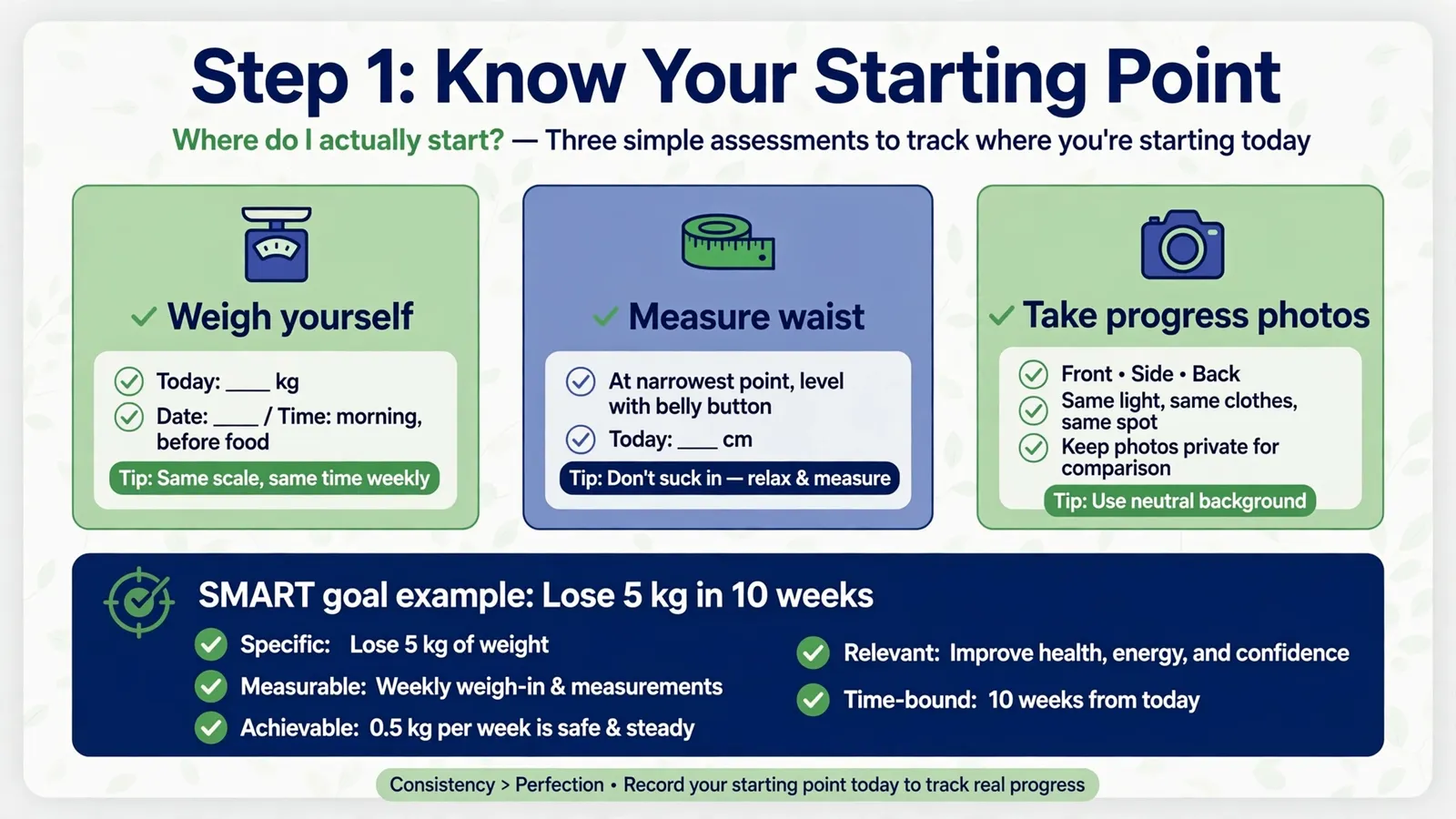
Start with your numbers, not a diet plan. Every good plan for how to start weight loss begins with the same foundation: data about your own body. Three numbers tell you almost everything: your BMI, your BMR, and your TDEE.
BMI (body mass index) is a simple height-and-weight ratio that shows which general range you are in. It is not perfect, but it gives you a starting point, so check your BMI before anything else.
BMR (basal metabolic rate) is the energy your body burns just keeping you alive. TDEE (total daily energy expenditure) is your BMR plus everything else: walking, workouts, fidgeting, even digesting food. TDEE is the number that matters most for weight loss, because your food intake has to sit below it.
You can estimate both with free tools instead of doing math by hand. Use a reliable calorie calculator to get your TDEE in under a minute, and write the number down somewhere you will see it. That single number becomes the foundation for every decision in this guide.
Step 2: How many calories should I eat to lose weight?
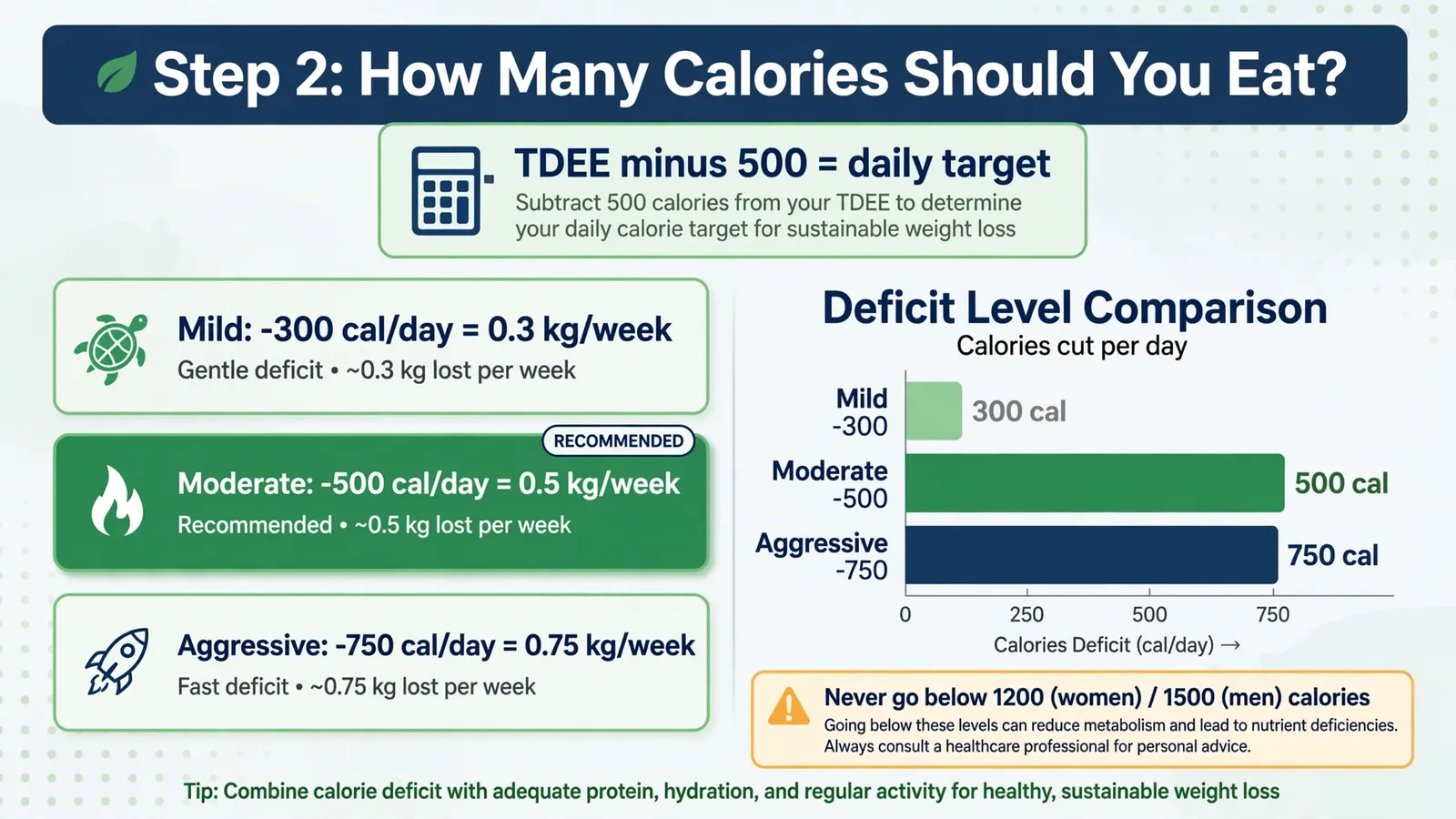
Take your TDEE and subtract 300 to 500 calories. That is your daily target. This simple subtraction is the real engine of how to start weight loss the right way. If your TDEE is 2,400, aim for about 1,900 to 2,100 calories a day.
Why that range? One pound of body fat holds roughly 3,500 calories. A daily deficit of 500 calories adds up to about 3,500 a week, which is roughly one pound lost. A 300-calorie deficit lands closer to half a pound a week. Both rates sit inside the safe zone most experts recommend.
Harvard Health suggests aiming to lose 5 to 10 percent of your body weight as a first goal, and losing weight gradually makes that goal realistic instead of miserable.
Do not go below 1,200 calories a day if you are a woman, or 1,500 if you are a man, without medical supervision. Bigger deficits are not better; they drain your energy, cost you muscle, and make you ravenous.
Still unsure about your numbers? calculate your TDEE again with honest activity settings, then subtract your deficit from that number. Now you have a target you can plan real meals around.
Step 3: What should I eat?
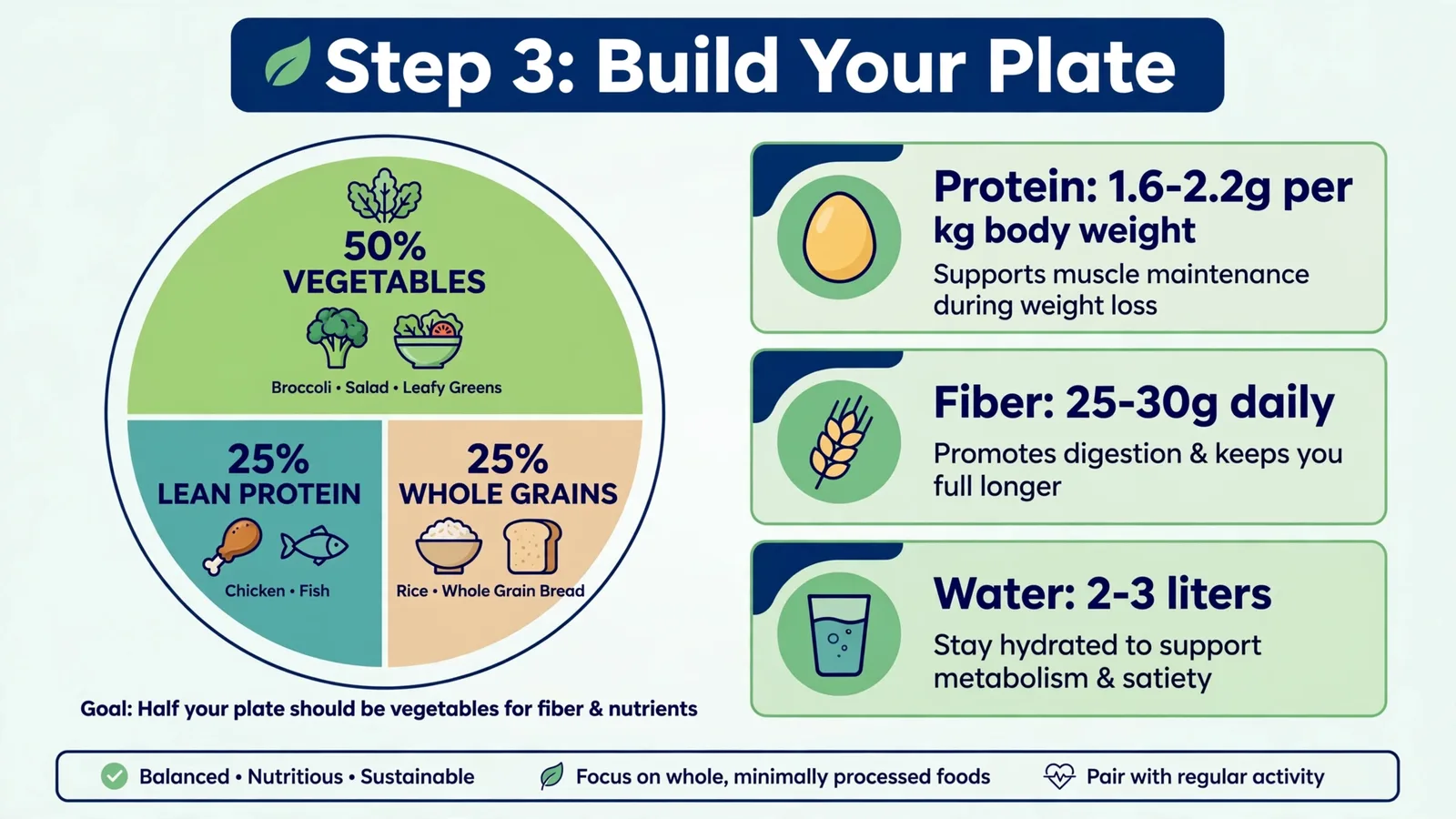
Here is the simplest plate you can build: a palm-sized portion of protein, half the plate covered in vegetables, and a fist-sized portion of whole carbs like rice, potatoes, or oats. Repeat that two or three times a day and you are most of the way there.
Protein matters because it keeps you full and protects your muscle while you lose weight. Aim for roughly 1.2 to 1.6 grams per kilogram of body weight per day, which for most beginners means a solid serving at every meal: eggs, chicken, fish, lentils, Greek yogurt, tofu, or beans.
Fiber is your second best friend. Vegetables, fruit, whole grains, and legumes add bulk without many calories, so you feel satisfied on less food.
No food is banned. Pizza, chocolate, and dessert fit fine when they are the smaller part of your day instead of the whole day. Restriction is what causes binges, not pizza.
One practical trick: pre-decide two or three breakfasts and lunches you like and rotate them. Fewer decisions means fewer impulse choices, and your grocery bill drops too. That is how to start weight loss without obsessing over every bite.
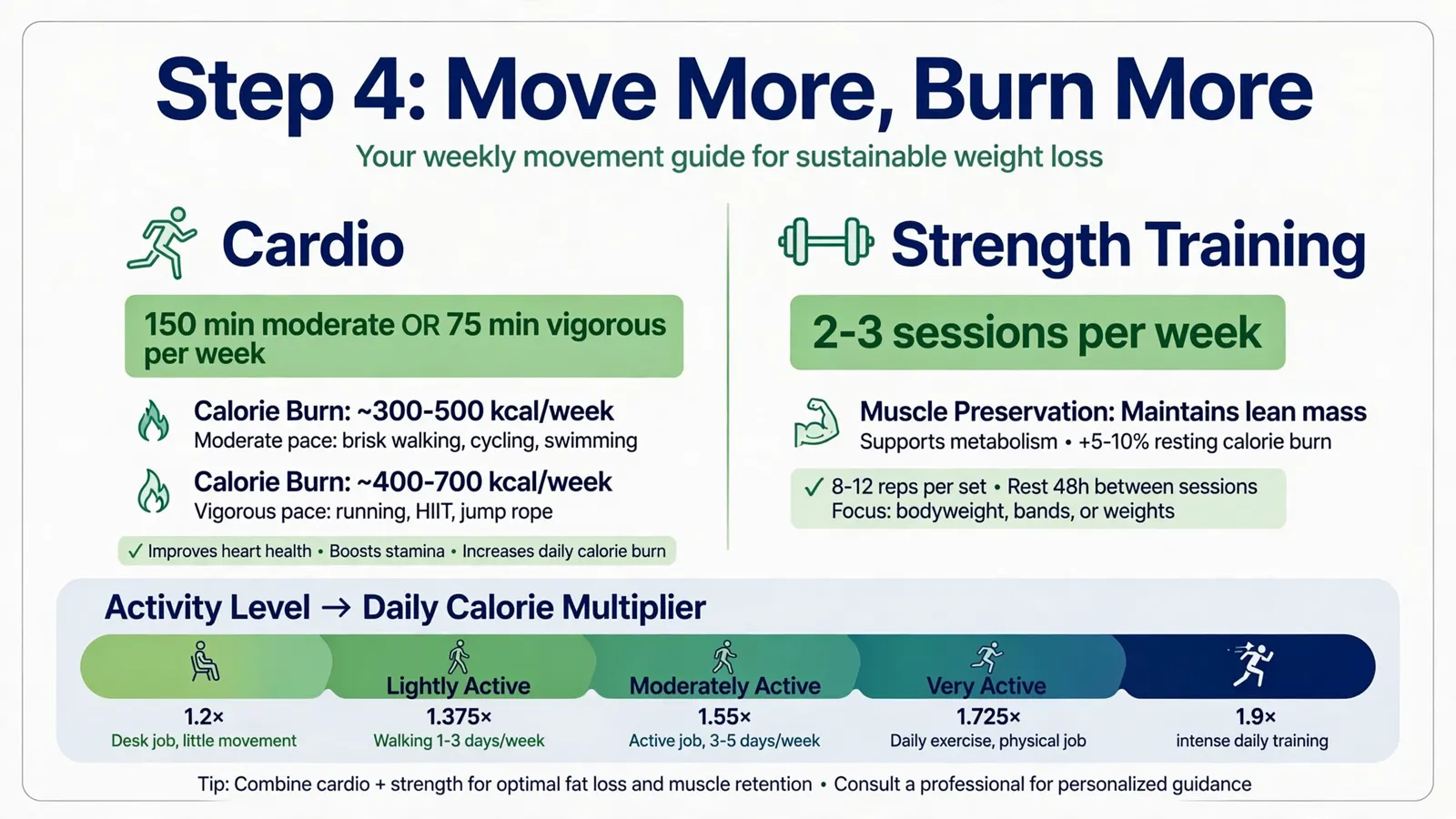
Step 4: How much should I move?
You do not need a gym membership to begin. Start with walking, because it is free, gentle on your joints, and easy to repeat.
Aim for 15 to 20 minutes of brisk walking most days. Once that feels easy, add five minutes a week until you reach 30 to 45 minutes. That alone can burn 150 to 250 extra calories a day while improving your mood and sleep.
Twice or three times a week, add simple bodyweight strength work: squats, push-ups against a wall or the floor, lunges, and planks. Two or three sets of each, twice a week, is enough to protect your muscle while you lose fat. Muscle matters because it keeps your metabolism from slowing down as you get lighter.
Then there is NEAT, the calories you burn from everyday movement: taking the stairs, parking farther away, standing while you work, playing with your kids. These small choices add up to hundreds of calories across a week without feeling like exercise.
Start small enough that you cannot fail. A 15-minute walk you actually do beats the 60-minute workout you skip.
Step 5: How do I stay consistent when motivation fades?
Motivation is a terrible engine because it runs out. Systems keep going after it does.
First, protect your sleep. Seven to eight hours a night keeps hunger hormones in check, and tired people make worse food choices. This is not optional wellness fluff; it directly affects your appetite.
Second, track something simple. Weigh yourself two or three times a week at the same time, or take a weekly photo, or keep a one-line food log. You are looking for trends, not judging daily noise.
Third, design your environment so the easy choice is the good one. Keep fruit on the counter and chips out of the house. Lay out walking shoes by the door. Prep one meal ahead on weekends.
Fourth, expect plateaus. After a few weeks your body adapts and the scale stalls. That is normal, not failure. Tighten portions slightly, add a few minutes to your walks, or recalculate your TDEE since your lighter body burns less now. Then keep going.
Fifth, talk to yourself like a friend. One bad day does not erase three good weeks. The people who succeed at how to start weight loss are not the ones who never slip; they are the ones who restart the next morning.
Frequently Asked Questions
How much weight can I safely lose in a month?
About 2 to 4 kilograms, which is roughly 4 to 8 pounds. That pace comes from a daily deficit of 300 to 500 calories, the safe range backed by most nutrition guidelines. Faster loss usually means lost muscle and quick regain.
Do I need to exercise to lose weight?
No, but it helps a lot. Diet creates most of the deficit, while movement protects your muscle, lifts your mood, and makes the whole process faster. People who combine both tend to keep the weight off longer.
What is a calorie deficit?
A calorie deficit means eating fewer calories than your body burns in a day. When that gap appears, your body covers it by using stored fat. A daily gap of 300 to 500 calories is the sweet spot for steady, safe loss.
How do I break a weight loss plateau?
First, confirm it is a real plateau: no change for three or four weeks. Then recalculate your TDEE, because a lighter body burns fewer calories, and trim another 100 to 200 calories or add 10 to 15 minutes of walking. Check your sleep too; it often slips before the scale does.
Should I skip breakfast to lose weight?
Only if you genuinely prefer it. Skipping breakfast saves calories only when you do not eat bigger meals later, and many people do. Eat when you are hungry, hit your protein targets, and keep your total calories inside your deficit.
How much water should I drink?
Around 2 to 3 liters a day is a good target for most adults, more if you sweat a lot or train hard. Drinking a glass before meals can also take the edge off your appetite. Your urine should look pale yellow; that is the simplest check.
How do I know my TDEE?
Use an online TDEE calculator with honest inputs: your age, weight, height, and real activity level. Pick the activity level that matches your actual week, not the one you wish for. That number minus 300 to 500 calories becomes your weight loss target.
Conclusion
Learning how to start weight loss comes down to five small habits: know your numbers, eat in a modest deficit, build a plate you enjoy, move every day, and protect your sleep. None of them is hard alone, and together they beat every crash diet.
Your first move is simple: calculate your numbers, set your calorie target, and take a 15-minute walk today. Small steps, repeated daily, are how to start weight loss that actually lasts. For more background, read the overviews of weight loss and body mass index on Wikipedia.