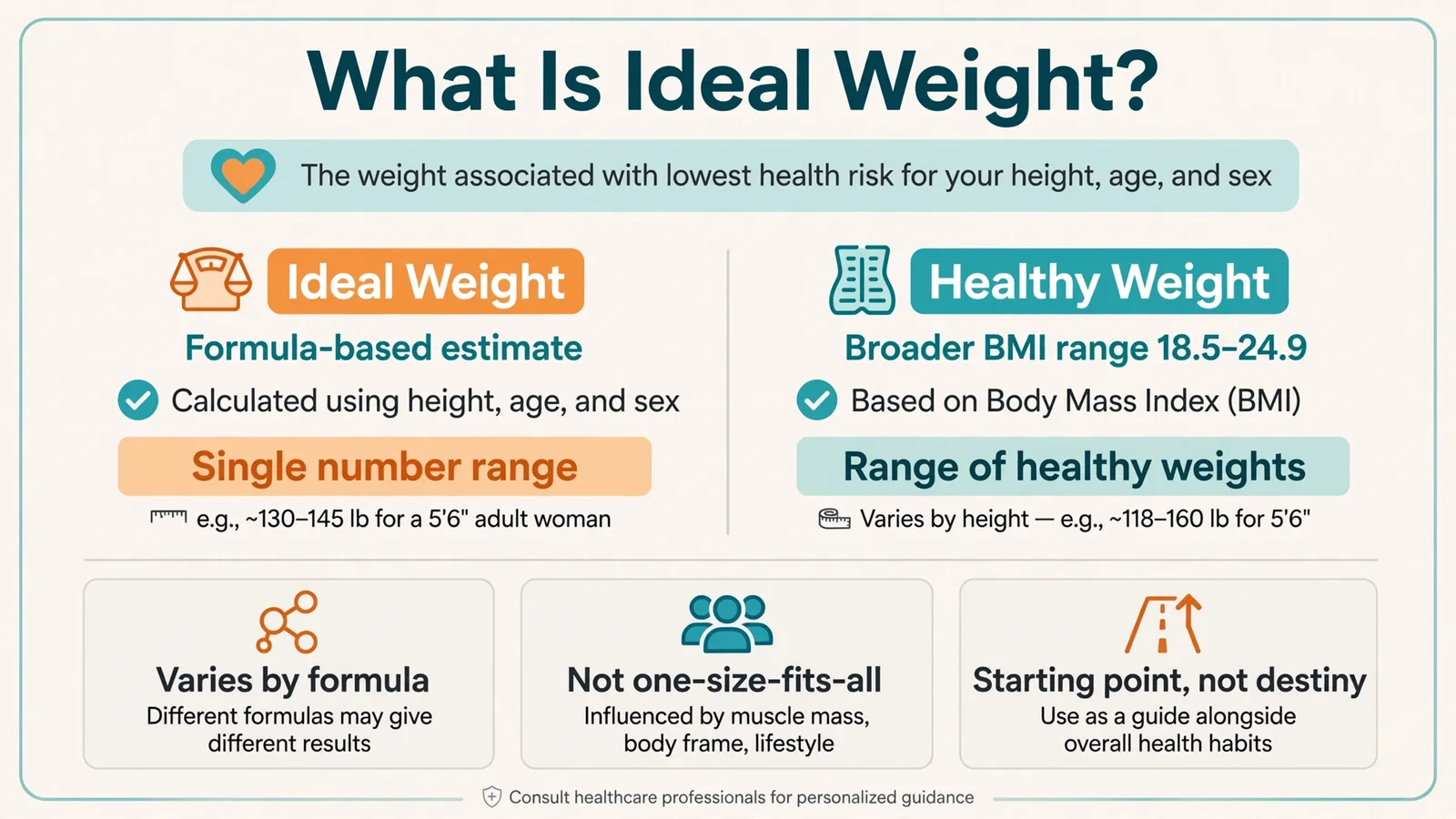
Your ideal weight is the weight tied to the lowest health risk for your height. Doctors estimate it with simple formulas, most famously the Devine formula, and pair it with your BMI to judge where you stand. In this guide you will learn exactly what the number means, how to calculate it step by step, and how the four classic formulas compare.
Most people guess their target weight or copy someone else’s. A smarter move is to use your own height and the formulas clinicians rely on. That gives you a realistic starting target, not a celebrity number. And once you know your ideal weight, you can compare it with your current weight to set a plan that actually fits your body.
Why does this matter? Because research has linked staying near your healthy weight range with better heart health, steadier energy, and lower risk of conditions like type 2 diabetes. Your ideal body weight is not a beauty standard. It is a data-backed reference point, and this guide shows you how to use it.
What is ideal weight?
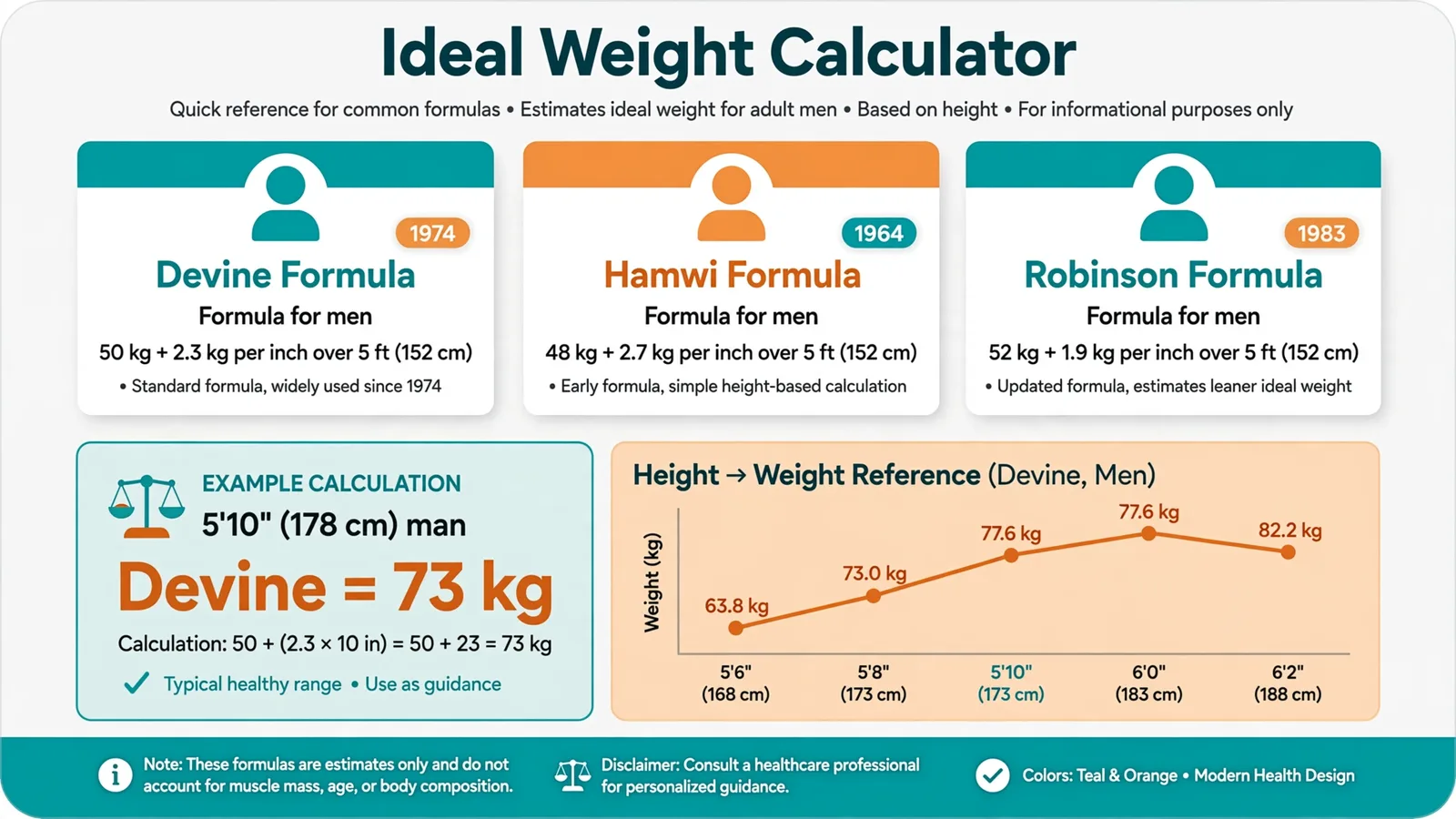
Ideal weight, also called ideal body weight or IBW, is the weight linked with the lowest mortality and disease risk for a given height. It is estimated with math formulas, not measured directly. IBW gives you one reference number, not a guarantee of health.
How is ideal weight calculated?
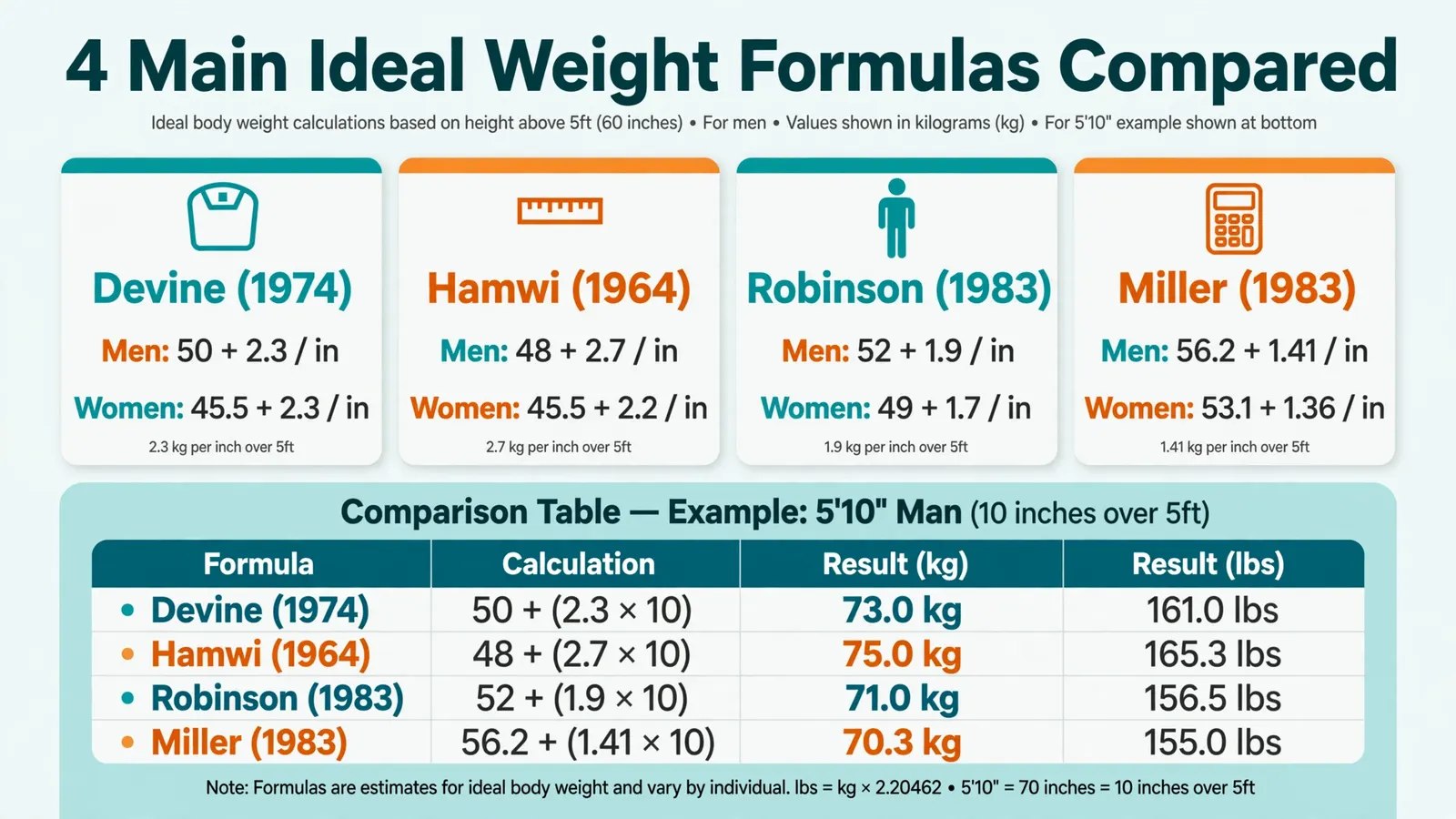
It is calculated with the Devine formula, which needs only your height and sex. Here is the step by step process:
- Convert your height to inches. For example, 5 feet 10 inches is 70 inches.
- Subtract 60 inches (5 feet). For the example above, 70 – 60 = 10 inches over 5 feet.
- Pick the formula. For men it is 50 + 2.3 x (inches over 5 feet). For women it is 45.5 + 2.3 x (inches over 5 feet). The answer is in kilograms.
Let us work the example fully. A man who is 5 feet 10 inches tall is 70 inches, which is 10 inches over 5 feet. Devine says 50 + 2.3 x 10. That is 50 + 23 = 73 kg. So his ideal weight is about 73 kg, or roughly 161 lb.
Note that the original formulas were built for adults 5 feet and taller. Below 5 feet the math breaks down, so results for shorter heights need a clinician’s judgment.
What are the main ideal weight formulas?
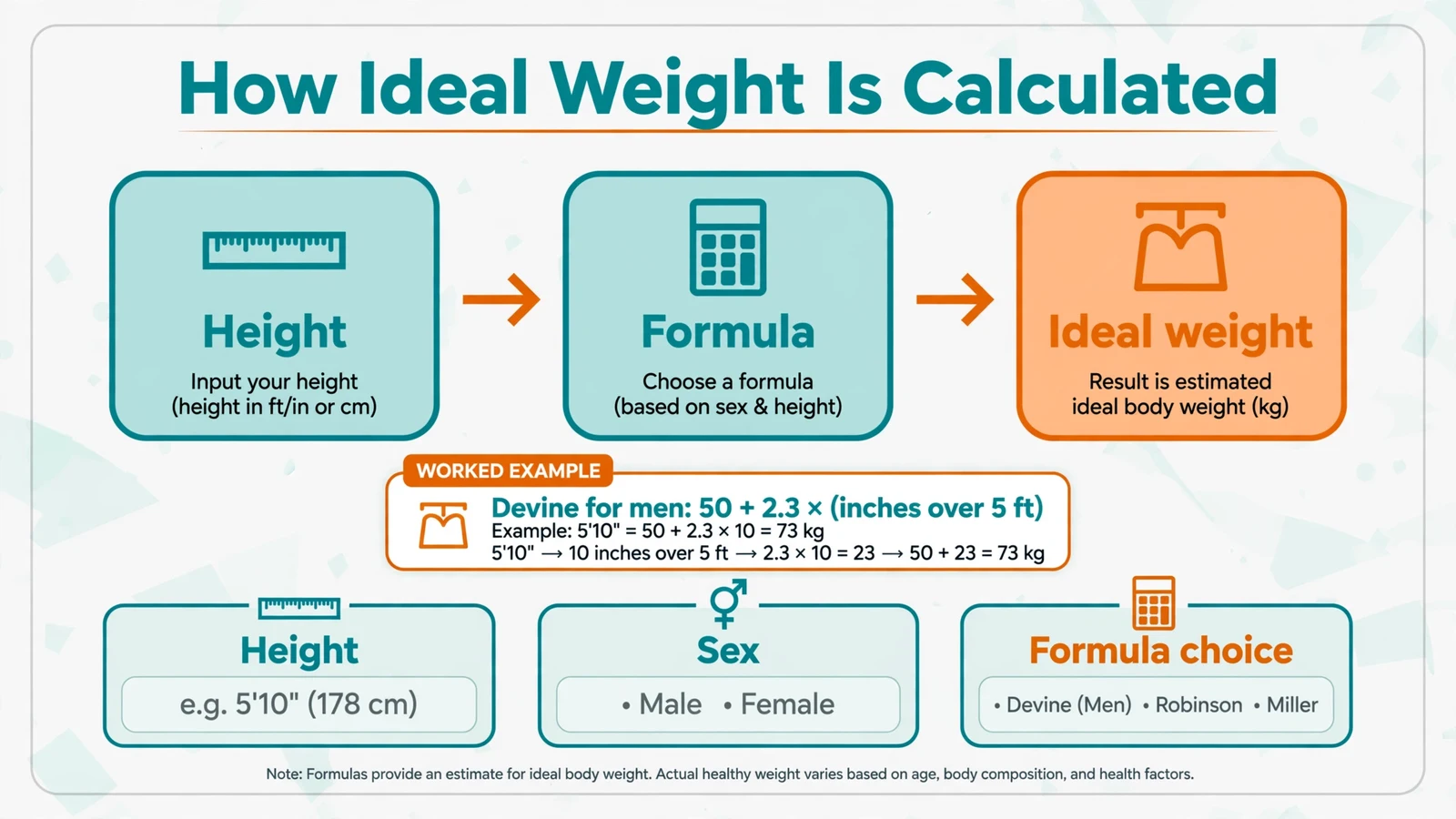
Four formulas dominate the field. They agree closely, but their bases differ slightly:
| Formula | Men (kg) | Women (kg) | Background |
|---|---|---|---|
| Devine | 50 + 2.3 x in over 5 ft | 45.5 + 2.3 x in over 5 ft | 1974; created for drug dosing |
| Hamwi | 48 + 2.7 x in over 5 ft | 45.5 + 2.2 x in over 5 ft | 1964; classic textbook method |
| Robinson | 52 + 1.9 x in over 5 ft | 49 + 1.7 x in over 5 ft | 1983; adjusts the Devine base |
| Miller | 56.2 + 1.41 x in over 5 ft | 53.1 + 1.36 x in over 5 ft | 1983; fitted to population data |
Devine remains the most cited, because hospitals adopted it for medication dosing back in 1974. Hamwi came from early insurance and clinical practice, while Robinson and Miller are later refinements. For a 5 foot 10 man, the four answers land between roughly 70 and 74 kg. The differences are small, so any of them works as a starting estimate.
Is ideal weight the same as a healthy weight?
Not quite. Ideal weight gives you a single number. A healthy weight is a range, and it looks at more than height.
BMI defines the healthy range as 18.5 to 24.9. For our 5 foot 10 example, that range spans about 59 to 79 kg. The Devine answer of 73 kg sits inside it. So the two systems agree in most cases, but they are not the same tool.
Body composition adds the nuance. Muscle weighs more than fat, so a lean athlete can sit above the ideal number and still be perfectly healthy. Older adults, who often carry less muscle, may sit lower and be fine too. Think of IBW as a first estimate, then adjust with your build, your doctor, and a quick check on our BMI calculator.
What factors change your ideal weight?
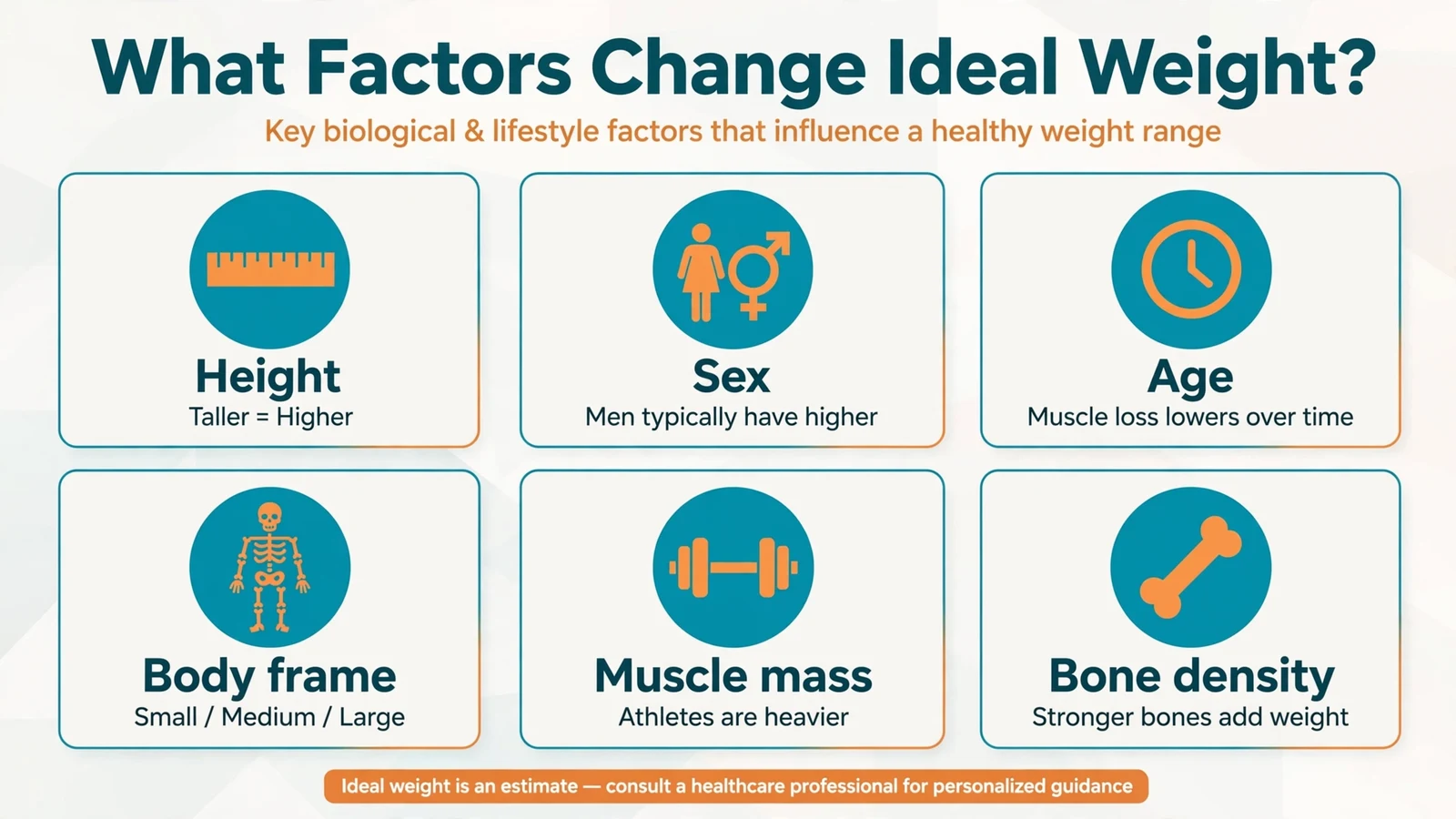
Formulas use only height and sex, but real bodies vary. These four factors move your personal ideal up or down:
- Frame size. Big-boned people carry more weight at any height. A quick check is wrist size: under 6.5 inches at 5 foot 10 for men usually means a smaller frame.
- Muscle mass. Lifters and athletes weigh more because muscle is dense. If you train hard, expect your healthy weight to sit above the formula number.
- Age. Adults often lose muscle with age, so the same formula can overestimate the ideal for seniors.
- Sex. Men carry more muscle and bone on average, which is why every formula gives them a higher base number.
That is why clinicians treat IBW as a starting point. If you are very active, muscular, or over 65, talk through your number with a professional instead of chasing it exactly.
Frequently Asked Questions
What is my ideal weight for my height?
Convert your height to inches, subtract 60 (5 feet), and apply the Devine formula: men use 50 + 2.3 x inches over 5 feet, women use 45.5 + 2.3 x inches over 5 feet. A 5 foot 10 man gets 73 kg. Pair the result with your BMI range to confirm it sits in a healthy zone.
Which ideal weight formula is most accurate?
No formula is perfect, but Devine is the most widely used in clinical practice, which makes it the safest default. Hamwi runs a bit higher, Robinson and Miller a bit lower, and for most heights they agree within a few kilograms. Accuracy matters less than using the number as a rough guide.
Does ideal weight account for muscle mass?
No. All four formulas ignore muscle, bone density, and body fat percentage. A muscular person can be very healthy while weighing more than the formula says. If you lift or play sport regularly, treat IBW as a lower bound and rely more on body fat measures.
What is the Hamwi formula?
The Hamwi formula dates to 1964 and gives ideal body weight in kilograms. For men it is 48 + 2.7 x inches over 5 feet, and for women it is 45.5 + 2.2 x inches over 5 feet. It was a standard teaching formula for decades, though Devine is now cited more often.
Is BMI better than ideal body weight?
They serve different roles. BMI gives a healthy range and is the standard screening tool worldwide. Ideal body weight gives one target number that is handy for dosing and quick checks. Use both together: BMI for the range, IBW for the bullseye.
Should I aim exactly for my ideal weight?
No. IBW is an estimate, not a prescription. Your frame, muscle, and health history shift the real target by several kilograms. Stay inside the BMI healthy range, focus on strength, food, and sleep, and discuss big weight changes with a clinician.
Conclusion
Your ideal weight is a simple, science-backed reference: one number from your height that points to the zone of lowest risk. The Devine formula takes a minute to run, and the other three classics land within a few kilograms of the same answer.
Use that number as a guide, not a verdict. Check it against your BMI, adjust for muscle and frame, and build your habits around food, movement, and rest. To put this into practice, use our calorie calculator to find the daily intake that moves you toward your goal at a steady pace.
This article is general information, not medical advice. For personal targets, talk to a qualified health professional.
Further reading: the Body mass index page on Wikipedia explains how BMI ranges are defined, and the NHS healthy weight guide offers practical, evidence-based steps for staying in a healthy range.