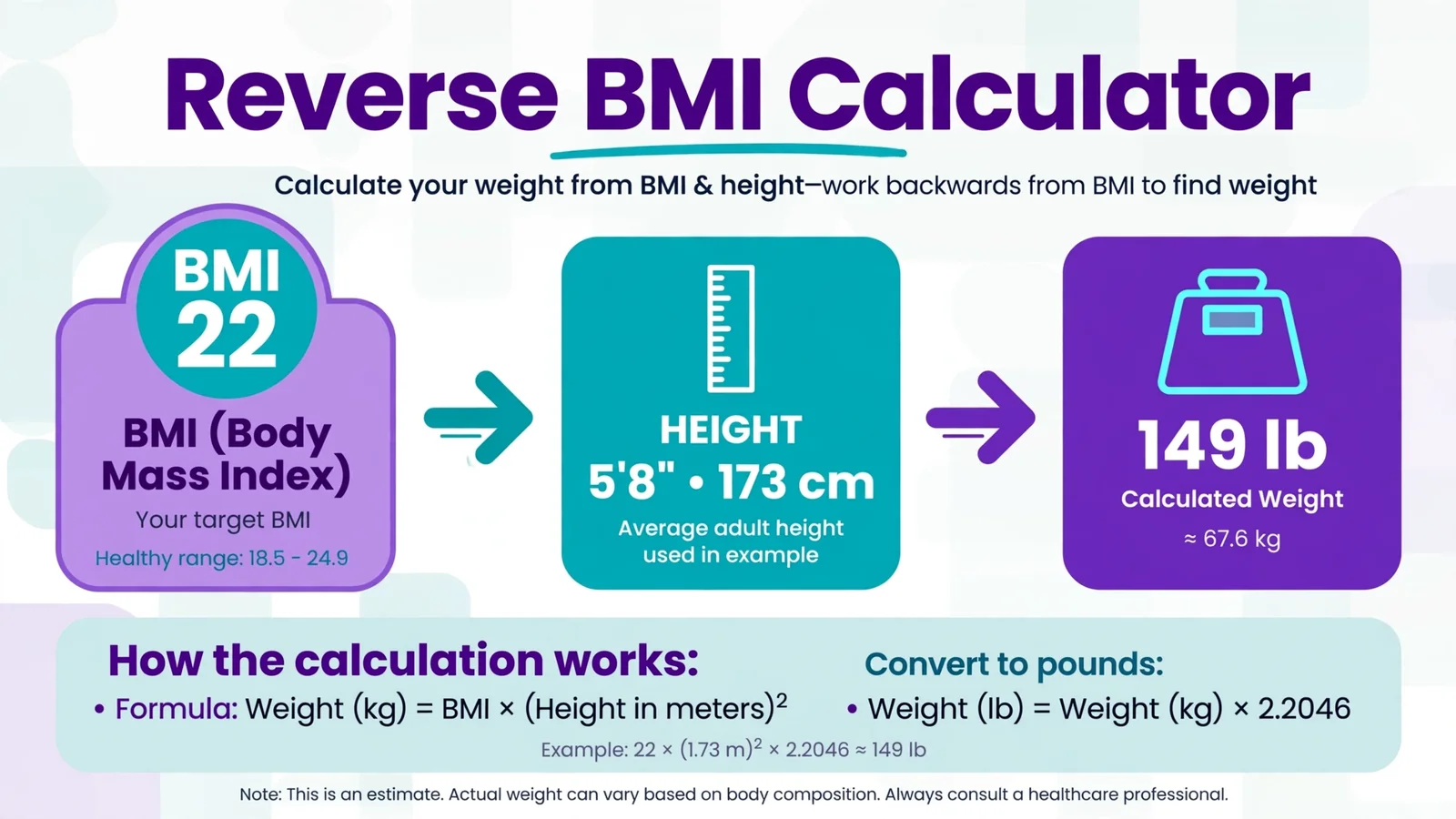
A reverse BMI calculator works backward from the standard formula: instead of entering your weight to find your BMI, you enter a target BMI and your height to find the weight that produces it. It answers the practical question of what you should weigh to land at any point on the BMI scale.
[Image: reverse-bmi-calculator-featured.webp]
Most people use BMI calculators to check where they are. A reverse BMI calculator is for deciding where you want to be. Whether you are setting a goal weight, checking what a healthy range looks like for your height, or translating a doctor’s advice into pounds and kilograms, this guide shows you how the reverse calculation works and how to use it well.
What Is a Reverse BMI Calculator?
A reverse BMI calculator flips the standard body mass index equation. The normal formula takes your weight and height and outputs a BMI number. The reverse version takes a BMI number and your height and outputs the weight that would give you that BMI.
The use case is goal setting. Say your doctor suggests aiming for a BMI of 22, or you want to know the weight range that keeps you inside the healthy 18.5 to 24.9 band. Instead of guessing weights and checking each one, you enter the target BMI once and get the exact answer. It turns an abstract number into a concrete target on the scale.
How Does Reverse BMI Calculation Work?
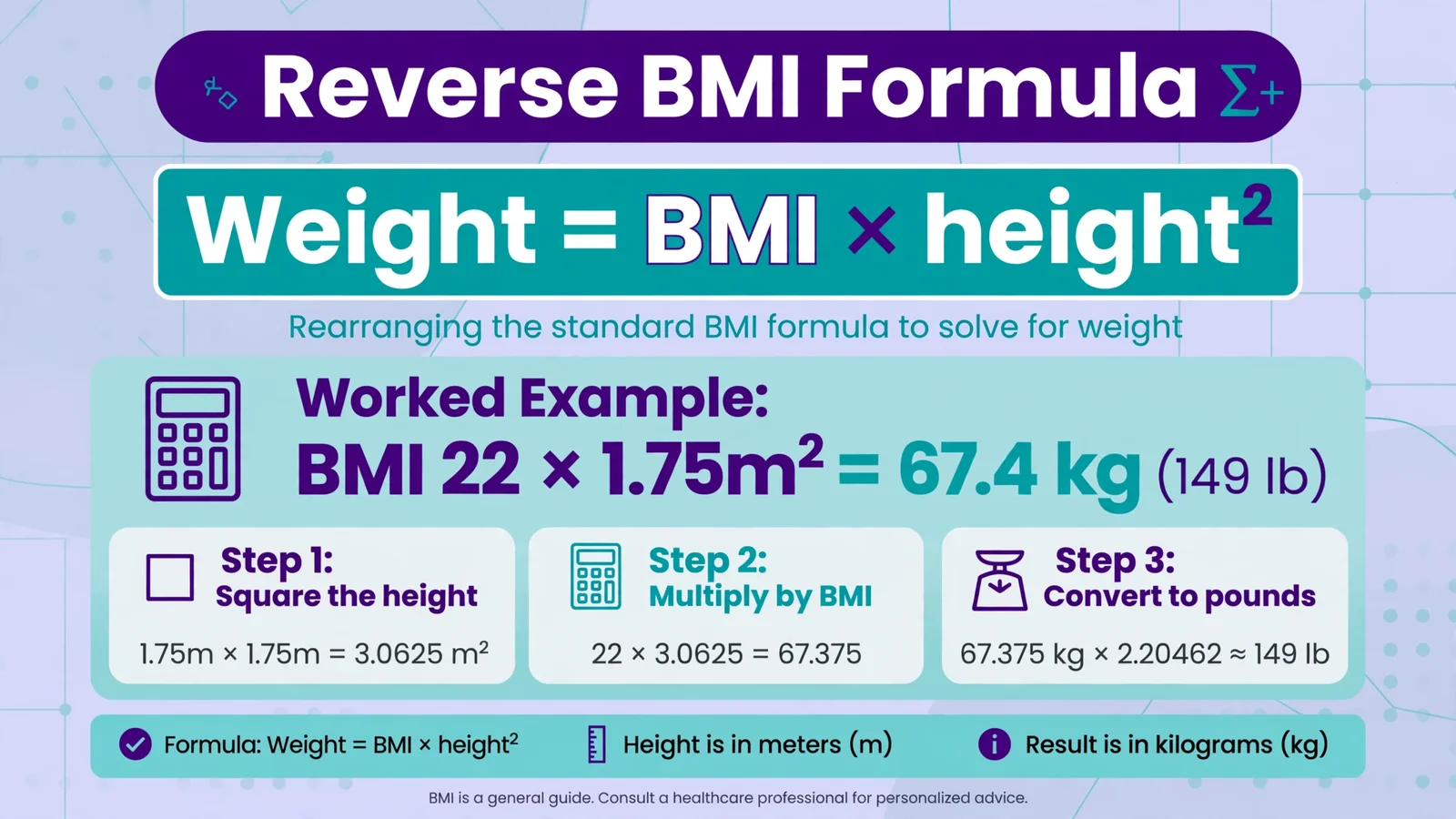
The standard formula is:
BMI = weight in kg divided by height in meters squared
Rearranging it to solve for weight gives:
Weight in kg = BMI multiplied by height in meters squared
In imperial units:
Weight in pounds = BMI multiplied by height in inches squared, divided by 703
A worked example makes it concrete. Take a target BMI of 22 and a height of 5 feet 9 inches (1.75 meters):
1. Square the height: 1.75 times 1.75 equals 3.0625. 2. Multiply by the target BMI: 22 times 3.0625 equals 67.4 kg. 3. Convert if needed: 67.4 kg is about 149 pounds.
So a 5’9″ person weighs about 149 pounds at a BMI of 22. One input, one answer, no trial and error. You can verify the math by running the result through the free BMI calculator in the normal direction.
[Image: reverse-bmi-calculator-formula.webp]
What Weight Range Is Healthy for Your Height?
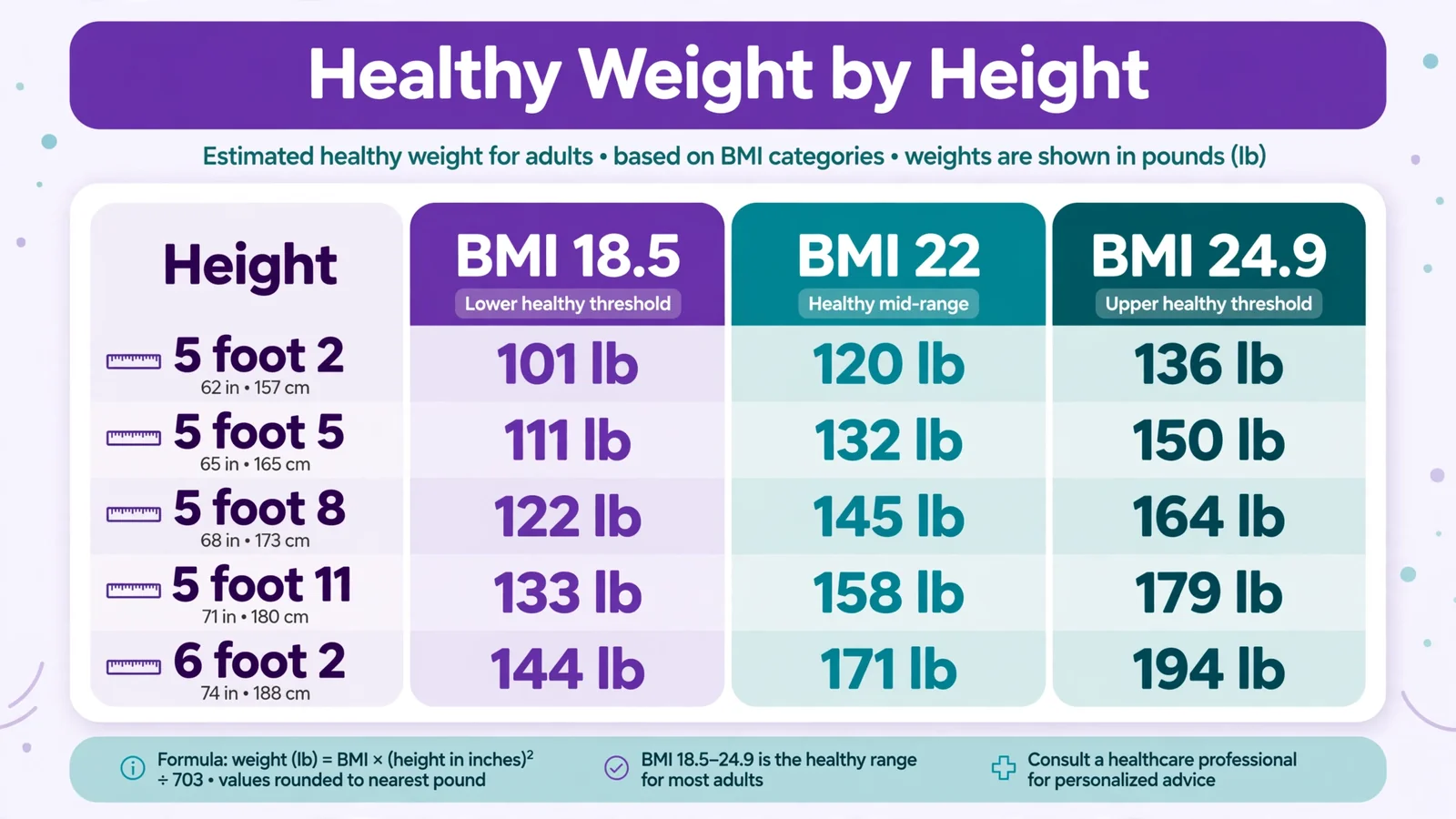
The most common use of a reverse BMI calculator is finding the full healthy weight range for your height, using the 18.5 to 24.9 band. Here is what that looks like at several heights:
| Height | Weight at BMI 18.5 | Weight at BMI 22 | Weight at BMI 24.9 |
|---|---|---|---|
| 5’2″ (157 cm) | 101 lb (46 kg) | 120 lb (54 kg) | 136 lb (62 kg) |
| 5’5″ (165 cm) | 111 lb (51 kg) | 132 lb (60 kg) | 150 lb (68 kg) |
| 5’8″ (173 cm) | 122 lb (55 kg) | 145 lb (66 kg) | 164 lb (75 kg) |
| 5’11” (180 cm) | 134 lb (61 kg) | 159 lb (72 kg) | 180 lb (82 kg) |
| 6’2″ (188 cm) | 146 lb (66 kg) | 174 lb (79 kg) | 197 lb (89 kg) |
The middle column, BMI 22, sits near the center of the healthy range and is a popular target because it leaves comfortable margin on both sides. But anywhere inside the 18.5 to 24.9 band counts as healthy by the standard categories.
[Image: reverse-bmi-calculator-weight-table.webp]
When Should You Use a Reverse BMI Calculator?
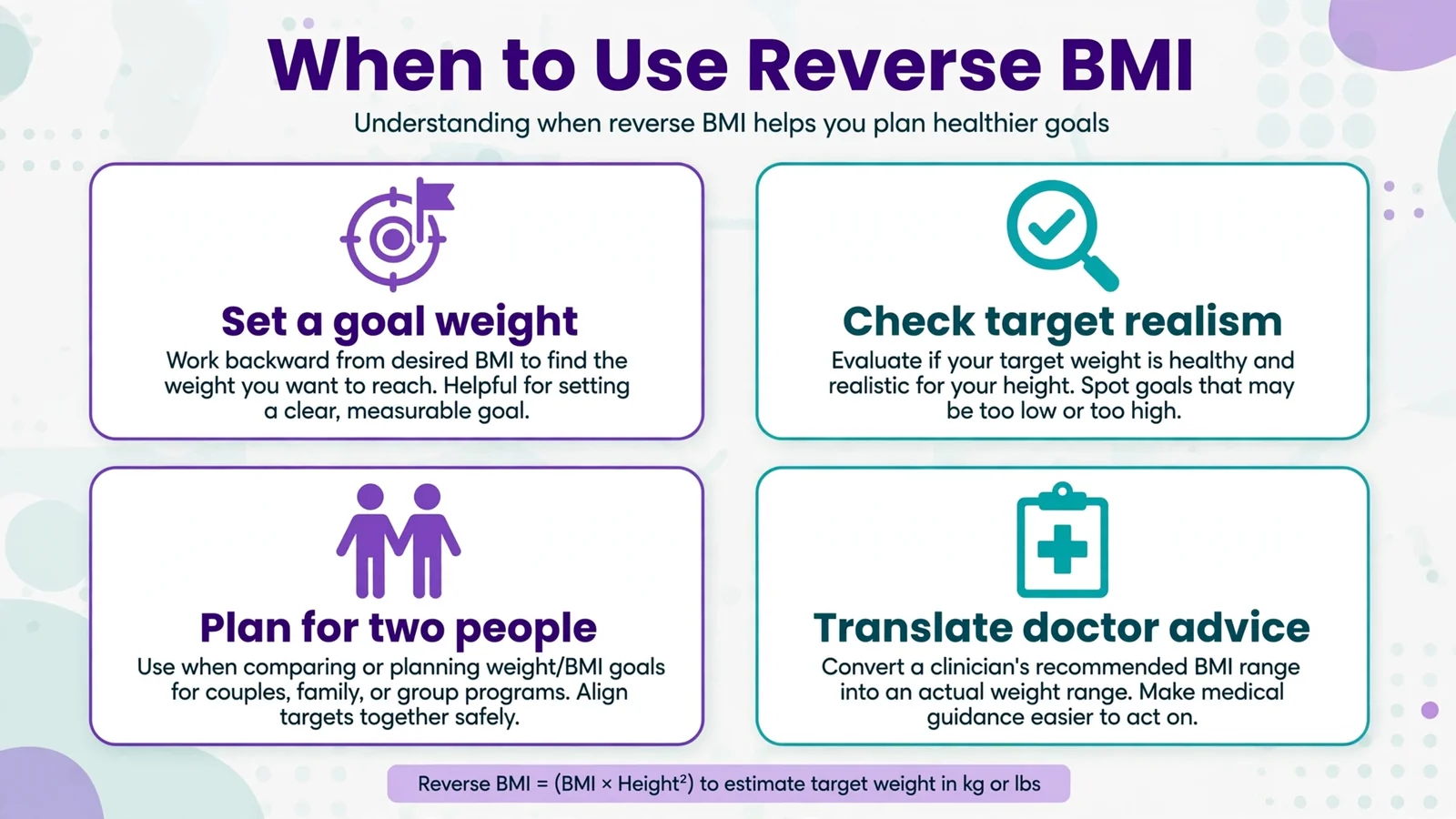
The tool shines in a few specific situations:
- Setting a goal weight. Your doctor says “aim for a BMI under 25.” The reverse calculator converts that into an exact number of pounds.
- Checking a target’s realism. Before committing to a goal weight, see which BMI it corresponds to. A target that lands at BMI 17 is a warning sign, not an achievement.
- Planning for two people. Couples or families with different heights can each find their own healthy range from the same BMI band.
- Translating advice. Health articles often cite BMI numbers. The reverse calculation turns those numbers into weights you can actually use.
It is less useful as a standalone health assessment. Knowing the weight for BMI 22 tells you nothing about your current body composition, muscle mass, or waist size. Pair the target with a calorie plan from a calorie calculator so you have both the destination and the route.
[Image: reverse-bmi-calculator-uses.webp]
What Are the Limitations of Reverse BMI?
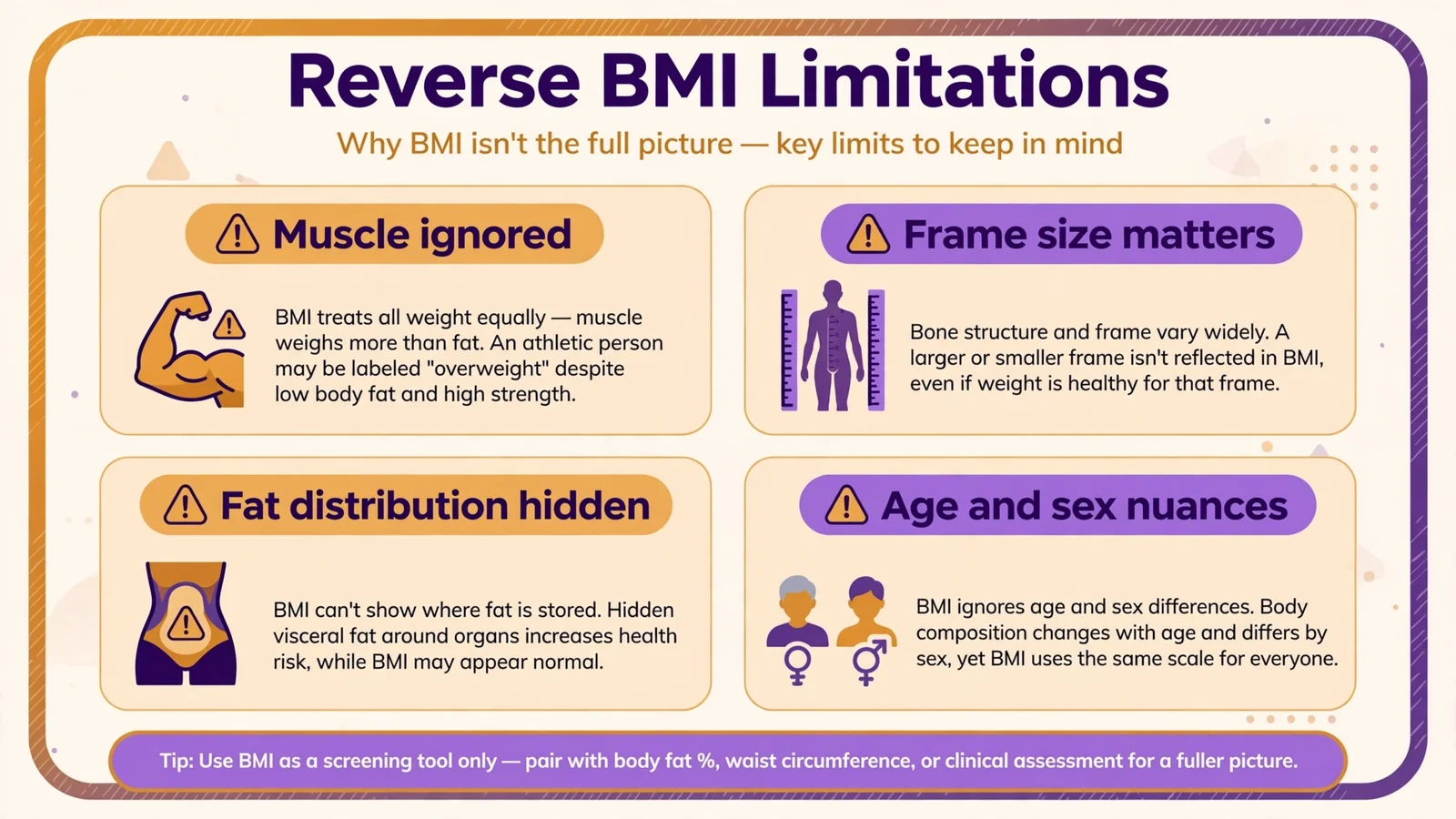
The reverse calculation inherits every limitation of BMI itself, since it is the same formula run backward:
- Muscle is ignored. A muscular person aiming for BMI 22 might target a weight that is unrealistically low for their build.
- Frame size matters. People with larger frames carry more bone and tissue weight at any BMI, so the “ideal” number can undershoot.
- Fat distribution is invisible. Two people at the same reverse-calculated weight can have very different health profiles depending on where they carry fat.
- Age and sex nuances. Older adults with muscle loss and women with higher essential fat may need targets adjusted with professional guidance.
The World Health Organization’s guidance on overweight and obesity sets the 18.5 to 24.9 range used worldwide, but even the WHO treats these as population-level cutoffs. Use your reverse-calculated target as a starting point and refine it with your doctor, especially if you train seriously or have a medical condition.
[Image: reverse-bmi-calculator-limitations.webp]
Frequently Asked Questions
How do you calculate weight from BMI and height?
Multiply the target BMI by your height in meters squared. For example, at BMI 24 and 1.70 meters: 24 times 2.89 equals 69.4 kg. In imperial units, multiply BMI by height in inches squared, then divide by 703.
What is a good BMI to aim for?
Most people aim for the middle of the healthy range, around BMI 21 to 23, which leaves margin on both sides. Anywhere from 18.5 to 24.9 is classified as healthy for adults, so pick a target that feels sustainable for your build and lifestyle.
What should I weigh at 5’6″ for a healthy BMI?
At 5 feet 6 inches (1.68 m), the healthy BMI range of 18.5 to 24.9 corresponds to roughly 115 to 155 pounds (52 to 70 kg). A BMI of 22 lands near 137 pounds (62 kg).
Is reverse BMI accurate?
The math is exact: a given BMI and height always produce the same weight. What is approximate is the health meaning of that weight, because BMI does not account for muscle, frame size, or fat distribution. Treat the number as a guide, not a prescription.
Can I use reverse BMI for children?
No. Children and teens are assessed with BMI-for-age percentiles, not fixed BMI numbers, so reverse-calculating from an adult target does not apply. Use a pediatric growth chart or ask your child’s doctor for guidance.
What is the difference between BMI and reverse BMI?
There is no difference in the formula, only in the direction. Standard BMI takes weight and height and outputs a number. Reverse BMI takes a BMI number and height and outputs the weight. Both describe the same relationship between the three values.
Conclusion
A reverse BMI calculator turns abstract BMI targets into concrete weights, making goal setting simple and precise. Enter your target BMI and height, get your number, and check it against the healthy range table above. For the full picture, run your current numbers through the free BMI calculator as well, and review the CDC’s official BMI categories to understand what each range means. A clear target plus a realistic plan beats guessing every time.
1 thought on “Reverse BMI Calculator: Find Your Ideal Weight Range”