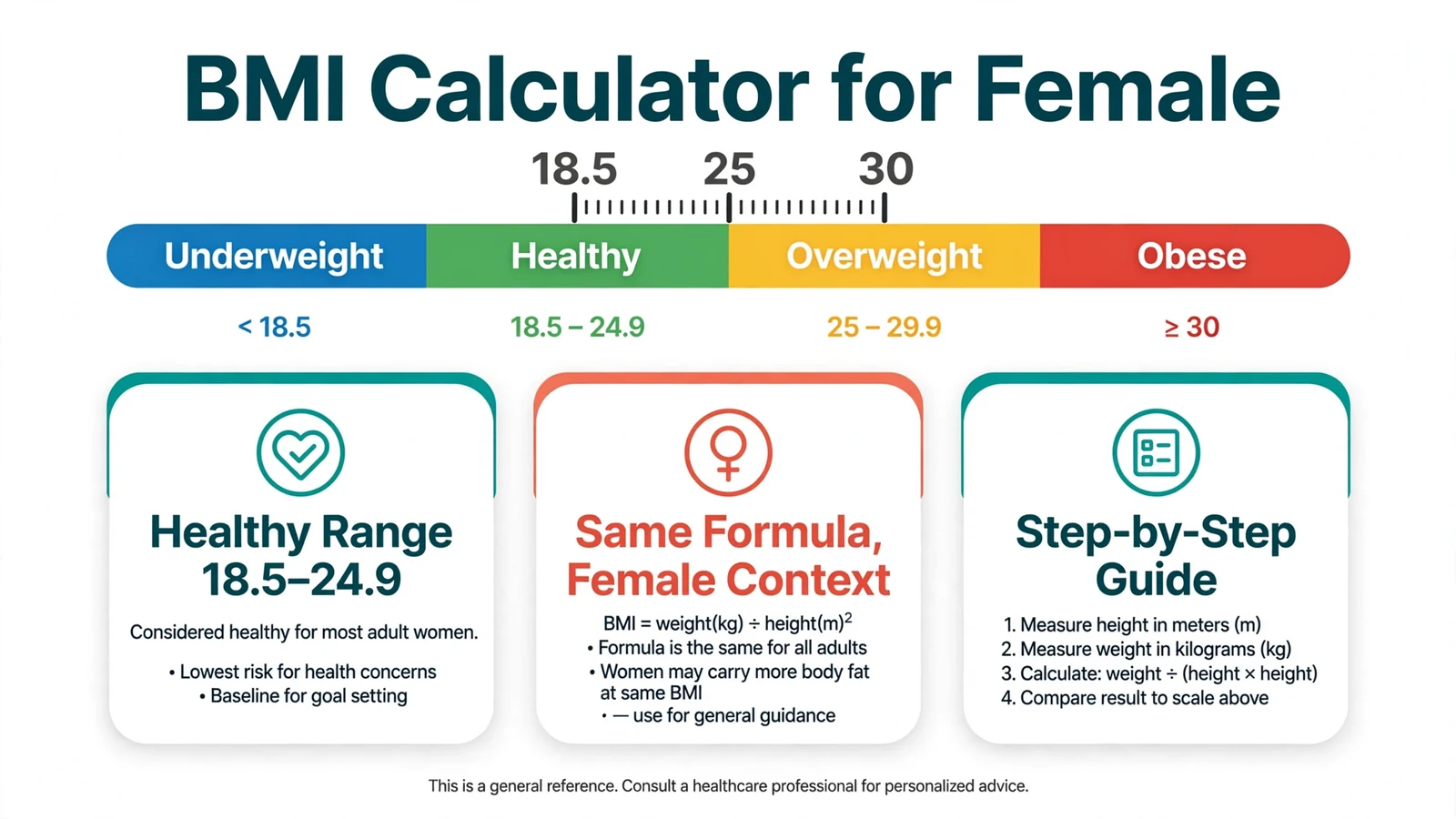
A BMI calculator for female users works just like any standard BMI calculator. You enter your height and weight, and it returns your Body Mass Index, a number that places you in the underweight, healthy weight, overweight, or obese range. The formula has no female-only version, but reading the result through a woman’s lens matters, because muscle mass, frame size, and hormonal cycles all shape what that number means for you.
This BMI calculator for female guide walks you through it step by step: the exact formula in pounds and kilograms, two fully worked examples, the healthy ranges for women, and when BMI can mislead.
What Is a BMI Calculator for Female Users?
A BMI calculator for female users is an online tool that estimates a woman’s body fat level from her height and weight using the standard body mass index formula. It applies the same equation and the same category cutoffs used for men, but it is framed around women’s bodies, measurements, and health concerns.
Why does a female-focused version exist if the math is identical? Because context changes interpretation. Women carry a higher healthy body fat percentage than men, see monthly weight swings from water retention, and go through stages like pregnancy where BMI pauses entirely.
How Do I Use a BMI Calculator Step by Step?
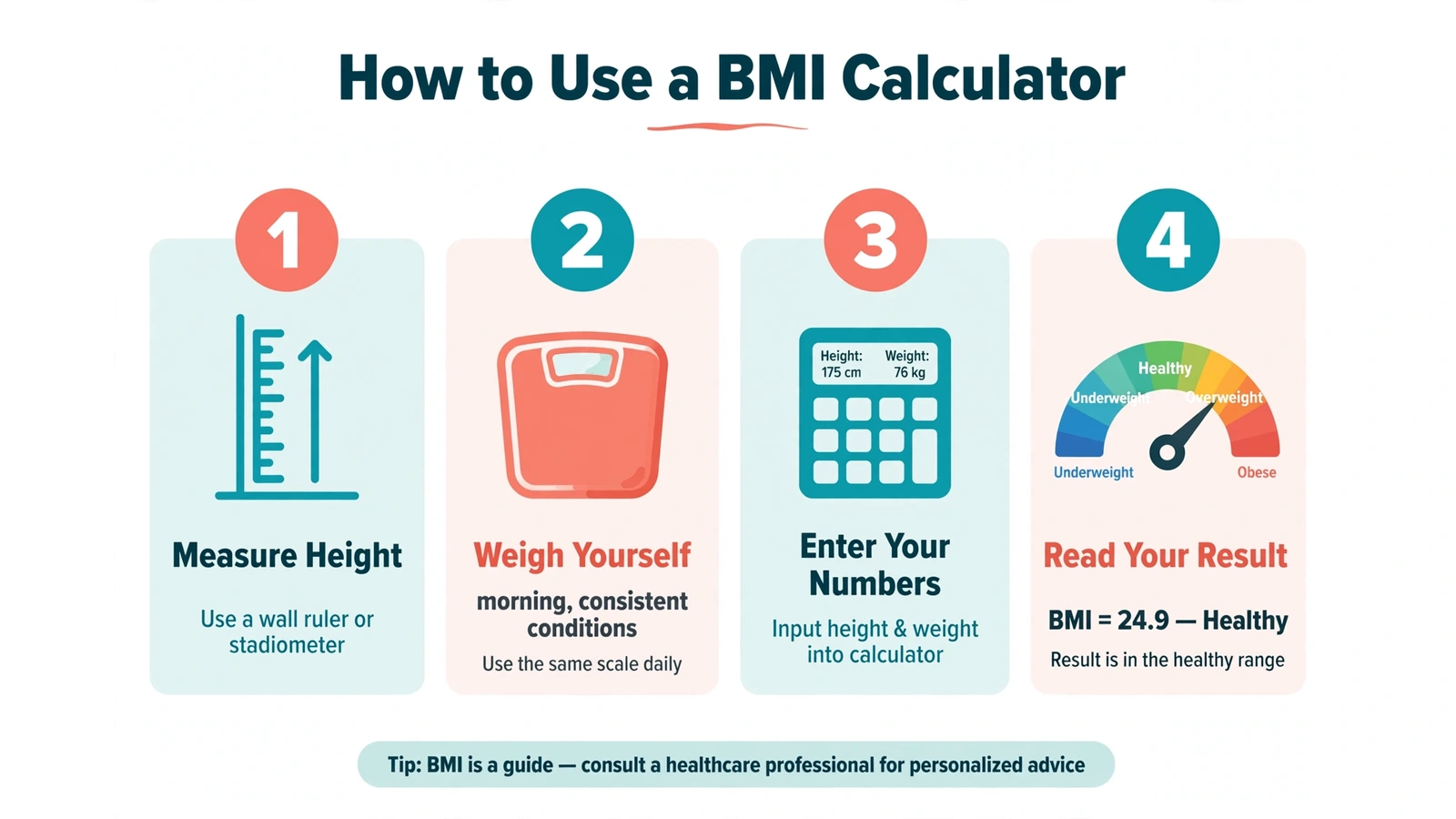
A BMI calculator for female measurements takes thirty seconds to use, but good inputs make a trustworthy result.
Step 1: Measure your height. Stand barefoot against a wall, heels together, and mark the top of your head. Morning is best; your spine compresses slightly by evening.
Step 2: Weigh yourself under consistent conditions. Weigh yourself first thing in the morning, after the bathroom and before eating, in minimal clothing. Consistency matters more than the hour you choose.
Step 3: Enter your numbers into the calculator. Match the unit system to your measurements: imperial for pounds and inches, metric for kilograms and centimeters. Mixing units is the most common mistake.
Step 4: Read your result and its category. You get a number, usually between 15 and 40, plus a category label. Note both: the number shows where you sit in the range, the label what it means.
Step 5: Track the trend, not the day. Weigh weekly under the same conditions and recalculate monthly. One reading is a snapshot; a three-month trend shows real movement.
What Is the BMI Formula for Women?
There is no separate female BMI formula. Women use the same equation as men. The “female” part of a BMI calculator for female users is the guidance around the result, not the math.
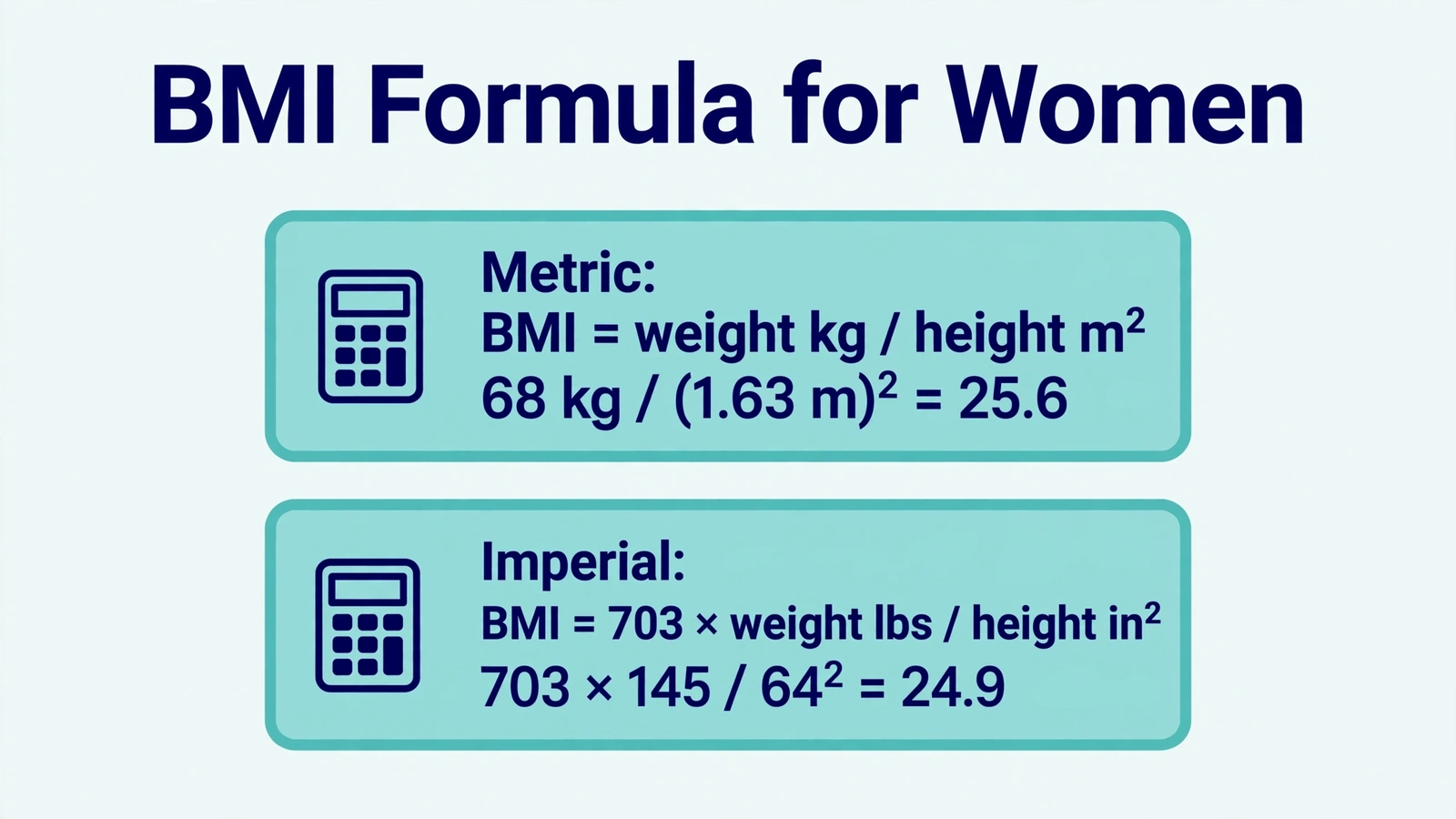
The metric formula is:
BMI = weight in kilograms / (height in meters squared)
The imperial formula is:
BMI = 703 x weight in pounds / (height in inches squared)
Two worked examples:
Example 1: pounds and inches. A woman, 5 foot 4 (64 inches), 145 pounds. Square the height: 64 x 64 = 4,096. Multiply: 703 x 145 = 101,935. Divide: 101,935 / 4,096 = 24.9, at the top of the healthy range.
Example 2: kilograms and centimeters. A woman, 163 cm (1.63 m), 68 kg. Square the height: 1.63 x 1.63 = 2.6569. Divide: 68 / 2.6569 = 25.6, just inside the overweight category.
The second woman is only slightly heavier for her height, yet crosses a category line. That is normal near boundaries, and why trends beat single readings.
What Are the Healthy BMI Ranges for Women?
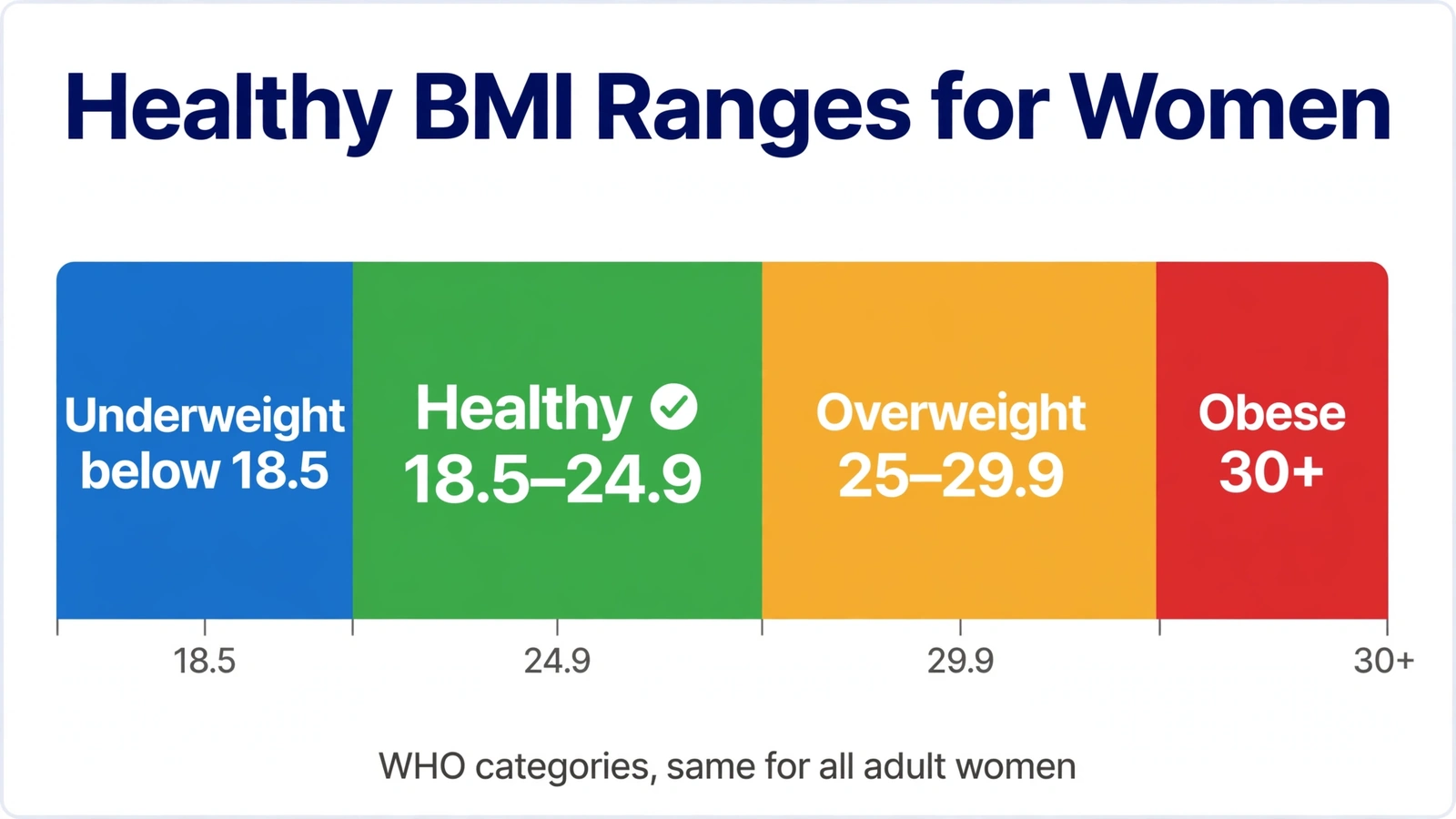
Women use the same BMI categories as men. These cutoffs come from the World Health Organization and are based on large population studies linking BMI ranges to health risks.
| BMI Range | Category | What It Means |
|---|---|---|
| Below 18.5 | Underweight | May signal undernourishment or an underlying health issue |
| 18.5 to 24.9 | Healthy weight | Lowest statistical risk for weight-related disease |
| 25.0 to 29.9 | Overweight | Elevated risk; modest weight loss helps |
| 30.0 and above | Obese | Higher risk for heart disease, diabetes, and joint problems |
For most women the target is 18.5 to 24.9. Very muscular women may sit above 25 with little body fat, which is one of the tool’s known limits, covered below.
When Can BMI Be Misleading for Women?
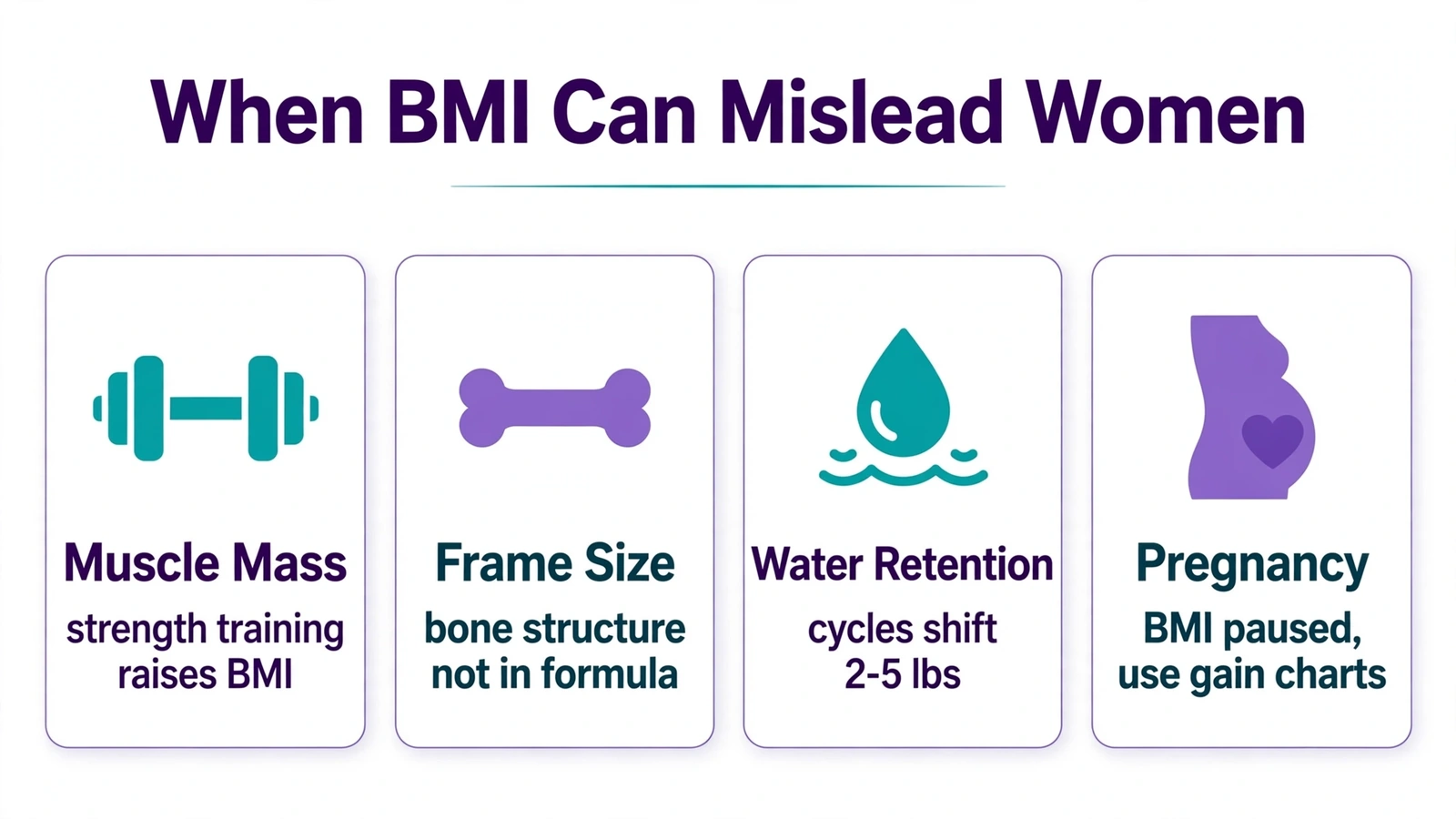
BMI screens; it does not diagnose. For women, these are the cases where the number deserves a second look.
High muscle mass. A woman who lifts regularly can carry a BMI of 26 or 27 with low body fat. Muscle is denser than fat, so it raises the scale without raising health risk. If you strength train three-plus times a week, add a waist or body fat measurement.
Small or large frame size. Two women can share a height and BMI yet look very different. Small-framed women often sit at the lower end of the healthy range, broad-framed women near the top. Bone structure is not in the formula.
Hormonal water retention. Many women gain two to five pounds of water before their period, lifting BMI by half a point with no change in body fat. If your reading spikes mid-cycle, recheck a week later.
Pregnancy and breastfeeding. BMI is not used during pregnancy. Doctors use pre-pregnancy BMI to set weight gain targets, and postpartum weight takes months to settle.
Fat distribution. BMI cannot tell where fat sits. Belly fat carries more risk than hip or thigh fat, so two women with identical BMIs can face different risks. Waist circumference fills this gap.
What Should I Do After Getting My BMI Result?
Your result is a starting point, not a verdict:
In the healthy range, your job is maintenance: stay active and recheck every few months. A calorie calculator can fine-tune your daily needs for staying put.
Between 25 and 29.9, aim for slow, sustainable loss. Dropping 5 to 10 percent of body weight meaningfully lowers risk, even short of the range’s middle. A moderate deficit plus movement beats crash diets; our Harris Benedict formula guide shows how to set your daily calories.
At 30 or above, book a checkup. Your doctor can check blood pressure, cholesterol, and blood sugar, which matter more than BMI alone, and rule out thyroid issues or PCOS.
Below 18.5, watch for nutrient gaps, bone loss, and hormonal disruption. See your doctor, especially if the loss was unintentional.
Whatever your result, recheck on our free BMI calculator next month. Trends beat snapshots.
Frequently Asked Questions
Is the BMI calculator for female users different from the standard one?
No, the math is identical: same formula, same cutoffs. A female-focused calculator differs in guidance. It accounts for women’s body composition, uses women’s measurements in examples, and flags situations like pregnancy where BMI does not apply.
What is a healthy BMI for a woman?
For adult women it is 18.5 to 24.9, the same as for men. The World Health Organization sets this range for all adults 20 and older. Within it, where you feel strongest matters more than any single ideal number.
How accurate is BMI for athletic women?
It can mislead. Muscle is denser than fat, so a trained woman can land in the overweight category with low body fat. Athletic women should pair BMI with a waist measurement or body fat estimate.
Can I use a BMI calculator while pregnant?
No. During pregnancy, doctors use your pre-pregnancy BMI only to set a recommended weight gain range. After delivery, wait until weight stabilizes, often several months, before using BMI again.
Why does my BMI change around my period?
Hormones cause water retention before and during menstruation, often two to five pounds. Since BMI comes from scale weight, it rises with that water. This is normal and reversible, so do not judge progress on readings from that window.
How often should I check my BMI?
Once a month is plenty. Daily weight swings from water, food, and hormones make frequent checks noisy. Weigh under consistent conditions and watch the trend across months.
Conclusion
A BMI calculator for female health is only as useful as the habits around it. Measure carefully, use the right formula for your units, and read the result with women’s realities in mind: muscle, frame size, and cycles. Used that way, it becomes a practical tool rather than a source of confusion.
Your next step is simple: take your height and weight, run them through our free BMI calculator, and pick one small action for your category, whether maintaining, adjusting calories, or booking a checkup.
For background on the categories, the World Health Organization’s obesity fact sheet explains the cutoffs, and the CDC’s page about adult BMI offers practical guidance on interpreting your result.