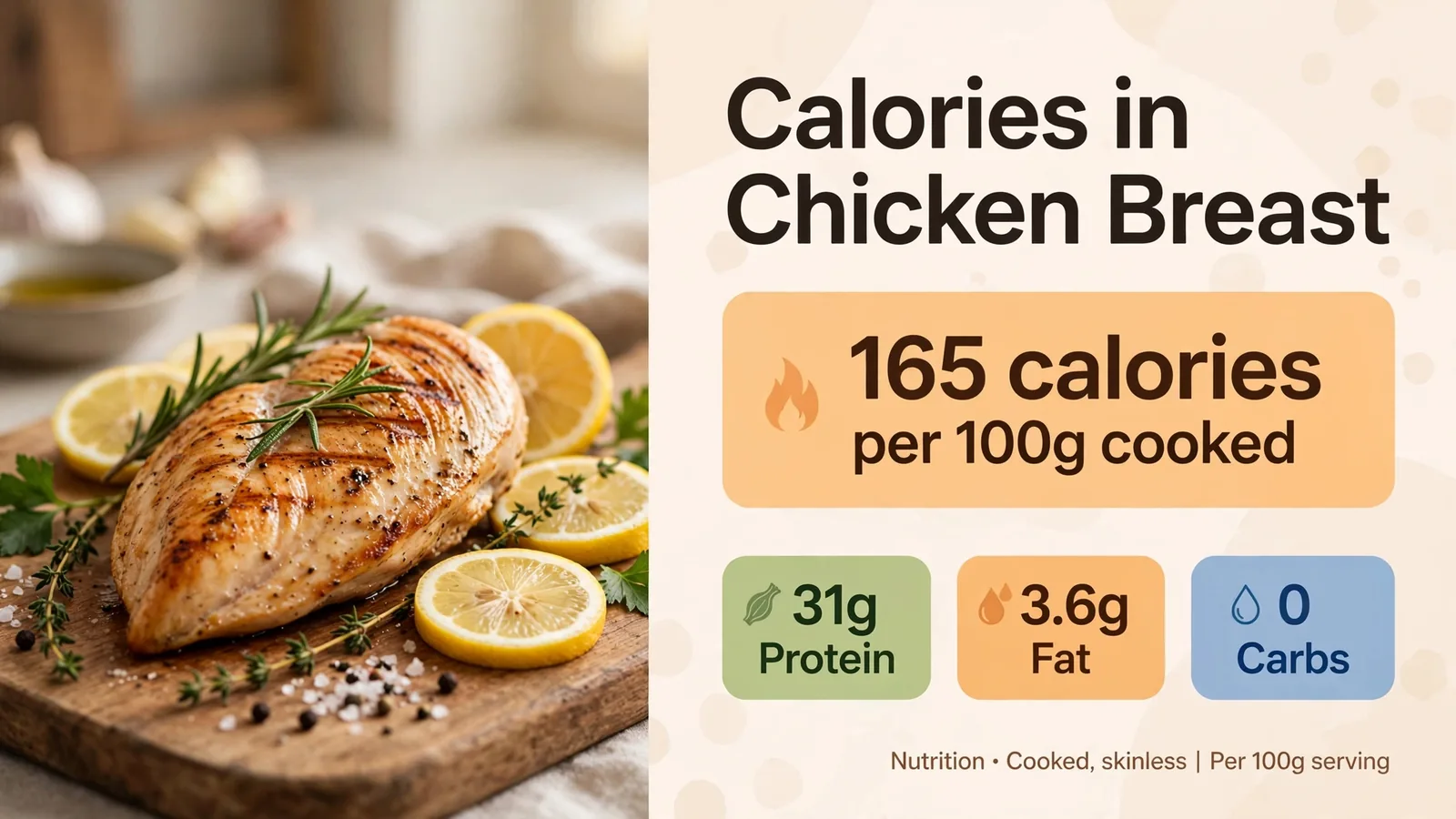
A 100g portion of cooked, skinless chicken breast has 165 calories, 31g of protein, and just 3.6g of fat. That simple number answers the most common version of the question, but the real calories in chicken breast depend on portion size, whether it is raw or cooked, and how you cook it.
Most people who look up the calories in chicken breast are tracking macros, planning meals for weight loss, or trying to hit a protein target. This guide covers all of it: exact calorie counts for common serving sizes, a full nutrition table, how grilling, baking, frying, and rotisserie cooking change the numbers, and how chicken breast compares to thighs and wings. If you want to fit chicken breast into a daily calorie budget, use a free calorie calculator to find your personal daily target first, then work these numbers into your meals. Learn more here.
How Many Calories in 100g of Chicken Breast?
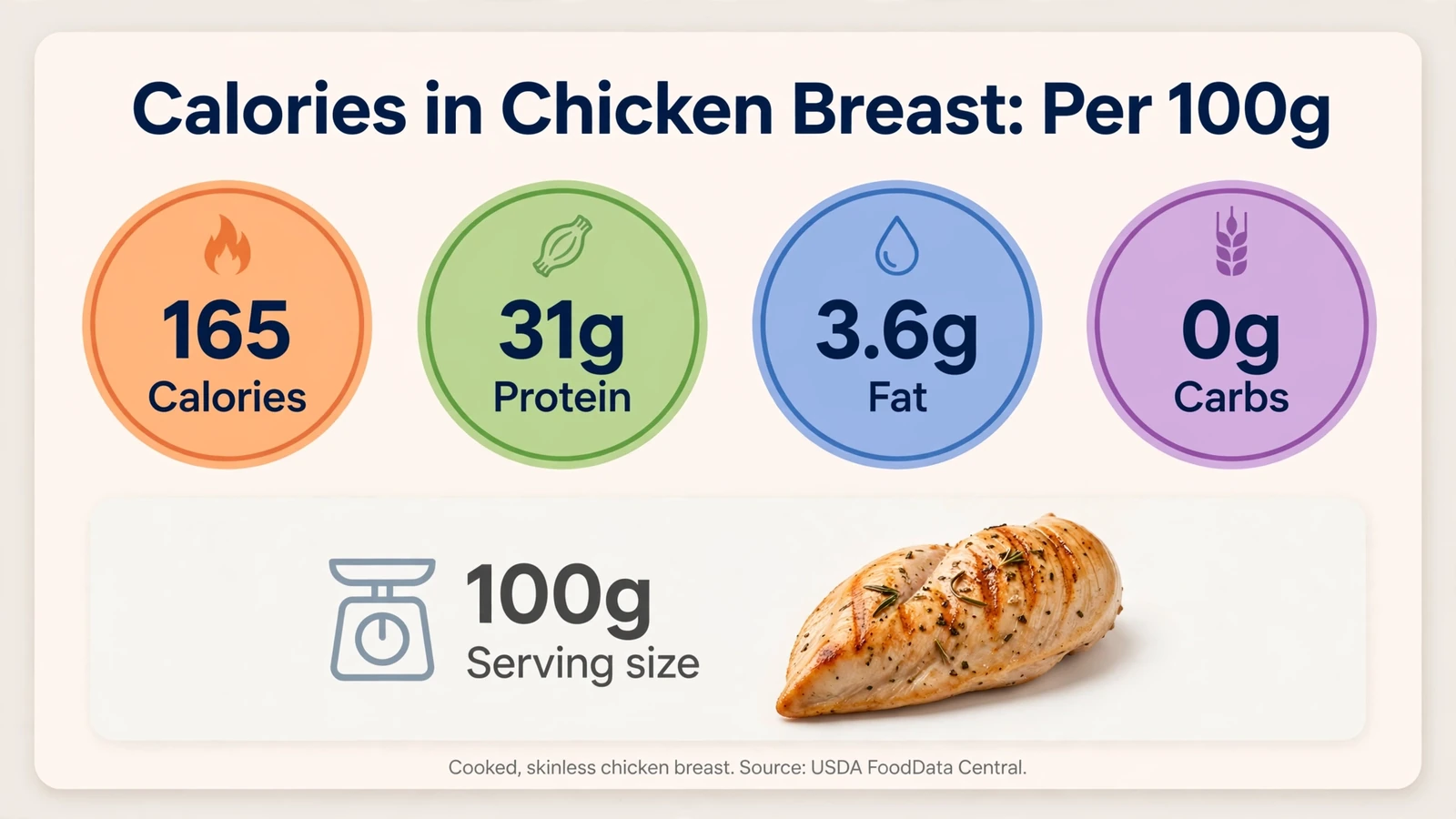
Per 100g, cooked skinless chicken breast contains 165 calories. That is the figure listed by USDA FoodData Central, and it is the standard reference value nutritionists use. At that serving, you also get about 31g of protein, 3.6g of fat, and zero carbs.
One hundred grams is roughly a deck-of-cards sized piece of cooked meat, which is a little less than what many people actually serve themselves. So while 165 calories per 100g is the reference number, your plate may hold more. Keep reading for the calorie counts of a full breast, half breast, and ounce-by-ounce servings.
How Many Calories Are in a Whole Chicken Breast?
A whole cooked chicken breast without skin usually weighs between 150g and 200g, and a typical medium one lands around 170g. At that weight, the calories in chicken breast come to about 280.
Here is how the numbers scale for common servings, all based on cooked skinless breast:
| Serving size | Calories |
|---|---|
| 1 oz (28g) | 46 |
| 3 oz (85g) | 140 |
| Half breast (~85g) | 140 |
| 100g | 165 |
| 1 medium breast (~170g) | 280 |
| 1 large breast (~200g) | 330 |
These numbers assume plain cooking with no added oil or breading. A tablespoon of olive oil adds roughly 120 calories on top.
Does Cooking Method Change Chicken Breast Calories?
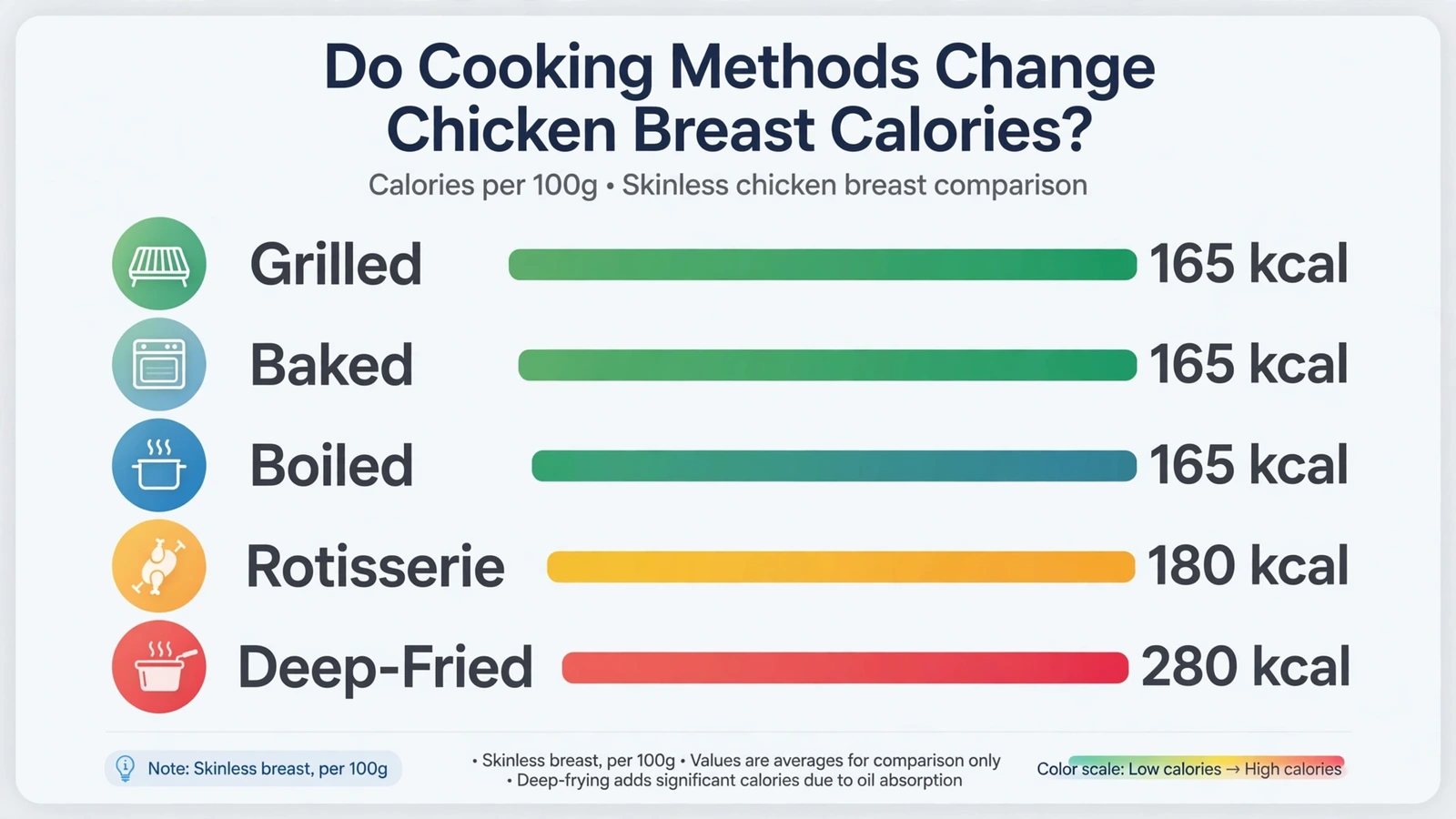
Yes, and sometimes more than people expect. The chicken itself stays the same, but the cooking method decides whether you add calories from oil or breading. This matters because many people search for the calories in chicken breast, then cook it in a way that doubles the final number.
The table below shows approximate calories per 100g of skinless breast for common cooking methods. Plain methods add nothing, while fried versions pick up oil and coating calories.
| Cooking method | Calories per 100g |
|---|---|
| Grilled (no oil) | 165 |
| Baked/roasted (no oil) | 165 |
| Boiled or poached | 165 |
| Pan-seared with 1 tsp oil | ~185 |
| Rotisserie | ~180 |
| Breaded and pan-fried | ~240 |
| Deep-fried | ~280 |
Grilling, baking, and boiling keep the calories in chicken breast at the baseline 165 per 100g, while deep frying can push the same amount of meat to nearly 280. Rotisserie sits slightly above baseline because of basting and seasoning fats.
How Much Protein Is in Chicken Breast?
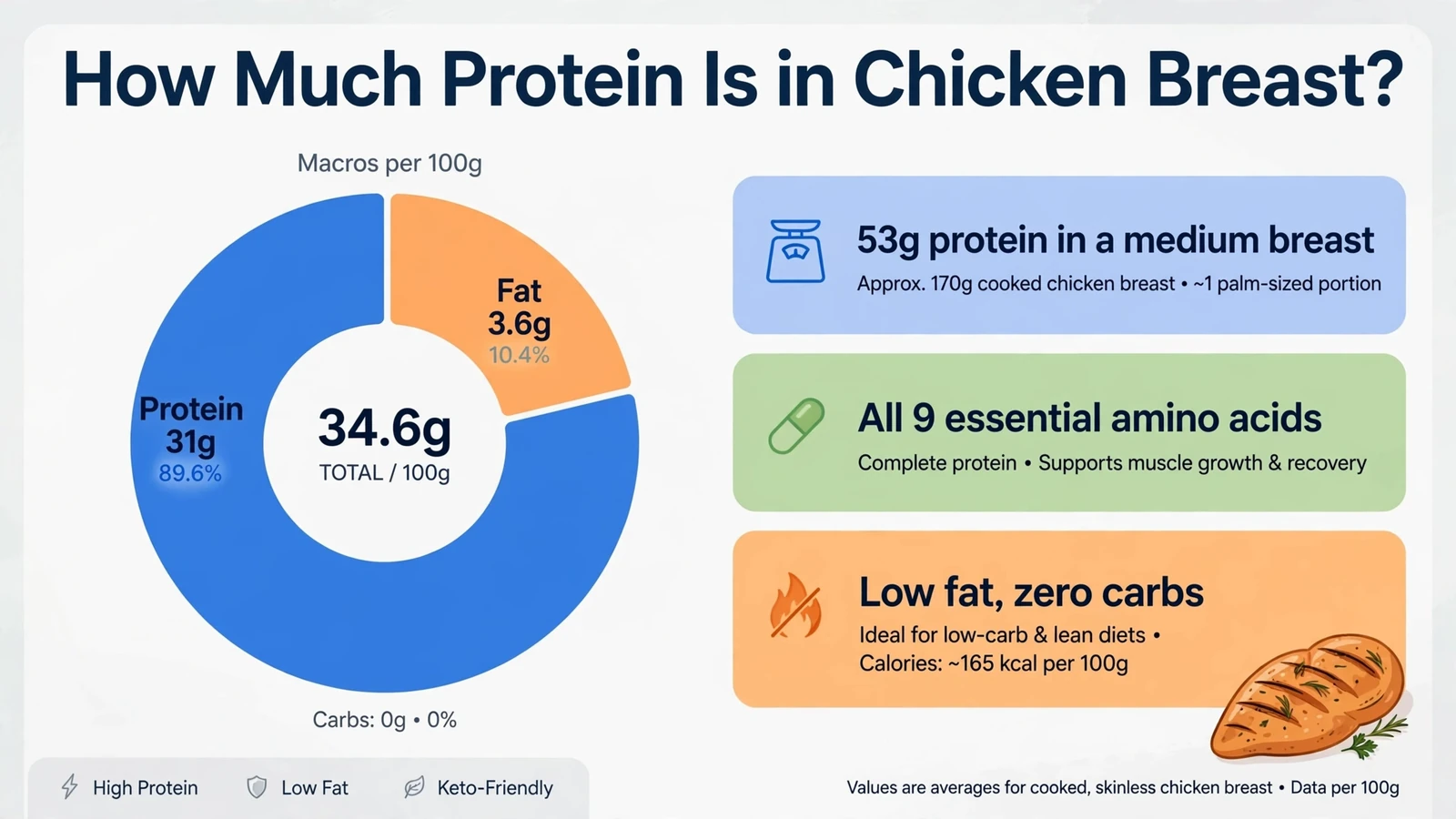
Chicken breast is one of the richest natural sources of protein per calorie. A 100g cooked portion provides about 31g of protein, which covers more than half of the daily requirement for most adults. A medium whole breast (~170g) delivers roughly 53g of protein.
Here is the full nutrition breakdown per 100g of cooked skinless chicken breast:
| Nutrient | Amount |
|---|---|
| Calories | 165 |
| Protein | 31g |
| Total fat | 3.6g |
| Saturated fat | 1g |
| Carbohydrates | 0g |
| Cholesterol | 85mg |
| Sodium | 74mg |
| Potassium | 256mg |
| Niacin (vitamin B3) | ~64% of daily value |
| Vitamin B6 | ~36% of daily value |
The protein quality matters too. Chicken breast supplies all nine essential amino acids, including leucine, which plays a key role in muscle repair and growth. That is why athletes and bodybuilders treat it as a staple. If you want to know how much protein you personally need each day, a BMI calculator is a good starting point for estimating your body composition goals before setting macro targets.
Is Chicken Breast Good for Weight Loss?
Chicken breast is one of the best foods you can eat for weight loss, and the reasons go beyond its modest calorie count. At 165 calories and 31g of protein per 100g, it has one of the highest protein-to-calorie ratios of any common food.
Protein does three things that help with fat loss. First, it keeps you full longer than carbs or fat, which makes it easier to eat less without feeling hungry. Second, it costs the body more energy to digest, a effect known as the thermic effect of food. Third, it protects muscle tissue during a calorie deficit, so the weight you lose comes mostly from fat instead of muscle.
Practical tips for using chicken breast in a weight loss diet:
- Stick to grilled, baked, or boiled preparations to keep calories at 165 per 100g.
- Pair a 100-150g portion with high-volume vegetables to make meals filling.
- Season with herbs, citrus, garlic, or chili instead of calorie-heavy sauces.
- Measure your portions for a week so you learn what 100g actually looks like.
A sustainable weight loss plan starts with knowing your daily energy needs. Your basal metabolic rate sets the baseline, and the Harris-Benedict formula is the classic method for calculating it accurately.
How Do Chicken Breast Calories Compare to Thighs and Wings?
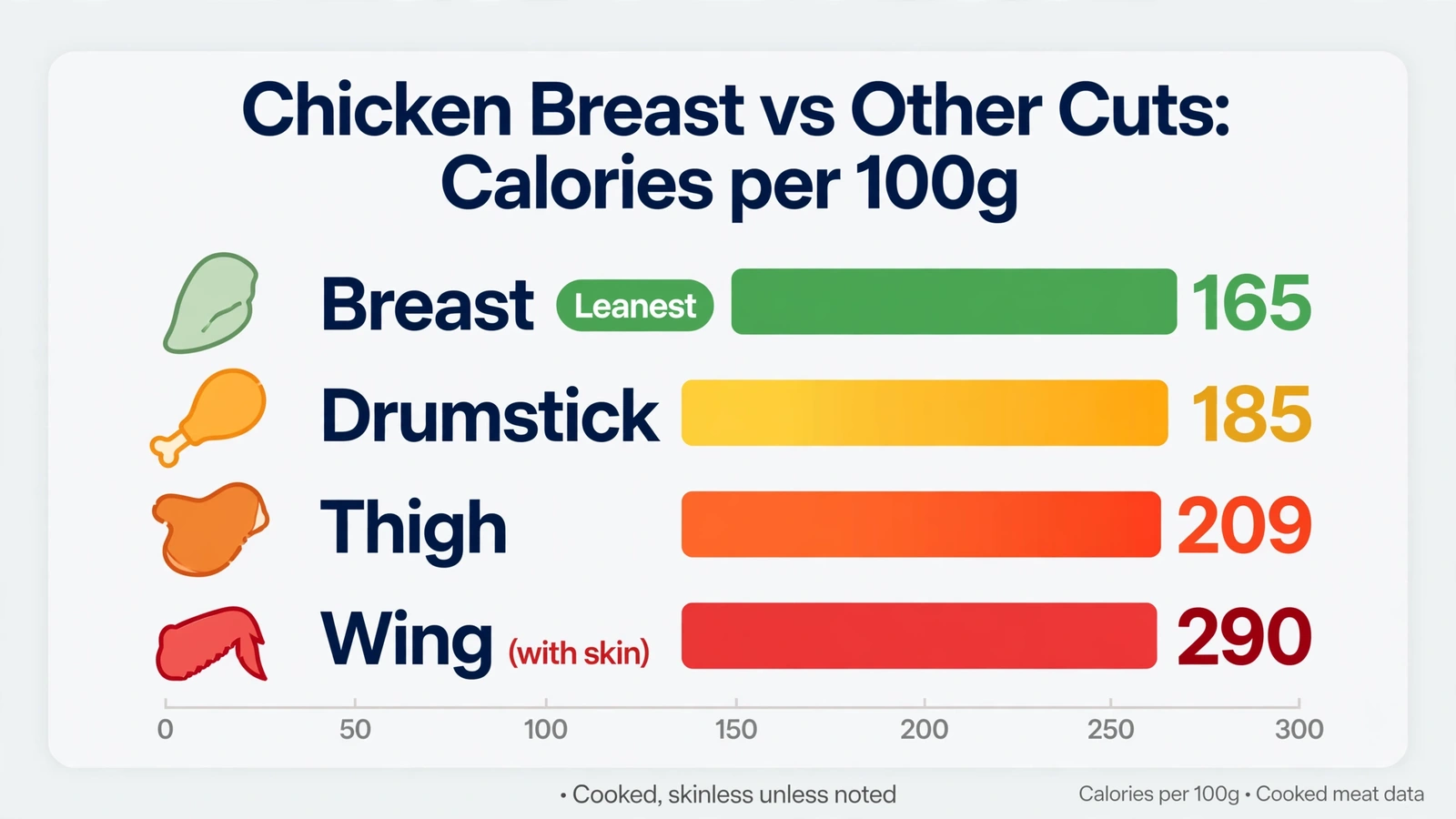
If you have ever wondered whether the leaner cut is worth it, the comparison is striking. Chicken breast has significantly fewer calories and far less fat than thighs, drumsticks, or wings, mainly because those cuts are darker meat and often eaten with the skin on.
Calories per 100g of cooked chicken (skinless unless noted):
| Cut | Calories per 100g | Fat per 100g |
|---|---|---|
| Chicken breast | 165 | 3.6g |
| Chicken tenderloin | 155 | 2.5g |
| Chicken drumstick | 185 | 10g |
| Chicken thigh | 209 | 11g |
| Chicken wing (with skin) | 290 | 19g |
Switching from thighs to breast saves about 44 calories and 7g of fat per 100g, while adding several grams of protein. Thighs taste richer and cost less, so the choice depends on your priorities: breast for a strict calorie deficit, either cut for a more relaxed approach.
How Big Is a Serving of Chicken Breast?
A standard serving of chicken breast is 3 oz (85g) of cooked meat, which contains about 140 calories and 26g of protein. That is the serving size on most nutrition labels. In real life, restaurant portions are often two to three times that size, which is why home cooking gives you much better control over the calories in chicken breast.
Useful visual references for portion sizes:
- 3 oz (85g): about the size of a deck of cards
- 100g: roughly a palm-sized piece
- Half a medium breast (~85g): one thick fillet half
- One medium breast (~170g): two cupped handfuls
If you cook in bulk, weigh the chicken after cooking, not before. Raw breast is about 120 calories per 100g because it holds more water; cooking drives the water out, so 100g of raw breast shrinks to roughly 75g cooked.
Frequently Asked Questions
How many calories are in 100g of cooked chicken breast?
A 100g portion of cooked, skinless chicken breast contains 165 calories, along with 31g of protein and 3.6g of fat. This is the USDA reference value and the number most nutrition labels are based on.
How many calories are in a whole chicken breast?
A medium cooked chicken breast (~170g) has about 280 calories. A large one (~200g) reaches roughly 330 calories, while a small one (~120g) has about 200 calories, all assuming skinless breast cooked without added oil.
Does chicken breast have more calories raw or cooked?
Per 100g, cooked chicken breast has more calories (165) than raw (120) because cooking removes water and concentrates the nutrients. But 100g of raw breast becomes about 75g after cooking, so the total calories for the same piece of meat do not change.
Is chicken breast good for losing weight?
Yes. With 165 calories and 31g of protein per 100g, chicken breast is one of the most filling, muscle-sparing foods you can eat in a calorie deficit. Stick to grilled, baked, or boiled preparations to keep the calories low.
How much protein is in a chicken breast?
A 100g cooked portion contains about 31g of protein. A whole medium breast (~170g) provides roughly 53g of protein, which is more than half the daily requirement for most adults.
Are chicken thighs or chicken breast lower in calories?
Chicken breast is lower. At 165 calories and 3.6g of fat per 100g, it beats chicken thigh (209 calories, 11g fat) by a wide margin, making breast the better choice for calorie-controlled diets.
Conclusion
The calories in chicken breast are simple to remember: 165 per 100g of cooked skinless meat, about 280 for a medium whole breast, and roughly 46 per ounce. Keep the skin off, cook it grilled, baked, or boiled, and you get 31g of high-quality protein for very few calories, which is exactly why chicken breast remains a staple for weight loss, muscle building, and everyday healthy eating.
For authoritative nutrition data, the USDA FoodData Central database publishes the official nutrient profiles for chicken breast and thousands of other foods. To understand why protein quality matters in your diet, the Harvard Nutrition Source protein guide explains the role of complete proteins like poultry in a balanced diet.
1 thought on “Calories in Chicken Breast: 100g, Cooked & Raw Guide”