A body fat percentage calculator tells you what the scale cannot: how much of your weight is fat versus everything else. Two people can weigh exactly the same and look completely different, because one carries more muscle and the other carries more fat. Body fat percentage captures that difference in a single number.
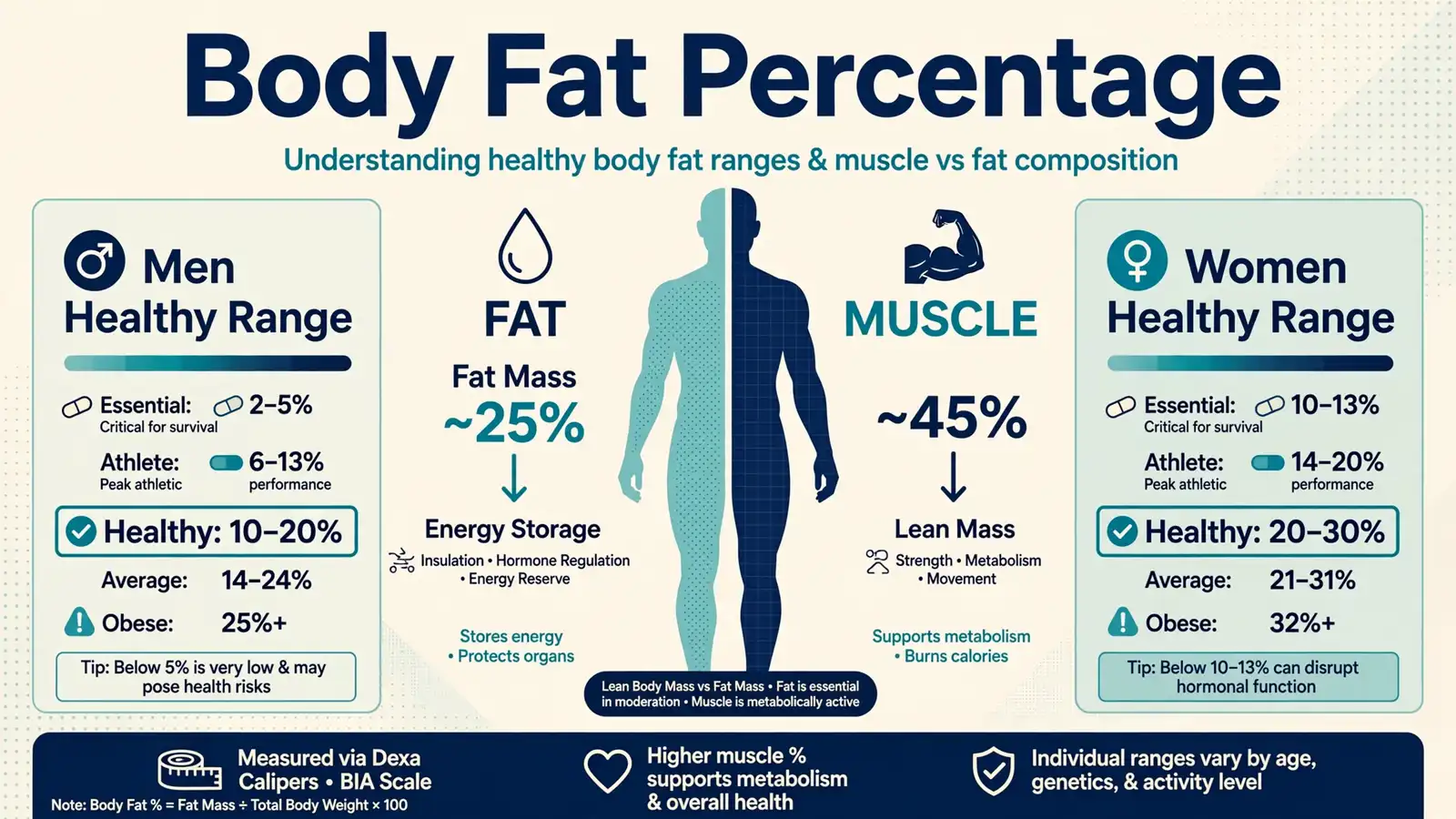
For most adults, a healthy body fat range is roughly 10 to 20 percent for men and 18 to 28 percent for women, though the ideal window shifts with age and goals. Knowing your number helps you set better targets than body weight alone ever could.
What Is Body Fat Percentage?
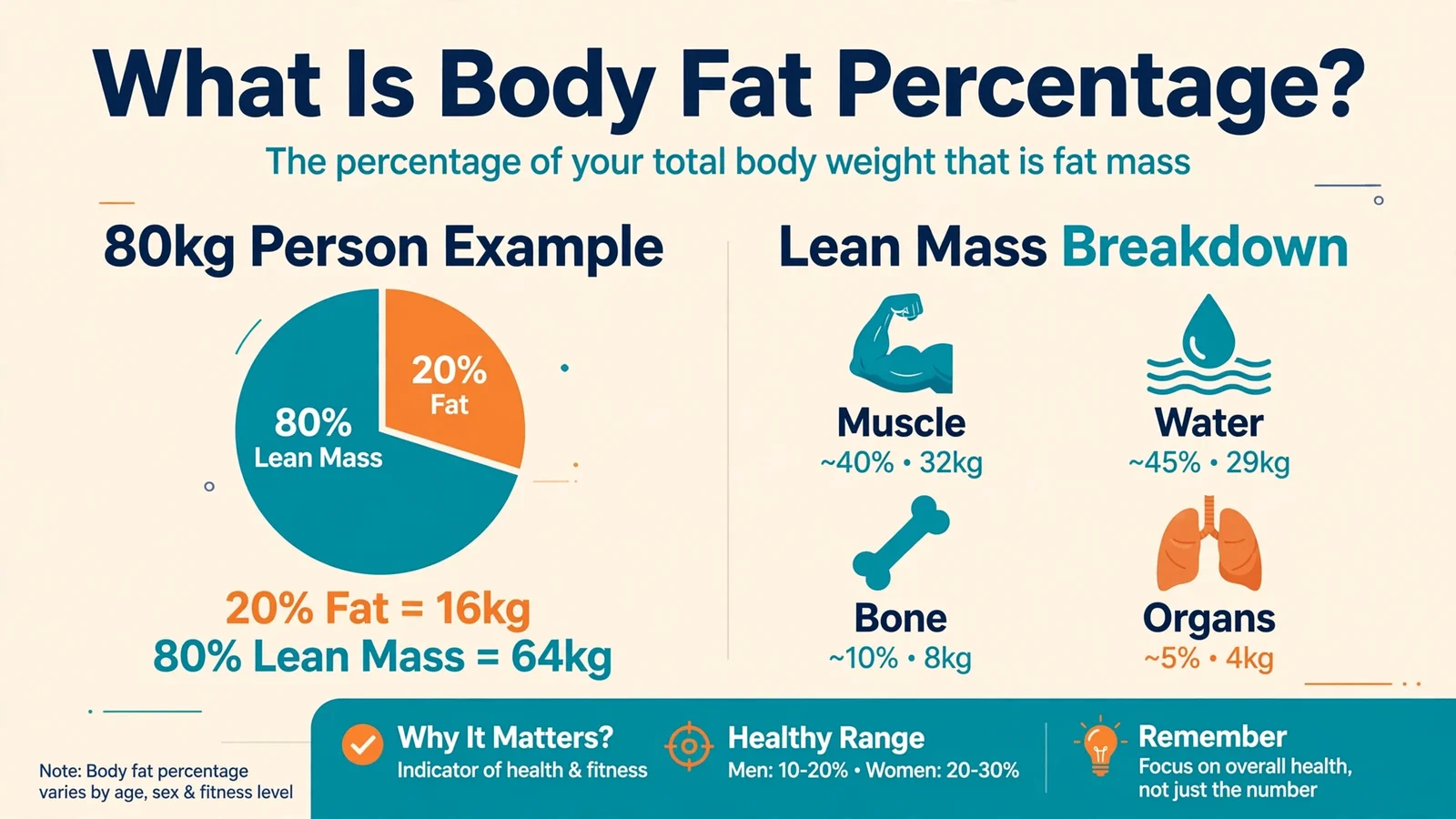
Body fat percentage is the proportion of your total body weight that comes from fat tissue. If you weigh 80 kg and your body fat percentage is 20 percent, you carry about 16 kg of fat and 64 kg of everything else, including muscle, bone, water, and organs.
This matters because not all weight is equal. Muscle is denser than fat and burns more calories at rest. That is why someone with more muscle can weigh more yet look leaner and have better metabolic health than someone lighter with less muscle.
Body fat percentage is widely considered a better health indicator than BMI alone, because BMI cannot tell muscle apart from fat. Athletes with high muscle mass often land in the “overweight” BMI range while having perfectly healthy body fat levels.
How Does a Body Fat Percentage Calculator Work?
Most online body fat calculators use the U.S. Navy method, which estimates body fat from simple tape measurements. You enter your height plus circumference measurements of your neck, waist, and (for women) hips, and the formula does the rest.
The U.S. Navy equations are:
- Men: 86.010 x log10(waist – neck) – 70.041 x log10(height) + 36.76
- Women: 163.205 x log10(waist + hip – neck) – 97.684 x log10(height) – 78.387
(measurements in inches for the original formula; metric versions exist too)
These formulas were developed from military body composition research and validated against hydrostatic weighing. They are not perfect, but for most people they land within 3 to 4 percentage points of lab methods, which is close enough to track progress.
What Are the Ways to Measure Body Fat?
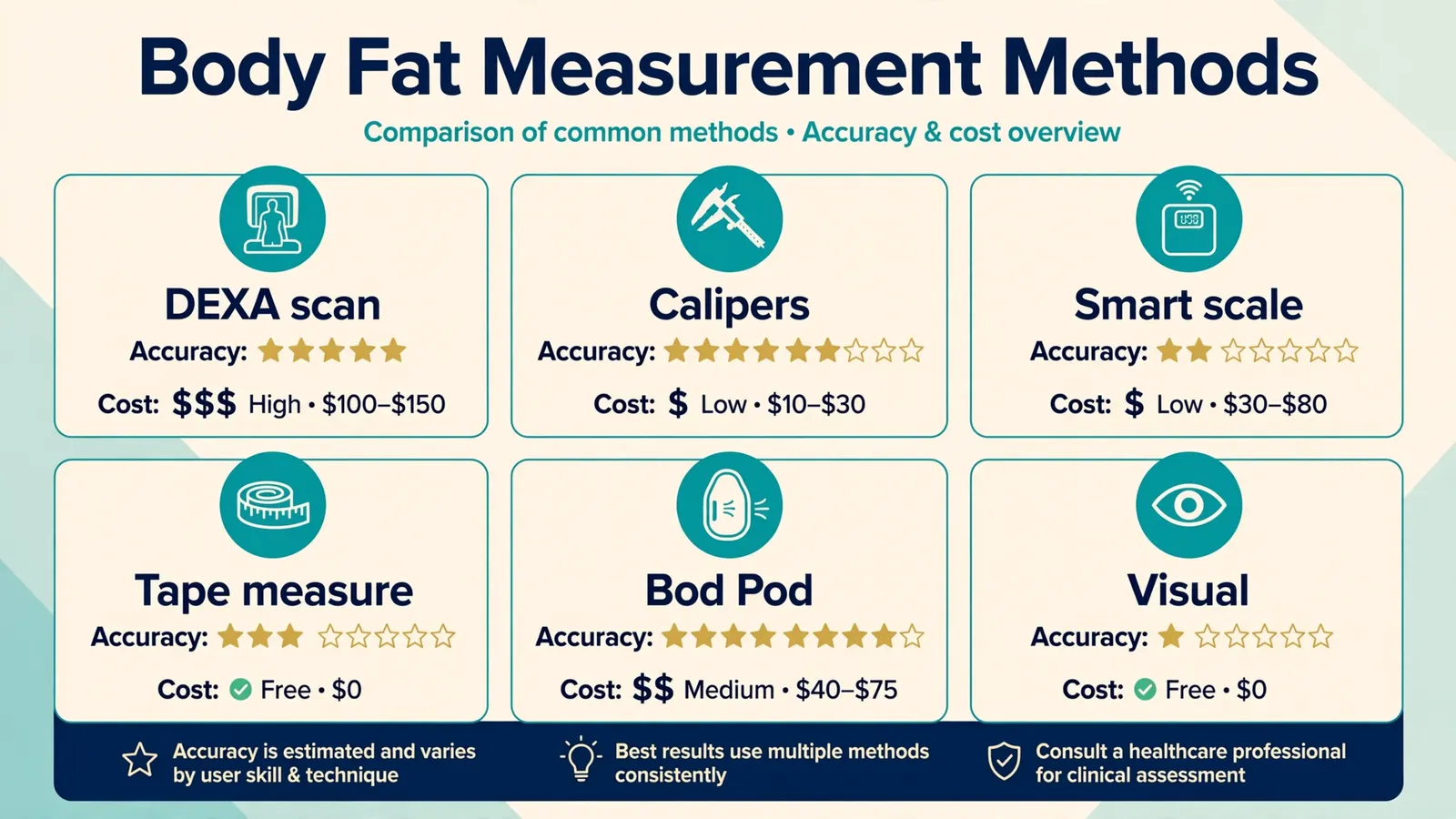
Not all measurement methods are equal. Here is how the common options compare:
| Method | Accuracy | Cost | Convenience |
|---|---|---|---|
| DEXA scan | Very high (+/- 1-2%) | High | Clinic visit needed |
| Hydrostatic weighing | Very high (+/- 2%) | High | Special facility |
| Bod Pod | High (+/- 2-3%) | Medium-high | Clinic visit needed |
| Skinfold calipers | Medium (+/- 3-5%) | Low | Needs practice |
| Bioelectrical impedance scales | Medium (+/- 3-8%) | Low-medium | Very easy at home |
| U.S. Navy tape method | Medium (+/- 3-4%) | Free | Very easy at home |
| Visual estimation | Low (+/- 5%+) | Free | Easy but subjective |
For most people, the tape method or a decent smart scale is the practical choice. DEXA is the gold standard if you want a precise baseline, and many clinics offer scans for a reasonable fee.
Consistency matters more than perfection. Whatever method you pick, use the same one under the same conditions each time, and watch the trend rather than obsessing over a single reading.
What Is a Healthy Body Fat Percentage?
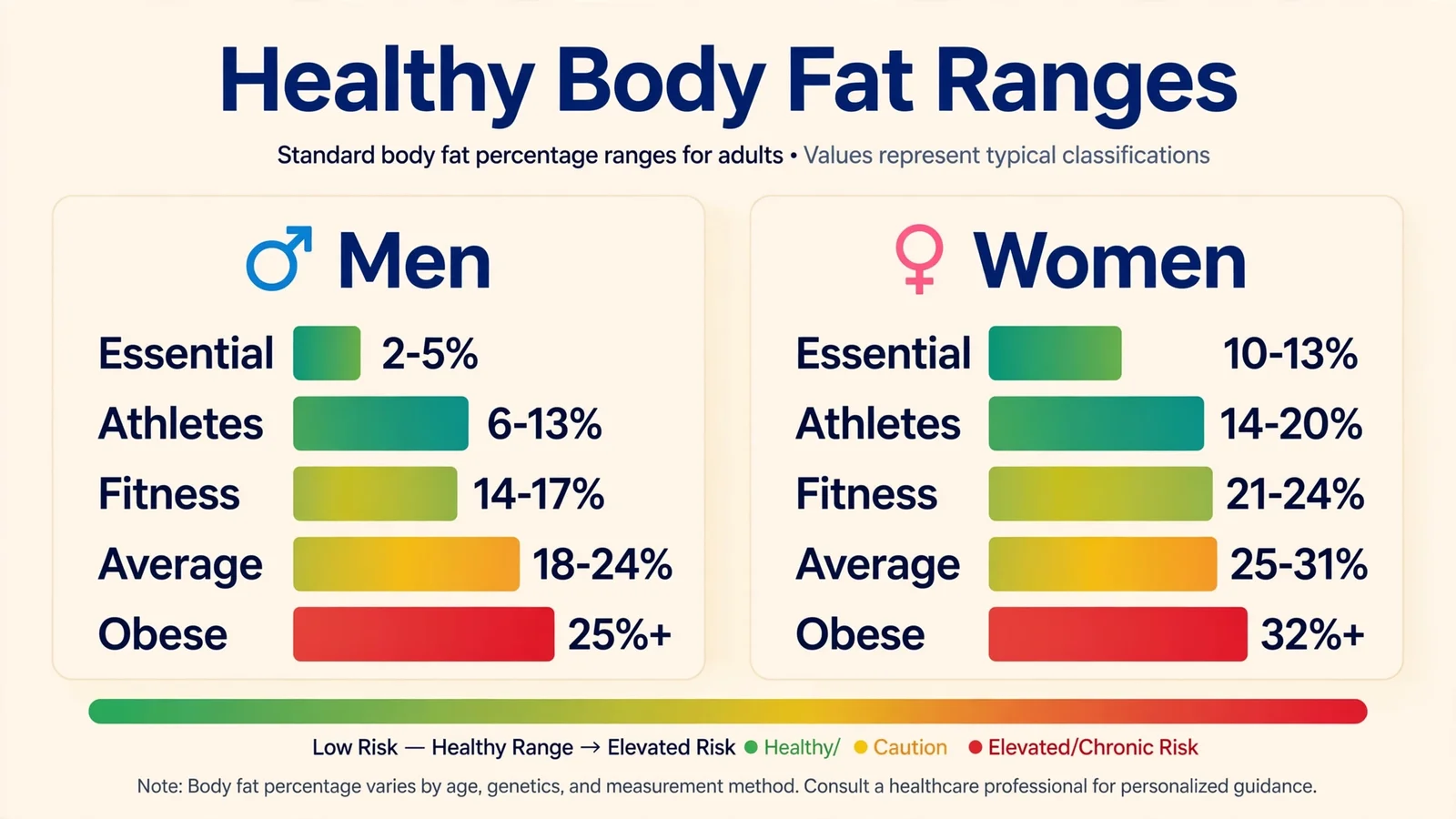
Healthy ranges differ by sex and age. The American Council on Exercise publishes widely used reference ranges:
Men:
| Category | Body Fat % |
|---|---|
| Essential fat | 2 to 5% |
| Athletes | 6 to 13% |
| Fitness | 14 to 17% |
| Average | 18 to 24% |
| Obese | 25% and above |
Women:
| Category | Body Fat % |
|---|---|
| Essential fat | 10 to 13% |
| Athletes | 14 to 20% |
| Fitness | 21 to 24% |
| Average | 25 to 31% |
| Obese | 32% and above |
Women naturally carry more essential fat because of reproductive biology, so the healthy windows sit higher. Age also nudges the numbers up slightly, which is normal and expected.
If your number falls in the average range or below, you are in good shape. If it lands in the obese range, it is worth talking to a doctor about a plan, since higher body fat is linked to greater risk of heart disease, type 2 diabetes, and other conditions.
You can also check your BMI alongside body fat for a fuller picture of where you stand.
Body Fat Percentage vs BMI: Which Should I Use?
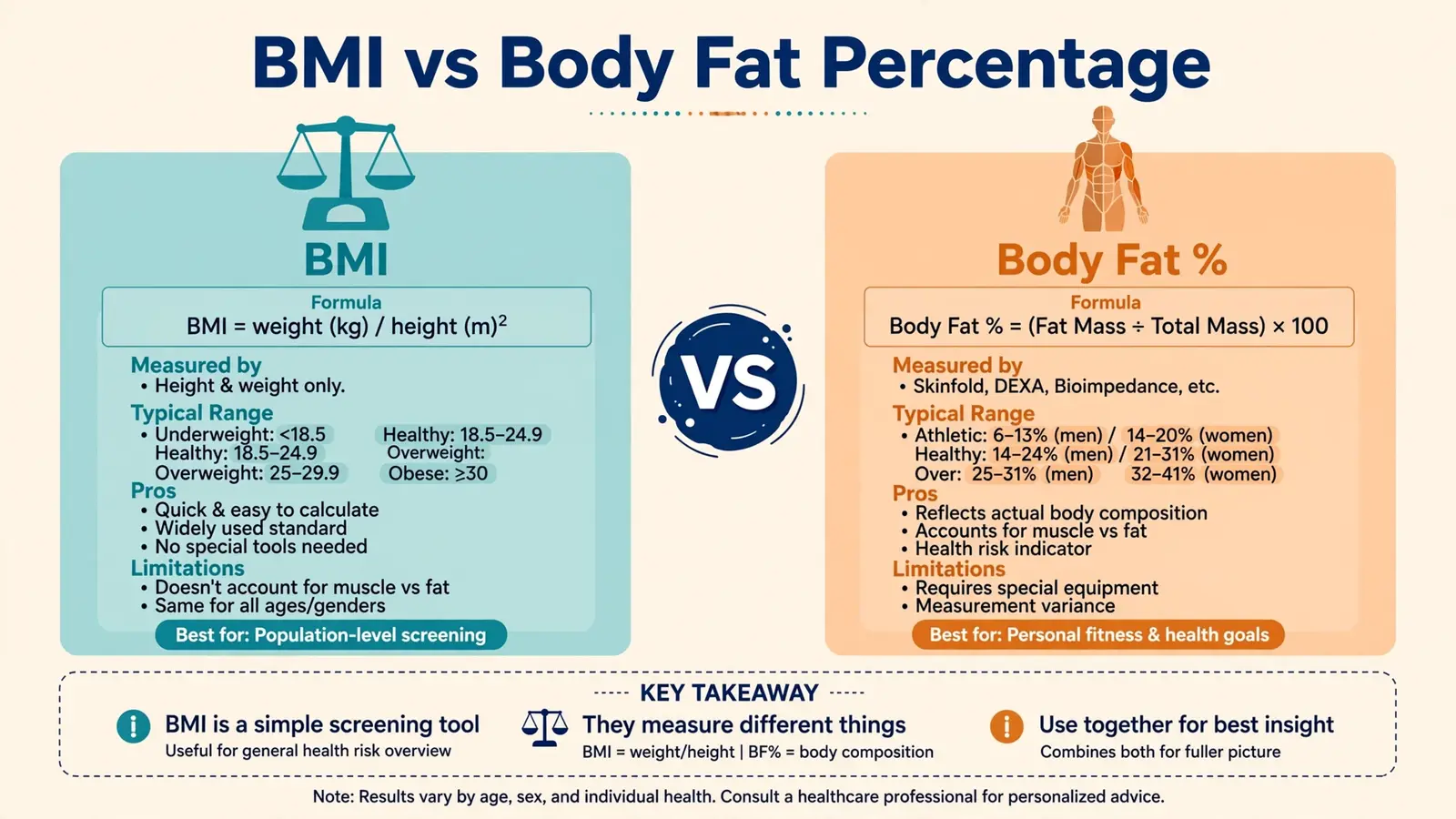
BMI and body fat percentage answer different questions. BMI is a quick screening tool based only on height and weight. Body fat percentage measures actual composition.
Use BMI when you want a fast, rough screen, especially at population level. Use body fat percentage when you want to track real changes in your body, set physique goals, or understand why the scale is not moving despite visible progress.
The classic example is the muscular lifter with a BMI of 28 (“overweight”) but a body fat percentage of 12 percent (athletic). BMI mislabels him. Body fat percentage gets it right.
Ideally, track both. They complement each other, and together they tell a more complete story than either alone.
How Can I Lower My Body Fat Percentage?
Lowering body fat percentage comes down to losing fat while keeping as much muscle as possible. The scale alone can mislead here, because crash diets often burn muscle along with fat, leaving body fat percentage unchanged or even worse.
These four pillars work together:
Eat in a moderate deficit. A daily deficit of 300 to 500 calories below your TDEE drives steady fat loss. Protein matters enormously during a deficit: aim for roughly 1.6 to 2.2 grams per kilogram of body weight daily to protect muscle.
Lift weights. Resistance training signals your body to hold onto muscle while in a deficit. Two to four sessions per week covering all major muscle groups is enough for most people. Cardio helps burn calories but does not preserve muscle the way lifting does.
Move daily. Walking 8,000 to 10,000 steps a day adds meaningful calorie burn without the recovery cost of intense exercise. This kind of low-intensity movement is the easiest lever most people overlook.
Sleep and manage stress. Short sleep disrupts hunger hormones and makes fat loss harder. Chronic stress raises cortisol, which encourages abdominal fat storage. Seven to nine hours of sleep is not a luxury here, it is part of the program.
Expect body fat percentage to drop roughly 0.5 to 1 percentage point per month with consistent effort. Faster is possible but harder to sustain, and sustainability beats speed every time.
Frequently Asked Questions
What is the most accurate body fat calculator?
No online calculator beats a DEXA scan, but the U.S. Navy tape-measure method is the most accurate free option, usually within 3 to 4 percentage points of lab results when measurements are taken carefully.
How often should I measure my body fat percentage?
Every two to four weeks is plenty. Body composition changes slowly, and daily fluctuations from water and food just add noise. Measure under consistent conditions, ideally in the morning before eating.
Can I have a normal BMI but high body fat?
Yes. This is sometimes called "skinny fat" or normal-weight obesity. It happens when someone has little muscle mass, so even at a normal weight their fat proportion is high. Strength training is the usual fix.
Does body fat percentage change with age?
Tends to, yes. Most people gradually lose muscle and gain fat with age if activity drops. Staying active and eating enough protein slows this shift considerably.
What body fat percentage is considered obese?
Generally above 25 percent for men and above 32 percent for women, per American Council on Exercise reference ranges. These are screening cutoffs, not diagnoses.
Is a smart scale accurate for body fat?
Roughly. Bioelectrical impedance scales can be off by 3 to 8 percentage points depending on hydration, recent meals, and the device. They are fine for tracking trends but not for precise single readings.
Conclusion
A body fat percentage calculator gives you a clearer target than the scale alone. Whether you use the free tape-measure method or book a DEXA scan, knowing your composition helps you train and eat with purpose.
Pair your result with an honest look at your habits. The CDC’s tips for balancing food and activity and the American Council on Exercise blog both offer practical, evidence-based starting points for improving body composition safely.