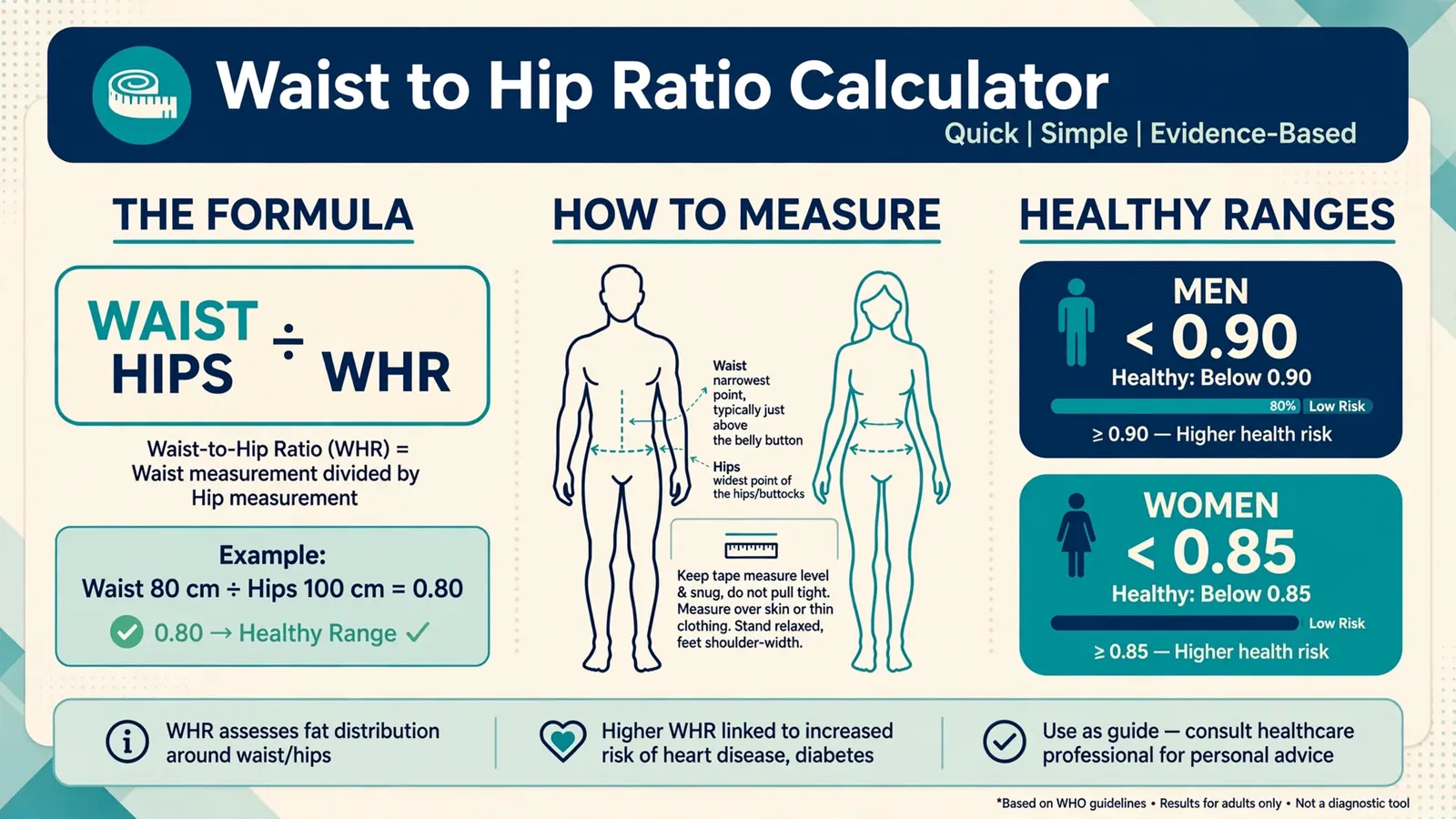
A waist to hip ratio calculator divides your waist measurement by your hip measurement to estimate health risk. A ratio below 0.90 for men and 0.85 for women is considered healthy by the World Health Organization.
Your bathroom scale tells you how much you weigh, but not where you carry it. Belly fat behaves very differently from hip fat, and the waist to hip ratio captures that difference in one simple number. Here is how it works and what your result means.
What Is a Waist to Hip Ratio Calculator?
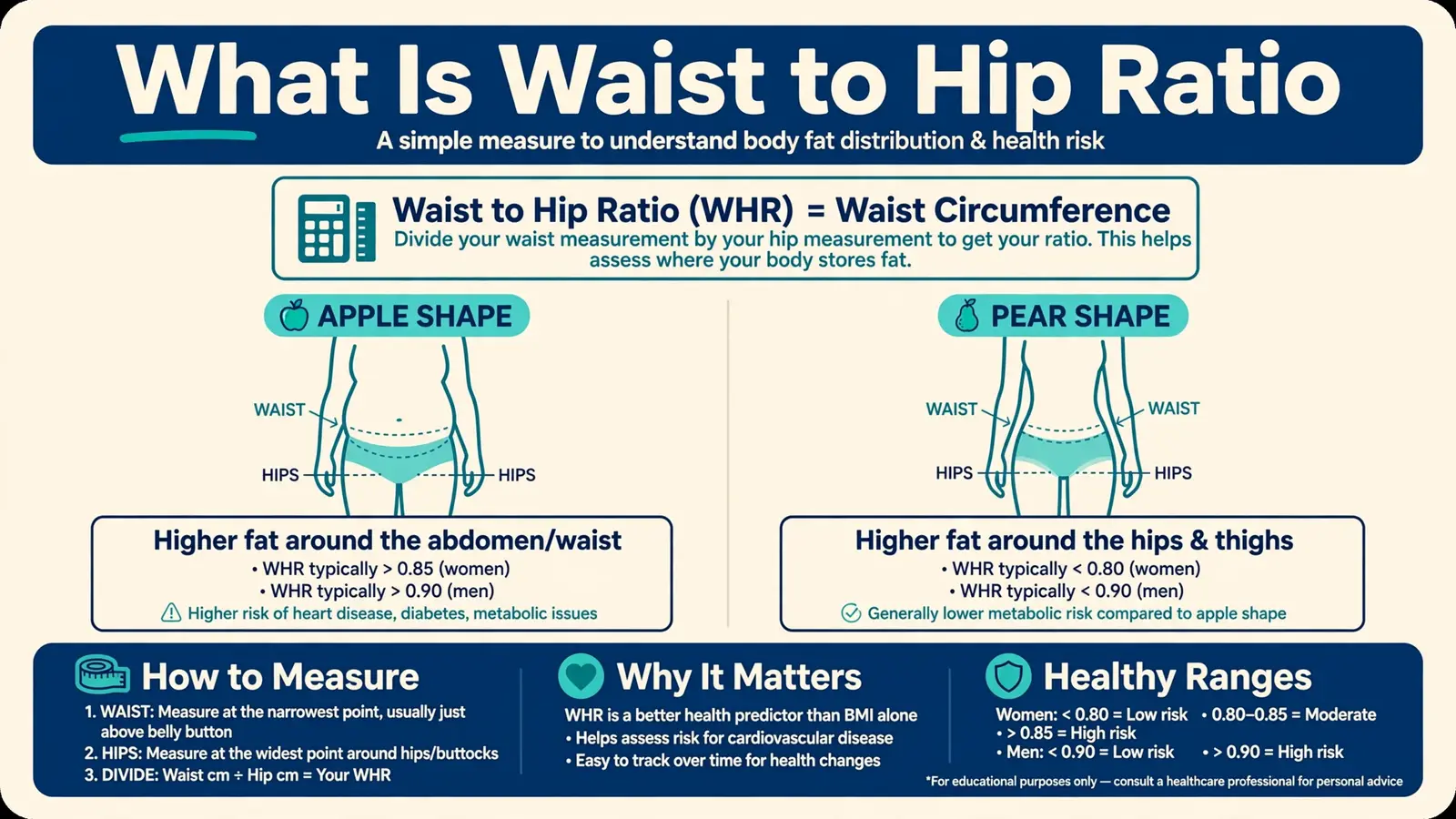
A waist to hip ratio calculator is a tool that divides your waist circumference by your hip circumference. The result, always a decimal like 0.82 or 0.95, reflects your body fat distribution.
The formula is straightforward: waist measurement divided by hip measurement, both in the same units. If your waist is 80 cm and your hips are 100 cm, your ratio is 0.80.
Unlike BMI, which cannot tell muscle from fat, the waist to hip ratio specifically reflects abdominal fat. That matters because fat around the organs is more strongly linked to heart disease and diabetes than fat on the hips and thighs.
How Do I Measure My Waist and Hips Correctly?
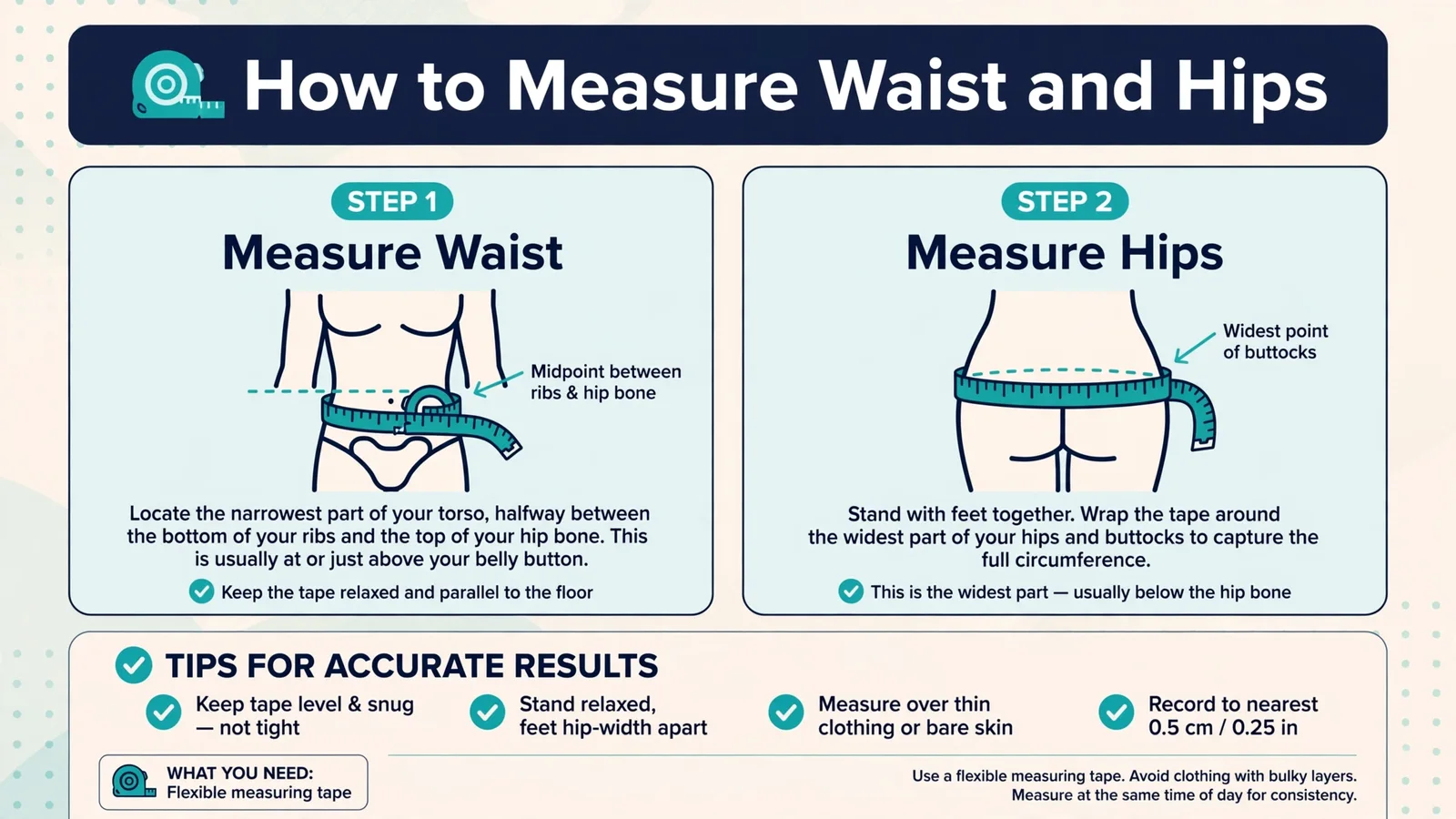
Accurate measurements make or break your result. You need a flexible tape measure and about two minutes.
Measuring your waist
- Stand relaxed and breathe out normally.
- Find the midpoint between your lowest rib and the top of your hip bone, usually near the belly button.
- Wrap the tape snugly but not tight. It should not dig into skin.
- Read the number at the end of a normal exhale.
Measuring your hips
- Stand with feet together.
- Wrap the tape around the widest part of your buttocks.
- Keep the tape level all the way around.
- Record the number.
Common measuring mistakes
- Measuring over thick clothing (adds centimeters)
- Sucking in your stomach (falsely lowers the waist)
- Placing the tape too high or too low
- Measuring right after a large meal
Take each measurement twice. If the two readings differ by more than 1 cm, take a third and average them.
What Is a Healthy Waist to Hip Ratio?
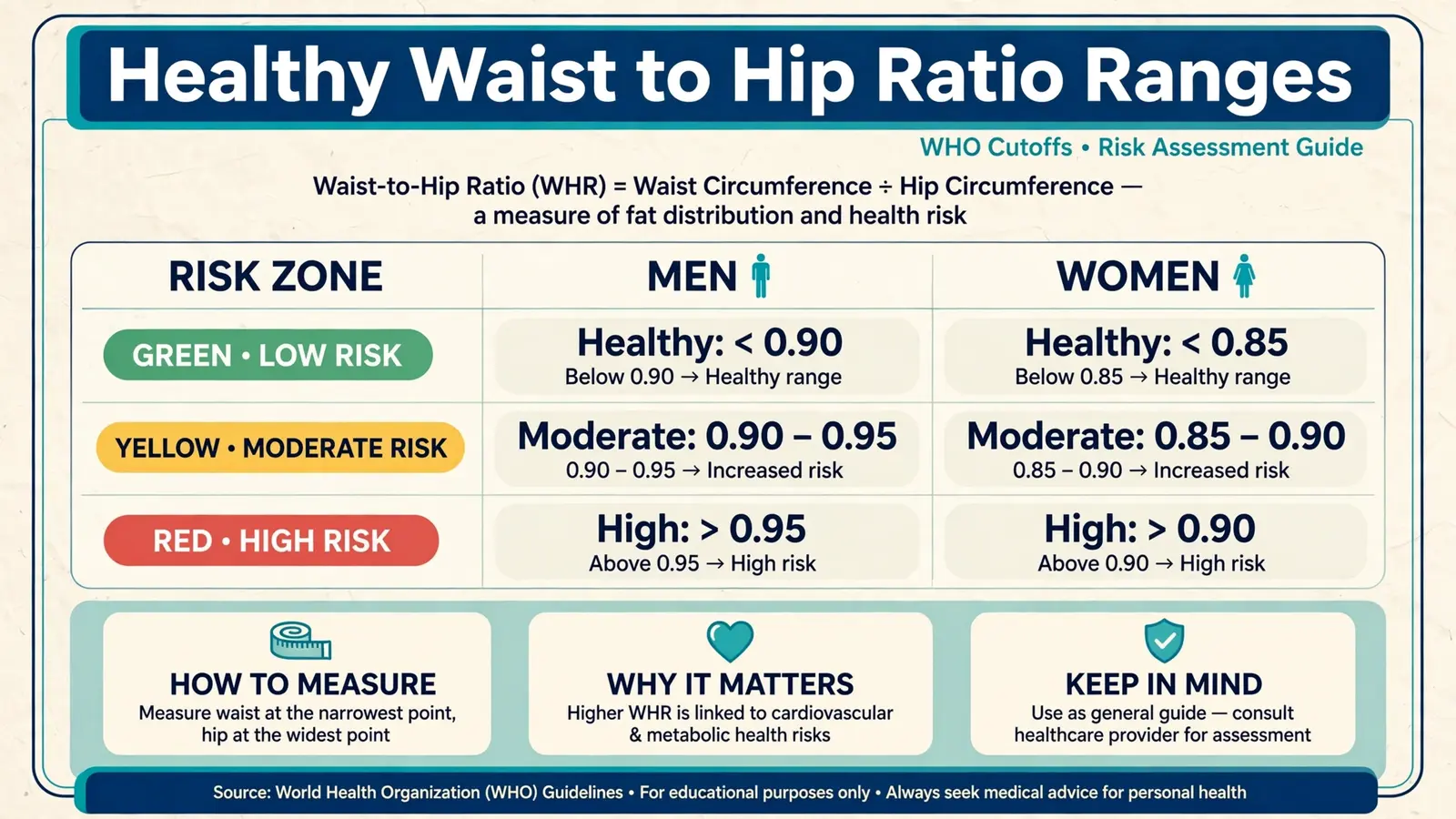
The World Health Organization sets clear cutoffs.
| Category | Men | Women |
|---|---|---|
| Healthy | Below 0.90 | Below 0.85 |
| Increased risk | 0.90 – 0.99 | 0.85 – 0.89 |
| High risk | 1.00 and above | 0.90 and above |
What does a high ratio mean?
A high ratio means you carry proportionally more fat around your waist. This pattern, sometimes called apple-shaped, is associated with higher risk of cardiovascular disease, type 2 diabetes, and metabolic syndrome, even at a normal BMI.
What does a low ratio mean?
A low ratio means fat sits more on the hips and thighs, the pear-shaped pattern. This distribution is linked to lower metabolic risk. That said, a low ratio does not guarantee health on its own. Blood pressure, cholesterol, and blood sugar still matter.
Why Does Waist to Hip Ratio Matter More Than BMI for Some People?
BMI has a blind spot: it cannot see where fat lives. Two people with a BMI of 27 can have very different risk profiles if one carries fat on the belly and the other on the hips.
Research published in major cardiology journals has found that waist to hip ratio predicts heart attack risk better than BMI in many populations. The famous INTERHEART study, covering 52 countries, identified abdominal obesity as a key risk factor independent of BMI.
This does not make BMI useless. The two work best together. Check your BMI for overall weight status, then check your waist to hip ratio for fat distribution. If either is high, that is worth discussing with your doctor.
How Can I Improve My Waist to Hip Ratio?
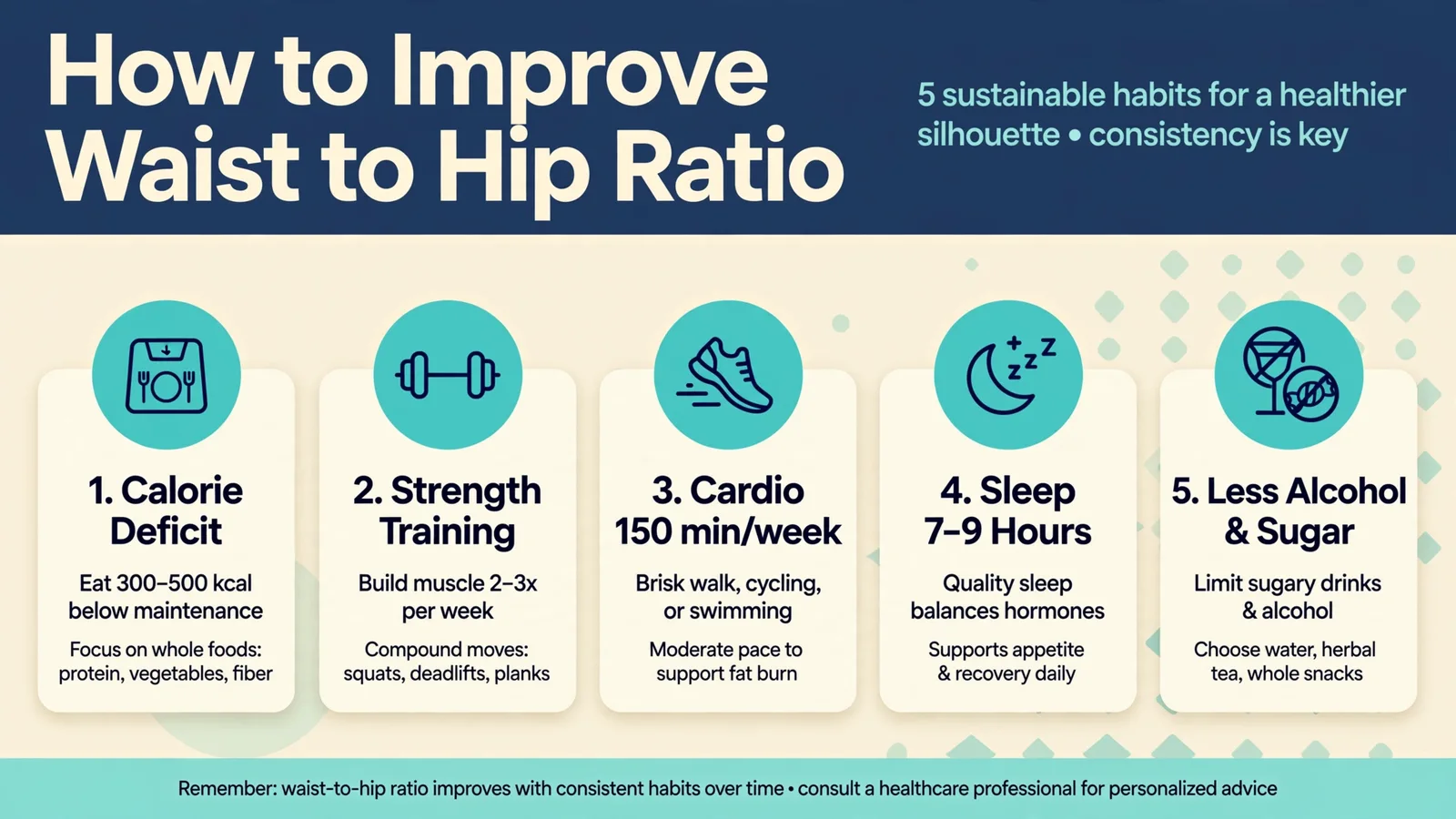
You cannot spot-reduce fat, but you can shrink your waist relative to your hips through overall fat loss and muscle building.
What helps most:
- A moderate calorie deficit (300 to 500 calories below maintenance). Try our calorie calculator to find your target.
- Strength training 2 to 4 times per week, with emphasis on glutes and legs to build hip muscle
- 150 minutes of moderate cardio per week, per WHO guidance
- 7 to 9 hours of sleep, since poor sleep raises cortisol and belly fat storage
- Less alcohol and sugary drinks, which preferentially add abdominal fat
What to expect: A realistic pace is 0.01 to 0.03 off your ratio every month or two with consistent effort. Measure monthly, not daily, because the tape moves slowly.
Should athletes worry about this ratio?
For most athletes, the ratio is less informative because muscle changes the picture. A sprinter with big glutes may have a low ratio purely from muscle, while a heavyweight lifter might read high without excess belly fat. Athletes should track performance, body composition scans, and blood markers rather than obsessing over the tape.
Does the ratio work the same across ethnicities?
Mostly, but with nuance. Some research suggests Asian populations face elevated metabolic risk at lower waist measurements than European populations, which is why some guidelines propose tighter cutoffs. The WHO cutoffs remain the standard reference, but your doctor may interpret your number in the context of your background and overall risk factors.
Frequently Asked Questions
How do I use a waist to hip ratio calculator?
Measure your waist at the narrowest point between ribs and hip bones, measure your hips at the widest point, then divide waist by hips. Enter both numbers into the calculator and compare your result to the WHO cutoffs.
What is a good waist to hip ratio for women?
Below 0.85 is considered healthy. Between 0.85 and 0.89 signals increased risk, and 0.90 or above signals high risk. These are population guidelines, not personal diagnoses.
What is a good waist to hip ratio for men?
Below 0.90 is considered healthy. The 0.90 to 0.99 range means increased risk, and 1.00 or above means high risk.
Is waist to hip ratio better than BMI?
For predicting heart and metabolic risk, it is often better, because it captures fat distribution. But BMI is still useful for overall weight classification. Use both together for the fullest picture.
Can I have a normal BMI but an unhealthy waist to hip ratio?
Yes. This is sometimes called normal-weight obesity or skinny fat. Someone with little muscle and extra belly fat can have a BMI of 23 but a ratio above the healthy cutoff. That combination still carries elevated risk.
Does age affect waist to hip ratio?
Yes. Fat tends to shift toward the abdomen with age, especially after menopause in women. That is one reason the ratio often creeps up over the decades even when weight stays stable.
How often should I measure?
Once a month is plenty. The ratio changes slowly, and frequent measuring just adds noise. Measure under consistent conditions: morning, before eating, same tape position.
Conclusion
A waist to hip ratio calculator turns two tape measurements into a meaningful health signal. Keep your ratio below 0.90 as a man or 0.85 as a woman, and treat higher numbers as a prompt to act, not a verdict.
Pair the ratio with your BMI, move regularly, eat sensibly, and recheck monthly. Small, steady changes in waist size add up. For official guidance, see the WHO report on waist circumference and ratio cutoffs and the CDC guide to assessing your weight.