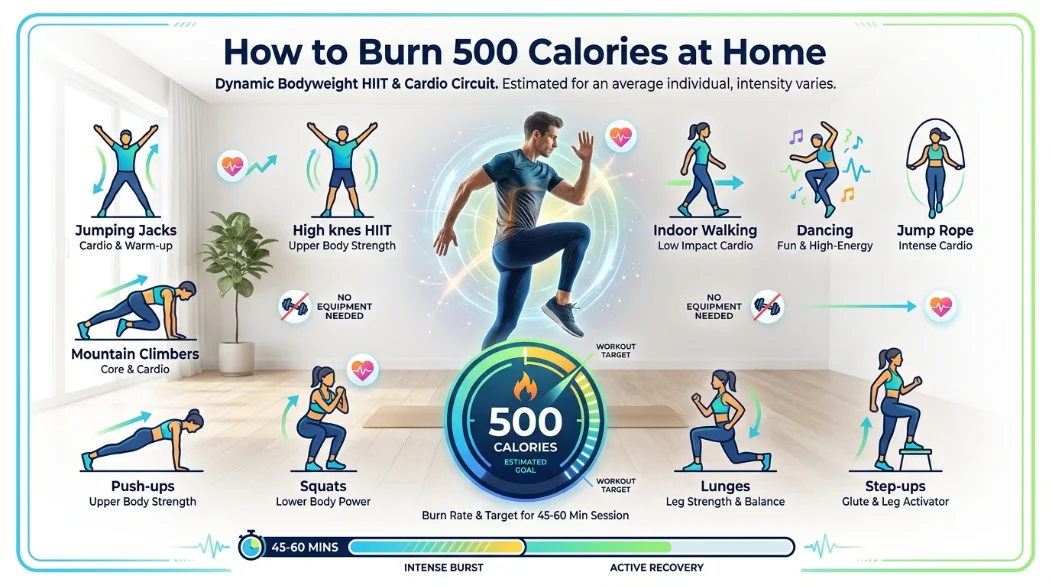
Burning 500 calories at home is possible. You don’t need a treadmill, expensive machines, or a gym membership to increase your calorie expenditure. With the right combination of cardio, bodyweight exercises, interval training, and steady movement, you can create a demanding workout in a small space.
However, there’s one detail worth understanding before you start. 500 calories isn’t a fixed number of minutes for everyone. Your body weight, exercise intensity, workout duration, fitness level, and the type of activity all affect how much energy you use.
For example, a 154-pound person burns about 295 calories in 30 minutes of running at 5 mph according to current CDC estimates. That same person uses about 140 calories during 30 minutes of walking at 3.5 mph.
That difference explains why one person may approach 500 calories during a vigorous workout while another needs a longer session.
The goal isn’t to chase a perfect calorie number. The goal is to create enough useful activity to make a meaningful difference over time.
Whether you’re a beginner, an experienced exerciser, or simply trying to burn 500 calories without going to the gym, the methods below can help you build a practical home routine.
Can You Really Burn 500 Calories at Home?
Yes. You can burn a substantial amount of energy at home through vigorous cardio, bodyweight circuits, dancing, step-ups, jump rope, and other forms of physical activity.
The catch is that your calorie burn depends heavily on how hard and how long you exercise.
The CDC classifies physical activity according to intensity. Moderate activity generally means you can talk but can’t sing comfortably. During vigorous activity, you usually can’t say more than a few words without pausing for a breath.
That simple test can help you understand why two workouts with the same duration can produce different results.
A slow 30-minute movement session won’t produce the same energy expenditure as 30 minutes of vigorous intervals. Likewise, a 180-pound person generally uses more energy performing the same activity than a 130-pound person.
What determines how many calories you burn?
Several factors influence calorie expenditure:
- Body weight: Larger bodies generally use more energy to move the same distance or perform the same activity.
- Exercise intensity: Faster and harder movement generally increases energy expenditure.
- Exercise duration: A longer session gives you more time to accumulate activity.
- Fitness level: Your body can become more efficient at familiar movements.
- Exercise type: Running, jump rope, dancing, and bodyweight circuits can have very different energy costs.
- Rest periods: Long breaks reduce the time spent actively exercising.
- Movement efficiency: Technique and pace change how demanding an exercise becomes.
- Individual characteristics: Age, body composition, and other factors can influence energy expenditure.
The 2024 Adult Compendium of Physical Activities assigns different MET values to different activities. For example, general bodyweight exercises can range around 3 METs while high-intensity bodyweight resistance is listed at 6.5 METs. Vigorous calisthenics is listed at 7.5 METs and vigorous interval exercise involving burpees, mountain climbers, and squat jumps is listed at 11 METs.
Those differences are substantial.
What is a MET?
A metabolic equivalent of task, commonly called a MET, is a way to describe the energy demand of an activity.
One MET represents the approximate energy cost of sitting quietly. According to the CDC, physical activity from 3 to 5.9 METs generally falls into the moderate-intensity range while 6 METs or more is considered vigorous intensity.
You don’t need to calculate METs every time you exercise. Still, they’re useful when you want a more realistic explanation of why calorie estimates vary.
How Many Minutes Does It Take to Burn 500 Calories?
There isn’t one universal answer.
A person weighing more may reach 500 calories sooner during the same activity. A lighter person may need more time. Intensity matters just as much.
The table below shows why a 500-calorie target can require very different workout durations.
| Activity intensity | Example MET level | Approximate time for 500 calories at 154 lb* |
|---|---|---|
| Moderate activity | 3.5 METs | About 117 minutes |
| Moderate-to-hard activity | 5 METs | About 82 minutes |
| Bodyweight circuit | 6 METs | About 68 minutes |
| Vigorous circuit | 7.5 METs | About 54 minutes |
| Very vigorous intervals | 11 METs | About 37 minutes |
*These are MET-based estimates rather than guarantees. Actual calorie expenditure varies by person, exercise execution, rest periods, and other factors.
The calculation demonstrates an important point: burning 500 calories in 30 minutes isn’t a realistic expectation for most people.
At 11 METs, a 154-pound person would theoretically expend roughly 400 calories in 30 minutes using a simple MET-based estimate. Reaching 500 would require a higher body weight, higher average intensity, or more time.
Why body weight changes the estimate
Consider the same 7.5-MET vigorous circuit.
A 60 kg person and a 90 kg person don’t use energy at the same rate.
| Body weight | Estimated calories per hour at 7.5 METs |
|---|---|
| 60 kg / 132 lb | About 473 |
| 70 kg / 154 lb | About 551 |
| 80 kg / 176 lb | About 630 |
| 90 kg / 198 lb | About 709 |
These figures illustrate a general principle rather than promising exact results. The CDC also notes that people who weigh more than 154 pounds generally burn more calories during the same activity while lighter people burn fewer.
Best Exercises to Burn 500 Calories at Home
You don’t need to perform one exercise continuously. In fact, combining several movements can make a workout more manageable and more interesting.
The best choices for a high-calorie home workout usually involve large muscle groups, continuous movement, and enough intensity to elevate your breathing and heart rate.
Burpees
Burpees are one of the most demanding no-equipment movements you can perform in a small space.
A basic burpee combines a squat, plank position, push-up variation, and explosive return to standing. Because several muscle groups work together, your cardiovascular system also has to keep pace.
The Adult Compendium lists vigorous calisthenics that include movements such as burpees and jumping jacks at 7.5 METs.
For beginners, remove the jump. You can also step your feet back instead of kicking them back quickly.
Jumping Jacks
Jumping jacks provide a simple way to keep moving without equipment.
They increase movement speed while involving your legs, shoulders, and trunk. Because they’re easy to learn, they’re useful during circuit workouts.
Try them as short intervals rather than forcing yourself to perform hundreds in a row.
For a lower-impact option, use step jacks. Step one foot out at a time while swinging your arms overhead.
High Knees
High knees can turn a small patch of floor into a cardio station.
Drive your knees upward while maintaining a quick rhythm. Your pace determines the intensity.
For beginners, marching with high knees provides a gentler option. As fitness improves, increase the speed or add short intervals.
Mountain Climbers
Mountain climbers combine a plank position with rapid leg movement.
They’re useful in HIIT workouts because they raise the heart rate quickly while requiring significant core and shoulder stability.
Don’t sacrifice form simply to move faster. Keep your shoulders controlled and avoid letting your hips bounce dramatically with every repetition.
Squat Jumps
Squat jumps add an explosive component to a regular squat.
Lower into a squat, drive upward, and land softly with your knees controlled. Because this is a high-impact movement, it’s better suited to people who already tolerate jumping comfortably.
A beginner-friendly alternative is a fast bodyweight squat without the jump.
Bodyweight Squats
Regular squats aren’t as intense as burpees or vigorous intervals. Still, they’re useful because they train large lower-body muscle groups.
They also fit easily between higher-intensity exercises.
For example:
Jumping jacks → squats → mountain climbers → push-ups → high knees
That combination creates a full-body circuit without equipment.
Lunges
Forward or reverse lunges add unilateral lower-body work.
Reverse lunges often feel easier for beginners because you step backward rather than forward. Maintain control throughout the movement.
You can increase the challenge by using a quicker pace while keeping good technique.
Push-Ups
Push-ups primarily train the chest, shoulders, triceps, and trunk.
They won’t burn calories as quickly as continuous cardio. Their value comes from adding resistance work to a broader circuit.
Use:
- Wall push-ups for beginners
- Incline push-ups for intermediate beginners
- Standard push-ups for stronger exercisers
- Controlled tempo push-ups for added difficulty
The 2024 Compendium lists general bodyweight resistance exercises at 3 METs and high-intensity bodyweight resistance at 6.5 METs.
Jogging in Place
Running or jogging in place provides a convenient indoor cardio option.
The trick is maintaining continuous movement rather than turning it into occasional bouncing.
To increase the challenge:
- Raise your knee height.
- Increase your arm swing.
- Use short speed intervals.
- Alternate fast and moderate periods.
If jumping feels uncomfortable, switch to brisk marching.
Step-Ups
Step-ups can provide a strong cardio stimulus while also working the legs.
Use a sturdy step designed for exercise or a stable staircase. Never improvise with an unstable chair, loose box, or slippery surface.
Increase intensity by moving at a controlled but faster pace.
Dancing
Dancing is one of the easiest ways to make a longer workout feel less repetitive.
The Adult Compendium includes several forms of dance with different MET values. Low-impact aerobic dance is listed at 4.8 METs while high-impact vigorous aerobic dance is listed at 8 METs.
That makes dancing a legitimate cardio option rather than simply a recreational activity.
Jump Rope
Jumping rope can create a high energy demand in a relatively short period.
The 2024 Compendium lists general rope skipping at 11 METs.
However, intensity comes with a trade-off. Jump rope can be technically demanding and repetitive. Beginners should start with short intervals rather than attempting a long continuous session.
How to Burn 500 Calories at Home Without Equipment
A no-equipment workout can still be challenging.
The key is exercise selection plus intensity. A slow set of squats followed by a long break won’t create the same calorie expenditure as a continuous circuit involving cardio and bodyweight movements.
Here are useful no-equipment exercises:
| Exercise | Main role | Typical intensity options |
|---|---|---|
| Jumping jacks | Cardio | Moderate to vigorous |
| High knees | Cardio | Moderate to vigorous |
| Burpees | Full-body cardio | Vigorous |
| Mountain climbers | Cardio and core | Moderate to vigorous |
| Squats | Lower-body strength | Light to vigorous |
| Reverse lunges | Lower-body strength | Moderate |
| Push-ups | Upper-body strength | Light to vigorous |
| Jogging in place | Cardio | Moderate to vigorous |
| Dancing | Cardio | Moderate to vigorous |
| Step-ups | Cardio and legs | Moderate to vigorous |
How to make a no-equipment workout harder
You don’t always need more exercises.
Sometimes a smarter adjustment works better.
Increase the work interval.
Move for 45 seconds instead of 30.
Reduce unnecessary rest.
A 60-second break can become 30 seconds when your fitness allows it.
Use bigger movements.
Deep, controlled squats typically demand more than half-range repetitions.
Mix cardio and strength.
Follow a strength movement with a cardio exercise.
Use intervals.
Alternate hard bursts with easier recovery periods.
The result is a workout that creates a meaningful energy demand without requiring machines.
500-Calorie Home Workout: A Practical Full-Body Routine
A useful home workout shouldn’t pretend that every person burns the same number of calories.
Instead, build a session that combines enough total movement to potentially approach the target while letting the person adjust the pace.
For a person around 70 kg or 154 pounds, the following is an example of how a roughly 500-calorie session could be structured using MET-based estimates.
| Workout segment | Duration | Example intensity | Approximate MET | Estimated calories at 70 kg |
|---|---|---|---|---|
| Warm-up | 10 min | Moderate | 3.5 | 43 |
| Aerobic/cardio block | 20 min | Vigorous | 7.3 | 179 |
| Bodyweight circuit | 15 min | High intensity | 6.5 | 102 |
| Dance/cardio block | 15 min | Vigorous | 8.0 | 147 |
| Cool-down | 10 min | Light | 2.8 | 34 |
| Total | 70 min | Mixed | — | About 505 |
These are calculated estimates based on published MET values. Actual calories can be higher or lower. Rest periods, actual effort, exercise technique, and individual characteristics can all change the result.
The goal isn’t to stare at the number on a fitness watch. Use the structure as a framework.
Warm-up: 10 minutes
Start gently.
Try:
- 2 minutes of marching
- 2 minutes of step-touch
- 2 minutes of bodyweight squats
- 2 minutes of light jogging
- 2 minutes of arm and hip mobility
Your heart rate should gradually rise.
Don’t turn the warm-up into a sprint. Save your energy for the main workout.
Cardio block: 20 minutes
Use a simple alternating structure:
2 minutes brisk jogging in place
1 minute high knees
2 minutes dancing
Repeat four times.
Keep the intensity controlled. The goal is continuous movement rather than an all-out effort.
Bodyweight circuit: 15 minutes
Perform each movement for approximately 40 seconds followed by 20 seconds of transition.
- Bodyweight squats
- Mountain climbers
- Reverse lunges
- Push-ups
- High knees
- Squat-to-reach
- Plank variation
- Jumping jacks
Repeat the sequence according to your fitness level.
Beginners can perform 20–30 seconds of work followed by longer recovery periods.
Cardio or dance block: 15 minutes
Choose one activity you can maintain safely.
Good options include:
- Dancing
- Step-ups
- Jogging in place
- Low-impact aerobics
- Jump rope intervals
- Fast marching
Enjoyment matters here. The easiest workout to repeat consistently often beats the theoretically perfect routine that you hate after three sessions.
Cool-down: 10 minutes
Slow the pace gradually.
Use:
- Slow walking
- Gentle marching
- Controlled breathing
- Light mobility exercises
You don’t need an elaborate stretching routine immediately after every workout. The main goal is to transition out of vigorous exercise gradually.
How to Burn 500 Calories With HIIT
HIIT stands for high-intensity interval training.
Instead of exercising at the same pace throughout the session, you alternate intense work with recovery.
The 2024 Adult Compendium specifically lists vigorous high-intensity interval exercise involving burpees, mountain climbers, squat jumps, and Tabata-style exercise at 11 METs.
That’s a very high intensity.
It also explains why HIIT can produce substantial calorie expenditure. Still, the number on the page doesn’t mean every person can sustain 11 METs for 30 or 60 minutes.
A practical at-home HIIT workout
Try this structure:
40 seconds work + 20 seconds recovery
Perform:
- High knees
- Mountain climbers
- Jumping jacks
- Squat jumps
- Burpees
- Fast marching
Rest for 1–2 minutes between rounds if needed.
Beginners should shorten the work period or choose low-impact variations.
Is HIIT the fastest way to burn 500 calories?
HIIT can create a high rate of energy expenditure.
However, “fastest” doesn’t automatically mean “best.”
A workout that is extremely hard may be difficult to perform for long enough. Fatigue can also affect technique.
For some people, a mixed session of cardio and bodyweight exercise is more practical than repeatedly pushing maximal intensity.
Think of HIIT as a tool rather than a magic calorie-burning switch.
How to Burn 500 Calories With Cardio at Home
Cardio doesn’t have to mean running on a treadmill.
At home, you can build a cardio session around repeated movement.
Good choices include:
- Dancing
- Jogging in place
- Marching
- Step-ups
- Aerobic routines
- Jump rope
- Shadow boxing
- Stair climbing
The CDC identifies activities such as brisk walking and dancing as moderate-intensity options while jogging, running, vigorous dancing, and jumping rope can fall into the vigorous category.
Dancing
Dancing works particularly well for people who dislike traditional workouts.
A playlist can turn 45 minutes of movement into something that feels less like exercise.
Choose faster songs for vigorous intervals and slower songs for recovery.
Jogging in place
Jogging in place offers a simple indoor alternative when weather or space limits outdoor activity.
Use your arms. Maintain an upright posture. Keep the movement controlled.
You can alternate:
60 seconds moderate → 30 seconds fast
Repeat throughout the workout.
Step-ups
Step-ups are particularly useful when you have safe access to stairs or an exercise platform.
Start with a comfortable pace. Increase your speed only when you’re confident about your footing.
Shadow boxing
Shadow boxing can provide a surprisingly energetic home cardio session.
Throw controlled punches while moving your feet.
Avoid locking your elbows and don’t swing wildly. Keep the movements sharp and rhythmic.
Can You Burn 500 Calories by Walking at Home?
Yes, but walking generally requires more time than vigorous exercise to reach the same calorie target.
The CDC estimates that a 154-pound person burns about 140 calories during 30 minutes of walking at 3.5 mph. That’s about 280 calories per hour.
At that rate, reaching 500 calories would take roughly 107 minutes.
That doesn’t mean you need to walk continuously for 107 minutes.
You can accumulate movement across the day.
For example:
- 30 minutes in the morning
- 30 minutes at midday
- 30–45 minutes in the evening
At home, walking can include:
- Marching around rooms
- Walking laps through the house
- Marching in place
- Using stairs
- Combining walking with active household tasks
The actual calorie burn will depend on your pace and body weight.
How to make indoor walking more demanding
Increase the pace until you’re breathing noticeably harder.
You can also add short intervals:
3 minutes brisk walking → 1 minute fast marching
Repeat the sequence.
This gives the workout more variation without turning every minute into a sprint.
How to Burn 500 Calories at Home for Beginners
Beginners shouldn’t copy an advanced athlete’s workout and simply hope their body catches up.
Start with movements you can control.
Low-impact exercises can include:
- Marching in place
- Step-touch
- Chair squats
- Wall push-ups
- Reverse lunges
- Low-impact jumping jacks
- Dancing
- Step-ups
The CDC’s intensity guidance provides an easy self-check. During moderate activity, you should generally be able to talk but not sing. During vigorous activity, speaking becomes difficult.
Build toward longer sessions
Suppose you’re currently comfortable with 15 minutes.
Don’t force yourself into a 60-minute high-intensity workout tomorrow.
Instead:
- Week 1: 15–20 minutes
- Week 2: 20–25 minutes
- Week 3: 25–30 minutes
- Week 4: 30–40 minutes
The exact schedule can vary. The point is gradual progression.
NIDDK recommends building physical activity gradually when someone hasn’t been active and notes that even shorter sessions can contribute to overall activity.
Beginner 500-calorie strategy
A beginner may find it more comfortable to spread activity throughout the day instead of forcing one huge workout.
For example:
Morning: 15 minutes of brisk movement
Afternoon: 20 minutes of walking
Evening: 25 minutes of low-impact cardio
This approach can be easier to recover from.
How to Burn 500 Calories Without Going to the Gym
A gym is convenient. It isn’t mandatory.
Your home offers several calorie-burning opportunities.
Household movement
Cleaning isn’t a replacement for structured exercise in every situation. Still, it does involve physical activity.
The Compendium lists sweeping, mopping, cleaning, and household tasks at different MET levels depending on the pace and effort. Vigorous multiple household tasks are listed at 4.3 METs.
That means everyday movement can contribute to total energy expenditure.
Useful examples include:
- Fast sweeping
- Mopping
- Cleaning the garage
- Carrying household items
- Climbing stairs
- Washing the car
- Active home organization
Don’t treat every chore as a guaranteed 500-calorie workout. Instead, view these activities as another way to increase daily movement.
Stair climbing
Stairs can dramatically increase intensity compared with slow walking.
However, they’re demanding.
Use a stable staircase and keep one hand near the rail when needed.
Short intervals are enough to start:
30 seconds stairs → 60 seconds easy walking
Repeat several times.
How to Burn 500 Calories in a Day
Burning 500 calories through exercise doesn’t necessarily require one long workout.
You can distribute movement throughout the day.
Here’s an example structure:
| Time | Activity | Goal |
|---|---|---|
| Morning | 20-minute brisk indoor cardio | Start the day actively |
| Midday | 15-minute walking session | Add steady movement |
| Afternoon | 20-minute bodyweight circuit | Add resistance and cardio |
| Evening | 25-minute dance or walking session | Accumulate more activity |
This structure can be easier than attempting a single punishing workout.
More importantly, exercise calories aren’t the same as total calories burned for the day.
Your total daily energy expenditure includes resting energy needs along with physical activity and other energy costs.
That’s why burning 500 calories through exercise doesn’t mean your body burns only 500 calories for the entire day.
How to Track Your 500-Calorie Burn
Tracking can be useful. Treat the number as an estimate rather than a measurement carved in stone.
Use body weight and activity intensity
A MET-based estimate can help illustrate how calorie expenditure changes with exercise intensity.
A common calculation is:
Calories per minute ≈ MET × 3.5 × body weight in kilograms ÷ 200
For example, a 70 kg person exercising at 7.5 METs for one hour would have an estimated energy expenditure of roughly 551 calories.
That doesn’t mean the person definitely burned 551 calories.
It means the published activity intensity provides a useful estimate.
Fitness trackers have limitations
Smartwatches and fitness trackers can be convenient for tracking time, heart rate, and general activity.
Their calorie estimates aren’t laboratory measurements.
A systematic review and meta-analysis found meaningful differences between activity-monitor estimates of energy expenditure and criterion measurements. Another systematic review reported energy-expenditure errors above 30% across all brands examined in its included studies.
Use the device to identify trends.
Don’t use it to convince yourself that an exact number of calories vanished from your body.
Does Burning 500 Calories Help With Weight Loss?
It can contribute to weight loss when it forms part of a sustained calorie deficit.
The basic principle is straightforward: your body uses energy and you obtain energy from food and drinks. When energy intake stays below expenditure over time, body weight can decrease.
However, one workout doesn’t determine long-term weight loss.
NIDDK explains that physical activity helps increase calorie use while a healthy eating plan can reduce calorie intake. It also emphasizes sustainable habits rather than short-term extreme approaches.
That matters because exercise can also affect appetite, recovery, and activity outside the workout.
Imagine burning 500 calories during a difficult workout and then unintentionally eating far more because you feel extremely hungry. The workout still provided health benefits, but the expected calorie deficit may not materialize.
Is a 500-calorie exercise target necessary?
No.
There is nothing biologically magical about the number 500.
For some people, 500 exercise calories may be a reasonable target. For others, it may be unnecessarily demanding.
A smaller amount of regular activity can still be valuable.
Federal physical activity guidance recommends adults get at least 150 minutes of moderate-intensity aerobic activity per week or 75 minutes of vigorous activity, along with muscle-strengthening activity on at least two days each week. People can perform more activity for additional health benefits.
The important word is regular.
How to Choose the Right 500-Calorie Workout for You
The most useful routine depends on your current fitness level, available space, preferred activities, and tolerance for impact.
| Situation | Practical starting point |
|---|---|
| Beginner | Low-impact cardio + basic bodyweight movements |
| Limited space | Marching, dancing, squats, lunges, HIIT |
| No equipment | Bodyweight circuit |
| Prefer steady exercise | Indoor walking or dancing |
| Short workout window | Intervals or vigorous cardio |
| Prefer low impact | Walking, marching, dancing, step-touch |
| Enjoy variety | Full-body circuit |
| Higher fitness level | Vigorous intervals + cardio |
| Need a simple routine | Walking + bodyweight exercises |
There’s no requirement to perform burpees just because someone online says they’re the best calorie-burning exercise.
A routine you can perform safely and consistently is far more useful.
Safety Tips Before Trying to Burn 500 Calories
A high calorie-burn workout can become difficult quickly.
Start at an intensity your body can manage. Increase the workload gradually.
Keep these points in mind:
- Warm up before vigorous exercise.
- Use controlled technique rather than racing through repetitions.
- Choose low-impact alternatives if jumping causes discomfort.
- Drink enough fluids based on your environment and activity level.
- Take recovery breaks when needed.
- Don’t treat pain as proof that a workout is effective.
- Give yourself recovery time after difficult sessions.
- Stop exercising if you develop concerning symptoms such as chest pain, fainting, or severe shortness of breath.
People with chronic medical conditions or physical limitations should discuss appropriate exercise with a qualified healthcare professional before beginning a demanding routine. NIDDK specifically advises people with conditions such as heart disease, high blood pressure, or diabetes to discuss safe physical activity with their healthcare professional.
Common Mistakes When Trying to Burn 500 Calories at Home
Trying to burn 500 calories as quickly as possible
Shorter isn’t automatically better.
An extremely intense workout may be impossible to sustain. It can also leave you too fatigued to train consistently.
Assuming sweat equals calorie burn
Sweat is primarily a cooling response.
A hot room can make you sweat heavily without producing the same energy expenditure as vigorous exercise.
Don’t use sweat as your calorie meter.
Ignoring rest periods
Rest is part of interval training.
If you need 60 seconds to recover, take it. Better movement with sensible recovery is more useful than chaotic repetitions performed while exhausted.
Counting fitness-tracker calories as exact
A device may report 510 calories while your actual energy expenditure differs substantially.
Use the number as a rough reference rather than a laboratory result.
Doing high-impact workouts every day
Burpees, squat jumps, and jump rope can be excellent tools.
They aren’t mandatory every day.
Rotate vigorous workouts with moderate activity and recovery. Your muscles, joints, and connective tissues also need time to adapt.
Using exercise as permission to overeat
A workout supports energy expenditure. It doesn’t create a free pass for unlimited calories.
Weight management depends on the broader relationship between food intake, activity, and total energy expenditure.
Frequently Asked Questions
Sometimes, but not for everyone.
A 30-minute session would require a very high average energy expenditure. For example, an 11-MET activity produces an estimated 462 calories in 30 minutes for an 80 kg person using a standard MET calculation. A 90 kg person would be around 520 calories under the same theoretical calculation.
The problem is that maintaining such high intensity for 30 minutes is difficult for many people. Interval workouts also include recovery periods.
Exercises with high energy-demand rates can reach 500 calories in less time than low-intensity activities.
Vigorous jump rope, vigorous calisthenics, and high-intensity intervals have high MET values in the Adult Compendium.
However, the fastest theoretical option isn’t automatically the safest or most practical option for you.
It depends on your body weight, intensity, and activity.
A 154-pound person could theoretically need around 50 minutes at an activity rate similar to 590 calories per hour. At a rate around 280 calories per hour, the same person would need nearly 2 hours.
That difference shows why the phrase “500 calories in 30 minutes” needs context.
Yes.
You can use:
Yes, but the exact amount varies widely.
HIIT can create a high energy expenditure rate because it includes vigorous intervals. The 2024 Adult Compendium lists some vigorous HIIT formats at 11 METs.
Still, the total calorie expenditure depends on how long you work, how hard you work, and how much recovery you take.
Yes, but it may take significantly longer than vigorous exercise.
For a 154-pound person, the CDC estimates roughly 280 calories per hour when walking at 3.5 mph.
Indoor walking, marching, and stair intervals can make home walking more practical.
“Easiest” depends on what you can sustain comfortably.
For many people, steady walking or dancing may be easier than repeated burpees. The trade-off is that lower-intensity exercise usually requires more time.
There isn’t one universally best workout.
A full-body combination of cardio and bodyweight exercises can provide a strong balance between intensity and variety.
For example:
Warm-up → cardio intervals → bodyweight circuit → cardio finisher → cool-down
That structure lets you adjust the pace without relying on a single difficult movement.
Beginners should focus on gradually increasing total activity.
Start with low-impact cardio, bodyweight movements, and short sessions. Over time, extend workout duration or add moderate intervals.
You don’t need to start by attempting a 60-minute HIIT workout.
Yes.
Indoor walking, dancing, step-ups, aerobic workouts, jogging in place, HIIT, bodyweight circuits, and household activities can all increase energy expenditure. The Compendium includes both exercise and household activities as measurable physical activities.
Not necessarily from one workout.
Weight loss depends on your overall energy balance over time. Regular exercise can help increase energy expenditure while a sustainable eating plan can help manage calorie intake.
You can be physically active every day. Whether you should deliberately target 500 exercise calories every day depends on your fitness level, goals, recovery, and health.
A daily 500-calorie exercise target isn’t required for general health.
Consistency matters more than forcing the same calorie number every day.
Final Thoughts
Learning how to burn 500 calories at home starts with understanding that calorie expenditure isn’t one-size-fits-all.
Your body weight, exercise intensity, workout duration, fitness level, and activity choice all influence the result. Vigorous circuits, HIIT, jump rope, dancing, step-ups, and bodyweight exercises can create substantial energy expenditure. Walking and lower-impact movement can work too, although they usually require more time.
The smartest approach isn’t to chase a perfect number on a fitness tracker.
Instead, build a workout you can perform safely and repeat consistently. Mix cardio with strength-focused movements. Increase your duration or intensity gradually. Use low-impact options when needed.
A sustainable workout that you repeat beats a brutal workout that you abandon.
For weight management, remember that exercise is only one part of the equation. Regular physical activity works alongside sustainable eating habits and overall daily movement.
1 thought on “How to Burn 500 Calories at Home | Turn Your Living Room Into a Calorie-Burning Zone”