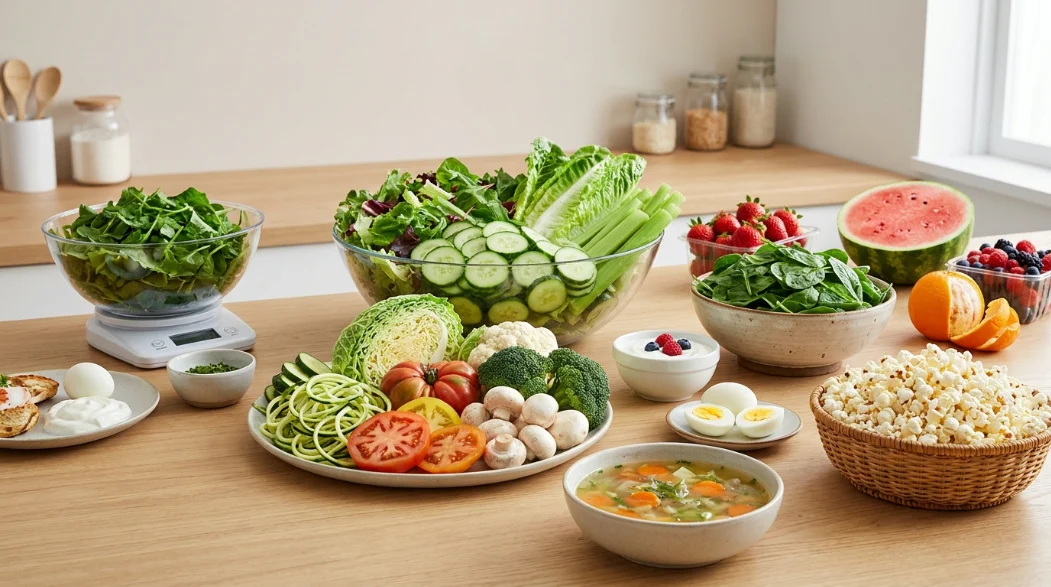
You’re hungry, you’re watching your calories, and another tiny snack just isn’t going to cut it. That’s where zero calorie foods that fill you up become an appealing idea.
There is one important catch, though. Truly calorie-free foods are rare. Water and some unsweetened drinks are the clearest examples. Many foods people call “zero-calorie foods” actually contain a small number of calories. Under U.S. food-labeling rules, a food with less than 5 calories per labeled serving may be listed as 0 calories.
That distinction matters because a cucumber, a bowl of lettuce, or a serving of strawberries isn’t calorie-free. Yet these foods can still be remarkably useful when you’re trying to eat a satisfying amount of food without consuming a large amount of energy.
The real strategy is food volume plus low calorie density, supported by water, fiber, and enough protein. The CDC notes that fruits and vegetables can help you feel full while contributing relatively few calories because they provide water and fiber.
So, instead of searching for foods you can eat endlessly, it makes more sense to find foods that give you the most fullness for the calories they contain.
The goal isn’t to eliminate calories from food. It’s to make those calories work harder for your appetite.
Can Zero Calorie Foods That Fill You Up Actually Exist?
The phrase zero calorie foods that fill you up sounds simple, but nutrition doesn’t quite work that way.
A food can be almost calorie-free without being particularly filling. Water is the obvious example. It contributes no meaningful calories, but it doesn’t provide protein, fiber, or the nutrients you get from a meal.
On the other hand, foods such as potatoes, beans, oats, Greek yogurt, and chicken contain calories. They can still play an important role in hunger control because they provide protein, fiber, complex carbohydrates, or a substantial physical portion.
Zero calorie, very low calorie, and low calorie are not the same
Here’s the distinction:
| Category | What it means | Examples |
|---|---|---|
| Calorie-free or near-zero calorie | Contains no meaningful calories or may qualify for a zero-calorie label | Water, some unsweetened beverages |
| Very low calorie | Contains a small amount of energy for the amount eaten | Lettuce, cucumber, celery |
| Low calorie and filling | Provides relatively few calories but also contributes fiber, protein, water, or food volume | Strawberries, potatoes, Greek yogurt |
| Higher-calorie but highly satisfying | Contains more energy yet can make a meal more satisfying | Eggs, oats, beans, chicken |
The FDA defines a “free” calorie claim around a threshold of less than 5 calories per reference amount and labeled serving for individual foods. That doesn’t mean the product literally contains no molecules capable of yielding energy. It means the amount is small enough to meet the labeling definition.
That’s why calling cucumber, celery, or watermelon “zero-calorie” can be misleading.
They’re better described as very-low-calorie, high-volume foods.
What Makes Low-Calorie Foods Filling?
Fullness doesn’t come from calories alone. Several physical and nutritional features influence how satisfying a food feels.
Food volume
Imagine eating 100 calories of leafy greens compared with 100 calories of a dense food such as peanut butter.
The calorie totals may be similar, but the amount of food on the plate is dramatically different.
That difference is called food volume.
Large portions can be useful during a calorie deficit because they give you more to chew, swallow, and digest without automatically adding a large calorie load.
This is one reason vegetables are so useful in lower-calorie meals. The CDC specifically recommends replacing some calorie-dense ingredients with vegetables and fruits because you can reduce calories without shrinking the physical amount of food on your plate.
Water content
Water adds weight and volume without adding calories.
Foods such as:
- Cucumber
- Watermelon
- Tomatoes
- Strawberries
- Lettuce
- Zucchini
- Grapefruit
- Oranges
contain substantial amounts of water.
That makes them useful when you want a physically satisfying portion without a large energy load.
Fiber
Fiber adds another layer.
Some fibers absorb water and increase the bulk of food. Other fibers form viscous mixtures or are fermented by gut microbes. Their effects on appetite differ by type, so it’s inaccurate to say that every gram of fiber automatically shuts down hunger.
Still, fiber-rich foods can be valuable parts of a filling eating pattern. Research reviews suggest that certain types of fiber can improve satiety, although the effect varies considerably between fibers and study designs.
Good sources include:
- Beans
- Lentils
- Oats
- Vegetables
- Berries
- Whole grains
- Whole fruit
Protein
Protein deserves special attention because a large body of research links higher protein intake with greater fullness in many settings.
A systematic review in adults with higher-weight or obesity found that higher dietary protein intake may increase fullness or satiety, although the researchers also noted limitations in the evidence.
A meta-analysis of randomized trials found that higher protein intake acutely reduced hunger and increased fullness compared with lower-protein control meals. Long-term effects were less certain.
So the most useful meal isn’t necessarily a giant bowl of lettuce.
It’s often:
High-volume vegetables + protein + fiber-rich carbohydrates + a measured amount of fat
That combination tends to be much more practical for staying satisfied.
25 Zero Calorie and Very-Low-Calorie Foods That Help Fill You Up
The foods below aren’t all literally zero-calorie. Most are very low in calorie density, which is the more useful idea when hunger is the problem.
Calorie values can vary by variety, ripeness, cooking method, and serving size. The USDA’s FoodData Central database provides detailed food-composition data and receives ongoing updates, including current Foundation Foods releases and newer branded-food data.
Quick calorie guide for common high-volume foods
| Food | Approx. calories per 100 g | Main advantage |
|---|---|---|
| Cucumber with peel | 15 | Very high water content |
| Lettuce | 15–20 | Large food volume |
| Celery | 14 | Crunchy and water-rich |
| Zucchini | 17 | Versatile high-volume vegetable |
| Tomatoes | 18 | Water and moderate fiber |
| Mushrooms | 20–25 | Meaty texture for few calories |
| Cabbage | 25 | Volume and fiber |
| Cauliflower | 25 | Filling texture and versatility |
| Broccoli | 30–35 | Fiber and structure |
| Spinach | About 20–25 | Nutrient-dense leafy green |
| Watermelon | About 30 | High water content |
| Strawberries | About 32 | Fiber and high water content |
| Grapefruit | About 40–45 | Water and fiber |
| Orange | About 45–50 | Whole-fruit fiber and water |
| Potato, cooked | About 80–90 | Surprisingly filling starch |
| Lentils, cooked | About 115–120 | Protein and fiber |
| Tuna, water-packed | About 110–120 | Lean protein |
| Chicken breast, cooked | About 160–170 | Concentrated protein |
| Greek yogurt | Varies by fat level | Protein-rich and convenient |
These figures are approximations rather than universal values. Different varieties and products can produce different numbers, so check the nutrition label when calories matter closely.
Cucumber
Cucumber is one of the easiest ways to increase food volume.
It contains a lot of water and very few calories per 100 grams. You can slice a large portion into salads, serve it beside a protein-rich meal, or turn it into a crunchy snack.
It also provides something many low-calorie foods lack: texture.
Crunch can make a snack feel more substantial because you’re physically eating something rather than simply drinking calories.
Try cucumber with:
- Vinegar
- Lemon juice
- Black pepper
- Chili flakes
- Plain yogurt
- Herbs
Be careful with heavy creamy dips. The cucumber stays low calorie while the dip can quietly become the calorie source.
Lettuce
Lettuce is a classic high-volume low-calorie food.
A large bowl can contain a surprising amount of physical food while contributing relatively few calories. That makes it useful as the foundation of salads, wraps, and meal bowls.
However, lettuce alone isn’t a complete meal.
Add a protein source such as chicken, tuna, eggs, beans, tofu, or Greek yogurt-based dressing. Then use a measured amount of dressing rather than pouring freely.
Celery
Celery provides crunch, water, and volume for very few calories.
It’s particularly useful when you want something to chew between meals.
Celery works well with:
- Greek yogurt dip
- Cottage cheese
- Hummus
- Tuna salad
- Salsa
The important detail is the accompaniment. Celery with a few tablespoons of calorie-dense nut butter is a very different snack from plain celery.
Zucchini
Zucchini is one of the more versatile filling low-calorie foods.
You can grill it, roast it, sauté it, add it to soups, or spiralize it into noodle-like strands.
Because zucchini absorbs sauces and seasoning easily, it can replace part of a denser ingredient without making the meal feel dramatically smaller.
For example, mixing zucchini with pasta gives you more food volume without requiring the same amount of pasta.
Tomatoes
Tomatoes are naturally high in water and relatively low in calories.
They’re useful in:
- Salads
- Omelets
- Sandwiches
- Soups
- Grain bowls
- Salsa
They also bring acidity and freshness to meals, which can make a large plate of vegetables feel less monotonous.
Mushrooms
Mushrooms deserve more attention than they usually get in low-calorie food lists.
Their savory flavor and firm texture make them useful as a meat extender or substitute for some calorie-dense ingredients.
Add them to eggs, stir-fries, pasta sauces, soups, or rice dishes.
Their texture can make a meal feel heartier even though mushrooms themselves aren’t calorie-dense.
Cabbage
Cabbage is inexpensive, versatile, and excellent for high-volume meals.
You can shred it into slaws, add it to soups, stir-fry it, roast it, or use it as a bowl base.
Because cabbage holds its structure when cooked, a large serving can feel more substantial than softer vegetables.
Cauliflower
Cauliflower is another workhorse.
It can become:
- Roasted florets
- Mashed cauliflower
- Cauliflower rice
- Soup
- A stir-fry ingredient
- A component in grain bowls
It isn’t calorie-free, but it can help you create larger meals with relatively modest calorie totals.
Broccoli
Broccoli supplies fiber and a firm texture that takes some time to chew.
That doesn’t make broccoli a magical appetite suppressant. It simply makes it a useful food when you want a nutrient-dense vegetable that adds bulk and structure.
Steam it lightly or roast it until the edges brown.
Then use lemon, garlic, vinegar, herbs, or spices rather than relying on large amounts of oil.
Spinach and leafy greens
Leafy greens are among the easiest foods to add to almost any meal.
Spinach, romaine, arugula, kale, and similar greens can increase volume while contributing relatively few calories.
Use them in:
- Egg scrambles
- Salads
- Sandwiches
- Wraps
- Soups
- Grain bowls
- Smoothies
The trick is to build around them rather than treating a plain pile of greens as dinner.
Low-Calorie Fruits That Can Help Satisfy Hunger
Fruit sometimes gets unfairly treated as a problem food during weight loss.
Whole fruit isn’t simply “sugar in disguise.” It also provides water, fiber, vitamins, minerals, and physical bulk. The CDC recommends choosing whole fruit more often than juice because whole fruit retains fiber and tends to be more filling.
Watermelon
Watermelon has a high water content and a relatively low calorie density.
That makes it useful when you want a large, refreshing portion.
It works especially well as:
- An afternoon snack
- A dessert replacement
- A side with a protein-based meal
- A base for fruit salads
The serving still matters. A very large fruit intake can add up even when each bite is relatively low in calories, and some fruits are denser than others — a medium banana, for example, contains around 105 calories.
Strawberries
Strawberries offer a lot of volume for relatively few calories.
A cup can feel generous compared with a calorie-dense dessert of similar energy.
They’re excellent with:
- Plain Greek yogurt
- Cottage cheese
- Oatmeal
- Chia pudding
- A small portion of dark chocolate
Oranges
Whole oranges can be useful when you want something sweet that takes time to peel and chew.
That matters more than it sounds.
A glass of orange juice can disappear in a minute. Eating a whole orange creates a slower eating experience and preserves the fruit’s fiber.
Grapefruit
Grapefruit is another water-rich fruit with relatively low calorie density.
It’s useful in salads, breakfast bowls, or as a standalone snack.
However, grapefruit can interact with some medications. Anyone taking prescription medicines should check whether grapefruit is appropriate for them.
Berries
Strawberries, raspberries, blackberries, and blueberries can fit well into a lower-calorie eating pattern.
Berries are particularly useful because you can combine them with a protein-rich food.
For example:
Greek yogurt + strawberries + raspberries
is typically more satisfying than eating a small amount of fruit alone.
The Most Filling Low-Calorie Protein Foods
Here’s where the article gets more interesting.
A diet built entirely around lettuce, cucumber, and celery may keep your plate large while leaving you hungry an hour later.
That’s because volume and satiety aren’t identical concepts.
Protein can provide stronger satiety signals than many carbohydrate- and fat-based foods. Research suggests higher-protein meals can increase fullness, particularly in the short term, although individual responses vary.
Eggs
Eggs provide protein and are easy to combine with high-volume vegetables.
Try:
2 eggs + spinach + mushrooms + tomatoes
The vegetables add bulk while the eggs provide a concentrated source of protein.
Eggs are not low calorie in the same way as cucumber. That’s fine.
The purpose isn’t to make every ingredient nearly calorie-free. The purpose is to create a meal that provides enough satisfaction for its calorie cost.
Greek yogurt
Plain Greek yogurt can make an excellent snack because it combines protein with a creamy texture.
Choose the variety that fits your calorie and nutrition needs.
Add:
- Strawberries
- Blueberries
- Cinnamon
- A small amount of oats
- Chopped fruit
Be cautious with sweetened flavored varieties because added sugars can increase calories substantially.
Cottage cheese
Cottage cheese is another protein-rich option.
It pairs well with:
- Cucumber
- Tomatoes
- Berries
- Peaches
- Black pepper
- Herbs
The savory version works particularly well when you’re craving something substantial rather than sweet.
Chicken breast
Chicken breast is much more calorie-dense than leafy greens. Yet it can be extremely useful for creating a filling meal because it provides concentrated protein.
Pair it with a large volume of vegetables.
For example:
Chicken + roasted zucchini + broccoli + baked potato
is a very different meal from a small chicken serving surrounded by a large amount of creamy sauce.
Tuna
Water-packed tuna offers concentrated protein without the calorie load of many oily preparations.
Use it in:
- Lettuce wraps
- Tuna salad
- Cucumber boats
- Vegetable bowls
- Whole-grain sandwiches
Watch the mayonnaise. A low-calorie tuna meal can quickly turn into a high-calorie one when large amounts of mayonnaise are added.
Beans and lentils
Legumes may be among the most useful foods for someone looking for healthy filling foods for weight loss.
They contain both protein and fiber.
That combination matters because you’re not relying on food volume alone.
Use beans and lentils in:
- Soups
- Chili
- Grain bowls
- Salads
- Wraps
- Vegetable stews
They’re more calorie-dense than lettuce but often far more satisfying.
Filling Foods Under 100 Calories
The phrase filling foods under 100 calories deserves some caution.
A 100-calorie food can be tiny or enormous depending on its composition.
Compare:
- 100 calories of oil
- 100 calories of cucumber
- 100 calories of popcorn
- 100 calories of strawberries
The calories are identical.
The physical quantity is not.
Good high-volume options
Examples include:
- Cucumber
- Celery
- Lettuce
- Tomatoes
- Strawberries
- Watermelon
- Broccoli
- Cauliflower
- Light vegetable soup
- Air-popped popcorn in a measured portion
Why air-popped popcorn works
Popcorn is interesting because it has a lot of physical volume for its calorie content when air-popped.
The problem starts when you add:
- Butter
- Oil
- Caramel
- Cheese powder
- Sugar
- Heavy seasoning mixes
A plain serving of air-popped popcorn can therefore fit into the category of low-calorie foods that satisfy hunger, while movie-theater popcorn can be a completely different nutritional proposition.
Filling Foods Under 200 Calories
Once you move toward 200 calories, the possibilities become more practical.
Instead of looking for a single “miracle” food, build small combinations.
Greek yogurt with strawberries
Plain Greek yogurt plus a generous serving of strawberries can create a creamy, protein-rich snack.
Cottage cheese with cucumber
This combination works when you want something savory.
The cucumber increases food volume while cottage cheese adds protein.
Vegetable soup
A broth-based vegetable soup can be filling because it combines liquid, vegetables, and physical volume.
Choose broth-based soups more often than cream-heavy versions when you’re aiming to keep calories lower.
Air-popped popcorn
A measured portion can provide a bowl of food rather than a handful.
That physical difference can matter when you’re trying to manage hunger.
Fruit with protein
Pairing fruit with Greek yogurt or cottage cheese can provide greater staying power than fruit alone.
High-Volume Low-Calorie Foods for Strong Hunger
When you’re very hungry, the biggest mistake is often choosing something tiny simply because the calorie number looks impressive.
A 60-calorie snack that leaves you hunting through the kitchen twenty minutes later isn’t necessarily more useful than a 180-calorie snack that actually satisfies you.
For stronger hunger, focus on foods such as:
- Large vegetable salads
- Broth-based vegetable soup
- Potatoes with lean protein
- Greek yogurt with berries
- Eggs with vegetables
- Lentil soup
- Chicken with roasted vegetables
- Cottage cheese with fruit
- Air-popped popcorn
- Beans with vegetables
Why potatoes deserve attention
Potatoes often get blamed for weight gain because they’re carbohydrates.
The problem isn’t the potato itself.
Preparation matters.
A plain baked or boiled potato provides substantial volume relative to its calories. Loading that potato with butter, cheese, sour cream, bacon, and creamy sauces changes the energy content dramatically.
That illustrates a broader principle:
The ingredient and the preparation are both part of the calorie equation.
Best Foods to Eat When Hungry on a Diet
When hunger hits during a calorie deficit, first identify what kind of food sounds satisfying.
Different cravings call for different solutions.
When you want something crunchy
Try:
- Cucumber
- Celery
- Carrots
- Bell peppers
- Air-popped popcorn
- Crisp lettuce wraps
When you want something sweet
Try:
- Strawberries
- Watermelon
- Berries
- Orange
- Greek yogurt with fruit
When you want something warm
Try:
- Vegetable soup
- Lentil soup
- Roasted vegetables
- Eggs with spinach
- Baked potato with lean protein
When you’re genuinely hungry
Don’t try to outsmart your appetite with endless handfuls of lettuce.
Build a real meal.
A useful template is:
| Meal component | Examples |
|---|---|
| Vegetables | Broccoli, spinach, cabbage, zucchini |
| Protein | Chicken, eggs, tuna, beans, yogurt |
| Fiber-rich carbohydrate | Potato, oats, lentils, whole grains |
| Healthy fat | Olive oil, nuts, seeds, avocado |
| Fruit | Berries, orange, apple, melon |
Current CDC guidance emphasizes vegetables, fruits, protein foods, whole grains, and nutrient-dense foods as components of healthy meals and snacks.
How to Build a Filling Low-Calorie Meal
The easiest way to make low-calorie eating sustainable is to stop thinking in terms of isolated “diet foods.”
Build meals.
Start with volume
Fill a significant part of the plate with vegetables.
This could be:
- Broccoli
- Zucchini
- Cabbage
- Spinach
- Mushrooms
- Tomatoes
- Cauliflower
- Leafy greens
This gives you a visible and physical foundation.
Add protein
Choose one:
- Chicken
- Fish
- Eggs
- Greek yogurt
- Cottage cheese
- Tofu
- Beans
- Lentils
Protein can make the meal more satisfying than relying on vegetables alone.
Add a carbohydrate source
You don’t need to fear carbohydrates to lose weight.
Useful choices include:
- Potatoes
- Oats
- Beans
- Lentils
- Brown rice
- Whole-grain bread
- Whole-grain pasta
NIDDK guidance for weight management includes vegetables, fruits, whole grains, dairy or suitable alternatives, and protein foods such as lean meats, eggs, seafood, beans, peas, lentils, nuts, seeds, and soy products.
Measure calorie-dense extras
This step is easy to overlook.
A tablespoon of oil can contribute far more calories than a large bowl of lettuce.
The same applies to:
- Nut butter
- Cheese
- Creamy dressing
- Mayonnaise
- Seeds
- Nuts
- Butter
- Sugary sauces
Healthy doesn’t mean calorie-free.
Zero-Calorie Foods vs. Low-Calorie Foods vs. Filling Foods
These terms often get mixed together online.
They shouldn’t.
| Food type | Main feature | Example | Useful for |
|---|---|---|---|
| Zero or near-zero calorie | Negligible energy | Water | Hydration |
| Very low calorie | Minimal calories per volume | Lettuce | Plate volume |
| Low calorie, water-rich | Water plus nutrients | Watermelon | Large fruit portions |
| Fiber-rich | Adds fiber and bulk | Lentils | Meal satisfaction |
| Protein-rich | Concentrated protein | Chicken | Hunger control |
| High-volume meal | Large amount of food for moderate calories | Vegetable soup with chicken | Sustained meal satisfaction |
The best option depends on the job.
Want hydration?
Water.
Want crunch?
Cucumber or celery.
Want a large plate?
Leafy greens and vegetables.
Want a snack that lasts longer?
Protein plus fruit or vegetables.
Want a complete meal?
Vegetables + protein + a fiber-rich carbohydrate.
Foods That Look Low-Calorie but Can Add Calories Fast
This is one of the most important sections for anyone using low calorie foods for weight loss.
Salad dressing
The lettuce isn’t usually the problem.
A heavy dressing can completely change the calorie total.
Use a measured serving rather than pouring straight from the bottle.
Cooking oil
Vegetables cooked in a little oil can be delicious.
The issue is quantity.
Because oil is energy-dense, multiple spoonfuls can add significant calories quickly.
Nuts and nut butter
Nuts provide valuable nutrients and can fit into a healthy diet. They’re simply not low-calorie foods.
A small portion can be appropriate. A few large handfuls can turn into a substantial calorie intake.
Cheese
Cheese can provide protein and calcium, but it also contains concentrated calories.
Use it intentionally rather than assuming a small visual amount is nutritionally insignificant.
Smoothies
A smoothie can contain healthy ingredients and still become calorie-dense.
It’s easy to blend several pieces of fruit, yogurt, nut butter, oats, and milk into one drink without realizing how much energy you’re consuming.
“Fat-free” foods
Fat-free does not automatically mean low calorie.
A product can contain little or no fat while still containing substantial carbohydrate, sugar, or other energy-providing ingredients.
The FDA distinguishes nutrient-content claims such as “fat-free,” “low,” and “free” because each has a specific regulatory meaning.
Does Water Help With Fullness?
Water is the clearest answer when someone asks for an actual zero calorie food or drink.
It provides no meaningful calories and supports normal hydration.
However, water isn’t a nutritional replacement for food.
If you’re genuinely hungry, drinking water instead of eating doesn’t solve the underlying problem.
A better strategy is to stay hydrated while also choosing foods with useful amounts of protein, fiber, and volume.
Unsweetened tea and plain sparkling water can also provide variety without the calorie load of sugary drinks.
NIDDK notes that sugary drinks and juices can contribute significant sugar and calories, while healthy eating patterns should emphasize nutrient-dense foods and appropriate portions.
How to Use These Foods During a Calorie Deficit
A calorie deficit means you consume less energy than your body uses over time.
That doesn’t mean you need to eat tiny meals.
In fact, one practical strategy is to use low-energy-density foods to increase meal volume while keeping the overall calorie total appropriate for your needs.
The CDC specifically recommends substitution. For example, replacing part of a calorie-dense ingredient with vegetables can reduce calories while keeping a meal physically substantial.
Use substitution instead of endless addition
Suppose a meal contains a large serving of rice.
Instead of keeping all the rice and adding vegetables on top, replace part of the rice with:
- Broccoli
- Mushrooms
- Zucchini
- Cabbage
- Peppers
You still get a generous plate.
The calorie total can be lower.
Don’t build your entire diet around “zero calories”
Your body needs more than volume.
A balanced diet still needs:
- Protein
- Essential fats
- Carbohydrates
- Fiber
- Vitamins
- Minerals
- Adequate fluids
NIDDK recommends a varied eating pattern rather than eliminating whole food groups.
Use low-calorie foods as strategic tools
A cucumber isn’t a meal.
A giant vegetable salad with chicken, beans, tomatoes, cucumber, and a measured dressing can be one.
That is the difference between eating low-calorie foods and building a low-calorie eating pattern.
Seven Filling Low-Calorie Meal Ideas
Vegetable egg scramble
Cook eggs with:
- Spinach
- Mushrooms
- Tomatoes
- Zucchini
- Herbs
The vegetables increase volume while the eggs provide protein.
Chicken salad bowl
Build a large bowl with:
- Leafy greens
- Cucumber
- Tomatoes
- Broccoli
- Grilled chicken
- A measured vinaigrette
You can make the bowl physically large without making the dressing equally large.
Greek yogurt berry bowl
Use:
- Plain Greek yogurt
- Strawberries
- Raspberries
- Blueberries
- Cinnamon
Add a measured amount of oats if you need more carbohydrate and staying power.
Broth-based vegetable soup
Use:
- Cabbage
- Zucchini
- Mushrooms
- Tomatoes
- Spinach
- Lean chicken or beans
Soup is especially useful when you want a warm, high-volume meal.
Tuna vegetable bowl
Combine:
- Tuna
- Lettuce
- Cucumber
- Tomatoes
- Celery
- Lemon
- Herbs
Use a measured amount of dressing or Greek yogurt-based sauce.
Lentil vegetable bowl
Combine:
- Cooked lentils
- Roasted cauliflower
- Tomatoes
- Spinach
- Cucumber
- Herbs
This gives you plant protein, fiber, and plenty of texture.
Baked potato protein plate
Try:
Baked potato + chicken or Greek yogurt + broccoli + salsa
This meal challenges the idea that potatoes are automatically “bad” for weight loss.
The total dish depends heavily on what you put on the potato.
Low-Calorie Snacks That Fill You Up
A snack should solve a hunger problem rather than create another one.
Here are useful combinations:
| Snack | Why it works |
|---|---|
| Greek yogurt + strawberries | Protein + fruit volume |
| Cottage cheese + cucumber | Protein + crunch |
| Air-popped popcorn | Large physical volume |
| Orange + Greek yogurt | Whole fruit + protein |
| Raw vegetables + hummus | Volume + fiber + some protein |
| Berries + cottage cheese | Sweetness + protein |
| Boiled egg + cucumber | Protein + very-low-calorie volume |
| Tomato and cucumber salad | Large volume + minimal calories |
| Vegetable soup | Warmth + fluid + food volume |
| Apple + plain yogurt | Fiber + protein |
The CDC recommends nutrient-dense snack choices such as whole fruits, vegetables with hummus, and other minimally processed foods rather than relying heavily on highly processed sweet or salty snacks.
Common Mistakes When Choosing Zero-Calorie Foods
Treating zero-calorie foods as unlimited
The word “zero” encourages all-or-nothing thinking.
Even low-calorie foods contribute calories when eaten in large quantities. More importantly, eating only low-calorie vegetables can leave your diet short on protein and other nutrients.
Eating vegetables without protein
A huge salad can be delicious.
A huge salad with no meaningful protein may not keep you satisfied for long.
Add chicken, eggs, beans, tofu, tuna, Greek yogurt, or another suitable protein source.
Ignoring preparation
A vegetable doesn’t automatically remain low calorie after cooking.
Deep frying, heavy oils, creamy sauces, and cheese can radically change the energy content.
Drinking fruit instead of eating it
Whole fruit usually gives you more chewing and retains its natural fiber structure.
The CDC recommends whole fruit more often than juice for this reason.
Cutting calories too aggressively
Trying to survive on almost nothing because a diet says “eat zero-calorie foods” isn’t a sustainable strategy.
A healthy weight-management plan needs enough food to provide essential nutrients and support normal daily life.
NIDDK emphasizes choosing a healthy eating plan that can be maintained over time rather than relying on short-term restriction.
Focusing only on the calorie number
Two foods can contain the same calories but produce very different eating experiences.
One may disappear in three bites.
The other may fill a plate.
That is why calorie density and satiety are more useful concepts than simply chasing the smallest calorie number.
What Foods Have Almost No Calories?
The clearest near-zero options are:
- Water
- Plain sparkling water
- Unsweetened tea
- Black coffee without caloric additions
Some packaged products may legally list zero calories when they contain fewer than 5 calories per labeled serving.
Most solid foods aren’t actually calorie-free.
Cucumber, lettuce, celery, tomatoes, and watermelon are better described as very-low-calorie foods.
What Foods Can You Eat a Lot of Without Gaining Weight?
No food guarantees that unlimited eating won’t affect body weight.
Total energy intake still matters.
However, foods with a low calorie density can make it easier to eat satisfying portions while keeping calorie intake lower.
Good examples include:
- Leafy greens
- Cucumber
- Broccoli
- Cauliflower
- Zucchini
- Cabbage
- Tomatoes
- Berries
- Watermelon
- Broth-based vegetable soups
The CDC notes that vegetables and fruits can help you feel full without adding many calories to the diet.
What Are the Most Filling Foods With the Least Calories?
For pure volume, vegetables and water-rich fruits are excellent choices.
For longer-lasting satisfaction, protein and fiber become more important.
Some of the most practical options are:
- Greek yogurt with berries
- Eggs with vegetables
- Chicken with vegetables
- Lentils with vegetables
- Beans with salad
- Potato with lean protein
- Broth-based vegetable soup with protein
- Air-popped popcorn as a snack
The important lesson is that the most filling food isn’t necessarily the food with the fewest calories.
What Foods Keep You Full Without Many Calories?
Choose foods that combine at least two of these characteristics:
High volume + water + fiber + protein
Strong options include:
- Vegetable soups
- Large salads with lean protein
- Greek yogurt with berries
- Lentils
- Beans
- Potatoes with protein
- Eggs with vegetables
- Air-popped popcorn
Protein has a particularly strong relationship with short-term fullness in controlled research, while the appetite effects of fiber vary according to the fiber type and food source.
What Can I Eat When I’m Hungry but Want to Lose Weight?
Start with the type of hunger you’re experiencing.
- If you want something crunchy, try cucumber, celery, or popcorn.
- If you want something sweet, choose whole fruit with yogurt.
- If you want something warm, have vegetable or lentil soup.
- If you’re truly hungry for a meal, build one around protein, vegetables, and a fiber-rich carbohydrate.
That approach is usually more satisfying than eating tiny snacks repeatedly.
What Foods Are Filling and Low in Calories?
Some of the most practical choices include:
- Cucumber
- Lettuce
- Celery
- Zucchini
- Tomatoes
- Broccoli
- Cauliflower
- Mushrooms
- Cabbage
- Spinach
- Strawberries
- Watermelon
- Berries
- Vegetable soup
- Air-popped popcorn
For a more complete meal, combine them with protein.
What Are Good Low-Calorie Foods to Eat at Night?
Nighttime hunger doesn’t require a special food category.
Choose foods that fit your overall calorie and nutrition needs.
Good options include:
- Plain Greek yogurt with berries
- Cottage cheese with fruit
- Vegetable soup
- Air-popped popcorn
- Cucumber and tomatoes
- Eggs with vegetables
- A small baked potato with a lean protein source
The best choice is usually the one that satisfies you without turning into an uncontrolled grazing session.
Are There Really Zero-Calorie Foods?
Yes, but the phrase needs context.
Water is effectively calorie-free.
Some unsweetened beverages also contain negligible calories.
For packaged foods, the FDA allows a food containing less than 5 calories per labeled serving to be expressed as zero calories under the applicable labeling definition.
Most fruits and vegetables aren’t zero calorie.
They’re simply low in calorie density, which is what makes them useful for fullness and weight management.
Can Low-Calorie Foods Help With Weight Loss?
They can help as part of an overall calorie-controlled eating pattern.
The advantage is practical.
High-volume foods can let you eat a larger physical amount of food while consuming fewer calories than you might get from an equally large-looking portion of a calorie-dense food.
The CDC recommends substituting fruits and vegetables for some higher-calorie ingredients, while NIDDK recommends a varied healthy eating pattern that includes vegetables, fruits, whole grains, and protein foods.
No particular food, however, guarantees weight loss.
Are Fruits Too High in Sugar for a Low-Calorie Diet?
Whole fruit can fit comfortably into a healthy, calorie-aware eating pattern.
The key distinction is whole fruit versus concentrated forms.
An orange takes time to peel and chew.
Orange juice is much easier to consume quickly.
Whole fruit also retains its fiber structure. That’s one reason public-health guidance favors whole fruit over juice.
Is Popcorn a Low-Calorie Filling Food?
Air-popped popcorn can be a useful low-calorie snack because its physical volume is large compared with its calorie content.
However, preparation matters.
Butter, oil, caramel, cheese, and sugary coatings can push the calories much higher.
Plain air-popped popcorn is therefore a better example of high-volume low-calorie food than heavily dressed popcorn.
Final Takeaway: Focus on Fullness, Not Just Zero Calories
The search for zero calorie foods that fill you up starts with a useful idea but needs a better definition.
Truly calorie-free foods are limited. Most foods that make dieting easier are simply low in calorie density.
That includes vegetables, water-rich fruits, broth-based soups, air-popped popcorn, and selected protein-rich foods.
The strongest strategy combines several features:
- High food volume
- Plenty of water
- Adequate protein
- Fiber-rich foods
- Reasonable portions
- Thoughtful preparation
- A sustainable overall calorie intake
Think of your plate as real estate.
Instead of giving the most space to foods with the most calories, give more space to vegetables, fruit, protein, and other nutrient-dense choices. Then use calorie-dense ingredients deliberately rather than accidentally.
The goal isn’t to eat as little as possible.
The goal is to get as much satisfaction and nutrition as possible from the calories you choose to eat.